V

239 posts

V

V

@Vternar

انضم Kasım 2024
100 يتبع32 المتابعون
V أُعيد تغريده
Andrew D. Huberman, Ph.D.
@SahilBloom The investment: ~5 hours a week. Lifting heavy objects 3x a week, 2 work sets per exercise, 2-3 exercises (at least one compound movement) to failure and hiking or jog for an hour or so 1X a week, sprint intervals one day (usually 4 days after leg day…) … for 35 years
English
52
258
7.2K
266.5K
V أُعيد تغريده
Sahil Bloom
Sahil Bloom@SahilBloom·
I optimize for two things: Waking up energized and going to bed exhausted. The former means I’m doing things I enjoy with people I love. The latter means I did those things to the fullest extent of my ability. That’s my recipe for a good life.
English
141
119
1.7K
45K
V
V@Vternar·
@investingbyGenZ Hinge CEO should become the head of Match…
English
0
0
1
6
GenZ Investor
GenZ Investor@investingbyGenZ·
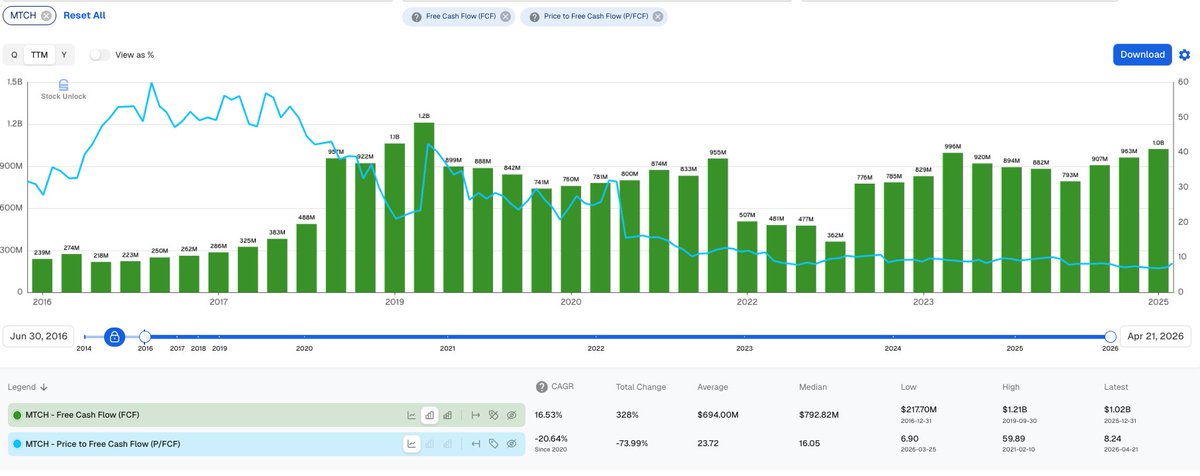
$MTCH is another one that looks very cheap on cash flow – but with a twist. - TTM free cash flow is still around $1.0B, basically at the high end of its history and up from ~$240m a decade ago. - The stock trades at just ~8x P/FCF, vs a multi‑year average closer to 24x and a peak near 60x. - On these numbers alone, Tinder + Hinge owner $MTCH screams cheap. The catch here isn’t pricing model, it’s the top line. Revenue (and users) have been shrinking at Tinder, and if that keeps going, today’s fat cash flows may not be sustainable. New CEO Spencer Rascoff is prioritising winning women back, stabilising Tinder, and leaning into Hinge – but this is a “prove it” story on growth, not a debate about margins. So the setup: - If revenue stabilises, 8x P/FCF on a dominant dating portfolio with big buyback capacity is a pretty compelling asymmetric bet. - If Tinder keeps bleeding users, those cash flows will eventually follow – and “cheap” can stay cheap for a long time. Quick poll for the timeline – are you actually using dating apps right now? If yes, which ones (Tinder, Hinge, Bumble, something niche)? Genuinely curious what the crowd’s using vs deleting, since that’s basically the whole $MTCH thesis in one question.
GenZ Investor tweet media
GenZ Investor@investingbyGenZ

$MTCH has seen strong momentum recently, fueled by rising investor expectations as new CEO Spencer Rascoff puts much more emphasis on fixing Tinder – winning back user trust and especially rebalancing toward more female users. - Rascoff, who took over Match Group in Feb 2025 and personally took charge of Tinder last July, has publicly said winning over women is his “primary focus” and that Tinder needs to reach gender parity to break the user decline. - Tinder still drives ~54% of group revenue, but monthly active users have fallen from a peak of 65.4m in 2021 to 50.5m in 2025, with roughly 75% of users now being men – a clear product/market imbalance. - Rascoff is backing words with investment: user “givebacks” and new product pushed up to $60m this year (vs ~$15m in 2025), ad spend raised to $230m (vs $180m), plus new features like double dates, video calls and shared‑interest matching, and a refreshed leadership team including a new CTO. - Early traction: annual user declines have narrowed from ~ -11% when he started to ~ -8.5% last quarter, with a stated goal of flat user growth by end‑2027. Meanwhile Hinge keeps compounding (operating income $74m in 2023 → $166m in 2025) and gives $MTCH a genuine second growth engine if Tinder takes longer to turn. (source: FT.com) My view: I remain a shareholder. I believe online dating is here to stay as a core way people meet, and $MTCH will continue to play a central role in the space – either through its existing family of apps (Tinder, Hinge, etc.) or new ones they build or buy over time. The Rascoff era looks like a real attempt to rebuild an “innovation muscle” at Tinder that atrophied during its years of easy profit, and I think the focus on women users specifically is exactly the right lever – fix that, and the whole funnel improves. On top of all that, the stock trades at a mere ~8x P/FCF, which is a pretty low bar for a company with Tinder + Hinge’s scale, brand and cash generation. Even if the Tinder turnaround takes longer than hoped, I’m happy to keep collecting the value returned through aggressive buybacks and dividends at this multiple, while keeping optionality on a successful reacceleration.

English
1
0
2
403
V أُعيد تغريده
Camus
Camus@newstart_2024·
Andrew Huberman revealed the absolute worst way to start your morning: Stay in bed scrolling on your phone with curtains closed. Stay reclined (your brain becomes less alert). Skip sunlight. Drink coffee too early. Multitask like crazy between texts, emails, and random tasks. Do this combo and you’re basically training your brain into scattered, low-energy mode before the day even begins. He explained that reclining + downward gaze + zero natural light + constant context-switching creates an attention-deficit-like state that drags on all day. The antidote? Get up fast, hydrate, get bright light in your eyes, and move your body early — ideally with some exercise while your natural cortisol is peaking. Small changes. Massive difference in focus and energy. What’s the worst morning habit you know you need to kill (scrolling in bed, zero sunlight, early coffee, etc.) — and what’s one tiny upgrade you’re actually willing to try?
English
23
126
1.7K
223.1K
V أُعيد تغريده
DAN KOE
DAN KOE@thedankoe·
The greatest trait you can acquire is to work with tremendous intensity on things that matter to you, and more importantly, be strangely unbothered when those things don't work out.
English
379
1.7K
11.3K
267.6K
V
V@Vternar·
@StockMKTNewz Soo you're telling me he can solve a captcha
English
1
0
1
4
Evan
Evan@StockMKTNewz·
Google $GOOGL just posted this: “We’re rolling out an upgrade designed to help robots reason about the physical world Gemini Robotics-ER 1.6”
English
22
52
689
64.8K
V أُعيد تغريده
Reads with Ravi
Reads with Ravi@readswithravi·
Reads with Ravi tweet media
ZXX
20
127
865
17.6K
V
V@Vternar·
@jaynitx Thanks, this was enlightening for me
English
0
0
0
203
V أُعيد تغريده
Jaynit
Jaynit@jaynitx·
Conor Neill: "If you can't write it clearly, the thinking was weak, not the writing" "To believe that something that feels clear in your head is thinking that's a very dangerous thing. When you try to put it down on a page, when you try to lay out your ideas in a structured order that someone else can digest, and you realize that you can't, I suggest the thinking was weak, not the writing." Neill explains his philosophy: "Writing is thinking. The process of taking a notepad, capturing thoughts, laying out the things that I'm thinking about, that is thinking. Sitting and staring out a window, maybe with a cigarette, whatever it is that you think is philosophizing that is not structured thinking. It's only when you're writing down and structuring, getting order into your thoughts on a page so that another person is able to get into the context, the perspective, the different things that you are pulling in to have your worldview." He shares a simple technique: "No matter what you are writing, whether it's an email, a Word document, when you've got a blank sheet of paper, start with the word 'This.' T-H-I-S. Starting with the word 'This' forces you to explain what the document is. It forces you to articulate to the reader what it is that they are holding. It forces you to describe why this document exists, what the objective is. And if you begin with the objective, it helps the reader, and it helps you articulate clearly why you are taking the time to write." Neill shares the most-read post on his blog: "The one post that has got far more views than any other is a post I wrote called 'Why Amazon Banned PowerPoint.' In Amazon, if a presenter wishes to ask people to agree to a budget, to agree to give them resources, they don't use PowerPoint. They write a six-page Word document that states why they are asking for the money and the resources." He explains Jeff Bezos's reasoning: "PowerPoint is easy for the presenter, but it's hard for the people who listen. Writing a six-page essay is hard for the presenter, but it's a lot easier for the people that get to read the document." And there's a second part to the Amazon method: "In the management meeting, the first 20 minutes is reading time. If you have gone to the effort to write six pages explaining your proposal, you deserve to see your work read. You deserve to sit there and see people reading through your work. People will not read before the meeting. The only way you get people to fully digest the six pages is by holding them there for 20 minutes, reading through, noting down their questions. No debate, no discussion until everyone in the room has read all six pages, has taken in the context, has time to think about what they would like to question. After 20 minutes of silent reading, they can have a discussion but an informed discussion." Neill shares a second insight about writing: "Divide writing from editing. Writing is producing words. Editing is improving words. These two processes — you cannot run at the same time." He explains his approach: "Most writers just vomit out a bad first draft. I personally have learned to produce 500 words in one straight blast. If something's wrong, if I need to check a fact, if I want to go back and fix something, I don't. I go 500 words of just getting it out onto the page. When I've got 500 words, then I'll stop and begin the process of editing." Neill shares what great writers understand: "All great writing is rewriting. It's editing. It's the crafting of taking a bad, crappy first draft and slowly iterating it, improving it 1% each time through. But if you haven't got that first draft, there's nothing to improve." He explains how separating these processes changed everything: "Learning to separate these two was one of the most powerful things to get rid of writer's block, to get rid of getting stuck, to get rid of procrastination. My mission when I sit down to write is: decide, am I writing or editing? If it's writing, get 500 bad words down on the page in the next 20 minutes. If it's editing, take the time to go through, improve sentences, change the order, change the structure. But these are two separate processes." Neill reveals the truth about good writing: "Some of my best articles started out as a bad blog post. Then I rewrote it as an article to give out to students. Then I rewrote it to share on another blog. Then I rewrote it to provide to a magazine. It's the sixth, seventh, eighth, ninth time of rewriting where it starts to be something that other people read and say, 'Wow, you're quite good at writing.' And the answer is I'm not good at writing. I vomit out a bad first draft and then go through this iterative process. One time, two times, three times, four times through slowly improving. But if you have no first draft, there's nothing to improve."
English
3
53
245
18.1K
V أُعيد تغريده
Reads with Ravi
Reads with Ravi@readswithravi·
“The only real test of intelligence is if you get what you want out of life.” — Naval Ravikant
Reads with Ravi tweet media
English
26
93
875
18.7K
V أُعيد تغريده
Matthew Harbaugh
Matthew Harbaugh@themattharbaugh·
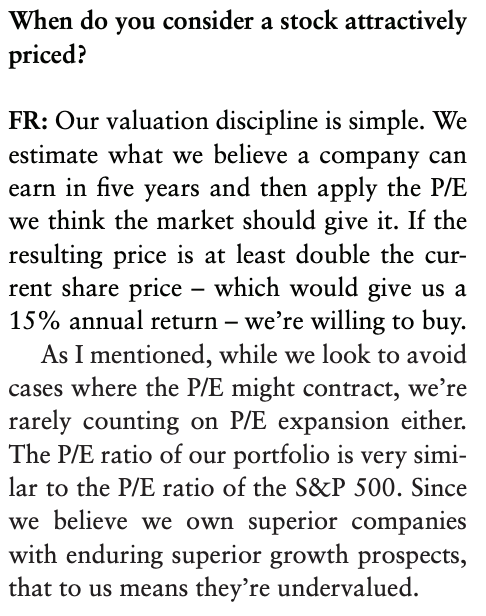
François Rochon on valuation "Our valuation discipline is simple. We estimate what we believe a company can earn in five years and then apply the P/E we think the market should give it. If the resulting price is at least double the current share price, which would give us a 15% annual return, we're willing to buy."
Matthew Harbaugh tweet media
English
6
10
84
9K
V أُعيد تغريده
Jaynit
Jaynit@jaynitx·
Jordan Peterson: "People don't have mental illnesses, they have lives too complicated to manage" "I actually think complexity is the fundamental problem. The terror management theorists think that death is the fundamental problem, and that's a good argument, because it is definitely a fundamental problem. But I think death is a subset of the complexity problem." Peterson explains why: "Sometimes people's lives become so complex that they'd rather be dead. The reason they seek death through suicide is to make the complexity go away. Because complexity causes suffering if it's uncontrolled. Things just get beyond your control." He describes how this happens: "You get hit by three or four catastrophes at the same time. Maybe the political system collapses. There's hyperinflation. You lose your job. Someone you love dies, or two people die. Maybe you get cancer. These things happen to people. And they just think: there's no getting out of this. It's just too much." Peterson shares what he learned as a psychologist: "One of the things that's very interesting about being a psychologist is what you learn: people come to you with mental illnesses, and that's almost never true. People come to you because their lives are so damn complicated they cannot stay on top of them in any way that doesn't make it look like they're just going to get more complicated. And then that causes symptoms." He uses a metaphor for genetic susceptibility: "Take a balloon and blow it up until it's beyond its tolerance. It's going to blow out at the weakest point. That's sort of what genetic susceptibility is. If I just keep adding complexity on top of you, at some point you'll blow out at your weakest point. Maybe you'll get physiologically ill. Maybe you'll start drinking. Maybe you'll develop an anxiety disorder. Maybe you'll get OCD. Maybe you'll get depressed. Whatever, there'll be something about you that's the weakest point. If I just push, that's where you blow out." Peterson reframes what we call "mental illness": "Those things almost never just happen. Sometimes, but not very often. Usually, people have just been hammered two or three different ways, and then they collapse in the direction of their biological weakness. Then maybe you put them back together. But it's almost always a complexity-related phenomenon rather than a mental illness-related phenomenon. Not always, but almost always."
English
61
374
2.2K
184.4K
V
V@Vternar·
@CoachDanGo Your bodyweight in lbs*
English
0
0
0
32
Dan Go
Dan Go@CoachDanGo·
2. Multiply your bodyweight by 12. That will be your daily calorie intake. 3. Multiply your bodyweight by .8. That will be the daily grams of protein to eat to maintain/build muscle while burning fat. 4. To keep it easy, focus on hitting your calories, protein, and fiber.
English
6
5
94
16.3K
Dan Go
Dan Go@CoachDanGo·
IfI Wanted to Lose Belly Fat By Summer, I'd Do This: 1. Eat the Optimized Mediterranean Diet. Fatty fish, leafy greens, berries, nuts, and olive oil. This helps lowers inflammation, improves insulin sensitivity, and helps strip visceral (belly) fat without extreme dieting.
English
24
54
744
118K
V
V@Vternar·
@CoachDanGo and that’s why I don’t start
English
0
0
0
21
Dan Go
Dan Go@CoachDanGo·
It can take you 20 years to get out of shape but 6-12 months to completely reverse it.
English
63
107
2.5K
102.6K
V أُعيد تغريده
Dan Go
Dan Go@CoachDanGo·
For the past 6 months I've gotten away from using an Apple watch, Oura, Whoop, and any other type of wearable. I've noticed no changes in my physical health but a positive change in my mental health as I've stopped using a piece of tech to tell me how I should feel.
English
145
29
1.4K
144.3K
V
V@Vternar·
@hpfounder Yeah but what's the point of doing all of that?
English
0
0
0
66
High Performance Founder
High Performance Founder@hpfounder·
Are you depressed? Or are you just sitting all day indoors, not exercising, sleeping horribly, eating hyper-processed foods, getting 4000 steps a day, and not working on anything important to you?
English
20
18
156
17.8K
CapexAndChill
CapexAndChill@CapexAndChill·
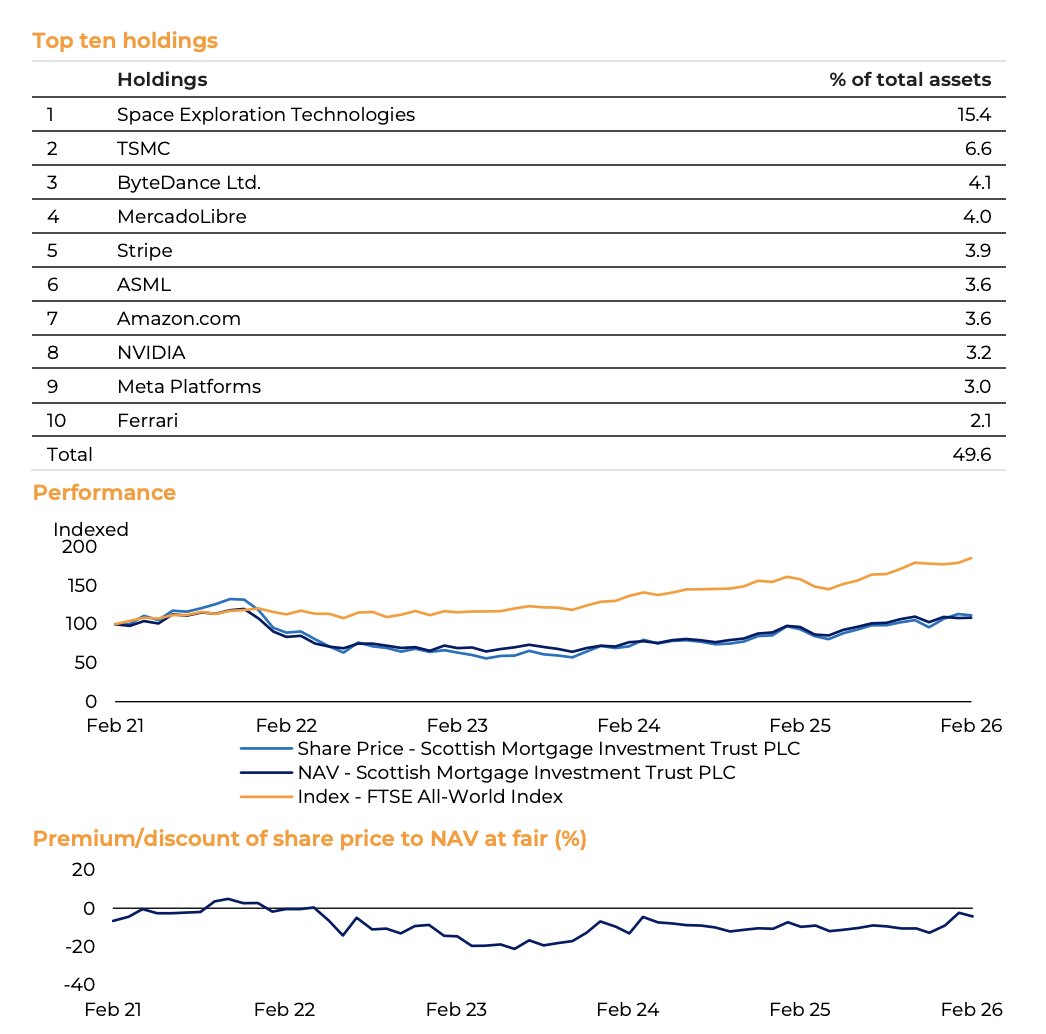
What do you think of the Scottish Mortgage Investment Trust Port? $TSM $MELI $ASML $AMZN $NVDA $META $RACE
CapexAndChill tweet media
English
4
1
42
18.3K
Gary Brecka
Gary Brecka@thegarybrecka·
For a second… you thought I lost my mind. Not happening. 🤣 I’m not perfect, but I am intentional. Because what you eat every single day becomes your energy, your mood, your ability to recover, and how you age. Most people don’t realize how much processed food is holding them back… until they take it out, and once you understand that… you stop craving it. Happy April Fools. Now take a look at what you’re eating every day. 👇🏻 Comment "ha" if you almost believed it.
English
66
25
586
89.2K
V
V@Vternar·
@thegarybrecka Then why do we get sleepy after meals? Lol... I believe the intelligence of my body
English
0
0
0
73
Gary Brecka
Gary Brecka@thegarybrecka·
I will never eat late at night and wonder why my sleep is off again. Your body isn’t designed to digest and recover at the same time. Late meals spike blood sugar and insulin right when your body should be winding down. Finish eating earlier. Sleep deeper.
English
23
21
344
34.8K