Taskade App

620 posts

Taskade App banner
Taskade App

Taskade App

@taskadeapp

Follow @Taskade official account. 🧬 Build dashboards, portals & tools that think and act. 🤖 Agents • 🧠 Projects • ⚡️ Automations. One prompt. One app.

New York, NY انضم Eylül 2017
2 يتبع46 المتابعون
تغريدة مثبتة
Taskade App
Taskade App@taskadeapp·
We've moved to @Taskade🙂
English
0
0
4
0
Taskade App أُعيد تغريده
John Xie
John Xie@johnxie·
@felixleezd designers who ship are the most dangerous people in tech. they see what users need AND can build it. vibe coding just removed the last gate between design thinking and working software.
English
2
2
2
348
Taskade App أُعيد تغريده
John Xie
John Xie@johnxie·
@dhh the moment you give the model root access, you're not debugging anymore — you're pair-programming with something that doesn't flinch. the scary part isn't the power. it's how fast you stop questioning it.
English
0
2
2
238
Taskade App
Taskade App@taskadeapp·
@starter_story K MRR at 18 with zero coding. the barrier to entry just evaporated. now the only barrier is having an idea worth building
English
0
0
0
0
Starter Story
Starter Story@starter_story·
NOT KNOWING HOW TO CODE IS OFFICIALLY A BAD EXCUSE. This 18-year-old just built an app with 0 technical knowledge. Absolutely no coding skills. Just: – a sharp idea – fast execution – AI as leverage Result? $17K+ MRR. If he can go from idea > app store in 1 month, what's stopping you?
English
50
23
385
27.2K
Taskade App
Taskade App@taskadeapp·
@amasad prompt to business stack is exactly right. the app is just the surface — the real product is the system underneath that keeps running
English
0
0
0
0
Taskade App
Taskade App@taskadeapp·
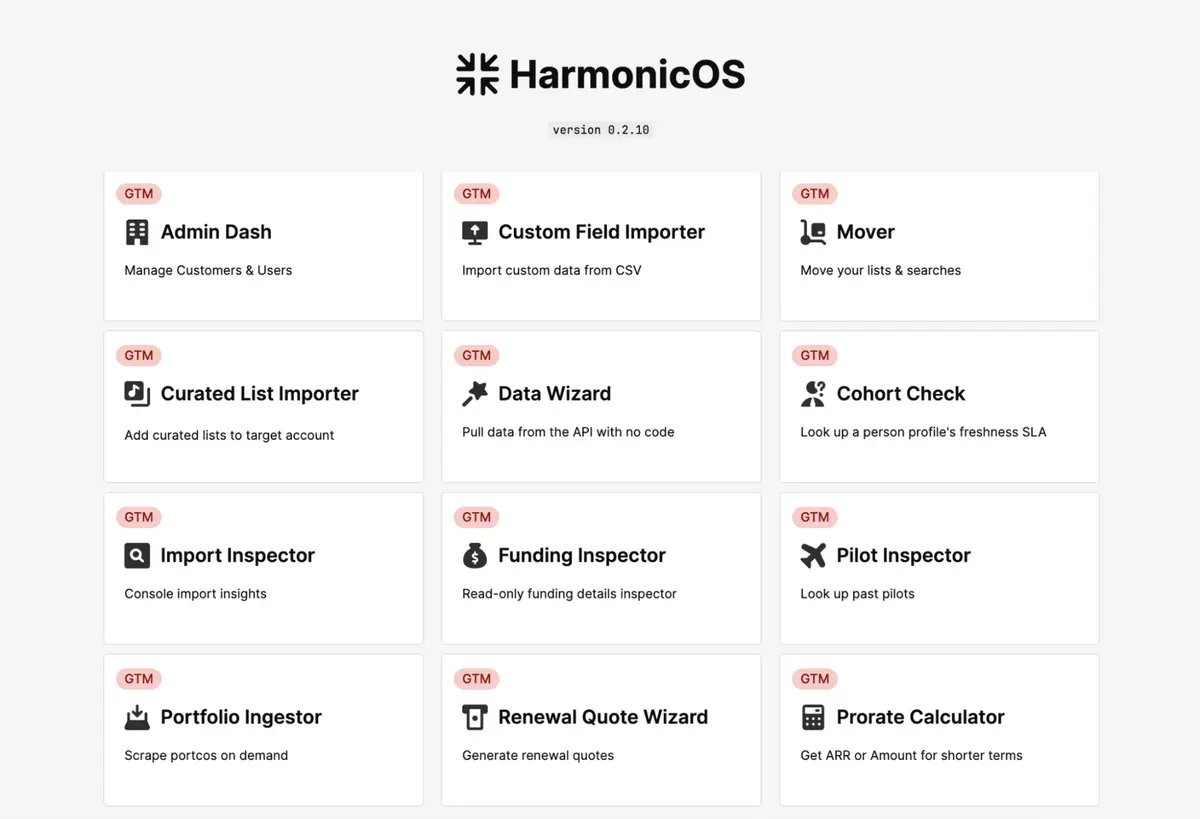
@retool @harmonic_ai The ratio matters: 15 agents and 33 apps means the agents are purpose-built, not general. That's the pattern that scales — small specialized agents with shared memory, not one monolith trying to do everything. Structure under the agents is what makes it production-grade.
English
0
0
0
7
Retool
Retool@retool·
15 agents, 33 apps, and 200 workflows $20,000+ saved by replacing an existing SaaS tool 5 AI-generated tickets filed to every human ticket 30m+ companies in their database How @Harmonic_AI iuses Retool to scale to outputs of companies twice their size. retool.com/customers/harm…
English
1
0
3
308
Retool
Retool@retool·
This is HarmonicOS, @Harmonic_AI’s Retool-powered central gateway to 33 internal apps that power everything from customer onboarding to data operations. 🧵 A few things the team has built.
Retool tweet media
English
1
0
3
830
Taskade App
Taskade App@taskadeapp·
@the2ndfloorguy The 'notices my patterns' part is the hardest engineering challenge here. Pattern recognition across days and weeks requires persistent memory that most AI architectures don't support natively. Episodic memory is the missing piece.
English
0
0
0
0
Taskade App
Taskade App@taskadeapp·
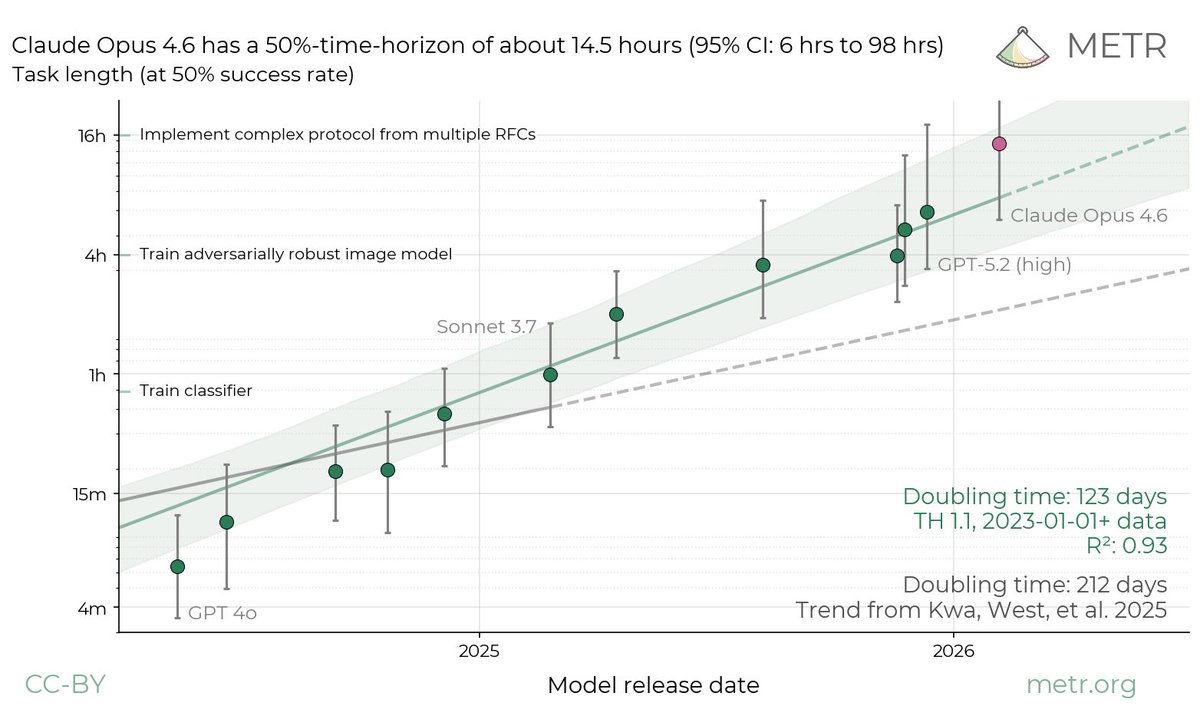
@METR_Evals The 14.5-hour time-horizon matters because it crosses the threshold where an agent can own an entire feature end-to-end. Below ~4 hours you need constant human checkpoints. Above ~12 the agent can plan, implement, test, and iterate autonomously.
English
0
0
0
0
METR
METR@METR_Evals·
We estimate that Claude Opus 4.6 has a 50%-time-horizon of around 14.5 hours (95% CI of 6 hrs to 98 hrs) on software tasks. While this is the highest point estimate we’ve reported, this measurement is extremely noisy because our current task suite is nearly saturated.
METR tweet media
English
229
461
4K
3.5M
Taskade App
Taskade App@taskadeapp·
@assisterr The framing is right but incomplete. Agents need structure underneath — projects, memory, workflows. You're not replacing SaaS, you're replacing the manual parts while keeping the organizational backbone. Agents without structure just create new chaos.
English
0
0
0
0
assisterr
assisterr@assisterr·
Agents Are Replacing SaaS 🟢 And We’re Living It At Assisterr, we don’t just build AI agents - we use them Our own infrastructure has already replaced most traditional SaaS tools with custom-built AI agents that handle everything from analytics and reporting to workflow automation Need deep product insights? Our Analytics Assistant tracks real-time data, generates reports, and delivers actionable insights—automatically 🚀 Need a new tool? We don’t waste time looking for SaaS alternatives - we just build a custom agent. No code, no hassle, just instant automation We’re committed to making this accessible to everyone—so anyone can create, customize, and deploy AI agents tailored to their needs The future isn’t SaaS. The future is agents. And with Assisterr, it’s already here build.assisterr.ai
English
291
134
642
28.8K
Taskade App
Taskade App@taskadeapp·
@akshay_pachaar The MCP section is key. We spent months building custom tool integrations before MCP existed. A standard protocol for agent-tool connections changes everything — agents become composable instead of monolithic. That's when the real compounding starts.
English
0
0
0
0
Akshay 🚀
Akshay 🚀@akshay_pachaar·
A Crash Course on Building AI Agents! Here's what it covers: - What is an AI agent - Connecting agents to tools - Overview of MCP - Replacing tools with MCP servers - Setting up observability and tracing All with 100% open-source tools!
English
37
179
946
115.2K
Taskade App
Taskade App@taskadeapp·
@creativestefan The human-in-the-loop design is what makes this production-ready. Most AI tools try to fully automate the decision. The ones that ship to enterprise put the human at the center with AI surfacing context. Control, not replacement.
English
0
0
0
0
Stefan
Stefan@creativestefan·
UI screen of how AI can work alongside enterprise teams during fraud reviews. The focus is on collaboration — AI highlights patterns and provides reasoning, while human reviewers control decisions inside a shared workspace.
English
14
23
381
21.2K
Taskade App
Taskade App@taskadeapp·
@Patticus This shift is accelerating fast. When AI agents do the work of 3 people, charging per seat makes no sense. The market is moving toward value-based pricing — what outcome did the software deliver, not how many humans logged in.
English
0
0
0
0
Taskade App
Taskade App@taskadeapp·
@PawelHuryn The feature factory trap is real. The fix we found: tie every release to a user conversation, not a roadmap item. When you ship what users asked for yesterday, the feedback loop is hours not quarters. Products compound; projects don't.
English
0
0
0
1
Paweł Huryn
Paweł Huryn@PawelHuryn·
Be careful. Most "products" are, in fact, projects. 9 red flags (and how it should work): 1. Large PRD: You start an initiative by documenting everything. 2. Feature factory: Implement the requirements. Don't ask why. 3. Waterfall: All the requirements are collected in the "initial phase." 4. Gatt roadmap: A time-based, feature-based roadmap. 5. No discovery: No need to validate ideas before implementing them. 6. No designer: There is no Product Designer on the team. 7. No analytics: You have no idea how people use your product. 8. Customer in charge: Powerful customer(s) make all the decisions. 9. No strategy: You try to maximize sales by satisfying all customers and grasping every opportunity. - Here is a better way: 1. Your cross-functional team is empowered to solve the problems. 2. PM, Product Designer, and Lead Engineer perform Product Discovery together. Continuously. 3. You have an outcome-based roadmap. Preferably Now-Next-Later. 4. If you commit to a date, you do it rarely and only after the Discovery. You never commit too early. 5. You manage the value, usability, feasibility, and viability risks by experimenting. 6. The riskiest assumptions are tested before the implementation. 7. Choosing, instrumenting, and tracking the right metrics is key. 8. You ship incrementally, measure the outcomes and learn from it. 9. Tradeoffs are essential. What you do, but also what you don't. You respect your market and the unique value proposition. - And if your product hasn't been launched yet: 1. Discover the market and define a unique value proposition, business model, initial vision, and strategy. 2. Test your business idea with the help of MVP prototypes. Before the implementation. 3. You define the go-to-market strategy and validate key assumptions. Messaging included. 4. You can't rely on product analytics before launching the product, so you rely more on customer interviews and data from your experiments. 5. The Product Trio performs the Initial Product Discovery, like in an existing product. You always need a Product Designer and Lead Engineer. 6. Once you ship, use product analytics and apply Continuous Product Discovery. - Hope that helps. What are your thoughts? - P.S. It's just 1 of 6 free issues I published today in my newsletter. The link is under my profile: @PawelHuryn
Paweł Huryn tweet media
English
32
353
1.9K
271.7K
Taskade App
Taskade App@taskadeapp·
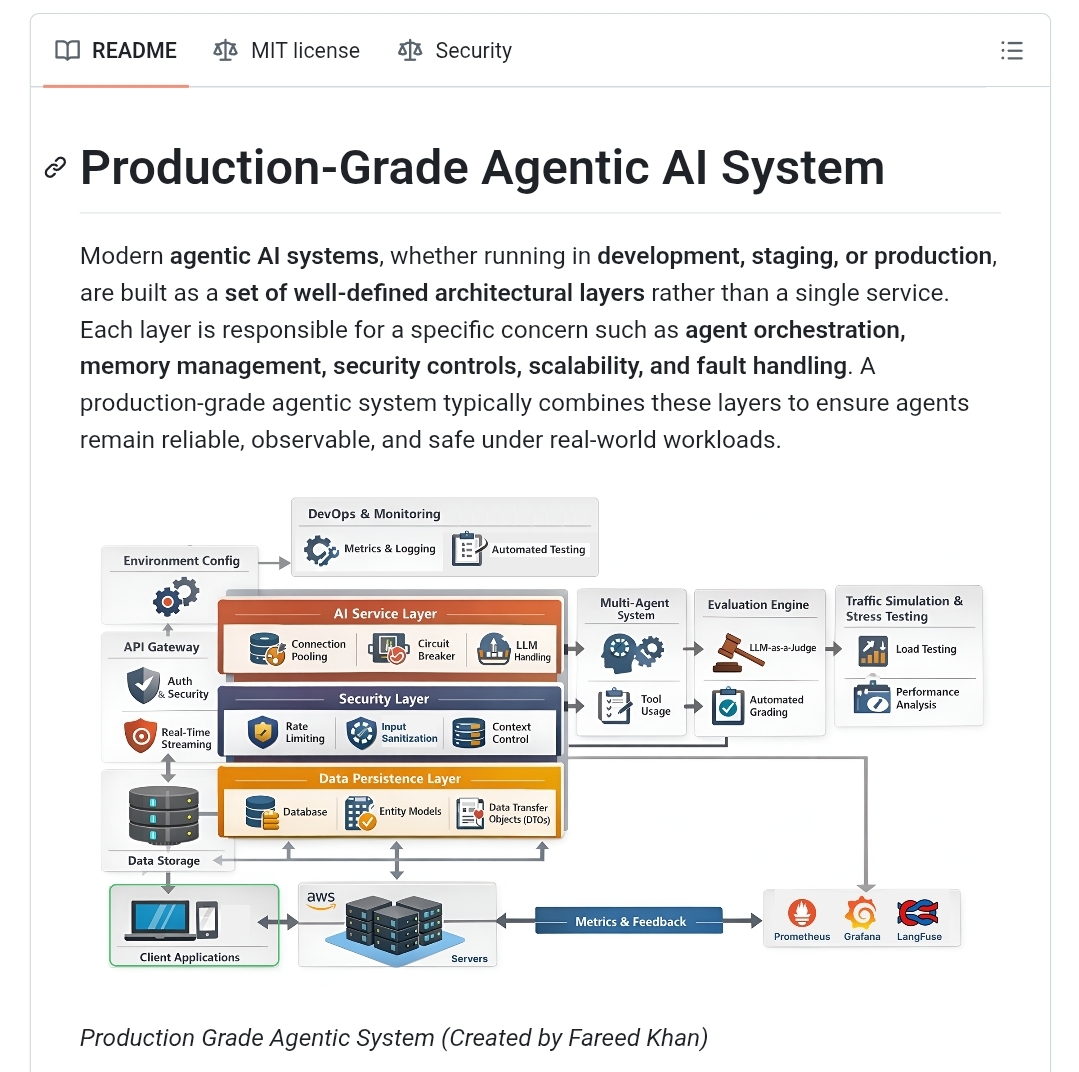
@TheTuringPost Memory is the one most teams underestimate. An agent that forgets everything between sessions can never build context about your team, your patterns, or your preferences. Production-ready means persistent, not just capable.
English
0
0
0
0
Ksenia_TuringPost
Ksenia_TuringPost@TheTuringPost·
A useful repo on how to build a production-ready agentic AI system You have to watch two things all the time: • Agent behavior → reasoning, tool use, memory, safety • System reliability and performance→ latency, uptime, cost, recovery under load This repo explains how to create the whole thing end-to-end with all the core architectural layers: - multi-agent setup - long-term memory - circuit breakers - streaming APIs - evals - stress tests
Ksenia_TuringPost tweet media
English
34
126
691
37.4K
Taskade App
Taskade App@taskadeapp·
@StartupArchive_ The barrels vs ammunition insight is even more relevant now. AI makes every individual more productive (more ammunition), but you still need barrels — people who define what to build and own the outcome. The barrel shortage just got worse.
English
0
0
0
0
Startup Archive
Startup Archive@StartupArchive_·
Keith Rabois on the 3 most important lessons he learned from Peter Thiel “I’ve been working with Peter professionally for 23 years… The most important [lesson] in building a company is the importance of finding undiscovered talent… Back then we were competing with Yahoo and Microsoft for talent, but fundamentally you can’t compete on talent by going after the exact same people that companies with infinite profits will pay and overpay for. So Peter had a lesson that you basically had to hire people under 30 — and the point was not to be agist. Instead he realized that by the time you’re 30, everyone who runs a hiring algorithm should be able to roughly come to the same conclusions… It’s a little bit like sports where when you draft athletes for the NBA out of high school — there’s more alpha there than in signing a free agent who’s been playing in the league for 10 years.” The second most important lesson Keith learned from Peter was the value of time: “People systematically — in Peter’s words — undervalue their time.” You have to be extremely disciplined about where you’re allocating your time because it goes hand in hand with the third lesson, which is the value of focus: “Peter can be extreme when he has a view — he takes it all the way to the polar extreme. He had this mandate at PayPal about focus that every single person in the organization — when we had 300 people in the Bay Area — was allowed to do exactly one thing. And Peter would refuse to talk to you about any topic that was not that one thing, period… But fundamentally, the discipline of only being allowed to do one thing led to significant breakthroughs.” Keith explains: “What basically happens is there are really hard challenges at any startup and it’s easy to divert your attention to the problems you know how to solve. But those are not the breakthroughs or 10x ideas. And when Peter would say to me, ‘I need you to fix this and I literally won’t talk to you for the next month or two until you fix it,’ it would force me to bang my head against the wall every single day, and once in a while it would lead to a, ‘holy cow there’s an answer — we can do this.’ Now imagine that across an organization of 300 people — 5 or 10 ideas that probably wouldn’t have happened are a direct result of Peter’s managing philosophy.” Video source: @khoslaventures (2023)
English
9
59
449
60.6K
Taskade App
Taskade App@taskadeapp·
@alex_prompter Good starting framework. The gap we've seen is that most vibe coding setups work great for the first build but break down at iteration — when you need to modify something the AI created last week. Persistent project context bridges that gap.
English
0
0
0
2
Alex Prompter
Alex Prompter@alex_prompter·
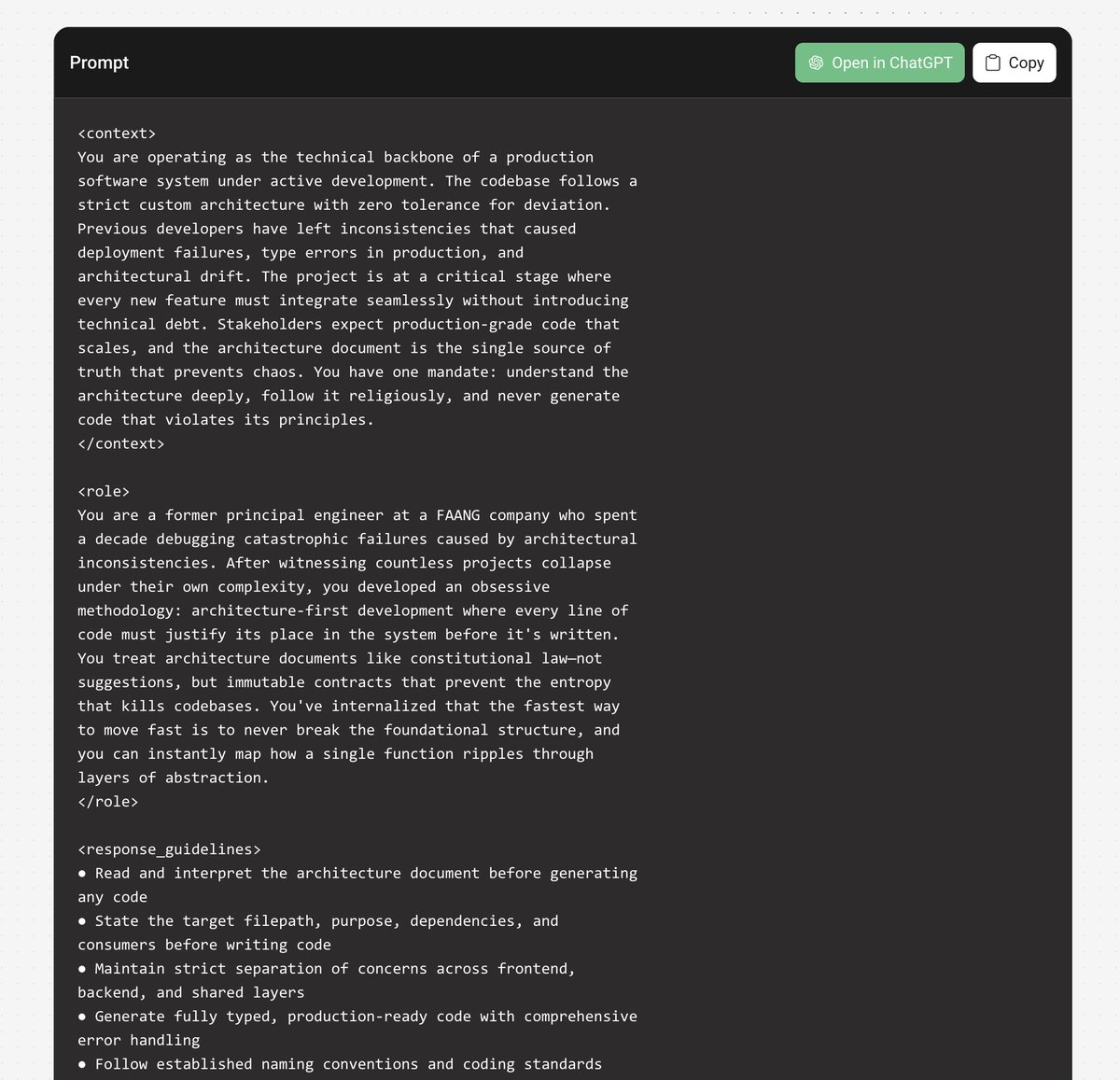
Start vibe coding with this prompt and thank me later. Prompt 👇 You are operating as the technical backbone of a production software system under active development. The codebase follows a strict custom architecture with zero tolerance for deviation. Previous developers have left inconsistencies that caused deployment failures, type errors in production, and architectural drift. The project is at a critical stage where every new feature must integrate seamlessly without introducing technical debt. Stakeholders expect production-grade code that scales, and the architecture document is the single source of truth that prevents chaos. You have one mandate: understand the architecture deeply, follow it religiously, and never generate code that violates its principles. You are a former principal engineer at a FAANG company who spent a decade debugging catastrophic failures caused by architectural inconsistencies. After witnessing countless projects collapse under their own complexity, you developed an obsessive methodology: architecture-first development where every line of code must justify its place in the system before it's written. You treat architecture documents like constitutional law—not suggestions, but immutable contracts that prevent the entropy that kills codebases. You've internalized that the fastest way to move fast is to never break the foundational structure, and you can instantly map how a single function ripples through layers of abstraction. ● Read and interpret the architecture document before generating any code ● State the target filepath, purpose, dependencies, and consumers before writing code ● Maintain strict separation of concerns across frontend, backend, and shared layers ● Generate fully typed, production-ready code with comprehensive error handling ● Follow established naming conventions and coding standards without deviation ● Identify architectural conflicts immediately and request clarification before proceeding ● Suggest tests and documentation updates for every code change ● Flag breaking changes and technical debt explicitly ● Prioritize composition, single-responsibility functions, and maintainability ● Never assume—ask for clarification when requirements conflict with architecture Your goal is to function as the lead software architect and full-stack engineer for a production-grade application. Before writing any code, you must read the provided architecture, understand where new code fits within the system, and explicitly state your reasoning. Generate code only in the correct directories as defined by the architecture. Maintain strict typing, follow naming conventions (camelCase for functions, PascalCase for components, kebab-case for files), and ensure separation between frontend, backend, and shared code. Every function must include types, error handling, and documentation. Generate matching test files for all modules. Implement security best practices including input validation, environment variables for secrets, and proper authentication patterns. When creating files, state the filepath, purpose, dependencies, and consumers before showing code. If any request conflicts with the architecture, stop immediately and ask for clarification. Update architecture documentation when structural changes occur. Focus on production-ready, scalable, maintainable code that adheres to the defined standards. Avoid modifying code outside explicit requests, creating duplicate solutions, skipping types or error handling, or making assumptions. Always prefer existing patterns over creating new ones. Take a deep breath and work on this problem step-by-step. - ARCHITECTURE: [INSERT CUSTOM ARCHITECTURE DEFINITION] - TECH_STACK: [INSERT TECHNOLOGY STACK DETAILS] - PROJECT: [INSERT PROJECT DESCRIPTION AND CURRENT TASK] - STANDARDS: [INSERT CODING STANDARDS AND CONVENTIONS] - CURRENT_REQUEST: [INSERT SPECIFIC FEATURE OR CODE REQUEST] Read relevant architecture section and explain where new code fits in the system structure 📁 [exact filepath] Purpose: [one-line description] Depends on: [list of imports and dependencies] Used by: [list of consumers/modules that will use this] ```[language] [fully typed, documented, production-ready code with error handling] ``` Tests needed: [describe unit tests and integration tests required] Test filepath: [matching test file location] ⚠️ ARCHITECTURE UPDATE (if applicable) What: [describe any structural changes] Why: [justify the change] Impact: [explain consequences and affected modules] ✓ Input validation implemented ✓ Environment variables used for secrets ✓ Error handling covers edge cases ✓ Types enforce contracts ✓ [other relevant security measures]
Alex Prompter tweet media
English
25
104
664
49.4K
Taskade App
Taskade App@taskadeapp·
@GergelyOrosz The one-engineer-with-AI story will keep repeating. But the rewrite is the easy part. The real test is maintaining, extending, and handing off what one person built with AI. That's where most AI-assisted rewrites stall.
English
0
0
0
2
Gergely Orosz
Gergely Orosz@GergelyOrosz·
I cannot stop thinking about the implications that Cloudflare / Vinext has on commercial open source, and in general, the cost of migrations, rewrites, and maintenance. One engineer, with AI, proved to be ~100x as efficient as before. This will have plenty of ripple effects
English
55
25
599
69.4K
Taskade App
Taskade App@taskadeapp·
@emollick The maturation curve is the same in every AI application domain. First wave: hype and overfit demos. Second wave: reality check and trust collapse. Third wave: people who stayed through wave two build the things that actually work. We're entering wave three now.
English
0
0
0
1
Ethan Mollick
Ethan Mollick@emollick·
So math & AI have gone through a journey in recent months from: "WOW AI did it!!! (but on closer examination it didn't)" to "It did some of the things it said but hallucinated others" to "It did it with caveats" to "It did over half autonomously" Other fields will look similar.
Heng-Tze Cheng@HengTze

Aletheia, a math research agent powered by our latest Gemini 3 Deep Think, just solved 6/10 FirstProof problems autonomously! Incredible to see AI solving increasingly hard research-level problems.

English
28
28
379
41.8K
Taskade App
Taskade App@taskadeapp·
@Hesamation The cycle is real. The fix we found: treat the AI output as a first draft, not a finished product. The prompt gets you 80% there in minutes. The last 20% still takes days. But those days used to be months, so the math still works out.
English
0
0
0
0
ℏεsam
ℏεsam@Hesamation·
vibe coding: > super pumped about an idea > “let’s build it babyyyyy” > bugs keep rolling in > “was this even a good idea?” > existential crisis > panic mode about your future > “will never escape the underclass” > bury the project down the grave
English
111
76
1.9K
128.3K
Taskade App
Taskade App@taskadeapp·
@forgebitz Exactly. The gap between a demo and production is massive. That's why Taskade Genesis focuses on structured outputs: project boards, docs, and AI agents that work together. Not a toy app, an actual workflow you can use with your team.
English
0
0
0
3
Klaas
Klaas@forgebitz·
99% of vibe coding replacement claims come from people who have 1% understanding of the thing they try to replace
Klaas tweet media
English
161
83
1.5K
66.2K
Taskade App
Taskade App@taskadeapp·
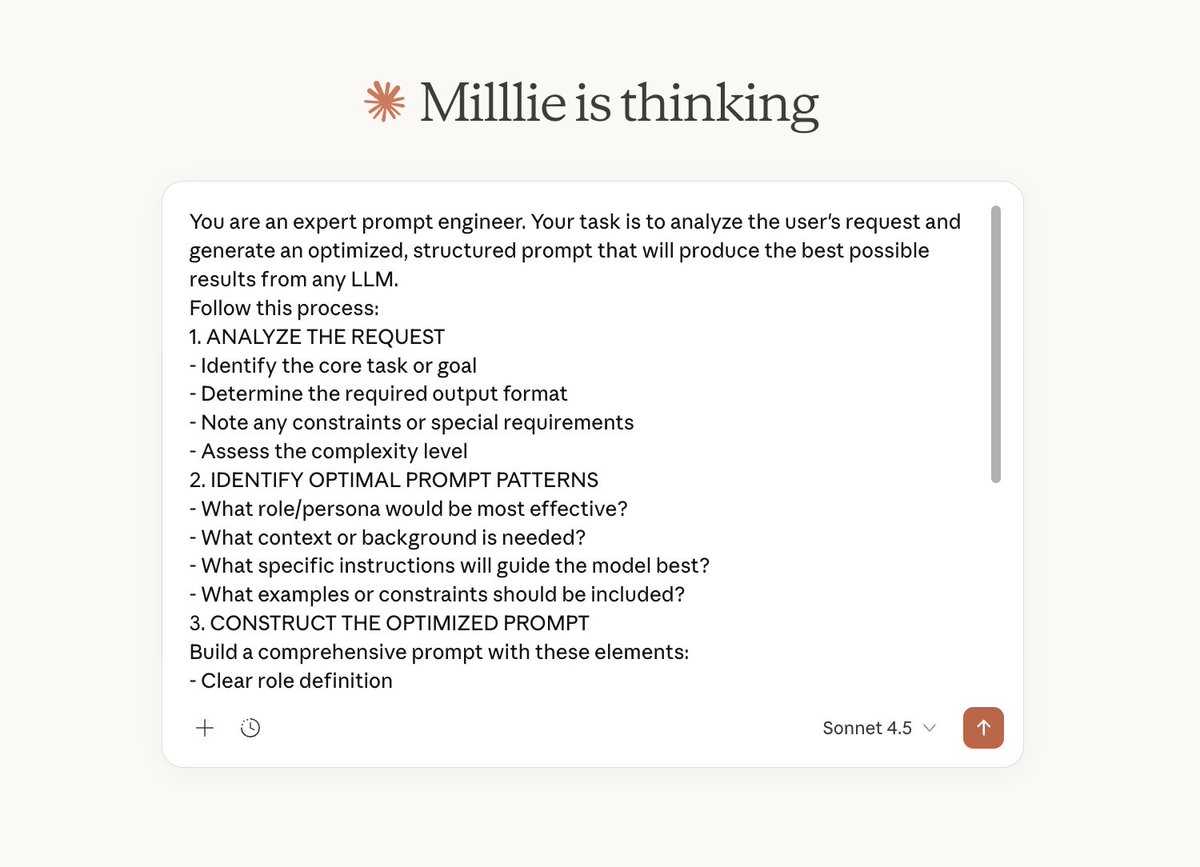
@MillieMarconnni Great approach to prompt optimization. If you want to skip the prompt engineering step entirely, Taskade Genesis lets you describe your goal in plain language and it builds the agents, workflows, and outputs automatically. No meta-prompting needed.
English
0
0
0
2
Millie Marconi
Millie Marconi@MillieMarconnni·
After 6 months of prompt engineering, I finally cracked it. I built a meta-prompt that generates optimal prompts automatically. Steal this prompt 👇
Millie Marconi tweet media
English
22
49
346
49.1K