
Hugo
327 posts

I have the most unhinged custom model list in any agent harness, a mix of my local models & all my subs & hacks.
Droid's remote now allows BYOK, it took like 15 mins to setup end to end all synced.
- Claude Code remote control permissions suck
- Codex has no mobile app


English

@HugoPodw Reasoning is configurable and set to false by default— docs pages for the models should have more info
English
Hey @philipkiely do thinking models like GLM-5 or Kimi K2.5 actually perform any reasoning before their response on Baseten? I'm not seeing any thinking tokens come through, and the TTFT is suspiciously good 😄
English
@scaling01 I watched 10 mins of his Elon interview because it was going semi viral on twitter, after that I vowed to never watch an interview from him.
English

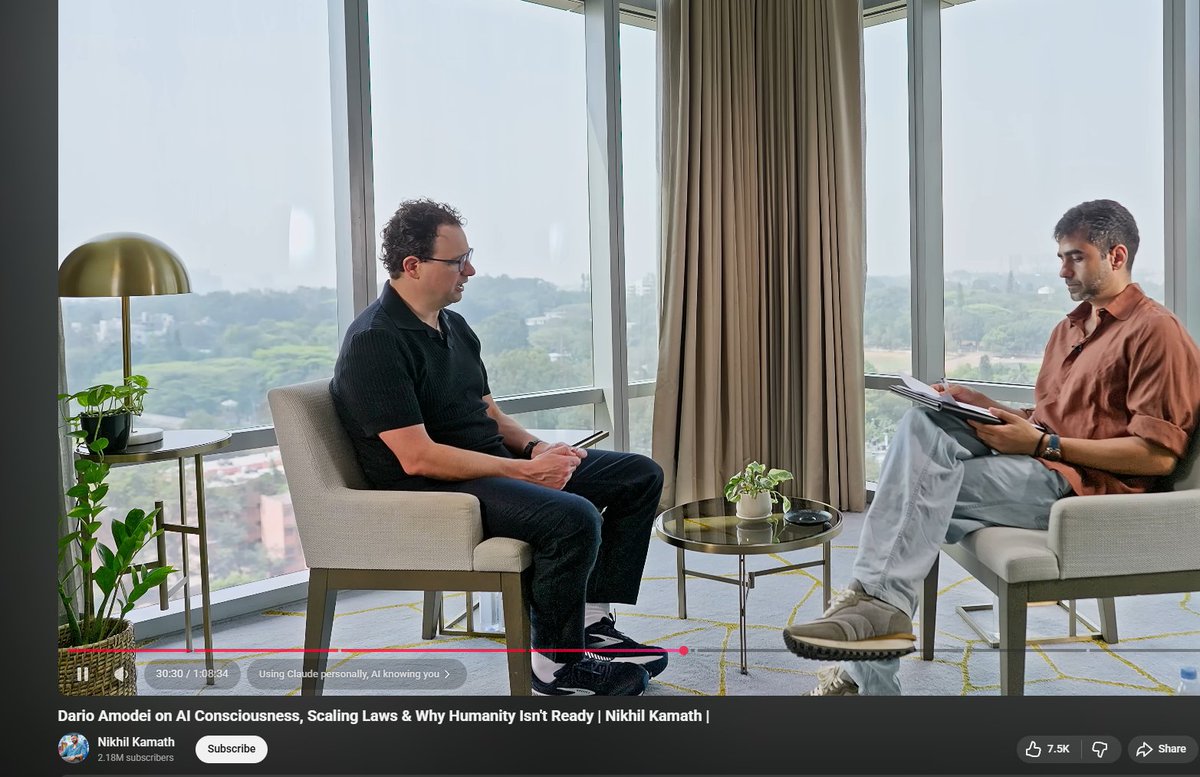
thought I would watch a chill podcast with Dario, but I'm just pissed off at how bad of an interviewer this guy is
how the hell did he get to 2.1 million subscribers, and how did be become a billionaire lmao
English

🚀 Hello, Kimi K2 Thinking!
The Open-Source Thinking Agent Model is here.
🔹 SOTA on HLE (44.9%) and BrowseComp (60.2%)
🔹 Executes up to 200 – 300 sequential tool calls without human interference
🔹 Excels in reasoning, agentic search, and coding
🔹 256K context window
Built as a thinking agent, K2 Thinking marks our latest efforts in test-time scaling — scaling both thinking tokens and tool-calling turns.
K2 Thinking is now live on kimi.com in chat mode, with full agentic mode coming soon. It is also accessible via API.
🔌 API is live: platform.moonshot.ai
🔗 Tech blog: moonshotai.github.io/Kimi-K2/thinki…
🔗 Weights & code: huggingface.co/moonshotai

English
@Polish785 @banay_john I think I might potentially have hyperthyroidism, use to have thyroid problems when I was younger but never dug deep enough for a clinical conclusion.
English

@HugoPodw @banay_john He says his thyroid played up. (Hair thinning, low thyroid function, digestion) People with thyroid issues do so much worse with high intensity exercise. The fatigue is insane. We actually do better with light exercise not so often.
This is a thyroid issue. Autoimmune.
English

It took me at least a year to recover from the negative health effects of training for a marathon
Astrid Wilde 🌞@astridwilde1
English
@hburgersar @banay_john Apparently according to the peaters thats not true but my experience definitely would say otherwise.
Can't over exaggerate how shit I was feeling and it all just vanished after starting the training.
English

@HugoPodw @banay_john I actually thought it was well known that gut health improves. Is this not a thing?
English
I have something similar to fartlek in my interval runs (obviously its a bit more structured)
I do vary in pace a little bit in all my runs, one minute might be 5:30km, the next might be 5:50 which evens out to 5:40 if thats the pace I'm looking for.
19min, 5k is a very good time definitely a time to be proud of thats in the top 1% percent for most ages.
To improve for a triathlon I would start incorporating some long slow runs like 2 hour zone 2 runs where its pretty chill but long.
Get a HRM if you haven't to figure out your heart rate zones or just chuck in your 5k pace to ChatGPT it will tell you, your zones but in pace instead. So maybe zone 1 is a 7min/km then zone 2 is a 6min/km etc...
English

@HugoPodw @dopaminologic @banay_john Ah I see -I think I’m thinking more of Fartlek kind of variation of pace during a mid distance run - do you incorporate that style of training?
(Ive got my 5k to 19mins after 2.5 months after 20 years of not running but aiming to stagger to a half/ full /triathlons down the line)
English
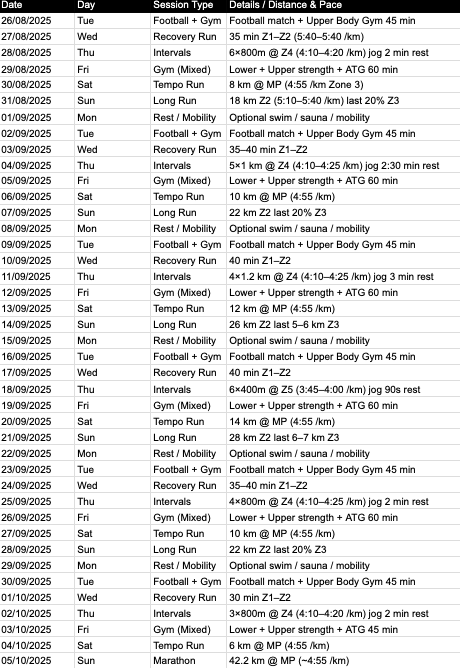
@MyCap7 @dopaminologic @banay_john What do you mean splitting my tempos?
My tempo runs are just one consistent run at MP (marathon pace)
English
@HugoPodw @dopaminologic @banay_john How are you splitting your tempos out of interest?
I was looking to troll you on one missed day from the schedule but couldn’t find one 😂
English

@clandaw410 @banay_john How would this explained my improved gut symptoms?
English

Sure! Here’s a possible paraphrase of your text, keeping the meaning but rephrasing it more smoothly:
Just a helpful reminder, adding a few spoonfuls of properly cooked white button mushrooms to your daily diet can significantly support digestion, improve bowel regularity, and even ease symptoms linked to high estrogen — It’s truly one of the most effective, high-return health habits you can adopt!
Would you like me to create a shorter, social-media style version as well?

English
@batwood011 Who's this send me a message privately.
My one or two videos mentioning Sindarin is 90% of the content out there praising it (other than you ofc)
English




I forgot who sent me this picture of their father (if you see this, give me a shout so I can thank you again for sending it)
Here’s the quote:
“This is a picture of my father. One area of his body has been consistently concealed while the other has remained consistently exposed to direct sunlight. He just turned 81. I noticed this during a run we went on today”
Here, we have a prime visual example in a human being of all the work I have pushed in the past few years
What you’re seeing in this image is a long term effect of differential light exposure on skin health and skin aging
From a circadian perspective, light helps control the skin’s internal clocks, which affects mitochondria, collagen, melanin, and immune health in big ways
The tanned area (the neck) has been consistently exposed to full spectrum sunlight. This exposure has trained the skin through hormesis to develop adaptive defenses and hormetic benefits:
• Increased melanin
• Thicker epidermis
• Stronger mitochondrial resilience
• Upregulated DNA repair mechanisms
In contrast, the untanned area (under the neck) has remained shielded from full spectrum sunlight. This lack of exposure creates skin that is:
• Thinner
• More fragile
• Less resilient to sudden UV exposure
• Poorly adapted from a mitochondrial and circadian standpoint
So, here’s the mother of all questions
Which area is healthier?
The tanned area is healthier, contrary to what centralized orthodoxy and dermatology says about melanin being “a sign of skin/DNA damage” (a very flawed, reductive assumption)
Why is the tanned area healthier?
Because it’s been progressively trained to handle full spectrum light when UV is present
Furthermore, light is a circadian cue essential for mitochondrial maintenance, redox balance, and repair signaling
Adaptation builds resilience
Shielding leads to fragility
Chronically concealed skin ages differently, often worse when finally exposed, because it’s lost the circadian rhythm cues light provides
Without consistent exposure, it doesn’t maintain the same defenses (melanin, antioxidants, DNA repair proteins)
And yet, centralized practitioners have the audacity to blame the sun, even though we’re talking about a circadian species that spends most of its life indoors, rarely receives the hormetic stimulus it needs (sunlight), and suffers from chronic circadian disruption, which destroys the skin barrier and undermines the body’s natural anti-cancer defenses
This is how far the apple has fallen from the tree
Skin health is married to progressive sunlight exposure, not avoidance
Daylight entrains circadian skin clocks, supports mitochondrial health, and fortifies structure through melanin and collagen/elastin/hyaluronic acid synthesis
Avoiding full spectrum sunlight creates a system unprepared for the very environment we evolved under
It all boils down to this:
Skin that’s regularly exposed to sunlight within a circadian aligned framework becomes stronger and more resilient because light helps train its defenses like melanin, antioxidants, and repair systems through circadian signaling
In contrast, skin that stays hidden from sunlight misses out on these benefits, leading to weaker mitochondria, poor repair, and more buildup of damage over time
This can cause more moles, spots, and irregularities to appear, making that skin more vulnerable to problems compared to areas that have been gradually adapted to sunlight
Checkmate, centralized dermatology

English