Guus Kroonen

568 posts

Guus Kroonen

Guus Kroonen

@KroonenGuus

Assoc. prof. at the Leiden University Center for Linguistics and prof. with special responsibilities at the Copenhagen Dpt. for Nordic Studies and Linguistics

Leiden & Copenhagen Beigetreten Kasım 2018
189 Folgt1.3K Follower
Guus Kroonen
Guus Kroonen@KroonenGuus·
@azforeman @AlCabbage045 'Archaic' is a rather vague label, at least in terms of phylogeny (even worse than 'old' for anything PIE!). The Sl and It compounds do not appear recent to me either, but to substantiate a formation *gʰosti-pot-s for core IE, an unambigous Indo-Iranian cognate would help a lot!
English
1
0
2
136
Α. Z. Foreman: Seriοuѕ Philology, Silly Вehavior
The word could well be but that compound does have a rather archaic feel to it. Use of *potis that way was productive at a much earlier stage (cf. *wikpotis) though you could argue that there’s no way of knowing how long that remained the case in these branches before sound-changes made the compound non-transparent. But it is enough to make me think the word is old enough to have participated in some pretty archaic derivational morphology.
English
2
0
3
154
Mate Kapović
Mate Kapović@Mate_Kapovic·
@KroonenGuus A potentially important fact is that both in Germanic and Slavic it's used in the 2nd part of compound names (e.g. HlewagastiR, Radogostь). Doesn't prove anything necessarily, of course, but still...
English
1
1
5
1K
Guus Kroonen
Guus Kroonen@KroonenGuus·
@AlCabbage045 Not necessarily, if you model the diversification with the help of the wave model. The word might be merely regional Northwest Indo-European (≈ dialectal "Corded Warese").
English
1
0
8
317
El Cabbage
El Cabbage@AlCabbage045·
@KroonenGuus Unless the Slavic word is a loan, wouldn’t it at least be reconstructible to (for lack of a better term) “Proto-Corded Ware IE” (Balto-Slavic, Indo-Iranian, Germanic, Italic, and Celtic)?
English
2
0
2
358
Guus Kroonen
Guus Kroonen@KroonenGuus·
@seeltersk Dank! Ja, dit past zo te zien bij Oudfries wēden 'blauw' < *waizdīna-.
Latviešu
0
0
0
40
Seeltersk.de
Seeltersk.de@seeltersk·
@KroonenGuus In het Mooringer Noordfries heeft dit "weden" zich trouwens tot "ween" ontwikkeld, het ongemarkeerde woord voor de kleur blauw.
Nederlands
1
0
1
32
Guus Kroonen
Guus Kroonen@KroonenGuus·
@seeltersk Twee losse vraagjes: is er een Saterfriese verwant bekend van Duits Waid 'Isatis tinctoria'? En van Nederlands smient 'Anas penelope'?
Nederlands
2
0
0
51
Seeltersk.de
Seeltersk.de@seeltersk·
@KroonenGuus Die zijn er vast geweest, maar daar is niets van overgeleverd. Ik heb hier een paar sprekers gevraagd, maar niemand weet het.
Nederlands
1
0
0
26
Guus Kroonen
Guus Kroonen@KroonenGuus·
@Tom_Rowsell The evidence supports a partial CW distribution at best, not encompassing the speech community ancestral to the Indo-Iranian branch. By this time, GAC ancestry had of course already been absorbed, meaning that direct attribution of this concept to (late) IE is risky / dubious.
English
1
0
13
494
Tom Rowsell
Tom Rowsell@Tom_Rowsell·
@KroonenGuus Interesting. But since Latin (bell beakers) broke away from Corded ware before the indo-iranic branch did, the word must date to the early Corded Ware culture which surely spoke late PIE?
English
2
0
11
837
Dr Neil Alexander Walker (𐐝𐐲𐑄𐐲𐑉𐑌-𐐺𐐫𐑉𐑌)
I have always hated the metric system. After 7 years of living in a nation that uses it, my feelings have not changes. I'll say this: kilograms, kilometers, liters, and decimeters are reasonable units of measure. Their names are dumb, however, &, sadly, no one uses decimeters :(
English
4
0
6
639
Guus Kroonen
Guus Kroonen@KroonenGuus·
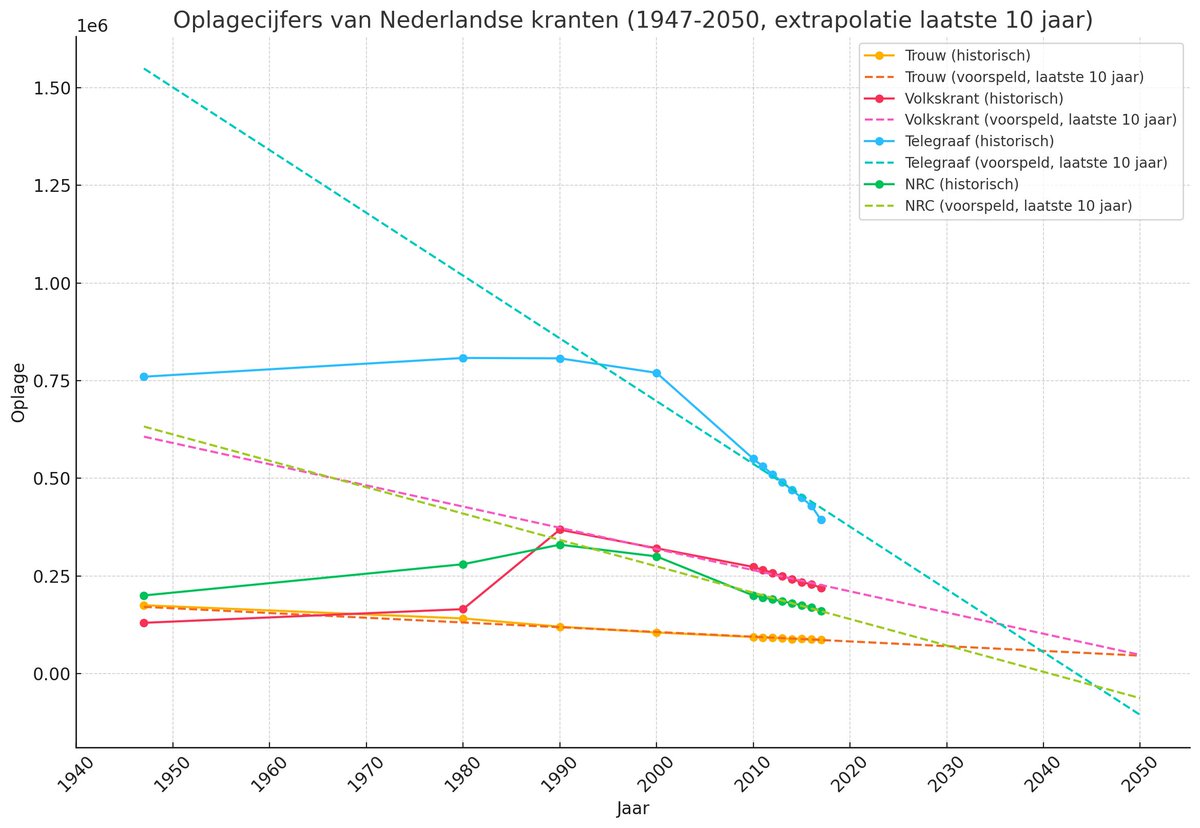
Volgens de huidige trends lijkt Trouw de meest waarschijnlijk winnaar in de lange strijd der dagbladen.
Guus Kroonen tweet media
Nederlands
0
0
2
554
Jörgenstein
Jörgenstein@AndersRJorg·
@GarnerJosh1667 That would be the implication, if the connection is correct. Simplification of initial *tn- seems unremarkable. But the entire connection is of course extremely uncertain.
English
2
0
1
90
JG
JG@GarnerJosh1667·
Basque ~ Pre-Greek comparanda 1. Basque naba ‘valley’ ~ Pre-Greek νάπη, νάπος ‘woodland vale, glen, dell’ 2. Basque arto ‘millet’ ~ Pre- Greek ᾰ̓́ρτος ‘a cake or loaf of wheat bread’ 3. Basque apar, afar ‘foam’ ~ Pre-Greek ἀφρός ‘foam’ 1/x
3
3
26
2.6K
Guus Kroonen
Guus Kroonen@KroonenGuus·
@GarnerJosh1667 #1 shows a good formal and semantic match, but can we exclude that B naba is a borrowing from Romance *nave- < Latin navis 'ship' in the documented (OPr.) meaning 'trough'? The shift "trough" > "furrow, valley" is very common. #2 is mysterious, but I suspect a chance resemblance.
English
1
0
5
153
Guus Kroonen
Guus Kroonen@KroonenGuus·
@GarnerJosh1667 The connection to Etruscan śpel looks tempting, but is the meaning secured? Basque -gune means 'place', cf. estal-gune 'place of cover' (you can find more here: academia.edu/2154989/Etymol…). So ospel-gune might mean 'place of shelter'.
English
0
0
3
62
JG
JG@GarnerJosh1667·
Pre-Greek comparanda — To expand upon Cid’s Basque & Pre-Sardinian comparisons: Srd *golósti (holly) ~ Bsq gorosti (id) ~ Pre-Gr κήλᾰστρος (id) Srd *mòkor (hillock) ~ Bsq mokoru (summit) ~ Pre-Gr μύκων (heap) Srd *mora (pile of rocks) ~ Bsq mora (id) ~ Pre-Gr μάρμᾰρος marble
2
0
8
830
Guus Kroonen
Guus Kroonen@KroonenGuus·
@GarnerJosh1667 I would leave out Gr. μύκων 'heap', cf. PGm. *mūhan- 'heap' < *muHk-on- and Alb. mys m. 'hump; hillock' < *muHk-io-. Πίνδος is a mountain, but does it exist as a word? More generally, I distrust most Greek links. Even κήλαστρος looks recent for its suffix -αστρος for wild plants.
Català
0
0
1
39
JG
JG@GarnerJosh1667·
Srd *péntum- ‘precipice, cliff, ravine’ ~ Basque pendoitz ‘hill, hillock; cliff, escarpment; precipice, slope’ ~ Pre-Greek Píndos ‘mount’
Română
2
0
4
232
Guus Kroonen
Guus Kroonen@KroonenGuus·
@MartinTerDenge De standaardmethode bestaat uit de identificatie van parallellen, d.w.z. woorden die in het Proto-Germaans dezelfde klankcombinatie hadden, en dan kijken of de dochtertalen ook dezelfde uitkomsten hebben. Ik krijg hierbij hulp van mijn woordenboek. archive.org/details/etymol…
Nederlands
0
0
2
32
Martin ter Denge
Martin ter Denge@MartinTerDenge·
@KroonenGuus Nu heb ik leyrd dat språken neet altyd rechtlynig alle regelen volget... 😉 Mär van protogermaansk en wo as dat afleided wördt med alle klangwetten, weat ik heylemål niks. Wår kan ik meyr vinden?
Dansk
1
0
0
24
Martin ter Denge
Martin ter Denge@MartinTerDenge·
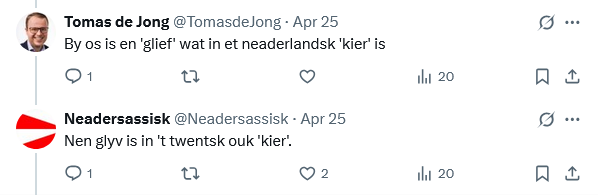
Gat in alle twentske wöördeböker, en woord wat in myne family vake bruked wördet: gliw. Ymand en idee?
Deutsch
4
0
2
276
Sassiske Språkvolger
Sassiske Språkvolger@Talenvolger·
@MartinTerDenge Hebbes! gluw , gliew , ongrijpbaar en onbetrouwbaar iemand. Bron: Dialectwârkgroep Heerde/Waopmvelde (2004), Nieje Heerder Woordnboek, Heerde & gluw , gluw , zelfstandig naamwoord , de; in bijv. kieken as een gluw als een duivel (Stellingwarv)
Nederlands
1
0
3
215
Guus Kroonen
Guus Kroonen@KroonenGuus·
@MartinTerDenge Dank je, dan zoek ik nog even door. Ik vrees dat afleiding van Proto-Germaans *glīwa- niet mogelijk is, want de w zou dan verdwenen moeten zijn, vgl. Westfaals Blī n. 'lood' < *blīwa-.
Nederlands
1
0
0
25