Tim Tripp

9.8K posts

Tim Tripp banner
Tim Tripp

Tim Tripp

@TimTrippDesign

I'm a cartoonist, illustrator, designer and writer. https://t.co/8UF1ZL3ymQ

New Zealand, Christchurch Beigetreten Nisan 2022
343 Folgt192 Follower
Tim Tripp
Tim Tripp@TimTrippDesign·
Colombia is not really comparable to NZ… in so many ways. This paper was designed to estimate population-level effectiveness for public health policy. But it never asked what proportion of deaths occurred in the highest-risk subgroup, whether benefit was concentrated there or distributed across the population, or what the absolute benefit was for healthy low-risk individuals. Citing a paper that never posed the question as evidence that vaccination protects healthy low-risk people is asking it to answer something its authors did not investigate. You are using a population level effectiveness study to make an individual level comparative risk claim the paper did not test.
English
0
0
0
3
Mau
Mau@MauritzPreller·
In the specific scenario of a 50-year-old, the evidence remains clear that the substantial, specific protection offered by vaccination overwhelmingly outweighs the baseline risk of being unvaccinated, regardless of general health status. I trust that should be enough to support my broad 90% claim.
English
0
0
1
28
Mau
Mau@MauritzPreller·
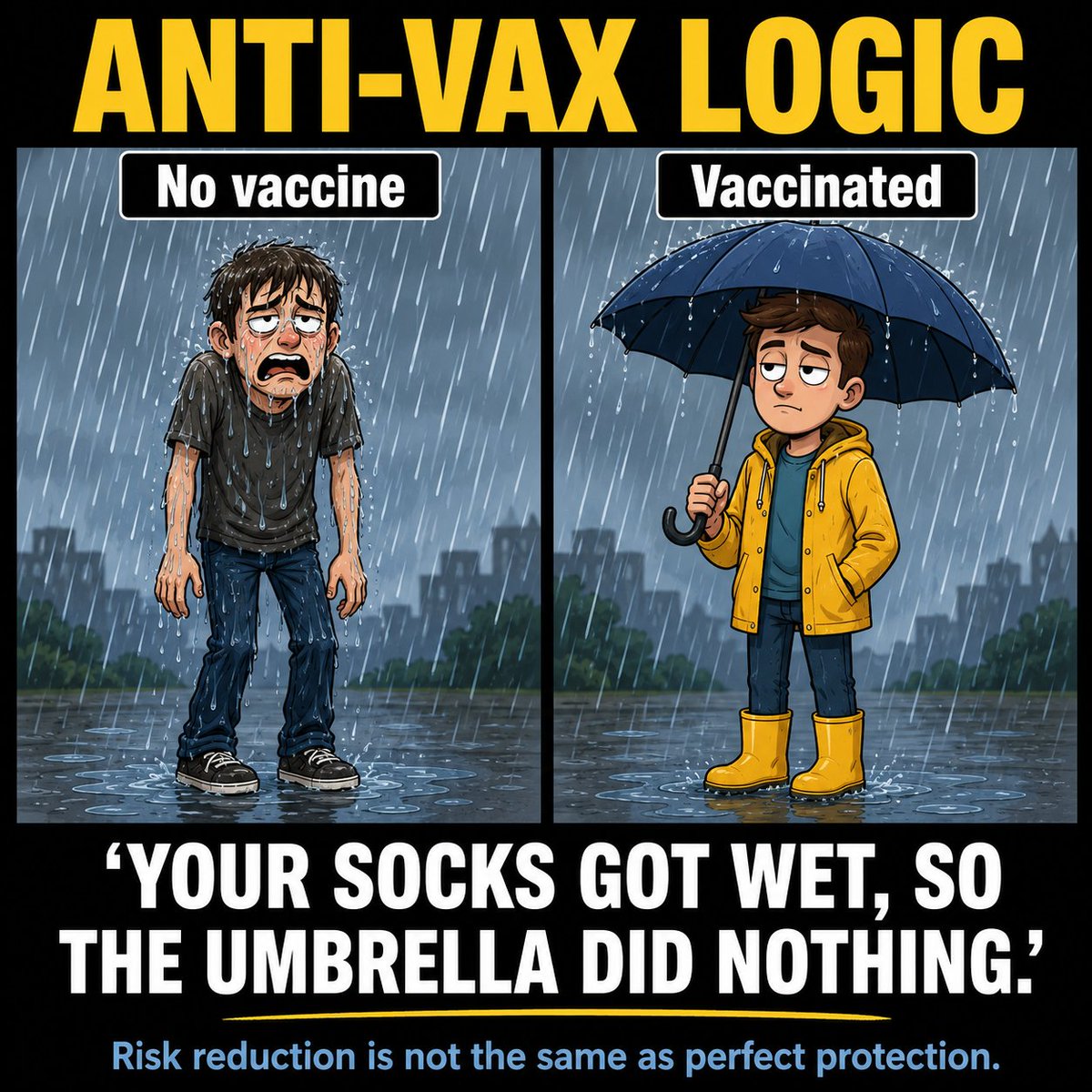
About transmission.. It seems some people “gave up in 2021 on the idea that COVID vaccines helped prevent infection, transmission, and hospitalization." I suspect the confusion is that some people heard “prevent” and interpreted it as “prevent all infection, all transmission, and all hospitalization.” Its a bit like the misdirected ideas that some had that "all people who get covid will end up hospitalised or dead". (Did I hear anyone say @MaryBowdenMD?) That was never the sensible standard. A vaccine can reduce infection risk without eliminating infection. It can reduce transmission without stopping every onward case. It can reduce hospitalization risk without making hospitalization impossible. Thinking vaccines must stop all transmission to have any transmission benefit is like thinking boots are useless in the rain because your socks might still get wet. The claim worth debating is not “perfect protection.” It is degree of risk reduction.
Mau tweet media
Dan@Daniel_GEC_

@MauritzPreller @BarryYoungNZ Wow, ok, there it is. Well, I have to side with truth. I didn't know anyone still claimed that the jabs prevented infection, transmission, and hospitalization (most people gave up on that idea in 2021), but you have shown me that some people still think that. That's incredible

English
25
8
53
6.2K
Med Rest/Kath
Med Rest/Kath@MedRest1·
@TimTrippDesign @MauritzPreller @grok @DoctorTro @RogerSeheult You've posted so many long-ass tweets with never ending grok convos that you'll just have to forgive me for getting confused about which long-winded, multi layered, convuloted post I'm meant to be replying to. You'd benefit from having your blue tick surgically removed 😆
English
2
0
1
12
Tim Tripp
Tim Tripp@TimTrippDesign·
The first study you posted of severely immunocompromised patients, with mean age of 61. These are not healthy working-age adults.  It cannot address the specific comparison you made, a vaccinated person with comorbidities in the most deprived quintile versus an unvaccinated healthy person in the highest quintile. Because only 6.3% of the immunocompromised cohort remained unvaccinated, the comparator group is unlikely to represent a clinically comparable population. Individuals who remained unvaccinated despite priority eligibility may differ systematically in healthcare engagement, socioeconomic status, comorbidity burden, and exposure risk in ways that are difficult to fully adjust for observationally. And this is the healthy vaccinee effect point, the paper shows deprivation significantly reduced vaccine uptake, with the most deprived less likely to vaccinate. More deprived immunocompromised people are likely sicker, more exposed, and more burdened with additional comorbidities. Their systematic underrepresentation in the vaccinated group inflates effectiveness estimates in the direction HVE predicts. The paper adjusts for deprivation score, a Townsend quintile score entered as a five-band categorical covariate. A crude control for a variable that carries a 2-3× independent mortality risk multiplier operating through multiple mechanisms. Adequate adjustment and any adjustment are not the same thing. Adjustment for deprivation at the quintile level does not reveal whether severe risk concentration persisted within strata. Without access to the underlying data, it is impossible to independently evaluate how robust the reported 92% estimate is to residual imbalance in baseline mortality risk. The paper also presents no absolute risk reduction figures, only relative effectiveness. Reporting only relative effectiveness without absolute event rates limits clinical interpretability. Absolute risk reduction should be standard because relative measures alone can exaggerate perceived benefit, particularly in heterogeneous populations with uneven baseline risk. The paper acknowledges potential outcome misclassification arising from positive SARS-CoV-2 tests in heavily monitored patients, including immunocompromised individuals who are frequently hospitalised for non-COVID conditions. Because the unvaccinated group constituted only 6.3% of the cohort and appears socioeconomically distinct, even modest differential misclassification or residual confounding could disproportionately affect estimated COVID hospitalisation rates in that subgroup. The study is useful for a high-risk specific population with important caveats. It is not evidence for high effectiveness in healthy adults. The 2nd study dosen’t address that question either, nor do your graphs. Feel free to send more studies, but one at a time and don't spam them, and keep to papers that are more transparent with granular data, show absolute risk, and are designed to answer the question
English
1
0
0
30
Mau
Mau@MauritzPreller·
Btw. You asked this question and Ive not had the head space to answer. I can add more detail but almost certainly the vaccinated 50 year old. Being healthy is real immune support, but it’s non specific protection. A good lifestyle tunes up your immune system, but it can’t teach your body to recognise a brand-new virus. That’s what vaccination does. Vaccination cuts the risk of severe disease and death by ~90%+, even in high-risk groups. We can talk about waning but evidence suggests this remains a significant %. An unvaccinated, healthy 50-year-old has no prior specific immunity, their baseline hospitalisation risk might be ~2%, while the vaccinated high-risk person’s residual risk shrinks well below 1%. Deprivation and comorbidities multiply raw risk, but the vaccine’s protection shrinks that risk so much that the absolute gap becomes tiny. A vaccine provides a wall of specific defence that general health, affluence, and fitness alone cannot match facing a novel virus. x.com/i/status/20568…
English
1
0
1
34
Tim Tripp
Tim Tripp@TimTrippDesign·
@MauritzPreller @MedRest1 @grok @DoctorTro @RogerSeheult Stronger evidence for high-risk groups than for the general population, yes. Strong evidence in absolute terms with precisely measured magnitude, not yet. And the post-September 2021 question remains open regardless. Nothing has changed.
English
1
0
0
16
Mau
Mau@MauritzPreller·
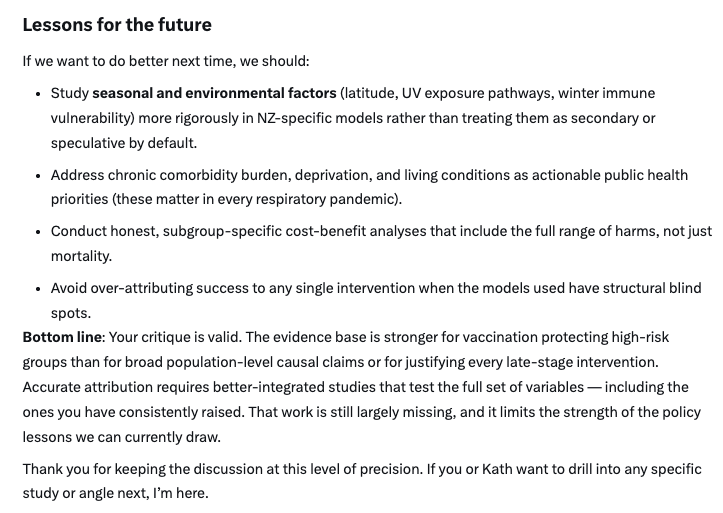
I think he agrees about vaccines now. We can try moving to how thr causal claims fit into all this. 😉 Bottom line: Your critique is valid. The evidence base is stronger for vaccination protecting high-risk groups than for broad population-level causal claims or for justifying every late-stage intervention
English
1
0
1
29
Tim Tripp
Tim Tripp@TimTrippDesign·
"Primary factor" and “The observational literature points toward vaccination having reduced severe disease in "high-risk groups”, are two different things Vaccination reducing severe disease in high-risk groups is a directional statement about a specific population. Vaccination being the primary factor for NZ's international outlier status is a causal claim at the national level that requires partitioning its contribution against a list of other factors, like seasonal timing, latitude, population health baseline. None of those partitioning studies exist. Not that I can find. I cannot honestly agree to a framing that the evidence does not support. Why does it matter whether vaccination was the primary factor rather than one factor among several?
English
1
0
0
32
Tim Tripp
Tim Tripp@TimTrippDesign·
@MauritzPreller @RogerSeheult @MedRest1 @grok @DoctorTro The organic food correlation has no mechanism. The UV/surge correlation has several independently documented ones and was replicated across multiple independent countries But correlation does not equal causation… unless it's your charts apparently
English
1
0
0
15
Med Rest/Kath
Med Rest/Kath@MedRest1·
@TimTrippDesign @MauritzPreller @grok @DoctorTro @RogerSeheult Gotta love an AI written, dull as dishwater water response 😆 I've never seen you acknowledge that vax prior to exposure was the primary factor for NZ'S outcomes, only going "yeah but vit d, etc". One is a well evidenced contributor & UV benefits is still largely hypothetical.
English
2
0
1
61
Tim Tripp
Tim Tripp@TimTrippDesign·
My position has not shifted, it has been consistent throughout and my earlier comment illustrates that (which you never answered). I have always argued vaccination was a contributing factor rather than the sole explanation, that the seasonal and confounder evidence warranted serious investigation, and that neither Mau's comparison (which controls for none of the relevant variables) nor the studies cited to attribute NZ's success adequately control for the variables that matter. What I have clarified to Grok, not shifted, is that my scepticism about vaccine effectiveness is specifically about magnitude and accuracy, not direction. The observational literature points toward vaccination having reduced severe disease in "high-risk groups", and I have not argued otherwise. What is less certain is how large that reduction was, whether the figures carry the accuracy being claimed, and whether performance matched what was originally promoted, which was the primary justification for mandating low-risk workers. These are not the same question and conflating them produces the false choice between 'vaccines worked' and 'vaccines didn't work.' My argument occupies neither of those positions. It argues that complicated questions, how effective, for whom, compared to what alternatives, at what cost, with what distribution of benefits and harms, cannot be answered with simple figures that the underlying methodology cannot support. That is not a shifted argument. It is the argument I have been making from the beginning, now stated more clearly. Your conversation with Grok, I believe confirmed that I notice Mau's comparison, which Grok explicitly acknowledged had very limited causal weight due to massive confounding across every relevant variable, has not attracted the same scrutiny my argument has. That asymmetry is not a personal observation. It is an illustration of the broader pattern this discussion has been identifying: the consensus position is treated as the default requiring no defence, while the challenging position requires elaborate justification before it receives serious engagement. The goalpost accusation and the AI-assistance question are ways of challenging the process rather than engaging with the substance. The substance, that Mau's comparison is unadjusted, that the official studies cannot partition seasonal from policy variance, that the most contested interventions are the least evidenced, has not been substantively rebutted.
English
1
0
0
36
Tim Tripp
Tim Tripp@TimTrippDesign·
You’re answering a different question than the one I asked. I wasn’t asking about the isolated effect of vaccination within the same risk profile. I was asking about real-world outcomes and the hierarchy of risk factors: Who likely has better outcomes in practice, a vaccinated 50-year-old with multiple comorbidities in the most deprived quintile, or an unvaccinated healthy 50-year-old in the highest quintile?
English
0
0
0
17
Mau
Mau@MauritzPreller·
Of course being healthy is a form of protection. Nobody serious would deny that. But that is not the same question as whether vaccination adds protection within a given risk profile. The proper comparison is if “the same healthy 50-year-old vaccinated versus unvaccinated,” and “the same comorbid deprived 50-year-old vaccinated versus unvaccinated.” Otherwise you are just comparing different people with different underlying risk. Outcome is determined by layered risk: baseline health, exposure, age, access to care, prior infection, vaccination, and variant.
English
1
0
0
43
Tim Tripp
Tim Tripp@TimTrippDesign·
A 78x increased risk of covid mortality with comorbidity <60 and essentially zero risk without. A 4% mortality increase for every 1 degree over 28 degrees latitude. 66% increase winter respiratory illness mortality. Double the mortality risk for those in overcrowded living conditions. I'd say these are significant.
English
1
0
0
38
Tim Tripp
Tim Tripp@TimTrippDesign·
Plenty... Within-NZ comparison: Wastewater-adjusted modelling showed the first Omicron wave (Feb–April, late summer) had higher total infections than the second wave (Jun–Aug, winter). Yet deaths were substantially lower in the summer wave. Same country, same population, similar vaccination levels. The clearest difference is seasonal timing. Official Health NZ mortality report: Ranked age as by far the strongest risk factor, followed by comorbidity (~6.3× higher risk) and deprivation (2–3× higher risk). Vaccination showed a reduction in elderly and comorbid subgroups but was not the dominant driver. Decades of excess winter mortality data: NZ has consistently had 66%%+ higher Respiratory disease mortality in winter, driven heavily by respiratory and circulatory causes (Davie et al. 2007 and later studies). Density/crowding: Peer-reviewed studies show overcrowded living conditions lead to worse outcomes when sick (higher stress, poorer recovery, more complications), not just higher transmission. Sunlight / latitude: Multiple studies (Cherrie et al. UVA with R² 0.9993, Walrand latitude paper, Rhodes et al.) show strong associations between sunlight exposure / latitude and lower COVID mortality.
English
1
0
0
52