James Falkiner

13.5K posts

James Falkiner

James Falkiner

@foxlow

L/S mgr, banks specialist. ExSBCWarburg/UBS. Securities industry since March1987. BSc(Syd, Biology) Skier. Cyclist. General advice only for wholesale investors.


Sydney, Australia Beigetreten Aralık 2009
478 Folgt645 Follower
James Falkiner
James Falkiner@foxlow·
@MacroEdgeRes So the Houthi have got their puts on. Will they announce the closure of Bab el Mandeb, pending a tolling arrangement?
English
0
0
0
196
MacroEdge
MacroEdge@MacroEdgeRes·
The spokesperson for the Houthi Armed Forces in Yemen is set to make a statement soon #MacroEdge
English
11
14
110
7.7K
James Falkiner retweetet
Wasteland Capital
Wasteland Capital@ecommerceshares·
$MSFT Satya has been asleep at the wheel for two years. Cucked by Altman, who went to bed with $AMZN. Windows 11 runs like sh*t. Copilot is a product disgrace, noone wants it. Claude even dominating Excel. Activision a write off & Xbox dying. Zero innovation. Wake up, bro.
English
154
130
2.2K
244.4K
James Falkiner
James Falkiner@foxlow·
I would be extremely cautious when looking to take equity stakes in Chinese banks. In fact I wouldn’t, unless planning to take a 12 month turn. The sector has minimal loss bearing capital if any sort of reasonable loan MTM is undertaken, and likely new capital needs will exceed 1.5x the existing sector bv capital base.
English
0
1
3
568
Michael Pettis
Michael Pettis@michaelxpettis·
Reuters: "China is considering easing shareholding restrictions for some major investors, people with knowledge of the matter said, in a move aimed at broadening capital-raising options for commercial banks reeling ​from an economic slowdown." reuters.com/sustainability…
English
2
9
64
17.9K
James Falkiner retweetet
John Spencer
John Spencer@SpencerGuard·
War does not operate on social media timelines. Here are some limited objective wars/operations: - Korean War (1950–1953): 3 years (1,125 days) - Panama (Operation Just Cause, 1989–1990): 41 days - Bosnia (Deliberate Force + IFOR/SFOR, 1995–2004): 9 years of NATO involvement - Kosovo (Operation Allied Force, 1999): 78 days (KFOR 1999–present) - Libya (Operation Unified Protector, 2011): 7 months (220+ days) - Persian Gulf War (1990–1991): 38-day air campaign followed by a 4-day ground war (100 hours), after 5 months of buildup - Operation Earnest Will (1987–1988): 14 months escorting tankers through the Strait of Hormuz)
English
12
59
453
20K
James Falkiner
James Falkiner@foxlow·
@Convertbond $META relative (to QQQ) now back to where it was before the early 2024 upgrade in outlook.
English
0
0
0
62
James Falkiner
James Falkiner@foxlow·
It could be argued that today's announcement is just an acknowledgement of reality. $META have struggled to reinvest with discipline. That was obvious 14 months ago as you highlight. Now that they have wound back the poor reinvestment, hey presto we see an increase in free cashflow. But what does this announcement say about the outlook for them as a high growth tech stock with boundless reinvest opportunities? $GOOG faces a similar dilemma with capital allocation discipline.
English
2
0
1
255
Lawrence McDonald
Lawrence McDonald@Convertbond·
Never, ever, ever invest in the present. It doesn’t matter what a company is earning, what they have earned. You must visualize the situation 18 months from now, and whatever that is, that’s where the price will be, not where it is today. Stan Druckenmiller
English
22
85
582
89.6K
James Falkiner
James Falkiner@foxlow·
As of 26 March 2026, there are currently 3 petroleum/product tankers (refined fuels: gasoline, diesel, and jet fuel) underway from US ports to Australia. These are part of the record March 2026 US-to-Australia fuel shipments (driven by Middle East disruptions cutting Asian supply). The highest in over 30 years. The 3 Tankers are all Medium-Range / MR Product Tankers). Two are estimated to arrive 18 April, the third 20-25 April.
English
0
0
0
105
James Falkiner retweetet
Michael Pettis
Michael Pettis@michaelxpettis·
The East is Red provides a translation of a very interesting essay by Wang Xiaolu, Deputy Director of the National Economic Research Institute. The problem with the Chinese economy, Wang says (and as I have argued for over a decade), is that China's excessively low consumption (21 percentage points below the global average, he notes) is intrinsic to its growth model. "The problem is not simply a shortfall in aggregate demand, but a deeper imbalance in its composition: investment has been excessive, while consumer demand has remained severely weak." The two are not separate conditions but are rather different sides of the same coin: "That imbalance is closely tied to years of expansionary monetary policy and a government-investment-led expansionary fiscal strategy." So far, he notes, Beijing has addressed the problem of excessively weak consumption by pairing it with excessively high investment, in order to maintain high domestic demand (although clearly not by nearly enough to prevent a soaring trade surplus). While this strategy generated sustainable growth in the 1990s and early 2000s, when China was highly underinvested, not only does it no longer generate healthy growth, but it tends to lock in the imbalances. This is because, he argues, the two are not functionally equivalent when it comes to sustainable economic growth: "One obvious defect in Keynesian theory is its assumption that consumer demand and investment demand are in a fully substitutable relationship. According to this theory, if saving is too high and household consumption too weak, policymakers can offset the gap by loosening monetary policy to spur investment, or by having the state invest directly. This logic implies that even wasteful public works—endlessly digging holes only to fill them in again—can generate growth, so long as money is spent." That's not quite what Keynes said, I would argue, because he was mostly talking about the need to create jobs, however useless, in times of high unemployment mainly as a way of reigniting the demand needed to justify productive investment, but I agree with Wang that this isn't the problem China currently faces. At any rate in China today this approach has serious limitations, Wang argues: "In reality, however, any such effect is at best short-lived. Policies that boost investment may raise demand in the near term, but over the medium to long run, they further expand production capacity and increase supply, thereby worsening the structural imbalance between excess supply and weak demand." Those who have in the past agreed with my views on Chinese overinvestment will find themselves in especially strong agreement with Wang when he writes that increasing government investment in order to balance the imbaility to increase consumption quickly enough just deepens the structural imbalances. "Government investment, of course, can be directed mainly toward infrastructure rather than productive capacity" he writes. "When such spending creates genuinely useful infrastructure and relieves bottlenecks in transport, communications, and related areas, it can generate positive spillovers, support growth, and raise returns across the wider economy." "But when infrastructure investment becomes excessive or duplicative, it too turns into low-yield or ineffective spending, consuming resources without generating commensurate returns and becoming little different from overcapacity. If continued, it will inevitably depress economy-wide returns, steadily erode the efficiency of resource allocation, and leave growth weaker. At the same time, high investment spends national income that might otherwise have gone to households, further suppressing consumer demand and deepening its inability to drive growth." For ten years or more Beijing has been trying to cut excess capacity, but it hasn't been able to do do. The reason, accoroding to Wang, "is that earlier efforts relied mainly on administrative measures to cut capacity in a few sectors, while leaving the underlying drivers of overcapacity largely intact—excessive investment, excessive monetary expansion, and excessive government borrowing. To address the structural imbalance at its root, those deeper institutional and systemic causes must be changed first." I of course agree that Wang is absolutely right to argue that resolving excess capacity in the worst-hit industries is useless if excess investment is simply shifted to other sectors with less excess capacity – in property, manufacturing and infrastructure. But while we agree, I think nonetheless that Wang may underestimate how difficult it will be to shift "national income that might otherwise have gone to households" without undermining China's manufacturing competitiveness. He is very clear, however, about the need to implement such a shift. I could go on to quote a lot more, but I think it is much better to read the essay. I know that over the years a number of prominent Chinese economists have made comments that are similar to those Wang makes in this essay, although mostly only in private conversations, but it seems that over the past 2-3 years this has started to become a consensus view – at least among economists, if not yet policymakers. Zichen Wang and his team should be thanked once again for their great work in bringing internal Chinese economic discussions to a wider public. @ZichenWanghere eastisread.com/p/wang-xiaolu-…
English
21
70
279
36.3K
James Falkiner retweetet
Josh Kale
Josh Kale@JoshKale·
If you bought into the mini Anthropic IPO last week you're now up 18x 🤯 this is just insane this point - $VCX is now trading at $565 - The fund's actual net asset value is $19 per share - Investors are paying ~30x what the underlying holdings are worth A $650 million portfolio of private companies is being valued by the market at nearly $10 billion. To put the premium in perspective: If you buy one share of VCX at $565, you're getting roughly $19 worth of Anthropic, OpenAI, SpaceX, Databricks, and Anduril. The other $546 is pure demand premium. You are literally paying $546 for the privilege of accessing these companies. And people are lining up to do it. Truly insane scenes
Josh Kale tweet media
Josh Kale@JoshKale

The Anthropic mini IPO is unfolding and you already missed a 15x return The stock is named VCX by Fundrise and just went up 1,500% in 5 days on the NYSE It’s a fund holding: - Anthropic = 21% - OpenAI = 10% - SpaceX = 5% - Databricks = 18% - Anduril = 7% $VCX has a NAV of $19 per share. This morning it just traded at $312. That means the market is valuing a $650 million fund at $5.4 billion 🤯 Investors are paying an 8x premium just to touch these companies. Why? Because the most important companies being built right now refuse to go public. And people are so desperate for exposure that they will pay almost anything to get it. The private markets are sitting on trillions in value that public investors have been locked out of and this stampede tells you everything about how much hype there will be around these IPOs. I hope this speeds things up
English
205
216
2.1K
1.5M
James Falkiner
James Falkiner@foxlow·
@George_Friedman @GPFutures Agreed that their economy has serious issues. They would also have to be quietly surprised at the U.S. Iran military operation. So, what does the Chinese behavior say about their intentions or likely future actions for Taiwan?
English
0
0
2
249
George Friedman
George Friedman@George_Friedman·
The Chinese, even without the oil crisis, face fundamental economic problems. This is why I have argued that the U.S. and China would reach an understanding with each other on both economic and military relations, even without the war in Iran and its impact on oil. It is interesting to me that, where Trump and Xi were scheduled to meet in late March, Trump has asked for a few weeks’ postponement and the Chinese graciously agreed to it. These talks have been ongoing at lower levels for a while now, and I think the summit was meant to be the place an agreement would be revealed. That the Chinese accepted the postponement seems to me significant. Even more significant is that China does not seem to be sending aid to Iran, which would be a wonderful opportunity to create more problems for the U.S. in the war. Clearly China has an interest in ending the war, but also an interest in regaining access to the United States for its exports. They are not letting the war get in the way of an agreement with the U.S., or so it seems.
English
12
18
102
10.6K
AusPoll
AusPoll@AusPoll6·
🚨 NEW: Victoria (state) voting intention 🟦 L/NP: 30% (+3) 🟥 ALP: 27% (-1) 🟧 ONP: 20% (-3) 🟩 GRN: 14% (+1) ⬛️ OTH: 9% (-) Two-party-preferred 🟦 L/NP: 52% (+2) 🟥 ALP: 48% (-2) Freshwater | 19-23 Mar | n=1062 | +/- 19-23 Feb
English
42
34
405
57.9K
James Falkiner
James Falkiner@foxlow·
@countdraghula @glengarryrd Until the money runs out. The great thing about democracies is that people get the governments they deserve, as the Victorians are now finding out. It seems that the electorate's memory of Cain/Kirner is ancient history.
English
0
0
0
24
Count Draghula
Count Draghula@countdraghula·
@foxlow @glengarryrd Voter appetite for volatility is zero because of this, so we get the governments we get who are terrified to charge anything and will always trade the future for the present
English
1
0
0
52
James Falkiner
James Falkiner@foxlow·
@countdraghula @glengarryrd Now, where can we find lots of debt in the private sector in Australia? Why, the residential mortgage market of course. Rising rates, over-geared H/H balance sheet, rising chance of government intervention. What could possibly go wrong?
English
1
0
0
36
Count Draghula
Count Draghula@countdraghula·
@foxlow @glengarryrd Yes, and to add the power of the modern government is enabled by the amount of debt outstanding in the private sector. If there were less debt, we wouldn't care about them nearly as much.
English
2
0
1
60
James Falkiner
James Falkiner@foxlow·
@countdraghula @glengarryrd I remember reading Paulson’s book, Whatever it takes, and I had to put it down. It reminded me of what a bun fight that whole episode was and how the inner circle knew what was about to happen. That first failure on TARP was a shocker. Pelosi at her most destructive.
English
1
0
1
41
Count Draghula
Count Draghula@countdraghula·
@glengarryrd Both other decisions were discretionary as well. To the unilateral claim COVID was unilateral and GFC technically wasn't but congress moves as a herd. Remember they failed to pass it the first time and then suddenly changed their minds when the market tanked
English
2
0
1
102
James Falkiner
James Falkiner@foxlow·
@SwingRequired @MarkoMatvikov Yes, so it's not surprising when Wong attacks the Coalition for the perceived evils of swapping prefs with ON, when, as you imply, the ALP cuddles up to the Greens. Hanson has made it clear she will cooperate on prefs, so for now its the battle for primacy in the ROC space.
English
0
0
1
22
PolicyTalk
PolicyTalk@SwingRequired·
@foxlow @MarkoMatvikov Liberal preferences to One Nation and vice-versa only flow perhaps 60/40 to each other, maybe a bit more or less. Greens flow 85% to Labor. Hence Labor still 5% in front 2PP.
English
1
0
1
27
Marko Matvikov
Marko Matvikov@MarkoMatvikov·
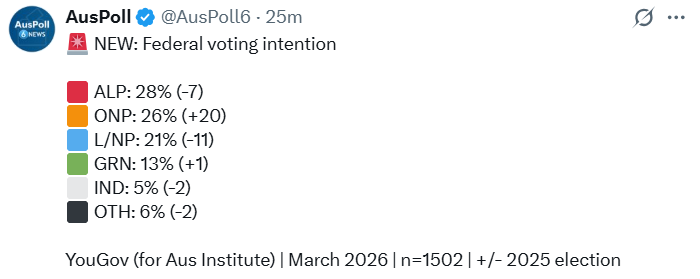
Just a few months ago, I thought Labor was definitely going to win the 2028 federal election - but now I think it's up for grabs. The economy's deteriorated quicker than I thought it would - that can they've been kicking for the last 4 years has run out of road.
Marko Matvikov tweet media
English
90
50
563
13.2K
Douglas Orr, CFA
Douglas Orr, CFA@EquitOrr·
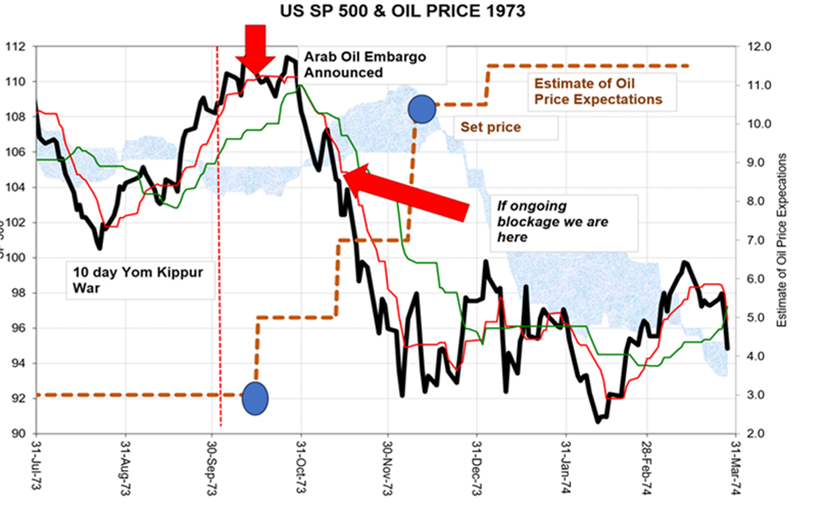
Trump showing signs of wanting to TACO – looking very difficult with Iran looking resolved & US public interest turning -ve Iran likely has incentive to “win by not losing” & keep up the blockade =>Risk is Straight of Hormuz passage not normalized into Apr-26 Our Base Case of the War, Sentiment & Oil all getting worse in the last 2 weeks of March appears to be playing out. REDUX 1973? Yom Kippur War playbook – negative was consequent Oil Embargo & Inflationary Bust. We are presently at red arrow - #2 market deciding if Oil > $100 /bl will continue thru Apr-26+
Douglas Orr, CFA tweet media
English
2
0
7
615
James Falkiner retweetet
Aravind
Aravind@aravind·
I still maintain the same. There are pro-US insider elements in the regime already that are ready to take over. Some from the same leadership now seen "fighting" US/Israel, but still left alive by them, will take over the new regime that will be US aligned. It may look on the outside, like venezuela now, that no change happened. But just like VZ, their policies will be pro US and not China. This is what regime change is about in the new US doctrine.
English
2
23
226
216.9K
Science girl
Science girl@sciencegirl·
The power of a dog’s nose is so extraordinary it can detect even the faintest trace—just a few molecules in the air.
English
699
6.7K
59K
1.9M