g023
5K posts

Angehefteter Tweet

So I optimized the model, i optimized the harness, now I'm optimizing the endpoint by making an openai api to deepseek endpoint proxy that has some context compression features automatically integrated to attempt to save $$$ (works well with copilot):
gist.github.com/g023/c2bb7b540…
English



@RoyShilkrot ... also a lot less reading to see what it messed around with.
English

@RoyShilkrot it truly does help to isolate and work on the problem as a component, rather than the whole, for speed and token efficiency. Especially when dealing with smaller models for tasks.
English

@antirez @ivanfioravanti I have little faith in those benchmarks. Real life is the best test.
English

@ivanfioravanti No, if it misrepresents models in random ways, how is it good? Only because 5.5 happens to be on top?
English

@lmrankhan depending on the task, cleaving out the subagents altogether gives some surprisingly good results.
English

A lot of people are talking about running tons of agents, parallel workflows, skills, and orchestration layers.
Honestly, for building an app, I've found two coding agents running in async works perfectly fine, Codex for backend and Opus/Claude Code for frontend.
Haven't had to use more than that, skills, or complex workflows. The bottleneck is usually figuring out what to build, not how many agents you're running or using any of the advanced workflows.
I'm sure there are more advanced things people are doing, but for most MVPs or early stage products, simplicity works
English

at tencent (china’s largest internet company), the token reimbursement quota is dynamic.
the more you use, the more you get when it refreshes next month.
so… it kinda looks like you’re incentivized to build side projects at work? 😂😂
Zack Korman@ZackKorman
Companies are like "we are spending all this money on AI but we don't know what the devs are even doing with it." Let me answer that for you: They're working on their personal side projects.
English

@RoguePoma I share a lot of my things in public, and yes sometimes they are pretty raw but useful to me. Always like to learn from others too.
English

@shyamalanadkat I think what would qualify as AGI would be a session that is always on, has infinite history that doesn't need to be cleared, and carries out its business on its own, either seeding itself with roles, or being directed to a role as a seed role.
English

@rajyaligar @smhanov try using deepseek as a subagent and opus as orchestrator to stretch out the window
English
g023 retweetet

@antoniolupetti I'm working on a concept: an agent that maintains a large, external, sparse key-value memory (not vector database, but differentiable memory like a sparse Transformer memory layer) that is updated during a single long session compressing past into mem tkns & retrieve w/attention
English

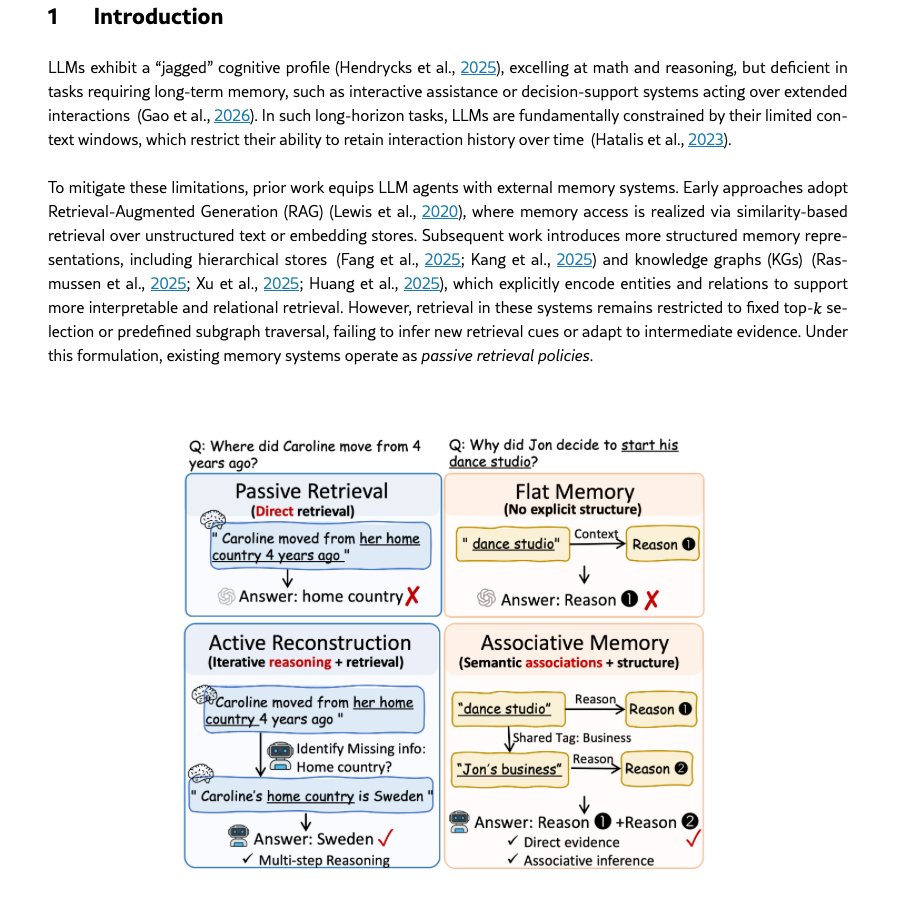
"Graph Memory for LLM Agents" is a recent paper that explores an idea that I find quite interesting. Most AI memory systems treat remembering as a retrieval problem (the model searches its memory, retrieves relevant information, and then reasons about it).
This paper argues that the process may be more dynamic than that and, instead of simply retrieving memories, an AI agent could reconstruct them during reasoning, following clues, associations, and intermediate evidence as they emerge.
What I find interesting is the possibility that memory and reasoning may not be separate processes at all, but that remembering itself could be part of reasoning.
arxiv.org/abs/2606.06036

English


@SolaTheAnalyst Try owning one in Calgary lol. Can't live without it, but you'll get taken to the cleaners.
English

@Sean_Speer Well considering AI is now being used in Alberta and BC to write all the police reports, guess what you'll be up against in court? These datacenters are for them, not you, but they'll be used against you for sure.
English

The Carney government gets it wrong on AI
This week, the Carney government released AI for All, its long-awaited national artificial intelligence strategy.
Although there are some useful aspects to the strategy—including the government’s recognition that Canada suffers too little AI adoption—its central premise is basically wrong.
The document repeatedly frames AI through the lens of “sovereignty,” including the need for greater control over AI infrastructure, data, and advanced models. But sovereignty is a poor organizing principle for Canadian AI policy.
Frontier AI development is increasingly concentrated among a handful of American and Chinese firms with capital budgets that exceed the annual spending of most national governments. The hyperscalers are investing hundreds of billions of dollars in chips, data centres, models, and talent. The notion that Ottawa can engineer a domestically controlled frontier AI ecosystem capable of competing head-to-head with those firms is an unserious starting point for Canadian policy.
University of Toronto economist @Afinetheorem has made the point particularly well. In his view, countries such as Canada face a simple strategic choice: they must find a way to become essential to either the American or Chinese AI stack. Attempting to recreate a fully sovereign stack of our own is neither economically realistic nor technologically plausible.
That insight exposes the main weakness of the government’s approach. The strategy contains pages of discussion about Canadian leadership, sovereignty, and domestic capacity. Yet it says comparatively little about how Canada will position itself within the global AI ecosystem that’s already emerging. There’s little discussion of guaranteed access to frontier models, Canada’s role in AI supply chains, or how Canadian firms can become indispensable partners to the companies building the world’s most advanced systems.
Canada has genuine advantages. We possess abundant energy resources, a strong research base, world-class universities, significant mineral assets, and geographic proximity to the United States. The goal should be to leverage those strengths to attract investment, host infrastructure, develop specialized applications, and deepen our integration into the North American AI economy.
Put simply: Canada’s AI future is more likely to depend on integration than independence. Yet if policymakers become so preoccupied with the political goal of sovereignty, they risk undermining the country’s place in the AI economy around taking shape.
The Hub@TheHubCanada
.@Sean_Speer: The Carney government gets it wrong on AI thehub.ca/2026/06/05/the…
English