

The Neutralist
7.2K posts
The Neutralist
@neutralto
The Neutralist is chairman, chief executive and only member of the https://t.co/BLxj7mMttY. It is a lonely job, but, literally, no one else will do it.
Swamp Yankee Massachusetts Beigetreten Aralık 2015
1.1K Folgt229 Follower

Yes but FGFF will never have the will or capacity to nationalize it.
But there is a workaround…
Mick Caul@caulmick
If Energy security is Important (which it is) - why did the government sell it off? Ireland's only oil refinery is being sold to a huge Canadian company. Canada’s Irving Oil is to buy the facility, sold by the government for €100m, for an undisclosed amount. thejournal.ie/whitegate-cork…
English
@UncleFlapjacks Once was a wild gin mill named after him in Boston's South End.
I might have gone there once...or twice.
Mea maxima culpa.
English


All Wars Are Bankers’ Wars: Iran and the Bankers' Endgame scheerpost.com/2026/04/10/all… via @Scheer_Post
English
@FabiusMaximus01 @tparsi Actually, I am more wondering if they are figuring the attack is coming and hope to be ready for it?
English

@neutralto @tparsi 1/ No. Their offensive weapons have been attritted. They’ve carefully husbanded them for retaliation - if needed.
2/ We’re the aggressors in this War. Our attacks serve our strategic goals. An attack by Iran does nothing for them.
English
Why the Iran ceasefire may have shifted the dynamics back in Trump's favor
Diplomacy between Washington and Tehran has not yet unraveled, despite JD Vance’s theatrical departure from last week’s talks in Islamabad. Trump now signals that the two sides could reconvene within days in the Pakistani capital. Whether negotiators return to the table or continue their exchanges through quieter, remote channels before the ceasefire lapses, one reality appears to have shifted: Trump has clawed back a measure of momentum—and with it, leverage—over Iran, largely by virtue of the ceasefire. Here’s why.
Trump entered this moment politically cornered and strategically constrained. Surging gasoline prices were inflicting acute domestic pain, eroding his standing at home. More critically, he faced a barren escalation ladder. Each conceivable move—strikes on Iran’s oil infrastructure, attacks on civilian targets, the seizure of Persian Gulf islands, or covert operations to capture enriched uranium—carried the near-certainty of forceful Iranian retaliation. Such responses would not merely match his escalation but compound it, deepening his economic exposure, amplifying political risk, and entangling him further in a perilous and unwinnable strategic bind.
Nor could he simply extricate the United States from the conflict on his own terms. Absent an understanding with Tehran, Iran retained both the capacity and the incentive to continue targeting Israel and vulnerable U.S. assets across the Gulf. Trump needed Iran’s permission to get out of the war.
The ceasefire, however, has subtly altered that equation. Trump may no longer need a formal nod from Tehran to step back. If he disengages now—without a comprehensive agreement—Iran will almost certainly maintain its grip over the Strait of Hormuz, a strategic setback for Washington. Yet Tehran is unlikely to resume direct military operations against U.S. targets in the Persian Gulf. To do so, in the absence of renewed American strikes, would cast Iran as the aggressor, inviting severe and potentially coordinated repercussions—not only from Washington but from wary global powers such as Russia and China.
Moreover, the balance of needs has tilted. Iran now appears to need an agreement more than the United States does. Trump has already secured his central objective—the escape from a war he was ill-advised to begin—while Iran, despite accruing leverage through its command of the Strait, remains far from realizing its broader ambitions: meaningful sanctions relief, a definitive and enduring end to hostilities, and perhaps even the contours of a more stable, constructive relationship with Washington.
Tehran’s decision to dispatch its largest, most senior, and most expansive delegation to Islamabad for direct talks with the American vice president reflected a striking confidence—that it occupied its strongest negotiating position vis-à-vis the United States since 1979. Yet to convert that moment of perceived ascendancy into little more than a cessation of U.S. bombardment would fall short of its aspirations. Even if Washington were to acquiesce to Iran’s control of the Strait, such an outcome would pale against the far more consequential gains Tehran believes are within reach.
Instead, Iran needs to translate this leverage not only into a durable end to the war, but ideally, into a new peace: One that delivers sweeping sanctions relief and inaugurates a more stable, mutually defined economic and political relationship with Washington. Such an arrangement would serve as a bulwark against renewed conflict. The economic imperative is especially stark: sanctions relief is indispensable to reconstruct a country now burdened with damage running into the hundreds of billions of dollars.
As I have argued before, sanctions relief is not merely an economic demand—it is a strategic necessity. Without it, Iran risks a condition of chronic erosion, a slow but steady weakening that would leave it exposed. That vulnerability, in turn, could invite further attacks. It was, after all, the misperception of Iranian weakness that helped open the window for initial strikes.
But Trump does not, in any fundamental sense, require any of this. The United States can endure without a formal agreement with Iran and without the benefits of an economic relationship with Tehran. To be sure, a negotiated settlement would better serve long-term American interests: the nuclear constraints Trump seeks can only be credibly secured at the negotiating table. Abruptly abandoning diplomacy while leaving Iran in undisputed control of the Strait would also unsettle key regional allies. Yet these are strategic preferences, not immediate necessities.
Trump’s calculus is far more transactional and far less patient. He can point to the damage already inflicted on Iran’s nuclear infrastructure and conventional forces, proclaim a hollow victory, and disengage. He has already emphasized that the United States no longer depends on Persian Gulf oil, insulating it from the direct economic consequences of Iran’s toll regime. As a result, the burden shifts outward: the Strait becomes a problem for European and Asian powers—countries that Trump has noted declined to rally to his side when he sought their help in prying the waterway from Tehran’s grip.
The window now open offers Tehran a chance to convert battlefield leverage into lasting strategic gain. To let it close would mean forfeiting not just incremental progress, but the possibility of reshaping its economic and geopolitical position. By contrast, the United States, having already secured a tenuous exit ramp through the ceasefire, has less at stake in the short term. Walking away, therefore, is politically and strategically easier for Trump than for his Iranian counterparts. Both can live with diplomatic failure, but Tehran has more gains to lose.
How Tehran chooses to navigate this narrowing corridor—whether it presses its advantage or overplays its hand—will be interesting to see.
English
@KelleyBVlahos @LobeLog Not, as they say in Boston, a wicked shockah.
English

Surprise! The five top boosters for Iran war - FDD, AEI, Hudson, and WINEP - fall squarely into the neoconservative camp of US foreign policy hawks in that support for Israel is a central principle of their world views and work. @LobeLog
responsiblestatecraft.org/iran-war-think…
English
@FabiusMaximus01 @tparsi As an American watching things get less fun everyday, who really has the time advantage?
English
@tparsi Despite all the claims that “Iran has won”, it was obvious that the ceasefire did nothing for Iran. Iran’s military & industry were hit very hard. Sanctions remain. US-Israel are rearming & can surprise attack again. It is the status quo antebellum - but with Iran much weaker.
Fabius Maximus (Ed.)@FabiusMaximus01
Iran has been seriously damaged. Now a 2-week pause for Israel and the US rearming while Hormuz reopens. This is a large win for Trump. It does nothing for Iran.
English
Again we see that the Left believes that only their wins are legitimate. Free elections putting the right in office “threaten democracy.” It shows their authoritarian values.
Barack Obama@BarackObama
The victory of the opposition in Hungary yesterday, like the Polish election in 2023, is a victory for democracy, not just in Europe but around the world. Most of all, it’s a testament to the resilience and determination of the Hungarian people – and a reminder to all of us to keep striving for fairness, equality and the rule of law.
English
@policytensor Iran prepared for a blockade by selling oil to China and Pakistan. Will they support Iran or the US?
English

Why don’t we talk about this once the right of passage of Chinese vessels is clear?
Karim Sadjadpour@ksadjadpour
"As Iran’s oil exports collapse, there’ll be no cash for imports, so activity implodes, the currency goes into a devaluation spiral and hyperinflation ensues. There’s no doubt in my mind this’ll bring the mullahs to the negotiating table in good faith.” -@robin_j_brooks economist.com/middle-east-an…
English
@_PeterRyan Predicting nothing, but sometimes in history the official government becomes superfluous.
English
40% of Ireland votes for FGFF
40% for SF + left
15% for independents
5% for populist right
The only two outcomes are continued FGFF establishment or SF + left takeover.
Anything else is wishful thinking.
English
@MishGEA @stavridisj the admiral was given a sinecure to parrot words.
English

It is stunning that admiral @stavridisj the "Vice Chair,The Carlyle Group; Chair, Rockefeller Foundation Board; PhD; ADM, USN(Ret.) fmr Supreme Allied Commander at NATO"
has no idea how global markets function!
The idea that allies will be no worse off is ludicrous.
Wow. Just wow.
Is Trump taking advice from him?
English
@ChrisRossini Thank you for making the case for a neutralist foreign policy and ethos. Come home America.
neutralistassociationofthe.us
English

U.S. foreign policy is a problem multiplier.
The first problem is America starting and fighting wars for Israel.
And then the problems expand and multiply from there.
Nostra, House of Gold@Nostre_damus
It’s day 43 of the 2 day military operation The U.S. Navy is blockading the strait of Hormuz
English
@BarackObama "The victory of the opposition in Hungary yesterday,"
Vapid, had Orban won by getting more votes, that would have been democratic.
So what?
English
The victory of the opposition in Hungary yesterday, like the Polish election in 2023, is a victory for democracy, not just in Europe but around the world. Most of all, it’s a testament to the resilience and determination of the Hungarian people – and a reminder to all of us to keep striving for fairness, equality and the rule of law.
English

Fuck the Islamic regime of Iran the world will be a better place without them
English
@NicholasLissack If y'all put your boots on the ground, I'd believe you were serious.
English

I’m in London, marching with 30k brave Iranian patriots to the US embassy, demanding President Trump finish the job.
Iran must be liberated to save both the Iranian people and Western civilisation from Islamist nuclear terrorism.
We will never stop. Free Iran. Javid Shah!
English
Supporting a US enemy during wartime.
Hmmmm
Stew Peters@realstewpeters
Since U.S. government is clearly occupied, I support Iran standing up to this genocidal maniac. Somebody has to do it.
English
@KelleyBVlahos My dear lady, the difference between you and Laura is that her shelf life is over.
English
Like Xi would care. He'd be happy to avoid the grip-n-grin with Trump right now 🤣
Laura Ingraham@IngrahamAngle
Trump should call Xi and threaten to cancel the summit.
English
@MishGEA Not a bad point, but I will continue to refer to the current government as the Biden-Trump administration.
English
I am amused by this A is better than B thing when it comes to Trump and Biden.
I now want to know if the Iran war was better than the Vietnam war so I can praise Johnson or Trump for starting a better war.
Stop the A is better than B silliness and admit they both awful.
English

Imagine being the foreign-born author of the Axis of Evil lie and the book An End to Evil with Richard “Prince of Darkness” Perle, demanding war throughout the world, and showing your face in public, much less complaining about your own failure like it’s someone else’s.
David Frum@davidfrum
Something very late Roman about the triumphal arches growing bigger and gaudier as the triumphs themselves grow scarcer and more dubious.
English


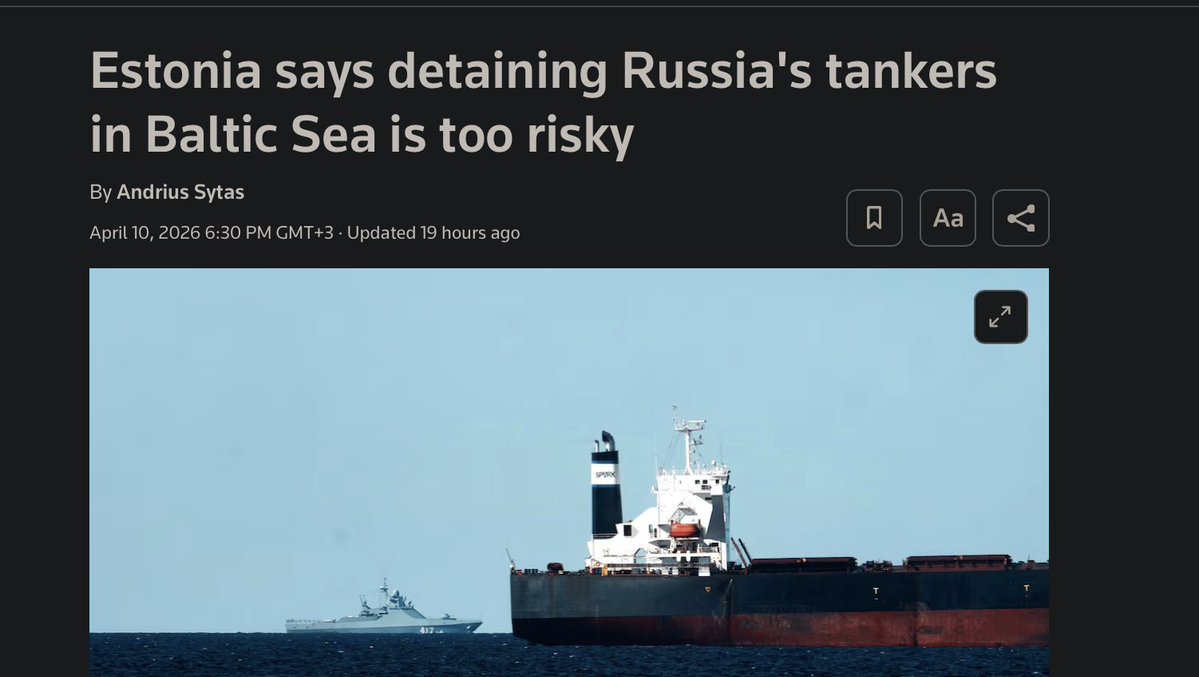
Reuters reports that Estonia will not attempt to detain Russian-linked tankers in the Baltic Sea, citing the risk of escalation and Moscow's increased military presence in the Gulf of Finland.
English