Namrata Narain

782 posts

Namrata Narain

Namrata Narain

@nummoose

AP at BU Questrom, Emerging Tech Fellow at HKS. PhD in Economics from Harvard. Interested in innovation, finance, economic growth, and macroeconomics.

Cambridge, MA Beigetreten Eylül 2015
2K Folgt2.4K Follower
Namrata Narain retweetet

Alex Armlovich
Alex Armlovich@aarmlovi·
Bad econ. "White collar workers switch to Doordash, driving down real wages there too" is partial equilibrium thinking Robot firms only grow if they're producing more real goods & services. If production is growing, real incomes are rising not falling. No doom loop! If production is growing but somehow consumption stalls, that's just a failure of monetary & fiscal policy. Cut rates to zero quickly; below zero, fiscal policy kicks in to redistribute income to consumers & restore consumption growth to trend Either there's no doom loop in the first place, or else New Keynesian monetary & fiscal policy kicks in to close any emergent wedge between robot output & human consumption This piece is ultimately just anticapitalist pablum (teasing a belief that most markets are just scams and rent seeking in the intro!)--and after that, the piece simply underrates or misunderstands the stabilizing powers of liberal democratic Keynesian capitalism to keep output & consumption in balance We don't have to allow what @delong calls "a failure of the exchange mechanism" in the future any more than we did in the 1930s
Citrini@Citrini7

JUNE 2028. The S&P is down 38% from its highs. Unemployment just printed 10.2%. Private credit is unraveling. Prime mortgages are cracking. AI didn’t disappoint. It exceeded every expectation. What happened?​​​​​​​​​​​​​​​​ citriniresearch.com/p/2028gic

English
26
30
327
77.4K
Namrata Narain retweetet
Jostein Hauge
Jostein Hauge@haugejostein·
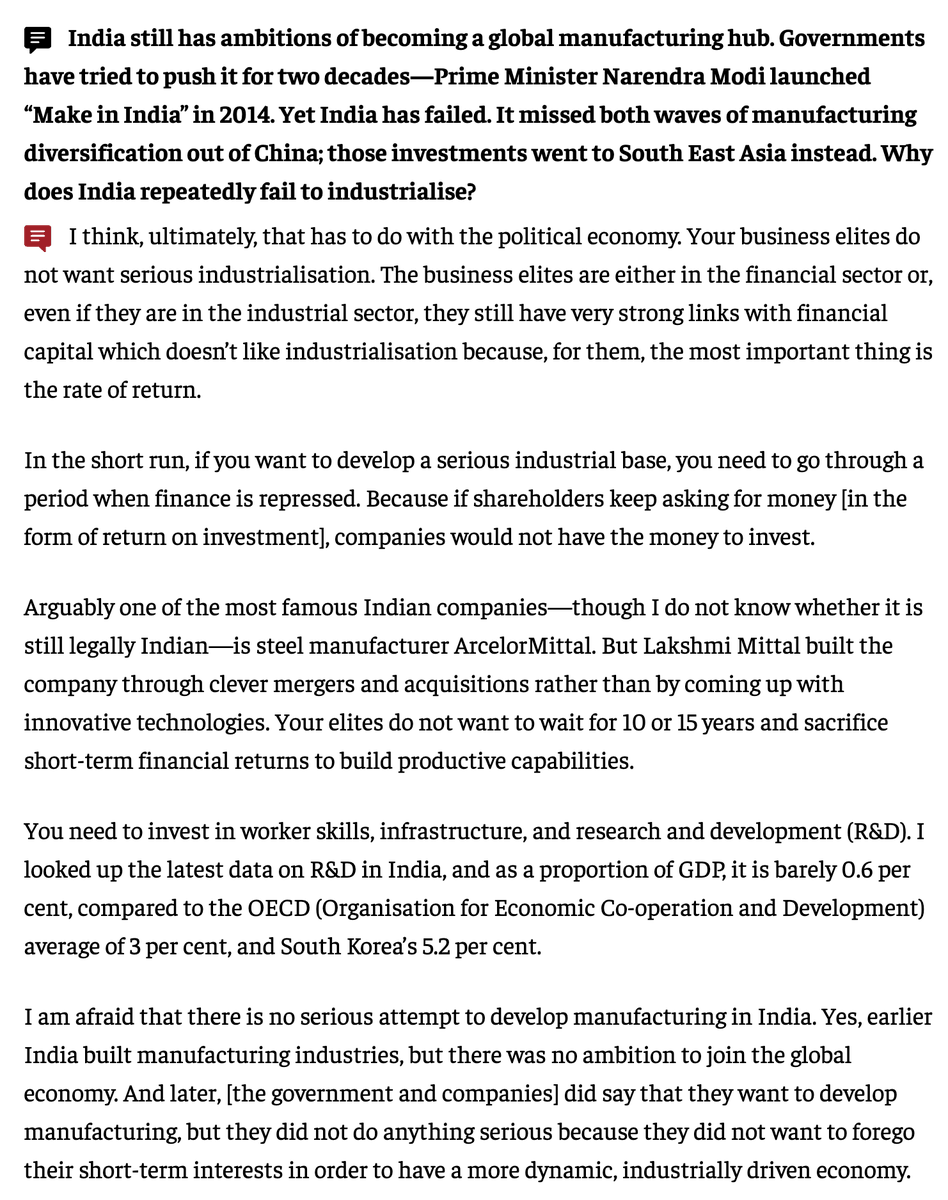
Why has India failed to industrialize? Ha-Joon Chang argues that it’s because India’s business and financial elites oppose industrialization — and that it won’t happen unless their power is curbed.
Jostein Hauge tweet media
English
191
1.2K
4.3K
197.6K
Namrata Narain retweetet
Nicolaj Thor
Nicolaj Thor@nicolajthor·
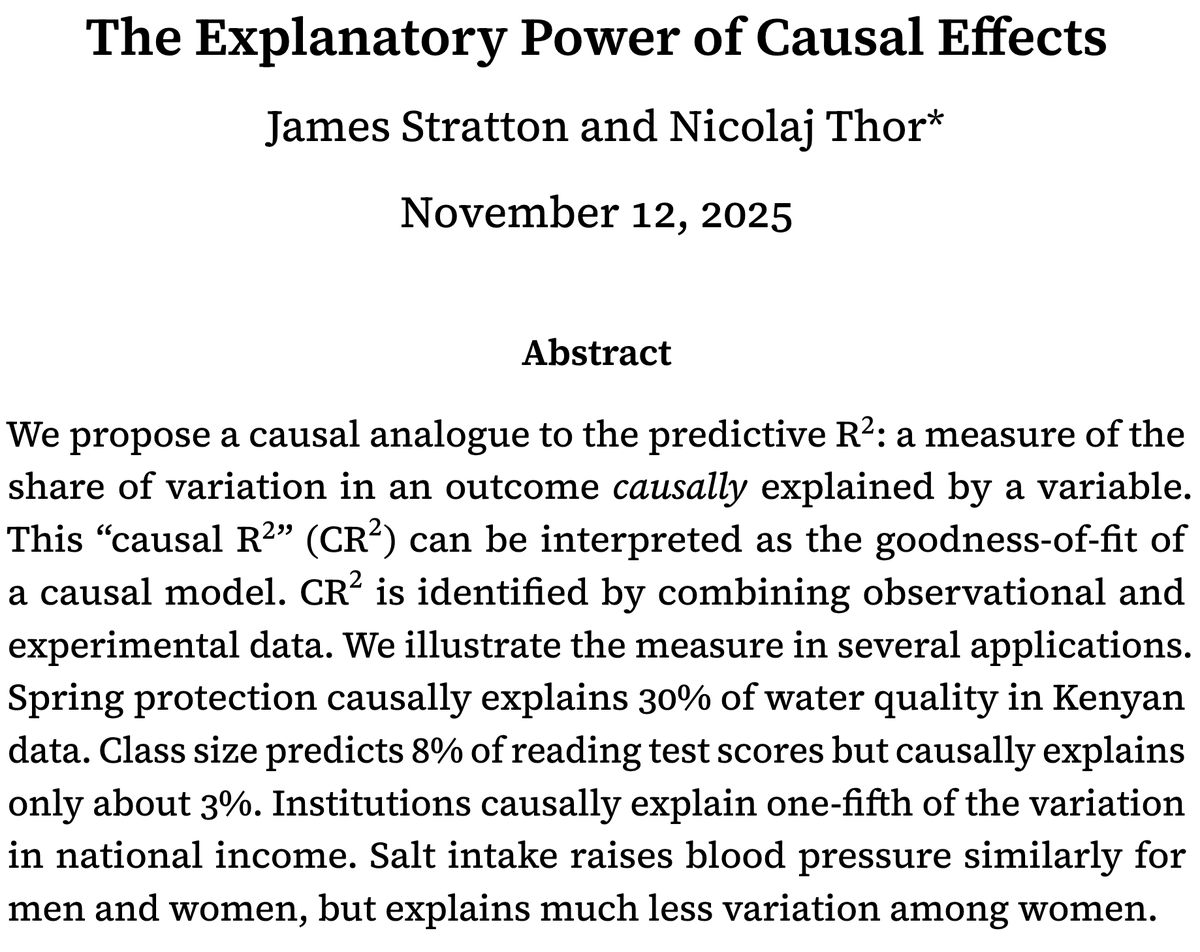
@jamespstratton and I put out a working paper a few days ago on exactly this question! We propose a way to answer it using a simple causal analogue of the R² ("Causal R²").🧵(1/12). Paper: drive.google.com/file/d/1FWNLf7…
Nicolaj Thor tweet media
Arpit Gupta@arpitrage

A lovely post. In addition the the causal inference revolution, we now need a "variance explained" revolution which focuses on understanding what drives the variation in the world we see around us

English
3
59
236
65.4K
Kevin A. Bryan
Kevin A. Bryan@Afinetheorem·
@danielrock 100%. It might be worth doing some kind of event where we get a few teams of economists and 48 hours to write a complete, publishable, interesting, novel paper, from data gathering on down. A group that understood how to build the scaffolding can do it today; I'm 100% sure.
English
2
0
8
454
Daniel Rock
Daniel Rock@danielrock·
As with other areas, good AI practices are often just good practices. Coding with AI will expose other faults quickly. And 55% should be disappointing once you get Claude code or codex to cook properly. See if you can get a month of work done in a day.
MIT Sloan Management Review@mitsmr

Generative AI tools can make developers up to 55% more productive, but rapid deployment creates dangerous technical debt. To avoid costly system failures, organizations must establish clear guidelines, make technical debt management a priority, and train developers to use AI responsibly. t.co/HYJ2Gqxmpq

English
1
1
31
10K
Namrata Narain retweetet
Rick Hornbeck
Rick Hornbeck@Rick__Hornbeck·
Hi all, please spread the word and we hope everyone can make good use of this new data drop: CMFdata.org The full surviving establishment-level Census of Manufactures manuscripts from 1850, 1860, 1870, and 1880!
English
5
123
345
61K
Namrata Narain retweetet
Olivier Blanchard
Olivier Blanchard@ojblanchard1·
With all my admiration for Philippe Aghion’s work on the importance of innovation (what he has done with Peter Howitt in the 1990s and what he does these days with his collaborators at the College de France is essential theoretical and empirical work), a caveat. An economy can grow without being at the frontier. Indeed, most economies in the world are not at the frontier. And most have experienced substantial growth. More important than being at the frontier, is to be able to use these new technologies in the rest of the economy. This puts the focus on other aspects, the organization of the labor market, bankruptcy codes, a new type of education, etc. Less exciting project than new AI centers, but probably more important. An analogy. It is nice to be ahead during a bicycle race. But it is easier to be just behind, protected from the wind by the racer who is ahead. One ends up second, but still with an impressive time. If Europe can be first, then all means let us try. If not, let’s make sure we are a close second.
English
28
199
1.1K
317.9K
Namrata Narain retweetet
Patrick Collison
Patrick Collison@patrickc·
Congratulations to Joel Mokyr! A terrifically deserving winner. Read *A Culture of Growth* if you haven’t.
English
23
46
852
112.6K
Namrata Narain retweetet
The Nobel Prize
The Nobel Prize@NobelPrize·
Say bonjour! This snapshot from one of our newest laureates in economic sciences was taken just after receiving the news. Stay tuned for our telephone interview with Philippe Aghion. #NobelPrize Photo: Mikhaela Aghion
The Nobel Prize tweet media
English
32
126
830
163.4K
Namrata Narain retweetet
Violet
Violet@buxwal·
1/ OPT OBSERVATORY I’ve spent the past year creating *the most in-depth public resource* on how the US retains international students after they graduate. Today, @IFP is releasing never-before-seen data we obtained from ICE via FOIA. Check it out: optobservatory.org
Violet tweet mediaViolet tweet mediaViolet tweet media
English
18
96
347
88.5K
Namrata Narain retweetet
Luis Batalha
Luis Batalha@luismbat·
Age of Nobel Laureates by Category (1901–2025)
Luis Batalha tweet media
English
19
72
429
92.4K
Namrata Narain retweetet
Martha Gimbel
Martha Gimbel@marthagimbel·
New from me @Mollykinder Josh Kendall and Maddie Lee: how should we be tracking the impact of AI on the labor market? Tldr: no signs of major disruptions yet, but we plan to update our trackers monthly 1/
English
4
27
64
48.7K
Namrata Narain
Namrata Narain@nummoose·
@Afinetheorem @paulnovosad Will definitely try it. ChatGPT has become like uber to me. Felt shockingly crippled when 5 came out and it was doing basic things weirdly. Thanks for the suggestion!
English
0
0
1
157
Kevin A. Bryan
Kevin A. Bryan@Afinetheorem·
@paulnovosad @nummoose If you write code and have Pro, I cannot tell you how much better CLI with Codex is. Takes some getting used to (incl. on your own evaluation process), but so so so good.
English
2
0
4
452
Paul Novosad
Paul Novosad@paulnovosad·
I find GPT5 "thinking" to be much less clear than o3 was. Responses are full of jargon, shorthand, much harder to use and interpret. It's like talking to someone who wants to show off his expertise but doesn't really want to help. Is it just me?
English
32
4
297
61K
Namrata Narain retweetet
Laura Veldkamp
Laura Veldkamp@laura_veldkamp·
Claudia Goldin at Jackson Hole says: You want more children, then promote gender equality. When men help out at home, women have more babies. #JacksonHole #econtwitter
English
27
28
216
28K
Namrata Narain
Namrata Narain@nummoose·
Q for scientist friends. I downloaded data on scientific publications from OpenAlex. Seems like a journal called FASEB is a really popular destination for NIH-funded science. FASEB seems to have more than tripled in size in the last 10ish years. Any leads on why FASEB is special?
English
0
0
0
460
Namrata Narain
Namrata Narain@nummoose·
Wow, this team of people continues to be amazingly innovative in reorganizing and identifying innovation research!
Matt Clancy@mattsclancy

What’s the return on government support for R&D? To try to get a credible answer, @open_phil and @SloanFoundation are committing up to $1 million to trying something new: we call it a Pop-Up Journal. Today, we’re inviting organizations to bid on a five-year contract to organize and run this Pop-Up Journal on the returns to public R&D: popupjournal.com The journal will publish several issues and then sunset after five years. Each issue seeks to make progress on one question: what’s the ROI on public funding for R&D? To that end, it will be one home for new research on the topic. Each issue will lead with an essay, accessible to non-specialist policymakers, that assesses the probability that the ROI of public R&D takes on specific values, based on a synthesis of all relevant work (including work published elsewhere). We expect it will also publish work that helps answer its main question, but isn’t a good fit for a typical journal: replications, reanalyses, new datasets, etc. Each issue’s synthesis essay will help make these contributions legible. What else will it do? That's could be up to you! We welcome ideas from organizations interested in running the journal. What if you’re a researcher interested in this topic? Several funders have expressed interest in supporting this kind of research. More details at popupjournal.com/individual-res…. The five-year contract is designed to give researchers time to start and finish new projects. Finally: we think Pop-Up Journals can be a useful way to help the academic community coordinate on answering big questions of all kinds and communicate those answers to the policy world. This Pop-Up Journal is only the first we plan to support. We are lucky to be supported in this initiative by a fantastic advisory board that will help us select the winning bid for this journal and select the big questions for future Pop-Up Journals: Matt Clancy (@mattsclancy) Doug Elmendorf Ted Gayer Danny Goroff (@DGoroff) Jonathan Haskel (@haskelecon) Margaret Levi Paul Niehaus (@PaulFNiehaus) Heidi Williams (@heidilwilliams_)

English
0
1
5
1.3K
Namrata Narain retweetet
Nicholas Decker
Nicholas Decker@captgouda24·
"Floods", by @dev_a_patel, is one of the more astounding Big Data econ papers I have ever seen. Machine learning can be used on satellite data to essentially do magic. How damaging are floods? How much do they affect human capital attainment? A thread on the paper 1/
Nicholas Decker tweet media
English
10
98
597
59.1K