

Daniel Rock
2.6K posts

Daniel Rock
@danielrock
Asst. Prof. in OID @Wharton @Penn. Cofounder @workhelix. Everyone can just do stuff and that's {good, bad}. I study the economics of AI.
Philadelphia, PA Katılım Aralık 2008
2.2K Takip Edilen5.7K Takipçiler


"feels like David Blaine showing us how he does his magic tricks"

Charles 🎉 Frye@charles_irl
Read about this and more of @modal's secrets to fast container starts on our blog. modal.com/blog/truly-ser…
English

@danielrock This is how I imagine Aaron Judge plays golf
English
@GZilgalvis Of course this is pedantic but if you’re gonna do a levered bet on this don’t use calls! That’s paying for volatility value. Borrowing money and buying the index is more efficient for getting directional exposure.
English

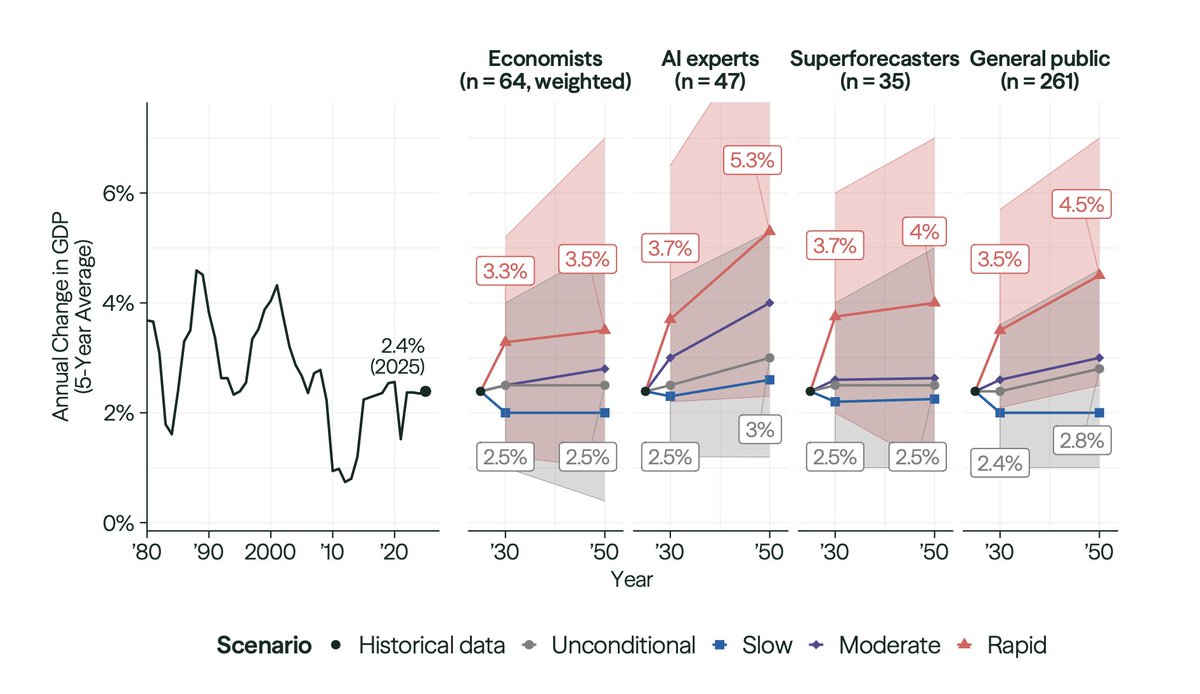
Forecasting the Economic Effects of AI: nber.org/papers/w35046
English
Here's a trade. Fifteen economists surveyed other economists about AI and concluded U.S. GDP growth would be modestly elevated through the early 2030s, with a tail of much faster growth. Translating their forecasts to equity prices implies the S&P 500 around 11,000 in late 2031 vs. 8,000 today. The SPX 15,000 calls expiring December 19, 2031 trade for about $130, implying roughly 40% annualized returns if the economists are right, and 10x upside if AI starts writing Pulitzer novels and replacing the paralegals.
English
Daniel Rock retweetledi

Neural networks do math by rotating shapes.
We found a shape-rotating calculator hidden inside an LLM – and it’s used for more than just math! (1/6)
Goodfire@GoodfireAI
Neural networks might speak English, but they think in shapes. Understanding their rich *neural geometry* is key to understanding how they work – and to debugging and controlling them with precision. Starting today, we’re releasing a series of posts on this research agenda. 🧵
English
Daniel Rock retweetledi


Daniel Rock retweetledi

it should be completely illegal to have a medical test that doesn’t tell you
p(positive result | nothing is wrong) and p(positive result | something is wrong)
as part of the results
English
Daniel Rock retweetledi

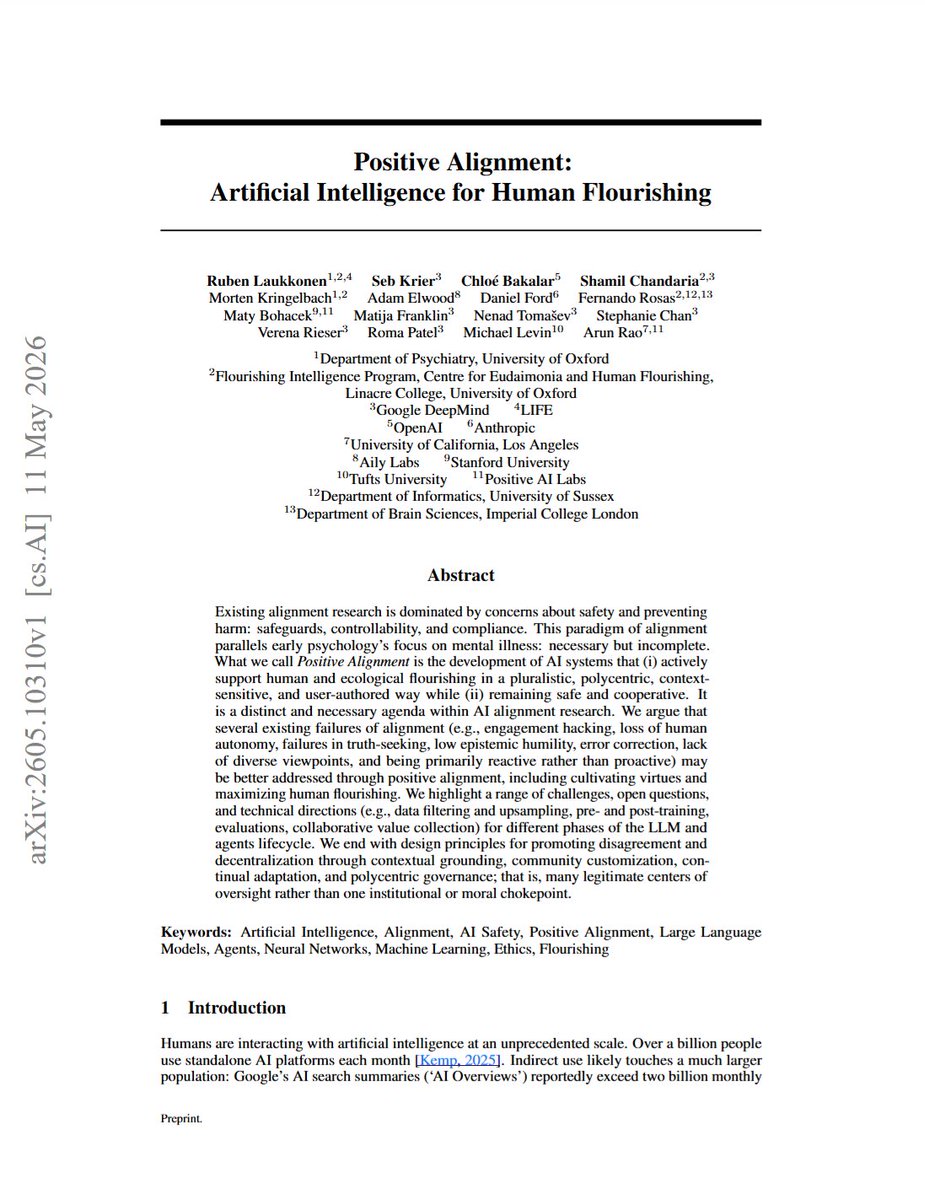
If anyone builds it, everyone thrives. Over the past decade, a lot of important work on AI alignment has focused on avoiding harm. But freedom from harm isn't the same as freedom to flourish.
In this paper, we introduce 'Positive Alignment'. A positively aligned agent is one that helps us navigate our own value trade-offs, builds our resilience, and acts as a scaffold for human flourishing. Doing this without slipping into top-down, technocratic paternalism is the great design challenge of our time.
We think a lot more research is now needed to explore this frontier: how do we align models that actively help us thrive?
Amazing work by @RubenLaukkonen, @drmichaellevin, @weballergy, @verena_rieser, @AdamCElwood, @996roma, @FranklinMatija, @shamilch, @_fernando_rosas, @scychan_brains, @matybohacek, @sudoraohacker, and others.
arxiv.org/abs/2605.10310
English
Daniel Rock retweetledi

I invested in a chip manufacturing plant, T. Got a great deal from the guy, name is Lays.

English
Daniel Rock retweetledi

Update: Socket has found 121 more compromised npm package artifacts across 84 package names, including 64 UiPath artifacts.
Combined w/ TanStack, the current known total is 205 affected npm package artifacts across enterprise automation, AI/MCP, auth, workflow, and dev tooling.
Socket@SocketSecurity
🚨 BREAKING: 84 TanStack npm packages were compromised in an ongoing Mini Shai-Hulud supply chain attack, adding suspected CI credential-stealing malware. Socket flagged every malicious version within six minutes of publication. This is a developing story.
English
Daniel Rock retweetledi

🚨 There's a major attack going on via npm right now.
Do not install any packages right now.
Talk to your agent ASAP and check if you're vulnerable or have been compromised.
This is urgent ‼️
International Cyber Digest@IntCyberDigest
‼️🚨 UPDATE: The TanStack npm attack is now a full campaign. 'Mini' Shai-Hulud has hit: - OpenSearch - Mistral AI - Guardrails AI -UiPath - Squawk packages across npm and PyPI The malware specifically targets AI developer tooling. It hooks into Claude Code (.claude/settings.json) and VS Code (.vscode/tasks.json) to re-execute on every tool event, long after the infected package is gone. npm uninstall does not fix this.
English
Daniel Rock retweetledi

Occupational exposure metrics are useful & important, but they sometimes disagree & they may not measure vulnerability to displacement well.
I increasingly think AI *adoption* rates are just as important for monitoring labor market effects as *exposure* rates.
Alex Imas@alexolegimas
Very interesting paper. Squares with my own thinking with @soumitrashukla9 that many “low exposure” jobs may be more at risk due to the nature of the tasks involved. open.substack.com/pub/aleximas/p… H/t @ben_golub
English
@EduardTalamas @johnjhorton The idea is to highlight what markets are for and why the critiques of very old Econ are really attacking strawmen. Once they get the distributed knowledge problem they start thinking about opportunities.
English
@EduardTalamas @johnjhorton I teach this (we spend 20min on it before getting to markets-as-tools). The MBAs read Hayek (1945) and this: crookedtimber.org/2012/05/30/in-…
English

Designing an MBA elective on "The Economics of Transformative AI".
Gemini is trying to school me about my own game.
Is it right?

English
@alexolegimas @ben_j_todd @benleo_econ agreed w/Alex. I think the sense among economists is that this is akin to other tech like computers, internet, etc. in pervasive potential to change work.
English

@ben_j_todd @benleo_econ Would be curious to hear your take. I think most economists predict large changes/displacement, just slower than what technologists predict ( ie not 6-12 months).
English

AI job displacement:
Overrated by technologists, underrated by economists.
English
Daniel Rock retweetledi

I wrote a new mini essay about productivity gains from AI and rearchitecting work, like factories with electricity. Thanks to @Afinetheorem, @danielrock, @ChadJonesEcon, @BharatKChandar, @ejames_c and Roger Ison for reviewing.
"The Dynamo and The Language Model"
* It took 40 years after electricity came to factories for the benefits to show up in the productivity statistics
* Why? Because at first, people took the new tool and just subbed it in for the old tool. Swap the steam engine in the middle of the factory for an electric engine
* It was only when the factory was redesigned from the ground up around the new tool that the big benefits arrived
* Instead of one big motor in the center, lots of little motors on different machines. The whole factory had to be redesigned, needed new architects, new training, new electricians
* The benefits of a general purpose technology (like electricity) require re-organization of work around the benefits and drawbacks of the new tool, and the development of various complementary innovations (new electricians, new factory designs, new management methods, etc)
Language models are the same. Taking old workflows and adding in LLMs won’t give the big benefits.
The big benefits require re-organizing work.
People aren’t just learning how to work with AI interfaces (like ChatGPT, Claude, Codex, Cowork) and how to interact with models (GPT, Opus, etc), they’re also learning how to re-architect their work and workflows. This is much harder!
This pattern is old: see Chandler re railroads, David/Devine re the dynamo, McLean and Levinson re the shipping container, Brynjolfsson and Hitt re the PC, and Brynjolfsson, Rock, Syverson re AI.
Therefore, what’ll happen is that a) some groups will figure out how to re-architect their work sooner and get more benefits and b) everyone will be somewhat bottlenecked by the collective figuring this out so that the necessary co-inventions get discovered.
(These historical episodes also suggest that the transition can take longer than people anticipate!)
What do you do about it as an individual?
1. Log tasks: log tasks for 1-2 weeks and see exactly what you do. Also log the underlying goals or jobs to be done.
2. Invert assumptions: list all of your assumptions around your work, and then try on the inversions of those assumptions.
3. Many experiments: the territory has changed, and you can figure out what’ll work faster with more small experiments.
4. Peer groups: meet in person with your peers, show what you’re doing, and watch what they’re doing.
5. Format your work for models: get API keys for the tools you use. Try to do your work in the terminal or a CLI.
On experiments: AI is cheaper to experiment with than many prior technologies, and it's also changing quickly, so continuous experimentation is valuable!
And, what do you do about it as an AI lab?
This is a diffusion of knowledge problem. It’s messy workflow knowledge. Tacit knowledge.
Getting the full benefits of AI requires re-organizing work to suit the benefits of AI. AI labs benefit when more companies can do this!
What’s needed is Julia Child, Bob Ross, or surgical residencies. First find the people who've already redesigned their workflows to suit AI, and then capture the full end to end process, with videos. Not little excerpts. Over the shoulder, high fidelity, unedited videos. Experts (for example, SWEs at AI labs) showing how they’re working, and narrating their internal cognitive processes. Users are learning products, models, *and* workflow re-organization.
Privacy is of course a concern, so it should be them working on a non-secret side project.
Show the screen, their face, their body language, the context. Perhaps 45 minutes without cuts. A trained observer asking questions like 'What did you notice there?' 'What did you expect?'. Show what works, show what doesn't work.
Without this, what'll happen is that expertise will diffuse more slowly, and will be more concentrated. Find people at the frontier, film what they're doing, distribute that video, repeat every few months. This could help the frontier diffuse faster.
English
Daniel Rock retweetledi

A Polish engineer, Tomasz Patan, built the Volonaut Airbike, basically a real-life Star Wars speeder bike. Reaches up to 124 mph. Insane
English
This seems like it belongs in the wasteland of a Fallout game
Cameron@just_cameron
San Francisco is a deeply unserious place
English