

T RZ Tayeb
11.9K posts

T RZ Tayeb
@primedark562
━━━━━━ ♡ ━━━━━━━━━━━━━━━━ Testnet Degen, Web3 Explorer, Yapper ━━━━━━ ♡ ━━━━━━━━━━━━━━━━
Beigetreten Mayıs 2023
3.3K Folgt1.2K Follower

🍩 Crypto Payments Are Now Live for D0
For a long time, accessing online services meant relying on traditional payment methods.
D0 is changing that.
Users can now subscribe and pay directly with crypto.
A small update on the surface, but an important step toward a more crypto-native experience.
Crypto payments eliminate unnecessary friction for users who already live and operate in Web3.
Instead of switching between ecosystems, users can now access D0 using the assets they already hold.
The onboarding process is intentionally simple:
• Visit the onboarding page
• Select Crypto as your payment method
• Complete the transaction
• Start using D0
No extra complexity.
What stands out most is the reason behind this launch.
The D0 team didn't introduce it out of nowhere.
The update came directly from community demand.
"You asked for it. We built it."
That kind of builder-user feedback loop is what helps products evolve in the right direction.
Crypto payments are becoming an expected feature for platforms serving global and decentralized communities.
They offer greater accessibility, broader reach, and a smoother experience for users across different regions.
As Web3 adoption grows, native crypto payment options will likely become standard rather than optional.
D0 is already moving in that direction.
🍩 Let's DONUT.

English

Everyone talks about scaling execution.
Very few talk about scaling communication.
One thing I have realized about blockchain scaling is this.
Execution is only one part of the equation.
Communication matters just as much.
Every transaction, block, and state update depends on information reaching the right nodes at the right time.
That is where @get_optimum comes in.
Its decentralized networking infrastructure improves how data is distributed across blockchain networks.
• faster propagation
• lower latency
• more efficient bandwidth use
• stronger network performance
The future of scaling is not just about faster execution.
It is about building communication layers that allow the entire ecosystem to coordinate more efficiently.
Gmum
@shariaronchain

English

𝗕𝗿𝗲𝗮𝗶𝗸𝗶𝗻𝗴 𝘁𝗵𝗲 𝗕𝗼𝘁𝘁𝗹𝗲𝗻𝗲𝗰𝗸 : 𝗪𝗵𝘆 𝗕𝗹𝗼𝗰𝗸𝗰𝗵𝗮𝗶𝗻 𝘀𝗽𝗲𝗲𝗱 𝗶𝘀 𝘁𝗵𝗲 𝗨𝗹𝘁𝗶𝗺𝗮𝘁𝗲 𝗦𝗲𝗰𝘂𝗿𝗶𝘁𝘆 𝗙𝗲𝗮𝘁𝘂𝗿𝗲
We’ve all been there waiting for a Web3 transaction to clear while staring at a spinning wheel. In the decentralized world, we demand two things above all else instant execution and ironclad security. Yet, as networks expand, they traditional hit a wall. That wall is block propagation latency.
When nodes struggle to stay in sync, the entire ecosystem stalls, opening the door to security risks.
Enter Optimum Network (@get_optimum). They aren't just tweaking the existing system; they are fundamentally redesigning Web3 communication from the ground up using Random Linear Network Coding (RLNC).
The Tech Shift: Enter Random Linear Network Coding (RLNC)
Standard blockchains rely on rigid, step-by-step data transfers that easily clog during high traffic. RLNC changes the game by mathematically optimizing how data packets are coded and distributed. Instead of waiting for a sequential line of data, nodes can reconstruct information dynamically.
This architectural evolution delivers four massive upgrades to decentralized infrastructure:
Zero-Grip Throughput: By dismantling traditional packet bottlenecks, data moves across the network at maximum velocity with virtually zero lag.
Flawless Node Harmony: Real-time synchronization ensures every single node across the globe stays updated on the state of the ledger simultaneously
Hardened Network Defense: A faster network leaves no idle windows or structural gaps for malicious actors to exploit. Security is baked into the speed.
Chaos-Proof Scalability: Whether experiencing a massive traffic spike or an unexpected network surge, the infrastructure remains stable without sacrificing performance.
The New Paradigm: Velocity is the Best Weapon
In Web3, coordination speed isn't just about convenience it is the ultimate defense mechanism. The quicker nodes can talk to one alone, the harder the network is to compromise.
Optimum Network isn't just launching another layer they are laying down a bulletproof, ultra fast foundation designed to power the next generation of DeFi and scalable Web3 infrastructure.
@shariaronchain

English

People Underestimate How Noisy Crypto Data Actually Is
you're not tracking one market.l
you're tracking three layers simultaneously:
→ Price action
visible to everyone, understood by few
→ Market signals
fast moving, easy to misread
→ Portfolio risk
ignored until it's too late
combining them manually isn't a strategy. It's exhaustion
and even if you track all three perfectly
your brain still fails you
crypto demands hundreds of micro-decisions daily
that's decision fatigue at scale
most people don't lose because of bad data
they lose because of mental overload
this is where most AI crypto tools get it wrong
more dashboards
more indicators
more alerts
they mistake complexity for intelligence
what actually matters is the opposite
take overwhelming data → make the answer obvious
that's what RAFA AI is building
√ multi-timeframe scores
√ hedge alerts
√ zero noise
the real test for any AI investing tool:
does it reduce your cognitive load or increase it?
in a market this noisy, that's harder than it sounds
worth watching :)
@Metamorfozzz_ @Zlatanair @srsh_os @RAFA_AI
English


The memecoin meta moves at lightning speed, but complex onboarding kills the hype. Not anymore.
We are thrilled to officially partner with @MemeLabzdotfun to eliminate all user friction. Powered by @QwertiAI DeFAI infrastructure, users can now bypass the fragmented UX and gain instant access to the $LABZ ecosystem—whether swapping with crypto or buying directly via card.
No multi-app confusion, no network juggling. Just pure, instant on-chain action right where the community is.
The lab is fully open, and it's time to cook.
@Web4Sunny
@__Soniiiaa

English

Speed is money, but in blockchain it's infrastructure.
Every millisecond saved in data delivery improves network coordination.
That's why Optimum accelerates information flow, helping decentralized systems become more responsive, efficient, and scalable.
🧵 Thread below

English

Here’s a quick demo of how D0 helps with market analysis, trade setups, and research without jumping between multiple tools.
Honestly, this is something every trader in this space should be paying attention to!💜
@DonutAI
English

spent some time digging through donut and one thing kept standing out to me.
most crypto products today are still built around the assumption that users want more control.
better dashboards.
more charts.
more data.
more tools.
but the weird part is… traders already have too much information.
the problem isn’t access anymore.
it’s processing everything fast enough to actually make good decisions.
that’s why donut feels interesting.
they’re not just stacking trading features inside one product.
they’re reducing the amount of decision friction between seeing an opportunity and acting on it.
what made me look deeper wasn’t even the execution layer.
it was their constant focus on validation.
checking outputs.
flagging fabricated contract addresses.
verifying information before transactions happen.
because in crypto, mistakes don’t stay theoretical.
one wrong input and funds are already moving.
feels like donut understands something a lot of teams ignore.
speed matters.
but correctness matters more when capital is involved.
and products that solve both usually end up defining the category.
@DonutAI

0x_Mîtå@0xMita_
been looking deeper into donut and one thing stood out immediately. they’re not trying to build a better trading app. they’re trying to remove the trader from half the workflow. think about how crypto works today. you discover narratives on x. check charts somewhere else. open wallet. track price action. monitor risk manually. execute manually. constantly switch tabs. constantly react. donut’s bet feels bigger than people realize. what if the future trader doesn’t interact with markets directly anymore? what if users simply define intent and agents handle discovery, decision making and execution underneath. that changes everything. because the biggest bottleneck in crypto isn’t infrastructure anymore. it’s human attention. and very few teams seem to be building for that reality. @DonutAI
English

What Optimum Enables Next Gen dApps
Most blockchain applications exist today despite latency constraints, not because they have solved them.
DeFi, trading, gaming and payments are all running on infrastructure that is still too slow for what they are trying to do.
@get_optimum helps reduce this constraint here's what gets unlocked.
The latency ceiling has been invisible to most builders because they have never experienced a world without it.
Centralized sequencers, offchain matching and trusted intermediaries have become so normal that they are treated like design choices.
They are workarounds and fixing the data layer removes the need for many of them.
Central Limit Order Books onchain.
Order book markets require sub-100ms matching to be competitive with CEXs.
Most existing L1s and L2s still struggle to provide this at decentralized network scale.
With mump2p's ~150ms global block propagation and ~7x lower latency variance, onchain CLOBs become more viable without relying on centralized sequencers for matching speed.
High frequency and algorithmic trading onchain.
Trading strategies that depend on detecting and acting on price movements within a single block window are currently not viable in fully decentralized settings.
Faster and more consistent block propagation shrinks the gap between onchain and offchain execution environments. it makes sophisticated strategies more realistic without CEX infrastructure.
Decentralized gaming with persistent shared state
Games require real time shared state like player positions, inventory, scores and outcomes.
Onchain games today either freeze game critical state offchain or accept second long update delays.
DeRAM, Optimum's decentralized RAM layer, aims to enable faster read/write access to onchain shared state.
The gameplay experience can move closer to native multiplayer without trust assumptions.
AI inference onchain.
AI models running against live blockchain data like prices, liquidity and onchain events currently require centralized infrastructure to meet latency requirements.
With a low latency decentralized memory layer, AI agents can read chain state, update models and execute decisions in timeframes that competitive use cases require.
Global payments infrastructure
The payment rails promise of blockchain has always been held back by confirmation latency.
Sub second finality is a key threshold for merchant acceptance at point of sale.
Faster propagation can compress time to finality without requiring new consensus mechanisms, just a data layer that moves blocks quickly enough to make existing finality windows feel instant.
Social applications onchain.
Social interactions require sub second feedback.
Like, post and follow all currently simulate real time by routing through centralized servers.
With faster propagation and real time onchain state access via DeRAM, social state can live fully onchain without the latency that makes decentralized social feel broken.
DePIN and IoT data streams.
Decentralized physical infrastructure networks generate continuous real time data like sensor readings, location pings and compute telemetry.
Onchain settlement of this data requires propagation fast enough that the data is still actionable when it arrives.
mump2p's latency profile helps make real time DePIN settlement viable at scale.
The common thread is simple.
Every category above is currently limited by propagation, not by blockchain's fundamental design.
The applications are not impossible. the infrastructure layer was just too slow.
Fixing the data layer is a horizontal unlock.
Every use case that ever cited latency as a constraint benefits at the same time.
The world computer gets its memory layer.

English

Measuring mump2p Performance: What the Numbers Show
The performance gains delivered by Optimum’s mump2p are not based on a single improvement they come from a combination of optimizations that can be measured across several key network metrics.
One of the most important is block propagation time, which measures how quickly a newly produced block reaches the majority of nodes in the network. By leveraging RLNC, mump2p enables blocks to spread more efficiently, reducing delays and improving overall network responsiveness.
Another critical metric is attestation propagation latency. For validators, timely attestation delivery is essential, as attestations must be seen by other validators within strict time windows. Faster propagation increases the likelihood that attestations arrive on time, helping validators participate more effectively in consensus.
The same advantages extend to the mempool, where transaction propagation speed directly affects user experience. When transactions reach validators faster, they can be included in blocks sooner, resulting in lower waiting times and a more responsive network for end users.
For Layer 2 ecosystems, blob propagation reliability is equally important. Rollups depend on blobs reaching the network before submission deadlines, and packet loss can create unnecessary risks. RLNC’s built-in loss tolerance provides an additional reliability margin, increasing the chances that blobs are delivered successfully even under less-than-ideal network conditions.
Each of these improvements has practical consequences for validators, node operators, rollups, and application users. Faster propagation reduces uncertainty, improves coordination across the network, and helps critical information reach its destination when it matters most.
Taken together, these gains create a measurable improvement over traditional gossipsub-based communication. Rather than optimizing a single aspect of network performance, mump2p enhances multiple layers of the propagation process simultaneously. The cumulative effect is a faster, more reliable, and more scalable networking layer one that delivers tangible benefits in real-world production environments.
@shariaronchain @marurlemo

English

Why does blockchain scalability depend on data movement?
@get_optimum focuses on a challenge that is often overlooked when discussing blockchain scalability: the movement of data across the network.
While scalability is frequently associated with transaction throughput and execution speed, blockchain performance also depends on how quickly information can reach participating nodes.
1. Every Node Needs Access to the Same Information:
Blockchain networks operate through distributed coordination.
Block Distribution: When a validator produces a block, that information must be propagated throughout the network before other participants can verify it.
Transaction Sharing: Transactions are continuously exchanged between nodes to maintain a consistent view of the network state.
Network Synchronization: Consensus becomes more efficient when nodes receive data within a similar timeframe.
As networks grow, distributing information quickly becomes increasingly challenging.
2. Data Movement Becomes More Difficult at Scale :
Higher adoption introduces greater communication demands.
Growing Network Size: More nodes mean more destinations that must receive blocks and transactions.
Increased Traffic Volume: Larger ecosystems generate more data that must be propagated across the network.
Propagation Delays: Information can take longer to reach distant nodes, creating temporary differences in network visibility.
Even if a blockchain can process transactions efficiently, delays in data delivery can limit overall performance.
3. Scalability Requires Efficient Communication Infrastructure :
Improving execution alone does not solve every bottleneck.
Faster Distribution: Networks benefit when blocks and transactions reach participants more efficiently.
Reduced Communication Overhead: Optimized transmission methods can improve propagation without requiring additional resources.
Better Network Coordination: Faster data movement helps nodes stay synchronized as activity increases.
This is where infrastructure focused on data transport becomes increasingly important.
Blockchain scalability is not only about processing more transactions.
@get_optimum it is also about ensuring that the information required to process those transactions can move efficiently across the entire network.

English
Happy Monday homies
Let's talk about Anti Detect Browser and Profiles System today.
You know Donut Browser also works as an anti detect browser.
It allows users to create multiple isolated browser profiles. Each profile has:
➥Separate cookies
➥Separate storage
➥Separate settings
➥Unique browser identity
This means each profile behaves like a different device.
It is useful for managing multiple accounts or separating different workflows without cross tracking between sessions.
gDonut

English
𝐅𝐫𝐨𝐦 𝐋𝐚𝐭𝐞𝐧𝐜𝐲 𝐭𝐨 𝐋𝐢𝐠𝐡𝐭𝐧𝐢𝐧𝐠 𝐒𝐩𝐞𝐞𝐝. 𝐓𝐡𝐞 𝐍𝐞𝐱𝐭 𝐆𝐞𝐧 𝐨𝐟 𝐁𝐥𝐨𝐜𝐤𝐜𝐡𝐚𝐢𝐧 𝐈𝐧𝐟𝐫𝐚𝐬𝐭𝐫𝐮𝐜𝐭𝐮𝐫𝐞.
Whenever we interact with Web3 networks, our priorities are simple: speed and security. However, as decentralized networks scale, they inevitably hit a major bottleneck—block propagation delays, commonly known as network lag or latency. When nodes take too long to sync, transactions slow down, and critical security vulnerabilities emerge.
This is exactly the core issue that @
@get_optimum is tackling head-on. By introducing RLNC (Random Linear Network Coding), they are entirely rewriting the rules of blockchain resilience.
How RLNC is Upgrading Web3 Infrastructure
Instead of relying on traditional, linear data transfers that choke under heavy loads, RLNC optimizes how data is coded and transmitted across nodes. Looking closely at the architecture breakdown, Optimum delivers on four massive pillars:
1/Faster Propagation: No more waiting around. It eliminates packet bottlenecks to achieve maximum throughput with minimal lag.
2/Better Synchronization: Real-time block delivery ensures that all nodes across the ecosystem stay updated simultaneously.
3/Stronger Security: Resilient by design and secure by default. There are no loose ends left for malicious actors to exploit.
4/Greater Network Resilience: Even under extreme network traffic or sudden volume spikes, the infrastructure maintains top-tier performance without breaking a sweat.
The Golden Rule: Faster Coordination = Stronger Security
In a truly decentralized ecosystem, communication speed equals safety. The faster the nodes can coordinate, the harder it is for the network to be compromised. Optimum Network isn’t just building another chain; they are establishing a bulletproof, lightning-fast foundation for the future of DeFi and decentralized scaling.
@get_optimum
@shariaronchain

English

One of the biggest issues with blockchain to me is privacy. In fact, we all want our financial information or transaction details to be kept private. But it has long been seen that getting good privacy requires a lot of hassle using multiple wallets, complex routing, or expensive solutions. As a result, those with more resources can enjoy relatively more privacy.
I think privacy should not be a luxury. Just as we want personal information to be protected on the Internet, blockchain needs to be equally secure for everyone. Whether a person transacts $10 or $10,000, both are entitled to the same protection.
This is why I find the concept of @FlutonIO interesting. By using FHE (Fully Homomorphic Encryption) they are trying to show a direction where privacy can be accessible not only for big investors or tech experts, but also for ordinary users.
We often talk about decentralization in blockchain, but privacy is equally important. Because if people always think their every move is visible to everyone, then true financial freedom is not achieved.
In the future I would like to see a Web3 ecosystem where privacy is a default feature, not a premium feature to be purchased separately. The real purpose of technology should be to give equal opportunities to everyone, not just the big players.

English

Data distribution has changed from past times. In the past times, very few people knowing the value of their data.
-----------------------------------------
They became more concerned about it from last few years.
We are seeingai companies reached billions and trillions of dollars valuation.
Why they are so much hyped ? Cause we know AI is currently the only thing which can help the human's to grow.
And "AI depends on data".
Nobody wants to share their private data to companies, cause it's there own IP.
For building an AI economy, companies need quality data, whether it's-
> Real human knowledge
> Real life experiences
> Actions & expertise
IP sits on the middle of companies and people.
IP determines it, without this platforms own and use it freely without any concern.
With IP, people own it-> share ownership with their own will-> gets a share.
>>>>>>>>>>>>>>>>>
We have to admit that "Future AI economy is not going to built on free data".
It is going to build where
People create IP-> owns it-> ai companies use it-> gives something as compensation.
Numo is working on this same feature.
The future will depend on who connects better (people and companies)
{ Human intelligence ↔ Ownership ↔ AI demand }
@StoryProtocol


English
English

Huge congratulations to the newest Story OGs and adepts💗
From educating communities and hosting Spaces to building, supporting, and staying consistent for months each of you has earned this recognition through dedication and impact.
👏 @khairun4491
👏 @hayxenxt
👏 @Siyam_Ahmed17
👏 @surojitpvt
👏 @Smith_creator
The OG title isn't just a badge it's proof of commitment, perseverance, and belief in the Story vision.
Well deserved.

Story@StoryProtocol
It's been a while since we last welcomed new OGs. The work hasn't slowed down. Meet this week's newest additions ↴
English
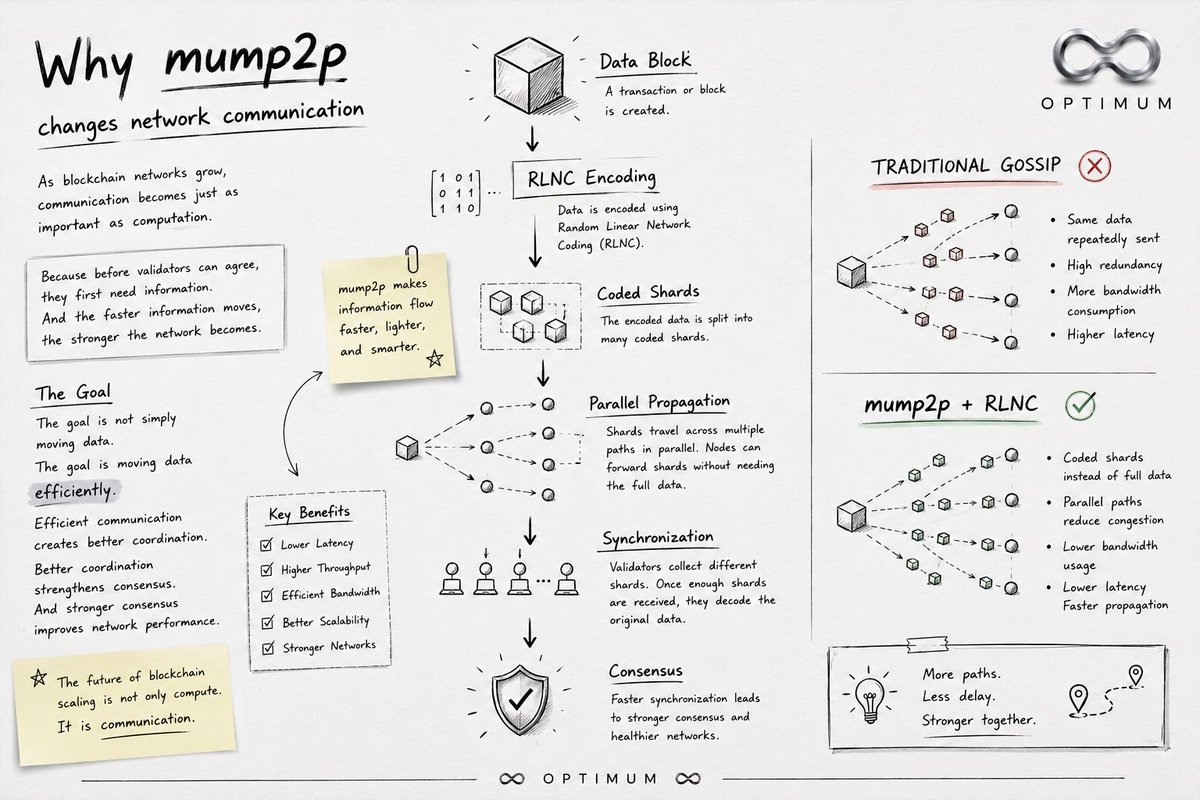
Why mump2p changes how networks communicate
Blockchains do not struggle because of computation alone.
They struggle because information takes time to move.
Before consensus happens,
data must reach validators.
And when data moves slowly,
the entire network slows down.
This is where mump2p comes in.
Traditional gossip protocols repeatedly send the same data across the network.
mump2p takes a different approach.
Instead of forwarding identical messages,
it encodes data into smaller coded pieces using Random Linear Network Coding (RLNC)
Validators can begin forwarding data even before reconstructing the full message.
The result:
faster propagation
↓
lower latency
↓
better synchronization
↓
stronger consensus
↓
healthier networks
By reducing redundant transmissions,
mump2p uses bandwidth more efficiently while keeping performance high as networks scale.
Because blockchain performance is not only about execution.
It is also about how quickly information reaches participants.
Faster information creates earlier awareness
Earlier awareness creates better coordination
And better coordination strengthens the network
The future of scaling is not only compute
It is communication
@get_optimum
English
markets become efficient by destroying edges
every market starts with inefficiencies
hidden opportunities
mispriced assets
unnoticed patterns
that is where edges are born
but markets do not stay inefficient forever
because every edge attracts attention
attention creates analysis
analysis creates competition
and competition compresses advantage
what was once unique
eventually becomes common
what was once profitable
eventually becomes expected
that is how markets become efficient
not by creating edges
but by destroying them
the question is not whether an edge will disappear
most eventually do
the real question is how long it stays valuable before the market catches up
that is why information matters
because visibility often determines the lifespan of an advantage
the more visible an edge becomes
the faster it expires
@FlutonIO is built around protecting that window
private intents
protected execution
less information leakage
more control over what becomes visible and when
markets become efficient by destroying edges
and sometimes
protecting an edge is just as important as discovering it

English
mump2p: How It Actually Works
mump2p is already running on Ethereum Hoodi testnet.
But how does it actually integrate with a validator? What happens at the protocol level?
Here's the full technical picture.
mump2p runs as a sidecar alongside any standard Ethereum validator client like Lighthouse, Prysm, or Teku.
No changes to the validator client itself. no changes to consensus logic. no new hardware required.
It slots into the existing setup as an additional process that handles the data propagation layer.
The architecture is simple.
Gateways sit between validators and the Ethereum P2P network.
Each gateway works as a transparent acceleration layer.
A validator's consensus client communicates normally with its gateway, then the gateway handles propagation via mump2p to the rest of the network.
Validators don't change their operation. the propagation layer changes underneath them.
When a block arrives at a gateway :
1. The gateway receives the block from the proposer's consensus client
2. It fragments the block into RLNC coded packets using algebraic linear combinations
3. It begins broadcasting unique fragments to peer gateways immediately
4. Receiving gateways recode received fragments and forward fresh combinations downstream
No gateway needs the full block before forwarding. every hop contributes new information.
The Prometheus metrics architecture
Each gateway records key data points per block :
→ Slot time, the deterministic start
→ libp2p received timestamp, the Gossipsub path
→ mump2p received timestamp, the Optimum path
→ Gateway ID
Both protocols run simultaneously on every block. same block, same gateway, only the protocol differs.
This makes the comparison methodology airtight.
Data is scraped into Prometheus histograms every 5 seconds across all 30 gateways.
This produces percentile views, time series latency evolution, and fleet wide consistency checks.
• p50
• p95
• p99
This is the same infrastructure used for the published 6x result.
The 30 gateway global fleet is distributed across US, EU, and Asia.
Each gateway independently measures both protocols on every block.
The ~200-250ms spikes visible in the latency charts are cross continental propagation. physics, not protocol.
They appear consistently across all gateways for the same blocks, which is how they're identified and characterized.
The dual path measurement is the methodological key.
Because Gossipsub and mump2p run in parallel on the same block from the same gateway, external variables affect both protocols identically.
Network congestion, block size, and time of day hit both paths the same way.
The only variable is the propagation path.
The performance difference is attributable to the mump2p/RLNC design.
Client compatibility is complete today :
→ Lighthouse supported
→ Prysm supported
→ Teku supported
All three major Ethereum consensus clients can run mump2p as a sidecar today with zero infrastructure changes.
The long term architecture extends mump2p beyond a single sidecar.
As Flexnodes join the network, they extend the fragment relay layer globally.
More coverage. more coding diversity. more redundant propagation paths.
The sidecar today becomes the entry point into a global decentralized relay network.
Validator operator? Get on the waitlist.
getoptimum.xyz/ethereum-valid…

English