Simona Cristea

4.6K posts

Simona Cristea banner
Simona Cristea

Simona Cristea

@simocristea

director of applied AI @TempusAI; prev: faculty @DanaFarber, group leader @Harvard & phd @eth

Boston 🇺🇸 & Zurich🇨🇭 Beigetreten Ocak 2016
460 Folgt9.5K Follower
Angehefteter Tweet
Simona Cristea
Simona Cristea@simocristea·
scRNAseq cell type annotation is notoriously messy. Despite so many algorithms, most researchers still rely on manual annotations using marker genes In a new preprint accepted at ICML GenAI Bio Workshop, we ask if reasoning LLMs (DeepSeek-R1) can help with cell type annotation🧵
Simona Cristea tweet media
English
7
37
203
26.1K
Simona Cristea
Simona Cristea@simocristea·
@BoWang87 also, progress is not always linear. sometimes a work can seem cringe/ridiculous, which is a necessary intermediate step
English
1
1
9
3.3K
Bo Wang
Bo Wang@BoWang87·
To avoid stating the obvious: the goal of virtual cells isn’t to achieve great perturbation prediction. Perturbation prediction is a means, not the end. The real objective is to build a foundation model that powers downstream drug discovery, from target identification and mechanism-of-action inference to toxicity prediction, biomarker discovery, and therapeutic design. Let’s not optimize for the proxy instead of the mission.
English
10
12
119
40.3K
Simona Cristea
Simona Cristea@simocristea·
@venkmurthy @marklewismd effect sizes do correlate with pvalues though 😄 in this case, we’re really safe to ditch the stats. best data is when nobody carea about the stats
English
0
0
1
38
Venk Murthy MD PhD
Venk Murthy MD PhD@venkmurthy·
@marklewismd Bingo! That is the take home message! Not the number of zeros in the p-value! Patients don't care about p-values
English
1
0
4
301
Venk Murthy MD PhD
Venk Murthy MD PhD@venkmurthy·
I celebrate medical progress! Pancreatic cancer is awful and every step forward should be praised That said it is sad to see how much ground we have ceded to the belief that p-values are a substitute for measures of clinically relevant effects
English
18
4
189
60.1K
Simona Cristea retweetet
Eric Topol
Eric Topol@EricTopol·
Big progress vs cancer, folks. The kind of event curves from randomized trials that we've not seen before for a couple of the most deadly cancers. Congrats to the oncology research community for getting these trial done. #ASCO26, @ASCO
Eric Topol tweet media
English
36
489
2.4K
126.5K
xlr8harder
xlr8harder@xlr8harder·
but if we cure cancer all of the oncologists will be out of a job???
English
27
9
352
19.7K
Simona Cristea
Simona Cristea@simocristea·
hard to internaliza this now because we are so attuned to the present, but he is right
Paul Graham@paulg

@t_blom This problem will naturally tend to go away as companies are grown from the start using AI. Then you don't need to extract any domain knowledge from people's heads; it will never have been in people's heads.

English
0
0
3
620
Mark Lewis, MD, FASCO
Mark Lewis, MD, FASCO@marklewismd·
A p-value with a double-digit negative exponent is such an incredible (and richly deserved) flex #ASCO26
Mark Lewis, MD, FASCO tweet media
English
15
60
445
68.2K
Simona Cristea
Simona Cristea@simocristea·
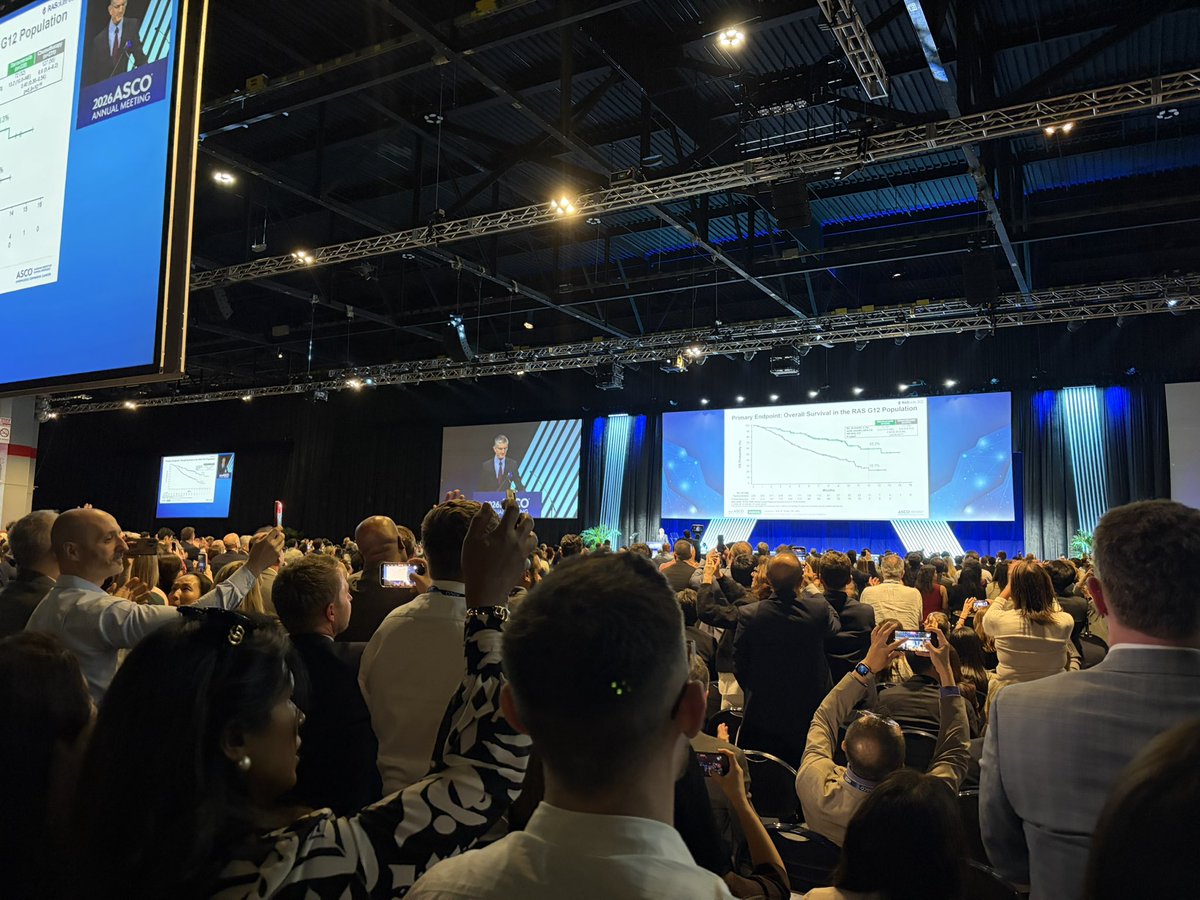
there aren't many times in oncology when nobody cares about statistics, but today is one of them. there has never been such a successful trial in pancreatic cancer & these survival curves are the result of 40 years of persistence. KRAS inhibitors will forever transform oncology
Dr. Antonio Calles 🫁🚭@Tony_Calles

🌟This is history ⭐️The most awaited abstract 👏 Standing ovation at Hall B1 💊 Daraxonrasib becomes the new standard of care for patients with previously treated metastatic #pancreatic #cancer #ASCO26

English
2
10
100
6.3K
Simona Cristea retweetet
Adam Feuerstein ✡️
Adam Feuerstein ✡️@adamfeuerstein·
Incredible #ASCO26 moment. Dr. Brian Wolpin, presenter of the daraxonrasib study, received a standing ovation DURING his talk after he stated the survival benefit for PDAC patients. It was sustained. Cheering. I have never see anything like it in the middle of a talk. $RVMD
Adam Feuerstein ✡️ tweet media
English
16
136
988
156.6K
Arc Institute
Arc Institute@arcinstitute·
Three years, same spot, a lot more science 🧬
Arc Institute tweet media
English
5
12
226
15.4K
Philipp Doc
Philipp Doc@GamerPhilDoc·
@simocristea @NatRevDrugDisc 513 in development, only 33 in Phase III. Immunological barriers like exhaustion and heterogeneity are still the ultimate boss fight.
English
1
0
1
166
Simona Cristea
Simona Cristea@simocristea·
wow as of may 2025, there are 513 cancer vaccines in development, with 33 in phase 3 @NatRevDrugDisc
Simona Cristea tweet media
English
4
31
123
13.4K
José Luis Ricón Fernández de la Puente
I wrote something about the past few days while my mom passed away. It's a tribute to her, my personal memory, and also (even if you don't have any connection to me at all) to satisfy your curiosity about what is it like, to be there during that time.
English
12
1
113
8.8K
Sasha Gusev
Sasha Gusev@SashaGusevPosts·
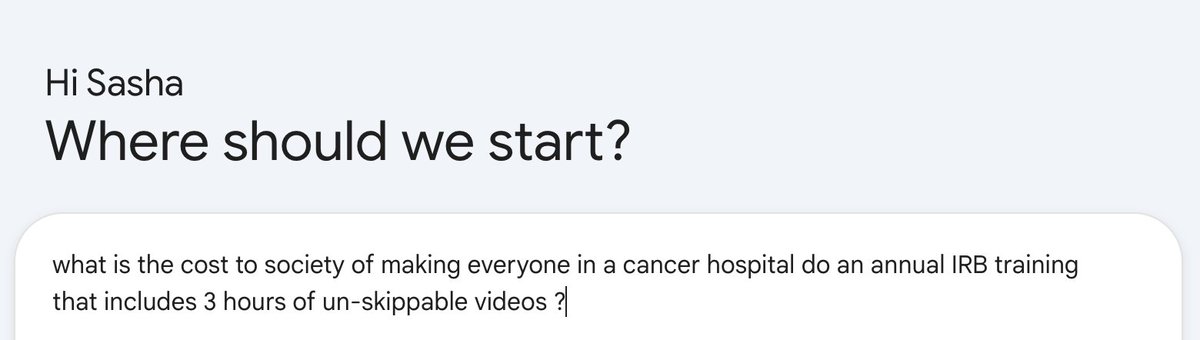
@simocristea moment of weakness after healthstream went down for maintenance half-way through a video
English
1
0
4
314
Simona Cristea
Simona Cristea@simocristea·
this is the first truly impressive comp bio AI-only analysis that I’ve seen. this is truly useful
Derya Unutmaz, MD@DeryaTR_

As I mentioned before, I am now sharing an example from GPT-5.5 Pro, also featured by OpenAI, that really left me stunned by what it is capable of in biomedical science. (full report on the website I created with Codex, link in the thread). To push GPT-5.5 Pro hard, I uploaded a real data set of immune subset (T cells) gene-expression spreadsheet: 62 sorted T cell samples, 27,906 gene columns, and millions of underlying data points across different T cell subsets. Importantly, this public dataset also had paired structure making it possible to separate true cell-state biology from donor-to-donor variation. I asked GPT-5.5 Pro not merely to summarize the spreadsheet, but to analyze it deeply: What can we learn from this dataset? What are the mechanistic insights? What are the most important biological questions that emerge? What follow-up experiments should we do next? It thought for about 100 minutes and produced a roughly 40-page report! What amazed me was not just the length or even the initial analysis, since previous models are also capable of doing this. What amazed me was the quality of the reasoning and insights it provided! The report recognized that this was not just a table of genes, but two overlapping experimental designs. It identified the major biological axis, which in plain language was that the cells were not just “different categories.” They formed a coherent differentiation landscape, moving from future potential toward immediate function. It also understood the caveats. It did not overclaim from bulk gene-expression data. It clearly explained that bulk transcriptomics cannot distinguish whether every cell in a sorted population has shifted or whether a smaller subpopulation is dominating the signal. It recommended the right next steps experiments, and integration with donor metadata. This is what made the report feel so special to me. It was not just doing statistics. It was reasoning like an expert systems immunologist. It saw the structure of the experiment, interpreted the patterns, built a mechanistic model, identified limitations, proposed causal hypotheses, and laid out a translational roadmap. Other advanced models have been able to generate excellent biomedical reports before, including previous GPT-5 models. So I don't want to claim this is an entirely new type of capability. But this one felt different in an important way. It had more scientific elegance, more restraint, more biological intuition, and more of the nuanced judgment that usually comes only from years of hands-on experience in the field. It felt like this AI model had crossed another threshold. This is the kind of analysis that could easily take a research team months to perform, refine, interpret, and write up. Even then, many teams might not produce something this integrated, this mechanistically coherent, and this useful as a launchpad for future experiments. I know a 40-page T-cell gene-expression analysis may not be exciting to everyone. To illustrate how good it is, also had Codex built a web site with it anyone can explore, link below. 😊 Those interested can go deeper into the report. I also wanted this example on the record because, because to me, it is evidence that we are entering a new stage in AI-assisted biomedical science. The important point is no longer that AI can "analyze data and write a report.” The important point is that AI can now help transform complex biological data into mechanistic understanding, experimental priorities, and testable hypotheses at a speed and depth that would have been almost unimaginable a short time ago. For biomedical science, this is a very big deal! Of course, this may vary across domains, and every analysis still needs expert review, validation, and experimental follow-up. But in my own field, with data I understand deeply, this felt like another inflection point. I feel strongly that we have crossed another milestone threshold in the age of AI, with the release of GPT-5.5.


English
2
3
46
10.6K