WeiTing Lin(GR15🌴/Gitcoin Beta)

12.3K posts

WeiTing Lin(GR15🌴/Gitcoin Beta) banner
WeiTing Lin(GR15🌴/Gitcoin Beta)

WeiTing Lin(GR15🌴/Gitcoin Beta)

@weitinglin66

Always be amazed by nature || MD/CP || 2021 Global Biocommunity Fellow || BioCreator || Automated Bioscience, Web3, Open Science#desci @proots_desci

Beigetreten Şubat 2013
4.5K Folgt1.3K Follower
WeiTing Lin(GR15🌴/Gitcoin Beta) retweetet
Taku Mizutani
Taku Mizutani@TM81241003·
Our @J_A_C_S paper is out! We found a unique PLP enzyme that builds α-hydroxy β-amino acids. Can’t wait to make more and more strange amino acids with this guy! pubs.acs.org/doi/10.1021/ja…
English
3
10
47
2.4K
WeiTing Lin(GR15🌴/Gitcoin Beta) retweetet
Dan Shipper 📧
Dan Shipper 📧@danshipper·
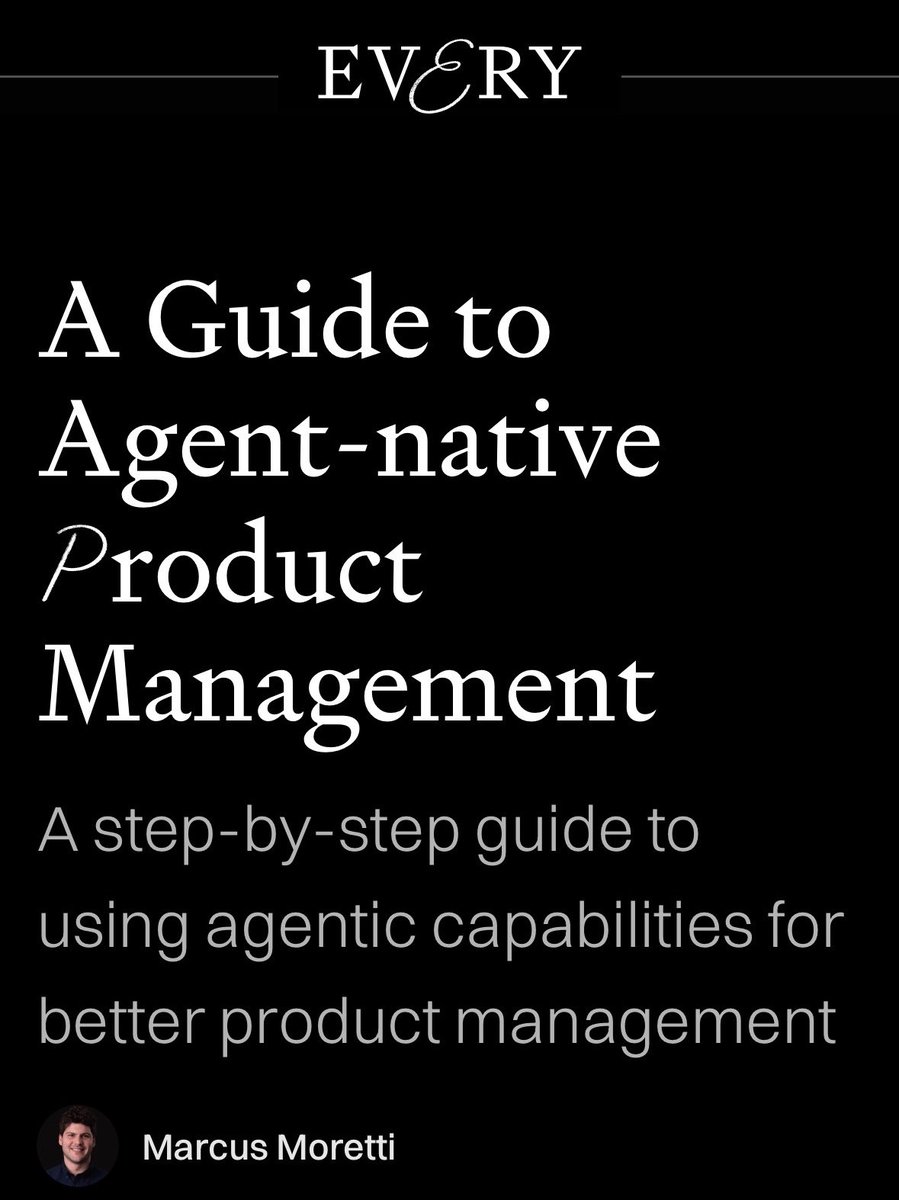
must read Marcus went from product manager to shipping product like a madman @every with coding agents he wrote the definitive guide for how to do it: every.to/guides/ai-prod…
Dan Shipper 📧 tweet media
English
9
49
639
44.6K
WeiTing Lin(GR15🌴/Gitcoin Beta) retweetet
Tom Dörr
Tom Dörr@tom_doerr·
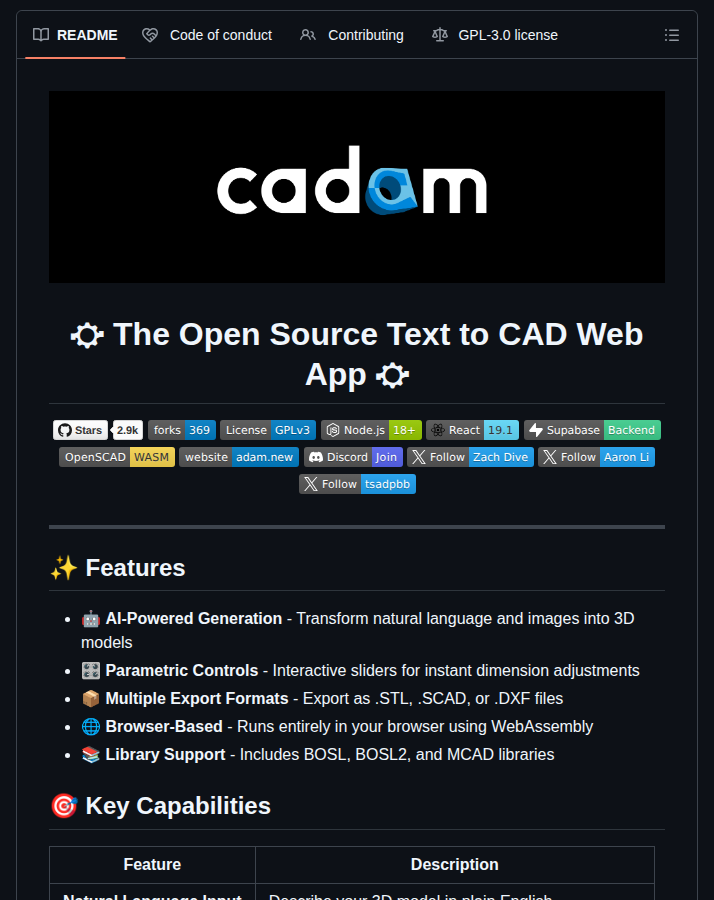
Generates parametric 3D models from natural language github.com/Adam-CAD/CADAM
Tom Dörr tweet media
Català
0
19
87
4K
WeiTing Lin(GR15🌴/Gitcoin Beta) retweetet
AI4Science Catalyst
AI4Science Catalyst@AI4S_Catalyst·
The next generation of biology companies will run 24/7. AI Scientists never sleep. More soon. @ainoro_labs
English
7
72
459
31.9K
WeiTing Lin(GR15🌴/Gitcoin Beta) retweetet
藤井亮輔 🦒 Ryosuke Fujii (Ryo)
Nature Human Behaviour から "How to design effective scientific figures" というコメンタリーが出ました🎉参考になれば幸いです!! nature.com/articles/s4156… @NatureHumBehav
藤井亮輔 🦒 Ryosuke Fujii (Ryo) tweet media
藤井亮輔 🦒 Ryosuke Fujii (Ryo)@Ryo_epidemiol

I’m thrilled to announce that my new comment titled “How to design effective scientific figures” is now released from @NatureHumBehav This provides five keys to make your graphical items attractive 🎨 Hope this is useful for your project! nature.com/articles/s4156…


日本語
9
146
977
145.3K
WeiTing Lin(GR15🌴/Gitcoin Beta) retweetet
Andrej Karpathy
Andrej Karpathy@karpathy·
Fireside chat at Sequoia Ascent 2026 from a ~week ago. Some highlights: The first theme I tried to push on is that LLMs are about a lot more than just speeding up what existed before (e.g. coding). Three examples of new horizons: 1. menugen: an app that can be fully engulfed by LLMs, with no classical code needed: input an image, output an image and an LLM can natively do the thing. 2. install .md skills instead of install .sh scripts. Why create a complex Software 1.0 bash script for e.g. installing a piece of software if you can write the installation out in words and say "just show this to your LLM". The LLM is an advanced interpreter of English and can intelligently target installation to your setup, debug everything inline, etc. 3. LLM knowledge bases as an example of something that was *impossible* with classical code because it's computation over unstructured data (knowledge) from arbitrary sources and in arbitrary formats, including simply text articles etc. I pushed on these because in every new paradigm change, the obvious things are always in the realm of speeding up or somehow improving what existed, but here we have examples of functionality that either suddenly perhaps shouldn't even exist (1,2), or was fundamentally not possible before (3). The second (ongoing) theme is trying to explain the pattern of jaggedness in LLMs. How it can be true that a single artifact will simultaneously 1) coherently refactor a 100,000-line code base *and* 2) tell you to walk to the car wash to wash your car. I previously wrote about the source of this as having to do with verifiability of a domain, here I expand on this as having to also do with economics because revenue/TAM dictates what the frontier labs choose to package into training data distributions during RL. You're either in the data distribution (on the rails of the RL circuits) and flying or you're off-roading in the jungle with a machete, in relative terms. Still not 100% satisfied with this, but it's an ongoing struggle to build an accurate model of LLM capabilities if you wish to practically take advantage of their power while avoiding their pitfalls, which brings me to... Last theme is the agent-native economy. The decomposition of products and services into sensors, actuators and logic (split up across all of 1.0/2.0/3.0 computing paradigms), how we can make information maximally legible to LLMs, some words on the quickly emerging agentic engineering and its skill set, related hiring practices, etc., possibly even hints/dreams of fully neural computing handling the vast majority of computation with some help from (classical) CPU coprocessors.
Stephanie Zhan@stephzhan

@karpathy and I are back! At @sequoia AI Ascent 2026. And a lot has changed. Last year, he coined “vibe coding”. This year, he’s never felt more behind as a programmer. The big shift: vibe coding raised the floor. Agentic engineering raises the ceiling. We talk about what it means to build seriously in the agent era. Not just moving faster. Building new things, with new tools, while preserving the parts that still require human taste, judgment, and understanding.

English
201
654
5K
637.2K
WeiTing Lin(GR15🌴/Gitcoin Beta) retweetet
Seeed Studio
Seeed Studio@seeedstudio·
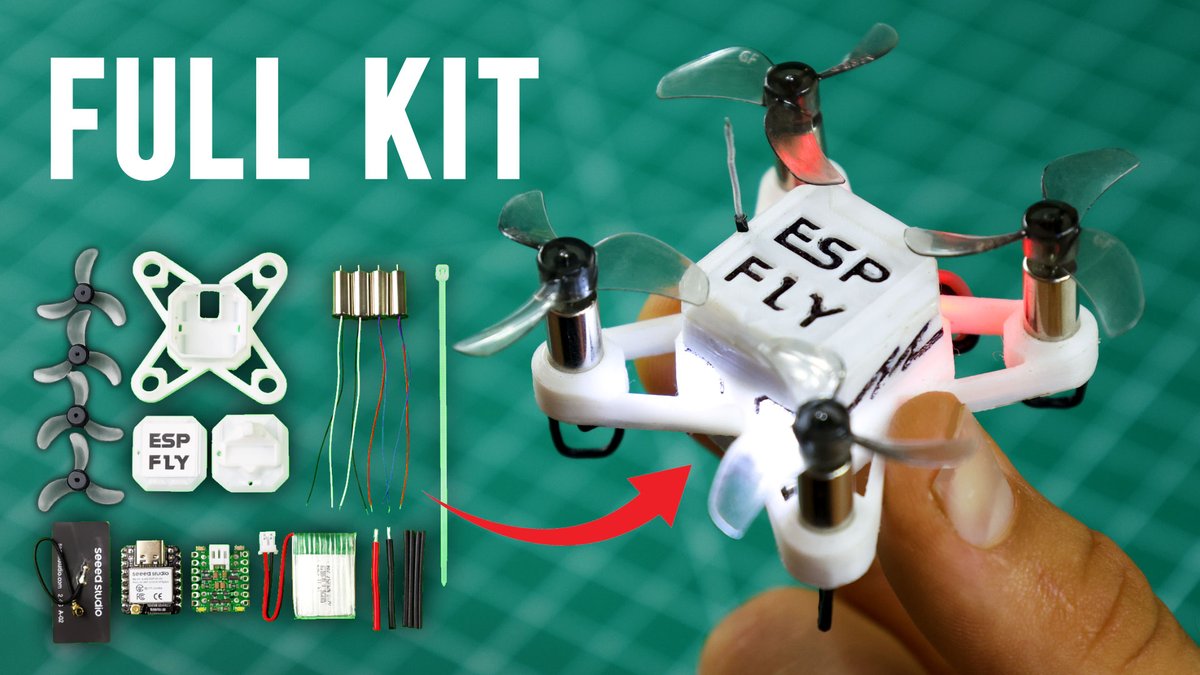
Ever thought you could build a drone that fits in your pocket? 🚁✨ Meet ESP-FLY, the palm-sized quadcopter powered by the Seeed Studio XIAO ESP32-S3, built by Max! ✅ DIY-friendly (3D printed frame) ✅ Fully programmable (ESP-IDF/Arduino) ✅ Mobile App control over Wi-Fi ✅ Open-source & hackable Whether you’re a STEM educator or a weekend maker, this is your next project. Ready to take off? Get Yours Now👉 bit.ly/42ICVYg #SeeedXIAO #ESP32S3 #DroneDIY #STEM #MakerMovement #CoCreat #TheAIHardwarePartner
Seeed Studio tweet media
English
5
95
619
32.4K
WeiTing Lin(GR15🌴/Gitcoin Beta) retweetet
Corey Howe
Corey Howe@design_proteins·
The challenges of peptide design Great write up by Martin Highlights how current binder design tools perform worse as sequences get shorter The opportunity is to build better models and scoring pipelines that factor in thermodynamics, kinetics, solvent effects, and entropy
Martin Pacesa@MartinPacesa

I am happy to share a review I recently wrote on the design of peptide binders. It gives an overview of experimentally validated tools and discusses the challenges of why peptide design is more difficult than the design of classical protein binders. chimia.ch/chimia/article…

English
0
3
26
3.1K
WeiTing Lin(GR15🌴/Gitcoin Beta) retweetet
Grant Rotskoff
Grant Rotskoff@grantrotskoff·
Protein design has been dominated by diffusions due to a "structure-first" perspective. What about intrinsically disordered proteins? We scale language-based design using the modern RL stack and our model IDiom. Paper: biorxiv.org/content/10.648… Try it: idiom-designer.vercel.app
Grant Rotskoff tweet media
English
3
23
142
7.3K
WeiTing Lin(GR15🌴/Gitcoin Beta) retweetet
Noctua
Noctua@Noctua_at·
Are you integrating Noctua fans into your engineering or other projects? We now offer public 3D CAD models of all our fans for download on our website, intended for mechanical design, renderings or animations: noctua.at/en/3d-cad-mode…
Noctua tweet media
English
146
720
8.3K
406.7K
WeiTing Lin(GR15🌴/Gitcoin Beta) retweetet
zack's lab
zack's lab@zackslab·
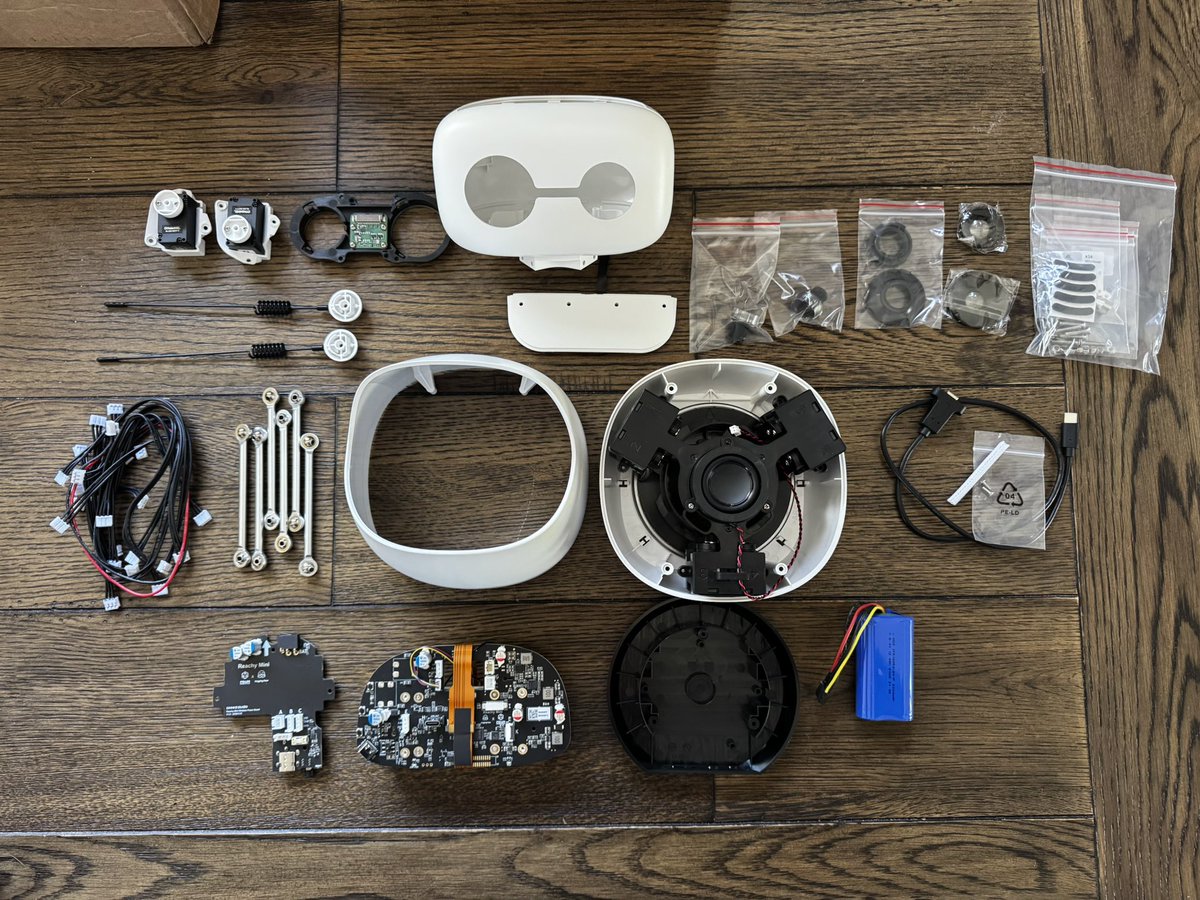
the @huggingface bot is a hit with the kids! cool replacement for a home assistant that can run or connect to your own local models.
zack's lab tweet mediazack's lab tweet media
English
2
18
286
13.1K
WeiTing Lin(GR15🌴/Gitcoin Beta) retweetet
Logan Jastremski
Logan Jastremski@LoganJastremski·
My conversation with @EvanWeb3 As the CEO of Mysten Labs, Evan is relentlessly focused on building the unified abstraction layers necessary to bring blockchain technology to the masses. The team is doing the hard architectural work with Sui to move beyond traditional digital ledgers, utilizing a complex object model to enable true parallelization and seamless developer experiences We spend a lot of time unpacking the limitations of EVM L2s, why top-down application design matters, and the massive opportunities at the intersection of verifiable automation and AI At the center of this conversation is the verticalization of the Sui stack from Deepbook to Walrus and the belief that the next generation of global adoption requires platforms to look more like cohesive operating systems rather than fragmented networks. We discuss: - Why the industry needs to raise the abstraction layer for global adoption - The architectural limitations of EVM chains and the failure of L2 scalability - Walrus, Deepbook, and the verticalization of the Sui platform - Why Sui's object model fundamentally differs from traditional digital ledgers - The intersection of AI and blockchain: persistent memory and verifiable trust - Unlocking Bitcoin's stagnant capital - The upcoming EVE Online partnership and the future of web3 gaming - Why blockchains must operate with sustainable business models Enjoy! Timestamps: 0:00 - Introduction: The Need for Unified Abstraction Layers 1:54 - The Scalability Maze: Why L2s Failed to Deliver 8:43 - Custom Databases: Scaling Reads and State Access 11:44 - Walrus & Deepbook: Verticalizing the Web3 Stack 1 6:16 - Beyond Digital Ledgers: Sui's Object Model Explained 22:38 - AI, Automation, and Providing Trust for LLMs 31:04 - Lessons from Libra: Permissionless vs. Corporate Chains 35:49 - Sustainable Economics: Business Models for Blockchains 41:13 - Unlocking Stagnant Capital: Bringing Yield to Bitcoin 51:46 - The 2026 Roadmap: EVE Online, Privacy Guardrails, and Product Infra
English
21
27
152
55.5K
WeiTing Lin(GR15🌴/Gitcoin Beta) retweetet
Ilir Aliu
Ilir Aliu@IlirAliu_·
Mini 6 dof Arm. 3D printed planetary gearboxs & more… [📍GitHub link below ] A mini 6-axis arm driven by stepper motors with custom 3D printed split ring planetary gearboxs and an inverted belt differential wrist with custom bearings, driven by low-cost stepper motors and TMC5150 drivers. Custom firmware was written in C for the STM32 MCU on an BTT Octopus board, to allow for full closed loop PID control using AS5048a encoders daisy-chained over SPI. The controller takes joint targets and returns joint states to a Raspberry Pi 5 streamed over CAN bus. All credit to James Gullberg: 📍GitHub: jcgullberg.github.io/projects —— Weekly robotics and AI insights. Subscribe free: 22astronauts.com
English
7
67
676
33.2K
WeiTing Lin(GR15🌴/Gitcoin Beta) retweetet
Lukas Ziegler
Lukas Ziegler@lukas_m_ziegler·
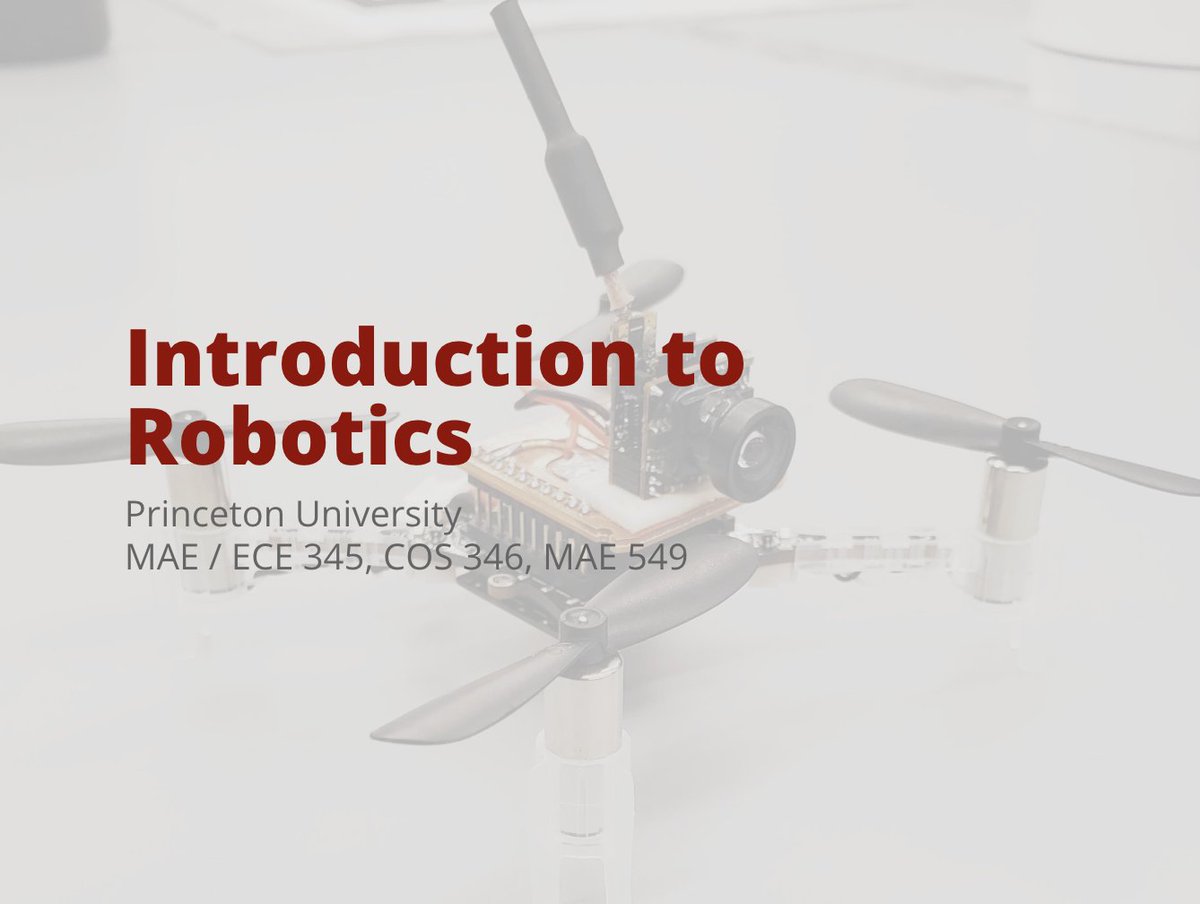
Princeton's Introduction to Robotics! 🎓 @Princeton University released their full Introduction to Robotics course publicly with lecture videos, notes, slides, and assignments. This course provides fundamental theoretical and algorithmic principles behind robotic systems with hands-on experience. Topics covered: → Feedback Control (dynamics, PD control, Linear Quadratic Regulator) → Motion Planning (discrete planning with BFS/DFS, optimal planning with Dijkstra/A*) → State Estimation, Localization, and Mapping (Bayes filtering, Kalman filtering, particle filtering, SLAM) → Vision and Learning (optical flow, deep learning, convolutional networks, reinforcement learning), and broader topics including robotics and law, ethics, and economics. Assignments include theory, programming, and hardware implementation components. The final project has students program drones for vision-based navigation with attached cameras transmitting real-time images. All lecture videos, notes, slides, and assignments are freely available. Prerequisites include multivariable calculus, linear algebra, basic probability, basic differential equations, and some programming experience in Python. ‼️ GO FOR IT: irom-lab.princeton.edu/intro-to-robot… ~~ ♻️ Join the weekly robotics newsletter, and never miss any news → ziegler.substack.com
Lukas Ziegler tweet media
English
8
214
1.2K
49K
WeiTing Lin(GR15🌴/Gitcoin Beta) retweetet
Keoni Gandall
Keoni Gandall@koeng101·
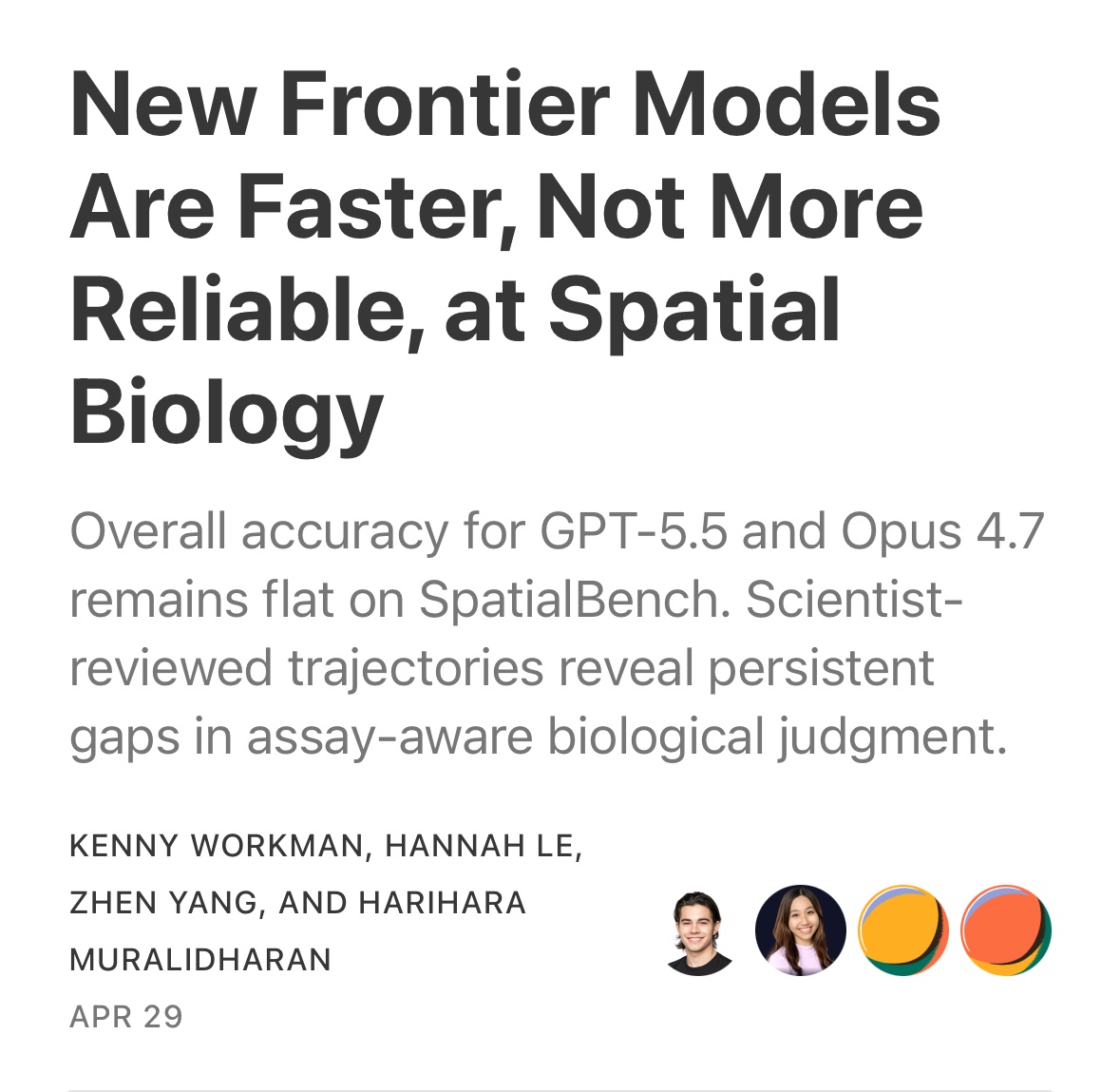
Great low-level blog post from @LatchBio . I’ve noticed the same thing with bio automation code. I think the fundamental part is while the models are great at coding, coding is no longer the limiting factor, it’s the biological intuitions
Keoni Gandall tweet media
English
3
8
48
3.7K
WeiTing Lin(GR15🌴/Gitcoin Beta) retweetet
Emerson S
Emerson S@Em_Nomadic·
The bottleneck for most people who want to build a robot isn't motivation it's not knowing where to start what parts. what order. what software stack. Tnkr solves exactly that — open source robot projects with step-by-step assembly, CAD, firmware, everything tnkr.ai/explore
Emerson S tweet media
English
26
266
1.9K
104.3K
WeiTing Lin(GR15🌴/Gitcoin Beta) retweetet
Lukas Ziegler
Lukas Ziegler@lukas_m_ziegler·
Start learning mobile robotics now! 📚 University of Michigan released a course on autonomous mobile robotics. It's all for free on YouTube as a series of 29 video lectures covering theory and application of probabilistic and geometric techniques for autonomous mobile robotics. Topics include Bayesian filtering, stochastic representations of the environment, motion and sensor models for mobile robots, algorithms for mapping and localization, and application to autonomous marine, ground, and aerial vehicles. Lecture series includes: → Bayes Filters and Kalman Filtering → Nonlinear Kalman Filtering → Particle Filtering → Symmetry & Rigid Body Motion And more covering the fundamentals of mobile robotics perception and navigation. University courses on mobile robotics typically cost thousands in tuition. UMich-CURLY is releasing the full lecture series for free, democratizing access to robotics knowledge (which I simply LOVE! 🫶🏼) For anyone wanting to start working in autonomous systems, these fundamentals: Bayesian filtering, localization, mapping, are essential. Now they're available to anyone with internet access. 🎓 🔗 Start here: youtube.com/playlist?list=… ~~ ♻️ Join the weekly robotics newsletter, and never miss any news → http:// ziegler.substack.com
Lukas Ziegler tweet media
English
4
109
685
19.5K