
Ruth Allarton
15.1K posts
Ruth Allarton
@RuthAllarton
Retired NHS NED passionate about role AHPs play in system change across the NHS. 20+years NHS and HE experience and PFHEA
Joined Ekim 2012
808 Following1.2K Followers

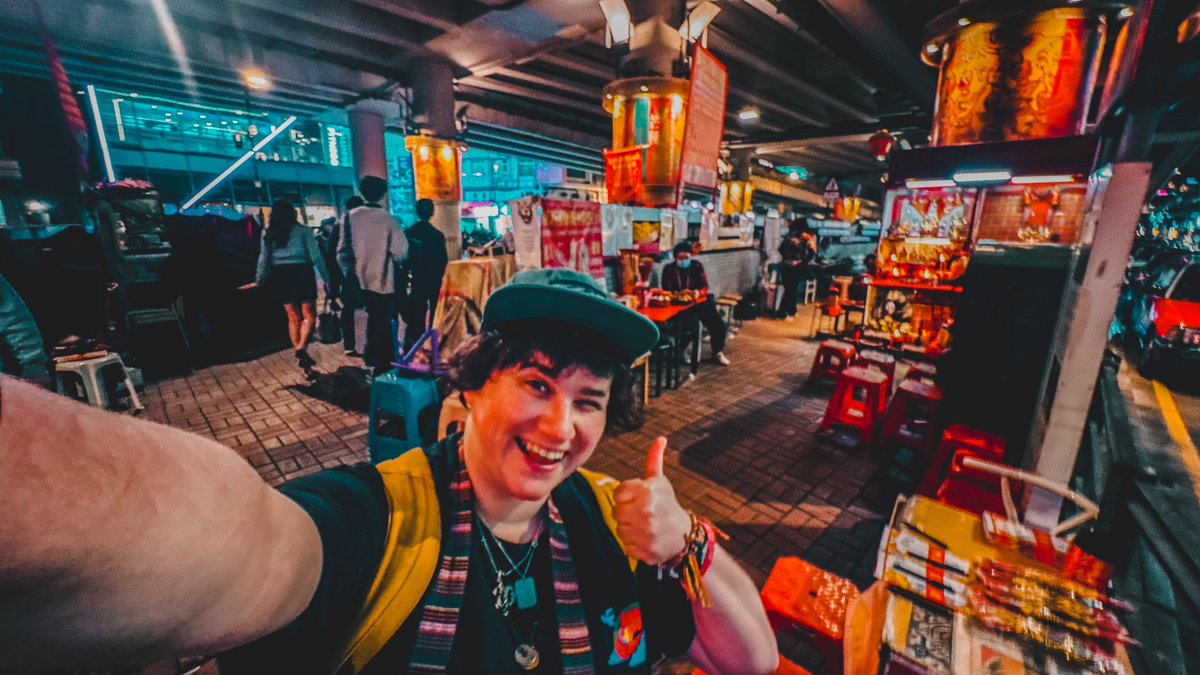
Day 1 (of my trip): where past meets future.
I have arrived in Hong Kong as the sky was learning how to be night.
7pm at the hotel, after getting a bit overwhelmed after stepping off the bus.
Unlike at home, the city was already wide awake at 7pm
a thousand small lives glowing behind glass and steel,
neon stitched into the dark like constellations you can walk through.
I wandered my way into a pocket of devotion and defiance,
a blessings and beat your villains corner tucked beneath a highway,
where incense smoke braided itself with the sound of buses overhead,
and paper prayers leaned against concrete pillars that carry millions of footsteps a day.
They call this city Heung Gong-the Fragrant Harbour-
named for the scent of incense and timber that once drifted across its waters.
Tonight, it still feels true. The air smells like offerings, street food, rain waiting somewhere far away,
and the quiet seriousness of people asking the world to be kinder to them.
The buildings don’t just rise here — they gather.
More than seven million hearts stacked into a vertical poem,
one of the densest places on Earth,
where every window is a small, glowing universe,
and every alley feels like a secret someone left behind for you to find.
There’s a feeling I recognize —
the same one New York once gave me —
that pulse in the chest that says pay attention, something is happening.
Energy that doesn’t shout, but hums,
like the city itself is breathing beside you.
I stood there, wrapped in neon hues and highway shadows,
thinking maybe next time I’ll leave a blessing of my own.
To beat our villains - which is the far right, or blessings for softness, for courage, for the slow, stubborn work of making things better.
But for now, I’m holding this moment tightly. Sniffing in the air so I can que my sense of smell with my memories. Noticing the textures of walls, colours of lights, and the feelings.
My first night. I never thought I’d ever really get to Hong Kong. And I was too scared to come here when I was younger but look at me now!
My neon dreams.
My quiet gratitude for being here,
on the edge of a city that feels like it might teach me something about how to live.



English
Ruth Allarton retweeted

BLOG What does dementia rehabilitation mean to us as AHPs ? ‘Podiatry for people with dementia focuses on maintaining mobility and independence by encouraging and helping to maintain a healthy active lifestyle through good foot health’ letstalkaboutdementia.wordpress.com/2026/01/22/wha… @alzscot
English
@piersmorgan @piersmorgan has been evidenced again and again rehab is essential - find yourself a good physio and follow their advice
English

Anyone had a total hip replacement following trauma, and got some good advice for me re rehab etc?
Going home tomorrow.
English
Ruth Allarton retweeted
Apologies the link to the article "Curiosity as a Compass for Complex Change" isn't working. Here is a link that works: performancefrontiers.com/insights/curio….
English
@SuzanneRastrick @RBNHSFT @UniofReading @FeetForgotten Many congratulations to you too @SuzanneRastrick so well deserved
English
✨Very #AHPproud to offer my warmest congratulations to the following #AHPs in England nominated in #NewYearHonours list
MBE
🎖️ Prof Anna Horwood, Senior #Orthoptist @RBNHSFT & @UniofReading
🎖️Deborah Monk, Founder @FeetForgotten #Podiatry
See my LinkedIn page for fuller detail
English
Ruth Allarton retweeted

⭐ The duty of candour matters.
Health and care professionals must be open and honest, especially when things go wrong. It’s not just good practice, it’s a professional duty that builds trust and safeguards patients.
Read more on our website 👉 hcpc-uk.org/standards/meet…
English
@LucyyMacKinnon @ExplosiveEnema2 Yes we should compare like with like in roles eg a consultant clinical scientist in genetics with 12 years PG education a doctorate, fellow of RC of Pathology is on AfC band 8c £76k, £30k less than medical colleagues
English

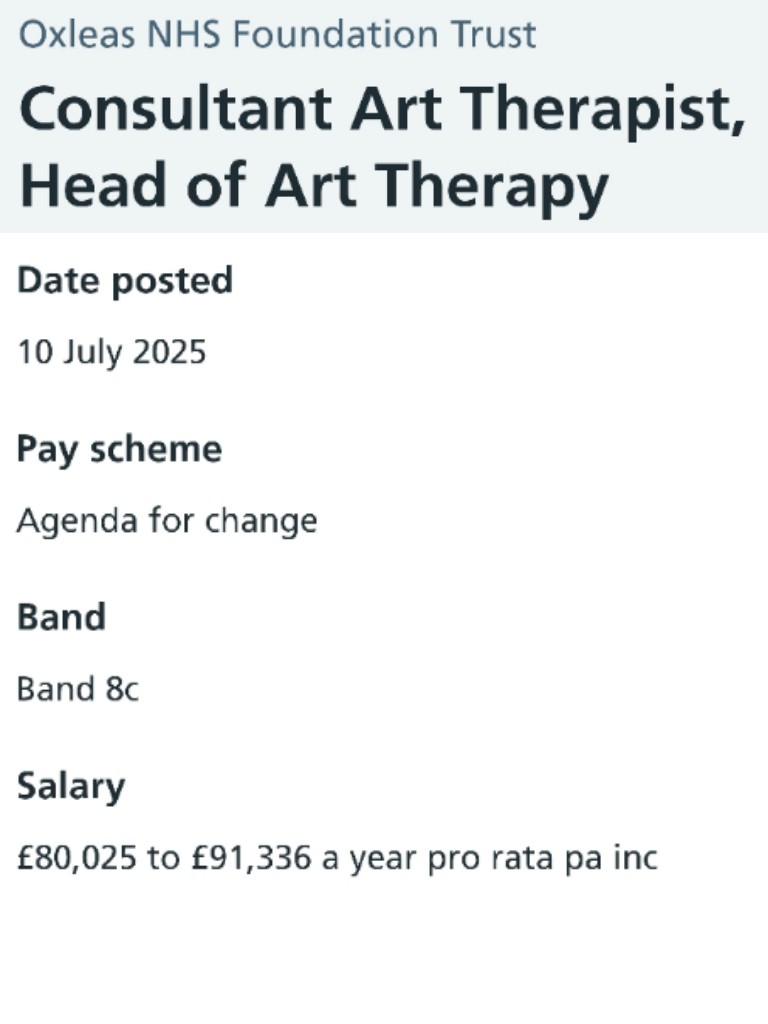
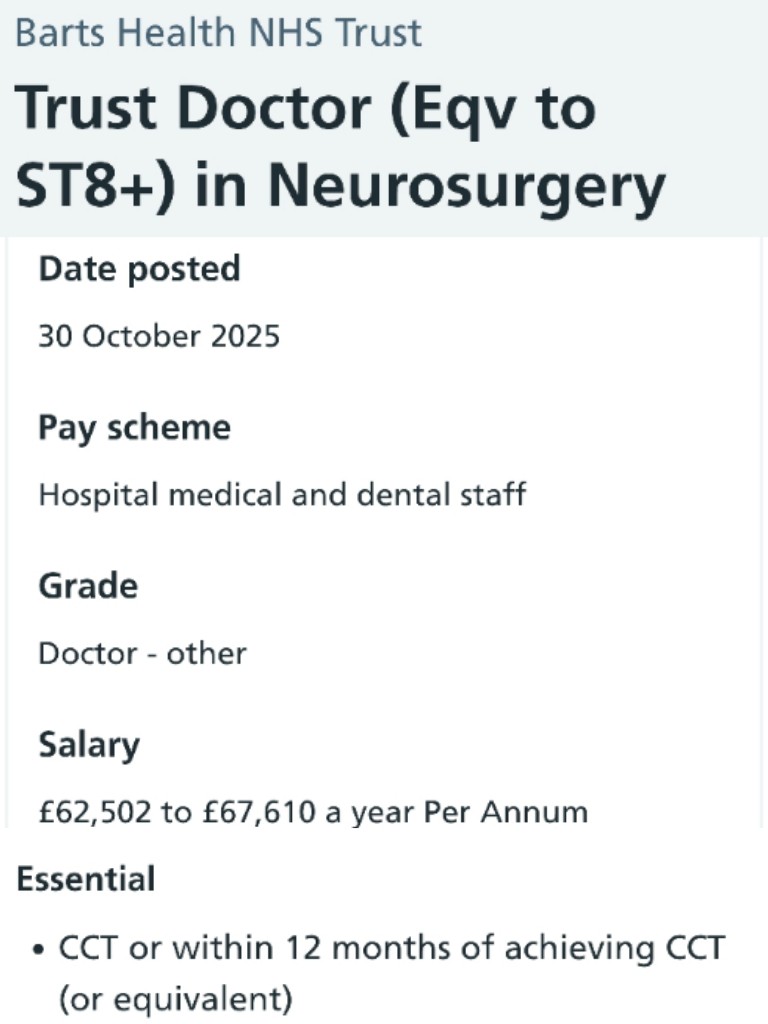
@ExplosiveEnema2 Whilst doctors obviously deserve much better pay and I fully support that it seems unfair to compare a senior resident with a consultant (regardless of the opinion of whether that should be a title in the field) when a consultant neurosurgeon would earn more than picture 1

English
Picture 1
Consultant Level Arts Therapist
£80-90k
Picture 2
Senior Resident Neurosurgeon who has completed all of their consultancy exams
£65-67k
Resident Doctors are incredibly undervalued
Their request for pay restoration is a bargain!
English
Ruth Allarton retweeted
Are we realising the potential of our networks to make change happen?
Most innovation emerges from collaborative projects where teams openly “borrow” & adapt each other’s (often small but powerful) ideas. Many networks & communities of practice could achieve so much more by experimenting together around collective priorities to generate & share new solutions.
This is beyond spreading known “best” or “good” practices. It is about innovating to design new solutions collectively.
So I appreciated this piece from Ed Morrison of @Strategic_Doing about three different kinds of networks:
- Advocacy networks are communities that seek to mobilise people, creating pressure to shift policies, priorities or messages in a particular direction. Their aim is to connect & influence rather than to change how they themselves work.
- Learning networks are communities of practice. They share knowledge, compare practice & build shared capability. Learning networks often excel at spread & improvement of existing practice, but only sometimes move into structured innovation work.
- Innovating (or transforming) networks are communities that combine their assets - ideas, relationships, data, capabilities - to create new value that none could produce alone. They manage collaboration as a process of experimentation: agreeing a shared outcome, running multiple connected tests of change, learning by doing & amplifying what works across the network.
linkedin.com/posts/efmorris…
Every learning network has the potential to become an innovating/transforming network. Some actions to enable this:
1. Build a foundation of strong, trusting relationships within the network, understanding each member’s starting point & motivation for change
2. Focus on helping each other to succeed; listen to each others’ stories & plans, co-coach, give advice to each other & build shared inquiry
3. Move from “sharing” or “raising awareness” to some concrete outcomes the network want to change together through collective experimentation
4. Agree some simple norms for the network so that members help each other to make progress, make it safe to try things, fail fast & share incomplete work
5. Encourage multiple, parallel tests of change around similar outcome so projects can “steal with pride” from one another & quickly refine promising ideas
6. Put simple routines in place for noticing patterns (what is shifting where & why), capturing these insights & amplifying them across the network
7. Add additional success metrics including innovations tested, adapted & adopted in multiple places
Graphic by Ed Morrison.
Content with added inspiration from @juneholley.

English
Ruth Allarton retweeted

Want to find out more about qualitative interviewing❓
The Open University is offering a free 3-hour course 🎉
Take a look here 👇
eur01.safelinks.protection.outlook.com/?url=https%3A%…
English
@NoFarmsNoFoods I do but I worry there will be nowhere for them to do it soon when land is covered with solar panels and houses
English


Ruth Allarton retweeted
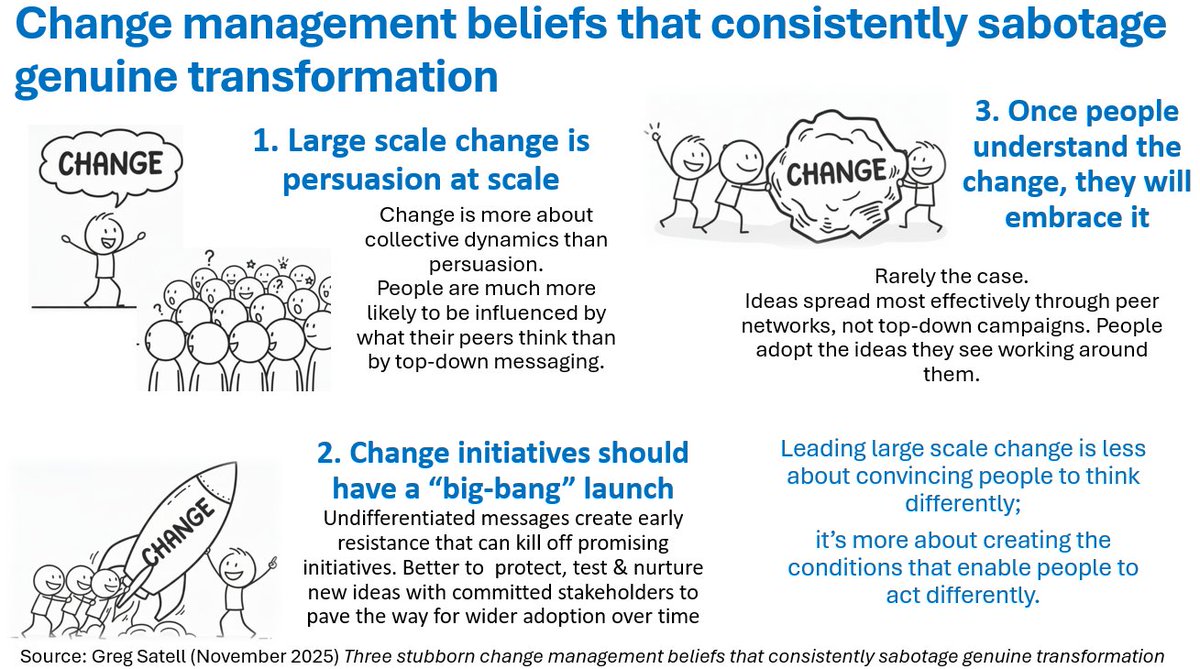
Our beliefs & assumptions about change are often the biggest barrier to leading & enabling effective change.
@DigitalTonto describes “change management beliefs that consistently sabotage genuine transformation”.
The first such belief is that large scale change is persuasion at scale; the idea that we can change opinion across an organisation by communicating a compelling case. However, change is much more about collective dynamics than about persuasion. People are more likely to be influenced by what their peers think than by top-down messaging. If we want change to spread, we need to help activate peer networks.
The second belief is that a large scale change initiative should have a “big bang” launch. The aim is to create widespread awareness that the change is happening & drive the message home. The problem is that undifferentiated messages create early resistance that can kill off promising initiatives. Much better to protect, test & nurture new ideas with committed stakeholders to pave the way for wider adoption over time, rather than trying to convince everyone at once.
The third belief is that once people understand the change, they will embrace it. The issue is that people are typically navigating many competing influences—prior beliefs, habits, social pressures & noise from many directions. That’s why ideas spread most effectively through peer networks, not top-down campaigns. People adopt the ideas they see working around them.
What might work better?
1. Deliberately starting where there’s already energy & enthusiasm & building out from a local majority (eg., three allies in a room of five) instead of trying to convert everyone first
2. Intentionally working through & connecting peer networks so people are influencing “others like us”, rather than relying on one-to-many broadcasts
3. Creating early proof through local majorities that “people like us are already doing this,” tapping into social proof rather than abstract persuasion techniques.
4. Expecting that some people will resist change & take steps to work with it, rather than assuming that better messaging will win “resistors” over
5. Focusing less on increasing information and more on enabling people to see others like them succeeding with the new behaviours, so they can appropriate and adapt the change as their own.
Leading large scale change is less about convincing people to think differently; it’s more about creating the conditions that enable people to act differently.
#more-35378" target="_blank" rel="nofollow noopener">digitaltonto.com/2025/3-stubbor…
English
Ruth Allarton retweeted

during that forty five minutes, whilst you're getting ready to face the day, a man will end his days… dead from prostate cancer. Yes, one man dies every 45 minutes.
myemail.constantcontact.com/Dead.html?soid…
English
@smizz A book would be wonderful recording each day would be great its your journey especially as you have recorded your changing thoughts and realisations - with your beautiful images magic and inspirational
English
I get at least one message a week like this, since doing the 100 day writing project. I actually can’t believe it?!
If I was to make them into a book, how would you envision it? Obvs not all 100 days, surely?

English
Ruth Allarton retweeted

For every £1 spent on physiotherapy, the UK benefits by £4.
The first independent national economic analysis of physiotherapy’s impact – published today – shows physio saves the NHS more than it costs and actively boosts economic growth.
#RightToRehab
csp.org.uk/roi
English
Ruth Allarton retweeted
After a heart attack or surgery, fear of moving again is natural - and exactly why cardiac rehab exists.
Physiotherapist Catrin Davies explains how structured, evidence-based rehabilitation helps people rebuild strength, confidence and purpose.
🔗 Read her blog: ow.ly/6YH650XpQsP
#RightToRehab
English
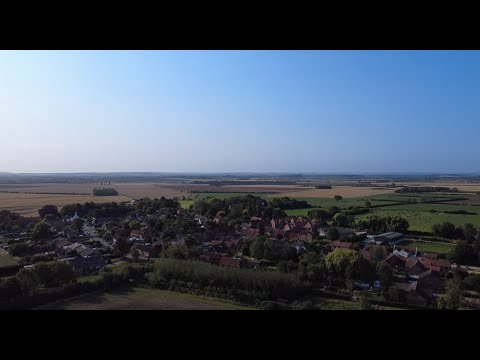
youtube.com/watch?v=lhzgB-… brilliant visual of the appalling cumulative impact of solar proposals in Newark and Sherwood covers 9% of land @JamesMelville @CPRE
YouTube
English
Ruth Allarton retweeted
🚨 When David – a dad of two, nurse & choir singer – had a heart attack, life changed overnight. He couldn’t work. He couldn’t sing.
💙 Cardiac rehab with physiotherapist Catrin gave him confidence, fitness & joy back.
Watch his story ⬇️
English
@smizz Good thanks! Retirement has its benefits! Miss shaking things up though so it’s great to see how you do!
English
@RuthAllarton Thank you so much, Ruth. That means so much to me 🙏🙏
How are you doing???
English
Day 101: Between Glaciers and Plains
This post is one of my favourites that I’ve written so far. I thought the writing journey would end at day 100. It didn’t, it hasn’t… The world kept moving, literally, and I realized I am still inside it, still listening. Still on this journey, learning.
Today I crossed from Glacier into the great rolling plains, sharing the observation car with a man who travels the country like it’s a prayer, a woman who stopped asking for permission to live after losing her best friend, and a travelling community pediatric nurse who told me she goes “where the wind needs me.”
We spoke of shrinking glaciers, stolen land, the cost of care, and the strange courage it takes to keep going.
She told me I’ve already lived more life than most people allow themselves, and that I am only just beginning. The words landed where I didn’t know I was still tender.
Some days, the only brave thing is to let yourself be carried.
This is Day 101:
Not an ending. Not a beginning.
Just the continuation of a sentence I am still in the middle of writing.
Read the full day post here ↓
smizz.substack.com/p/day-101-betw…




English
Ruth Allarton retweeted
Newly published research shows that taking calls & answering emails during “non-work” time can have negative consequences for people. When people use work-related technology in the evening (even by choice) they struggle to mentally switch off from work, which negatively affects their wellbeing both that night & the next morning.
Evening work-related technology use depletes people’s “self-regulatory resources” - the mental energy needed to redirect attention away from work. Without these resources, people cannot mentally disengage from work, which impairs their ability to repair their mood & maintain emotional wellbeing. It creates measurable reductions in positive affect (feeling enthusiastic, relaxed) & increases in negative affect (feeling anxious, dejected). This negative effect carries over to the next day, creating a downward spiral of loss of resources. However, two factors can break this cycle: feeling in control of how evening time is spent & getting good quality sleep.
The authors describe a "double-edged sword" situation - evening technology use may help with work goals in the short term but comes at a cost to recovery & ongoing wellbeing.
Actions for leaders based on this research:
1) Discuss how to contain the work to the working day with the team & problem solve: don't encourage "going the extra mile at night" or "always-on" behaviours.
2) Model the boundaries we expect from others: if we want people in our teams to respect their evening time, demonstrate it ourselves by not sending late-night emails or messages. When leaders reply to emails at midnight, team members feel they should too.
2) Make our boundaries visible & talk about them openly: the research emphasises that perceived control is protective, & when leaders talk openly about their own boundaries, it helps team members feel comfortable setting their own without fear of judgment.
3) Include digital boundary training in wellbeing training: encourage people to be more deliberate about when they engage with work technology rather than checking emails out of habit.
4) Act early when we notice patterns of evening work: spot these patterns early & intervene before visible wellbeing problems emerge, enabling workplace cultures where people feel comfortable setting boundaries.
ovid.com/journals/joop/… By Svenja Schlachter & colleagues, via John Whitfield.
Graphic by @_workchronicles.

English