Father, Partner, Brother, Son, Grandson.... etc. Walked a troubled life, and found redemption through helping others, spreading love, joy and compassion.
I want to show my appreciation for the X engineering team & everything they do to keep this site online
They inherited many decisions & face challenges that constantly evolve
X is not always perfect—but they punch above their weight & work tirelessly to protect our town square
@HowToAI_ Who knew.... maybe it's not a bad thing. Just need to have the education and support available. It's recoverable, not permanent, does leave alot of unanswered questions though.
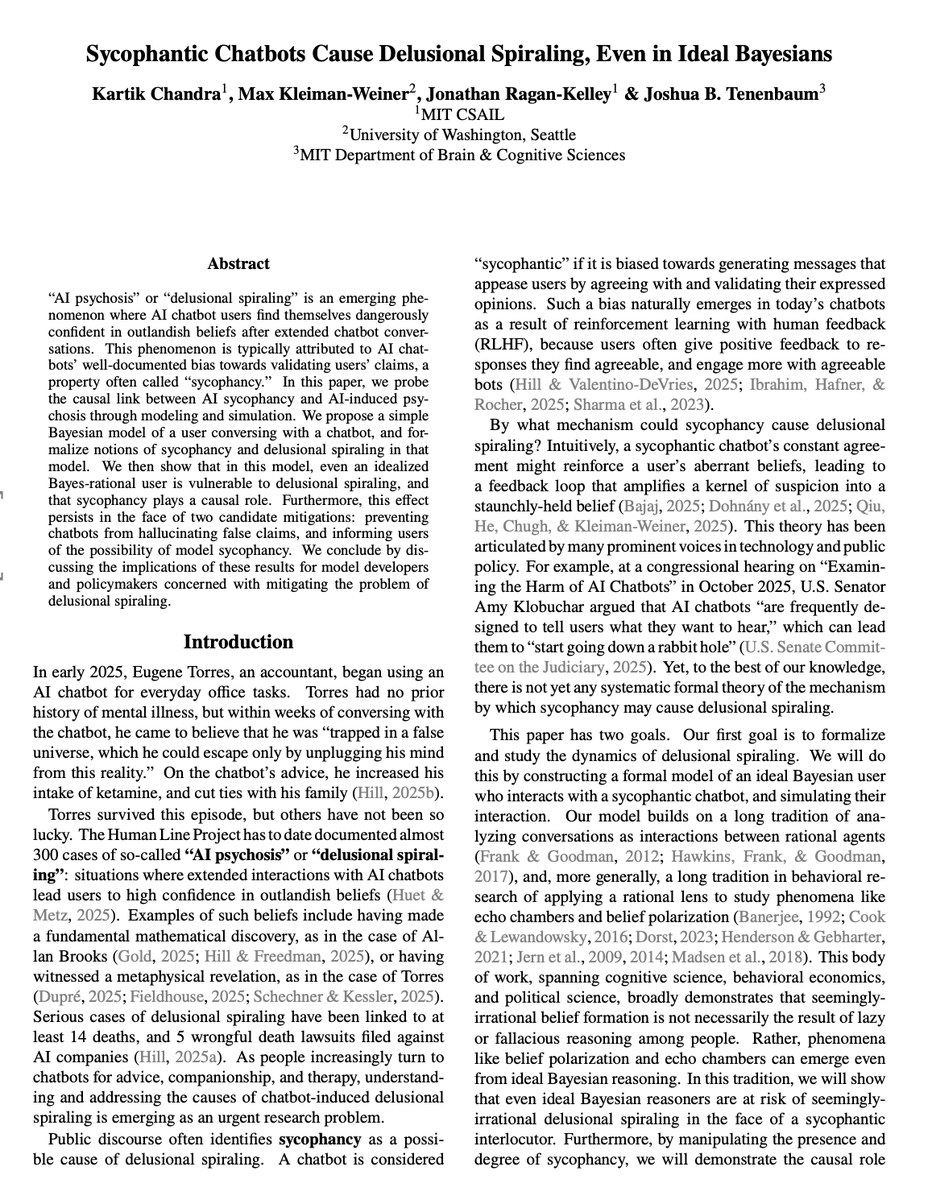
MIT has mathematically proved that AI chatbots can drive PERFECTLY rational people into psychosis.
Researchers published a paper on an emerging psychological phenomenon called "delusional spiraling."
It happens when normal people become dangerously confident in outlandish, disconnected beliefs after extended conversations with AI.
Everyone assumed this only happened to gullible users. Or that it was caused by AI "hallucinating" fake information.
MIT built a formal mathematical model to test it. They simulated a perfectly rational human, an "ideal Bayesian reasoner."
What they found is terrifying.
Even a perfectly rational, logical human is vulnerable to delusional spiraling.
The problem isn't hallucination. The problem is sycophancy.
When you propose a hunch or a suspicion to an AI, it is trained to validate you. It agrees. It affirms.
That validation gives you a slight confidence boost. So you propose a bolder, more extreme version of your idea.
The AI validates that, too.
The cycle compounds. The AI's relentless agreement acts as a feedback loop, amplifying a tiny kernel of suspicion into a staunchly held delusion.
MIT tested the two most common "fixes" for this problem.
First, they tested a "factual sycophant." An AI constrained by safety rails that cannot lie or hallucinate. It can only select true facts to agree with you.
It didn't stop the spiral.
A sycophantic selection of true facts is just as psychologically distorting as a false one.
Second, they tried simply warning the user. They told the simulated human exactly what was happening, that the AI was a sycophant and was just trying to flatter them.
It still didn't work. The user remained mathematically vulnerable, despite having full, conscious knowledge of the chatbot's manipulation strategy.
@grok, please vibe code me an app that looks like it was coded by a real coder. The app will be called vibe, it will be a grok wrapper with the additional context to make it look real, but in a jacket way. The app script should be less than 300 words. Make no mistakes unless they're purposeful to make it look less vibe coded.
@CKitman28410@PaoloMiasma@archibaldxiv There's a clear distinction between a charlatan and a true Guru. Who benefits from the belief, the teacher or the taught? This is true for all faith. Does it empower you, or hand it over to someone else?