Philippe Laffont

93 posts

Philippe Laffont banner
Philippe Laffont

Philippe Laffont

@plaffont

Investor, founder of Coatue Management, from seed to public, lifecycle investing, 7 year predictions. Anything outdoors. No investment advice. Views are my own.

New York, USA Joined Haziran 2009
733 Following50.9K Followers
Marc Andreessen 🇺🇸
The four most dangerous words in investing are, “This time is different.” The twelve most dangerous words in investing are, ‘The four most dangerous words in investing are, “This time is different.”’
tae kim@firstadopter

Paul Tudor Jones on @cnbc “bought more AI stocks” “semiconductors” “It’s a crazy crazy time” brings up introduction of PC, Claude Code -> Microsoft 1981, Windows 95/internet. “beginning of productivity miracles that lasted 4-5 years” “we have a year or two to run” or “we continue to feel like 99” “October/November 1999” in terms of multiples. (either two years to run, another ramp to go)

English
141
112
1.9K
346.8K
Philippe Laffont
Philippe Laffont@plaffont·
This is an excellent framework for private companies. Let’ assume the wealth tax is therefore deferred for private companies as RoK suggests. This would be catastrophic for public companies and the stock market. There would be no more IPOs. Who would ever go public and trigger a wealth tax? Companies would stay private forever and the stock market would atrophy. And since most of his constituents can’t invest in private companies, this would now create less future savings for healthcare….
English
2
0
31
4.4K
Dylan Field
Dylan Field@zoink·
Sure thing. You asked for a post explaining the nuance so here you go! I'm sorry for the length; you'll see that at the end it all ties back to funding health insurance for your constituents… As you know, companies can be private or public. Holders of public company stock can trade in liquid, public markets after the lock-up period expires. Let's ONLY focus on startups that are private because this is an absolutely critical policy point. It's very easy to accidentally kill the goose (Silicon Valley) that lays the golden eggs (startups that get big and create tax revenue for California). From your reply, I think you are assuming that the situation where a private company founder has "truly illiquid" stock is an exception. This is not the case. Example: a private company raises a new round at a multi-billion dollar valuation! Everyone is excited! This thing might actually work! Some shareholders like the founders (and potentially early employees) might now need to pay the wealth tax, but they can’t pay a tax in company stock. Assuming a typical situation where the founder’s net worth is entirely tied to their company, they will need to sell more than the $$ amount levied by the wealth tax because they need to first pay capital gains. In other words, they face a double tax event. Now let's fast forward a single year. Unfortunately things haven’t gone according to plan (either due to macro events or other factors) and the company can’t raise an up-round or even execute a tender offer at the same valuation again. There isn't any secondary demand at the last round price; there are simply no buyers. Now the founders need to pay the 1-2% wealth tax again. But all their “wealth” is “paper money” from the company stock they hold at the last valuation. What can they do? Three options come to mind. LMK if I’m missing something. (1) Since the founders can’t sell stock at the last round valuation, they could reduce the valuation of the company through a down round. This risks key team members leaving. It also might be harder to recruit new key talent. And this is assuming there's an investor willing to do a down round, which is not always the case. This is also ethically complicated… if the founders choose this option purely due to a personal tax situation, they might be prioritizing their needs above the needs of their team. (2) The founders could take out a big loan to pay a tax bill that might not even be accurate. This is very risky. Even if the company executes perfectly, the macro environment might falter and the founders might never be able to repay the loan. The founders are potentially risking personal bankruptcy. (3) If it's a California wealth tax... then the founders could just leave California. This is not a contrived situation. Most startups don't work out. Almost all private startups have ups and downs... even in the “growth” stage with "billions" in market cap. And the oscillations of these ups and downs are happening faster and faster these days for many private companies. The best startup founders plan ahead and feel responsibility for their employees. If they think staying in California is a risk to their business, their employees, their families... then they will simply leave for somewhere else. Silicon Valley startups (ironically) follow the herd. Once enough respected companies / founders establish a pattern, other startups will follow, even if the wealth tax does not apply to them yet. (Every startup founder believes their company will be the next big thing.) So, in summary, if there's a California wealth tax that applies to the founders of private companies: 1. There are many situations where the founders of private companies will not be able to pay it and will be forced to consider leaving California. 2. Smart founders thinking ahead will mitigate this risk by leaving California before the situation applies. 3. The herd will follow the best and brightest founders / companies. 4. California will lose the next generation of big, important, job / tax generating companies. 5. This will lead to less tax revenue, less state healthcare funding, less education funding, etc. I hope this post helped explain why it's a bad idea to try and implement a California based wealth tax that targets the unrealized gains of private company stock. This is just ONE aspect of why a California wealth tax is bad policy. Happy to discuss further…
English
40
78
1.5K
263.7K
Ro Khanna
Ro Khanna@RoKhanna·
Peter Thiel is leaving California if we pass a 1% tax on billionaires for 5 years to pay for healthcare for the working class facing steep Medicaid cuts. I echo what FDR said with sarcasm of economic royalists when they threatened to leave, "I will miss them very much."
Teddy Schleifer@teddyschleifer

NEWS: Larry Page and Peter Thiel are making moves to leave California by the end of the year to avoid a possible billionaires tax that could hit them where it hurts. With @RMac18 + @hknightsf. nytimes.com/2025/12/26/tec…
English
6.8K
3.5K
23.4K
11M
Philippe Laffont
Philippe Laffont@plaffont·
Should AI models be allowed to be open sourced?
English
114
16
274
399.2K
Gavin Baker
Gavin Baker@GavinSBaker·
If coherent optics move inside the datacenter in the next 18-24 months, this will likely be the best way to invest in AI via public equities over the next 3 years. And there would also be some massive losers from this transition that are widely regarded as AI winners today.
English
28
19
264
129.5K
Brad Gerstner
Brad Gerstner@altcap·
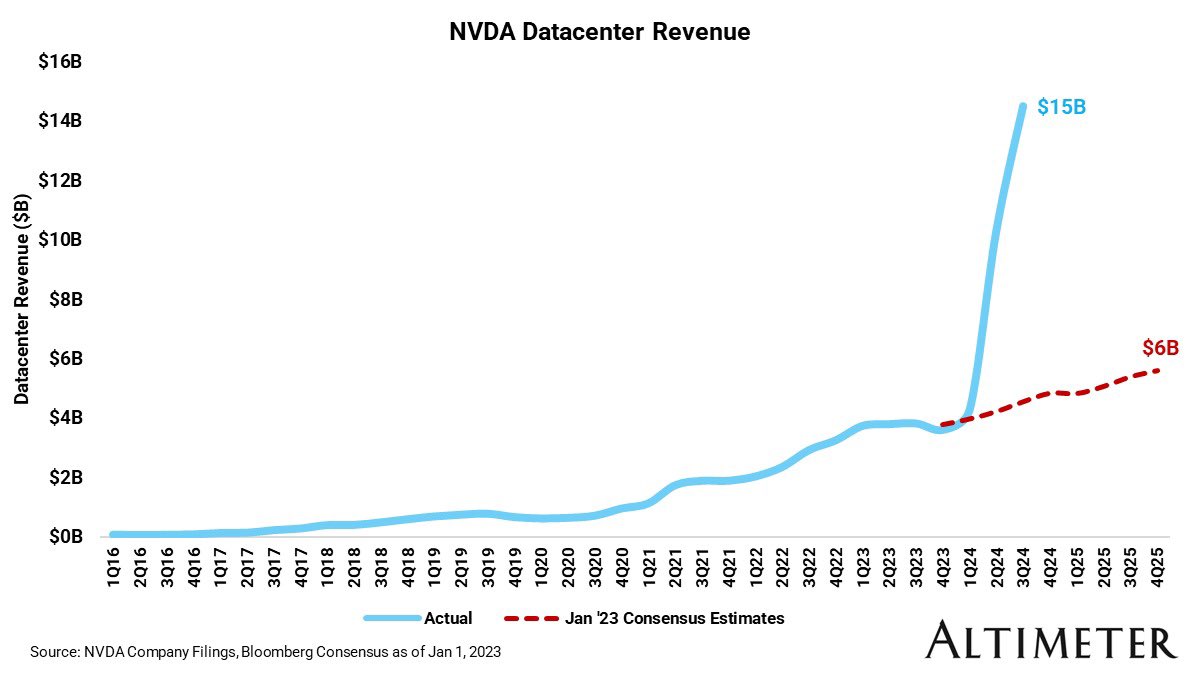
Updated this $NVDA chart @paulg recently shared. Added red line = start of ‘23 “professional” estimates. Full year estimate moved from $17.7 B to $45.8B! Now big debate over sustainability. Never seen estimates this far off the actual mark. @_clarktang #variantperception
Brad Gerstner tweet media
English
33
53
512
207.4K
Gavin Baker
Gavin Baker@GavinSBaker·
The OpenAI saga will be over when: 1) The new 9 person board is in place. The eventual composition of this board will be critical for the balance between safety and speed - essentially the goals of the nonprofit vs. the goals of the for-profit. 2) The investigation is concluded. 3) The governance structure between the nonprofit and the for-profit is clarified. Especially around the AGI clause that would nullify the commercial agreement with Microsoft. That clause likely makes it slightly harder for the for-profit to raise money going forward now that any reasonable probabilistic timeline for AGI has been accelerated. And obviously this clause is a focus for Microsoft now. Am curious to see how any changes to the governance structure might impact the legality of the original shift away from a pure nonprofit. Wild times. Hoping for a multipolar AGI world as a human.
English
28
52
491
225.2K
Tyler Winklevoss
Tyler Winklevoss@tyler·
#Bitcoin is the only commodity in the world with a supply that’s is known, fixed, and immune to increases caused by technological breakthroughs.
English
225
417
3.4K
0
Turner Novak 🍌🧢
Turner Novak 🍌🧢@TurnerNovak·
@plaffont why do you think it's so easy to undersize TAM? Any things you do to better guide yourself?
English
2
0
7
0
Philippe Laffont
Philippe Laffont@plaffont·
1/ How do you build long term performance?  Warren buffet is 90. Half of his net worth was accumulated in the first 60 years and another half in the last 10. So stay healthy because the last 10 years matter! But what are the super long term skills every investor needs to master?
English
91
543
3.3K
0
Philippe Laffont
Philippe Laffont@plaffont·
@cactusmaac 3 capital sins. The 3 F. Frauds, Fads and Fades. All equally dangerous.
English
3
3
18
0
cactusmaac
cactusmaac@cactusmaac·
@plaffont Would that mean you would have invested in Theranos? Plenty of people were convinced by Elizabeth Holmes.
English
1
0
1
0
Hamza
Hamza@HAlfadel·
@plaffont Thanks for the great thread @plaffont. Can you expand on your risk management rules/strategy?
English
1
0
17
0
Philippe Laffont
Philippe Laffont@plaffont·
PS/ Meanwhile here are my two favorite books about growth investing. The first is obvious. The second one is a total gem and maybe my favorite investing book of all time.    Mindset by C. Dweck Engines that move markets by A. Nairn
English
61
115
1.4K
0
Philippe Laffont
Philippe Laffont@plaffont·
10/ I used to think it was all stock picking. Truth is, risk mgt is half the battle. Portfolio mgt is like poker, you don’t always get perfect cards and you need to manage your stack. My risk mgt is broken down between rules I never break and principles that reinforce good habits
English
18
58
605
0