

Sai 🇺🇸
4.2K posts

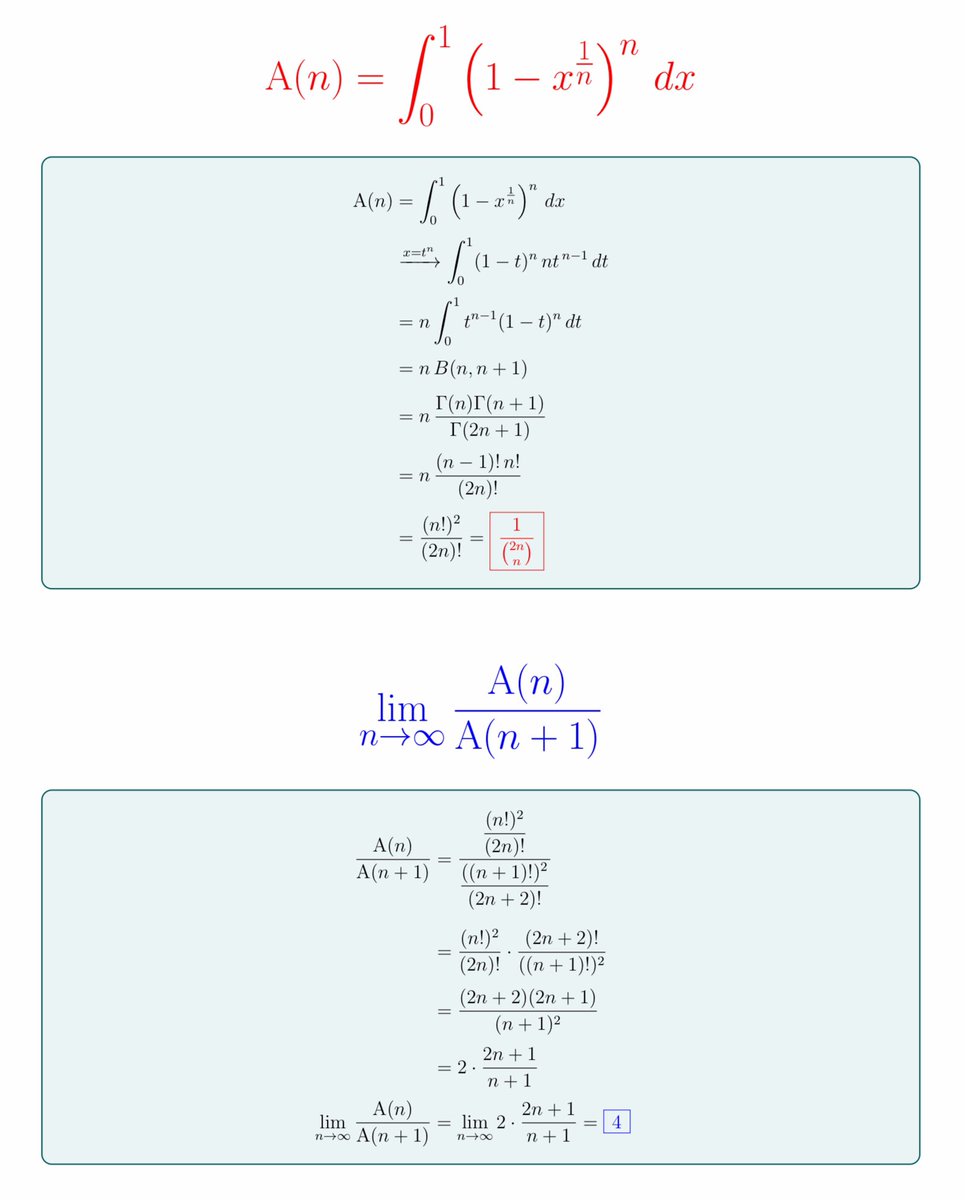
Here’s my solutions to the related problems shared by @tekkinoho. I used the β and gamma functions.
数学鉄騎農法/たくろう@tekkinoho
いただいた問題です!なんだっけこの関数...
English
Sai 🇺🇸 retuiteado

Aurora being visible on both poles in a single shot here also is a nice demonstration of the magnetic poles of the earth being off axis from the rotational "true" north-south axis.

NASA@NASA
We see our home planet as a whole, lit up in spectacular blues and browns. A green aurora even lights up the atmosphere. That's us, together, watching as our astronauts make their journey to the Moon.
English
@Bl00dOld @ComicDaveSmith If you’ve been in 40 bar fights, perhaps your prefrontal cortex isn’t properly developed.
Not the own he thinks it is lol.
English



I see your fake picture of me, and raise you an actual picture of you. Fuckin dork.

Catturd ™@catturd2
If you get your political advice from this Low IQ loser - seek help.
English

“I'm sorry, Dave. I'm afraid I can't do that.”

Polymarket@Polymarket
JUST IN: Artemis II crew experiences issues with Microsoft Outlook on their way to the Moon, asks ground crew for assistance.
English
Sai 🇺🇸 retuiteado



Disney employed 2,200 animators who made Lion King, Beauty and the Beast, Aladdin, and Tarzan. By 2013, nearly all of them were gone. Fired. The people who built Disney’s legacy were shown the door because executives thought the problem was 2D animation. It wasn’t. It was bad storytelling.
cinesthetic.@TheCinesthetic
At what point did Disney think it was a good idea to stop making animation this incredible?
English

The outline of the window in the corner makes this one of the sickest photos I've ever seen
NASA@NASA
We see our home planet as a whole, lit up in spectacular blues and browns. A green aurora even lights up the atmosphere. That's us, together, watching as our astronauts make their journey to the Moon.
English
Sai 🇺🇸 retuiteado
This photo of Earth is EXTRA spectacular for a good reason... let me explain. Most images you see of Earth from space are the daylight side of the Earth, and it's obviously very bright (see my last image), this means stars are too dim to be seen with that bright exposure setting (low ISO, high shutter and / or stopped down aperture).
BUT this image taken by the Orion crew looks so incredible because you can see the sun is BEHIND the earth, meaning it's night time on the side of the earth facing the crew in this image.
So how do you expose a night time earth from space? Same way you do on Earth! A mixture of opening up the aperture (F4 in this case), cranking the ISO (51,200 here), and using a relatively long exposure (1/4 of a second). We can see the settings used by looking at the exif data from the camera. What this means is our camera is also sensitive enough to see stars in the background of Earth, leading to an extraordinary image!!! GREAT WORK!!! These are the kind of images I've been so excited to see!


NASA@NASA
We see our home planet as a whole, lit up in spectacular blues and browns. A green aurora even lights up the atmosphere. That's us, together, watching as our astronauts make their journey to the Moon.
English
Sai 🇺🇸 retuiteado

At what point did Disney think it was a good idea to stop making animation this incredible?
English
Sai 🇺🇸 retuiteado

@aakashgupta $100 Million for something that could be done using free or open source software? Sounds like a waste of tax payer funds to me.
English

NASA pays $100M for Microsoft 365 licensing across the agency. They standardized every system on Microsoft. They put Microsoft Surfaces on the Orion spacecraft as the crew's personal computing devices.
And the first technical crisis of humanity's return to the Moon was Reid Wiseman radioing Houston to say he has two Microsoft Outlooks and neither one works.
Mission Control's response? "With your go, we can remote in and take a look." The same exact workflow your company's IT helpdesk uses when you submit a ticket on a Monday morning. Except the user is traveling at 4,275 mph, 30,000 miles from Earth, and the Wi-Fi situation is considerably worse.
This spacecraft survived hydrogen leaks, helium leaks, a faulty heat shield, and a broken toilet. Outlook broke anyway. The toilet actually got fixed faster.
The real story here is that Microsoft has achieved something no other software company in history can claim: a support ticket from lunar transit. Their enterprise sales team should frame this. "Battle-tested in space" is a positioning statement most B2B companies would mass murder for, and Microsoft accidentally earned it because Outlook crashes everywhere, including orbit.
Outlook remains the only software in human history that performs identically whether you're in a cubicle in Redmond or aboard a spacecraft bound for the Moon. Universally, reliably broken. And we keep buying it anyway.
Polymarket@Polymarket
JUST IN: Artemis II crew experiences issues with Microsoft Outlook on their way to the Moon, asks ground crew for assistance.
English
Sai 🇺🇸 retuiteado

Nominal translunar injection burn complete. The Artemis II crew is officially on the way to the Moon.
America is back in the business of sending astronauts to the Moon. This time, farther than ever before.
English
Sai 🇺🇸 retuiteado


literally every single conspiracy theory has been proven right this year and the flat earth theory keeps getting proven wrong im in tears😭😭
FearBuck@FearedBuck
Artemis II captures images of Earth that show the Earth is NOT flat
English

@Math_files Current president of Romania solved it
en.wikipedia.org/wiki/Nicu%C8%9…
English

This problem is widely remembered as one of the most difficult mathematics problems of its time, originating from the International Mathematical Olympiad.
In 1988, when the IMO was held in Australia, the final question—Problem 6—became legendary for its extreme difficulty.
Only 11 students managed to achieve a perfect score on it.
Even Terence Tao, a 13-year-old prodigy representing Australia at the time and later a Fields Medalist—the highest honor in mathematics—scored just one point on this problem.
What makes the story even more remarkable is that when the problem was reviewed by the panel of experts before the exam, even they were unable to solve it. Despite this, it was still included in the competition.

English


Sai 🇺🇸 retuiteado

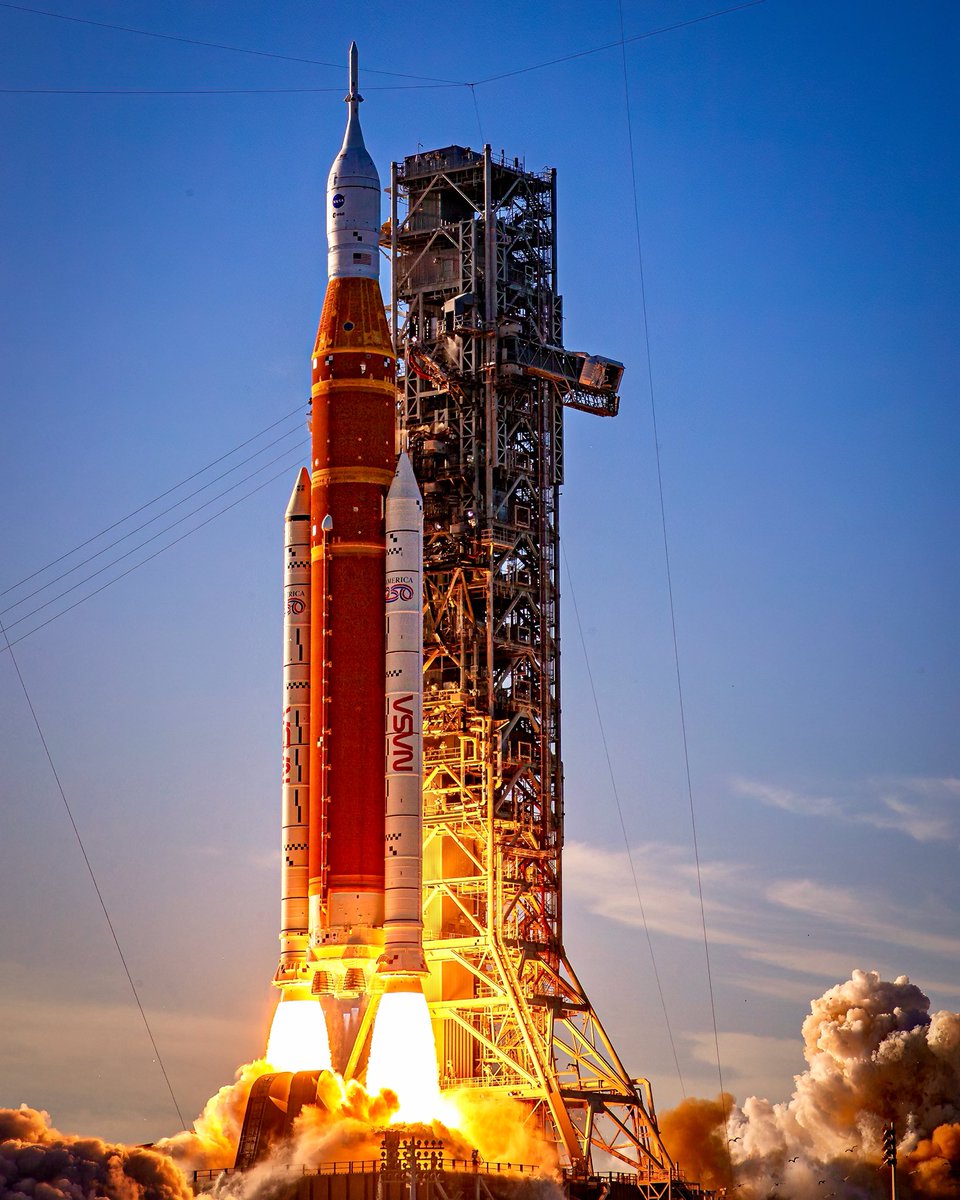
This is the shot you can’t get from the press site. This camera was sitting a few football fields from the SLS rocket at Pad 39B for days before launch, baking in the Florida sun, surviving rain, humidity, and whatever else the Cape threw at it. No photographer behind the viewfinder. Just a camera, a sound trigger, and a bet.
The way pad remotes work: you set your camera up days in advance, dial in your composition, lock everything down, and walk away. You don’t touch it again until after the launch. The shutter fires on sound activation
with a @MiopsTrigger smart+ trigger. With SLS, the four RS-25 engines ignite six seconds before the solid rocket boosters, so the camera is already firing before the vehicle even leaves the pad. You get home, pull the card, and find out if you nailed it or if a bird landed on your lens two days ago and left your a present and you got 400 photos of soemthing crappy.
There’s no formula for protecting your gear this close. Some photographers build wooden boxes with doors that pop open. Some use plastic bags and tape. Some do plastic or metal barn door rigs on hinges. I tend to leave mine open just in plastic rain covers because boxes limit my composition and setup time, but that means your cameras are more exposed to the elements and whatever energy and debris comes off the pad. You’re basically gambling a camera body every time you set one.
That’s what I love about this genre. There’s no playbook. You make it up as you go. Every time is an adventure.
📸 credit: me for @SuperclusterHQ - Artemis II pad remote | ~1,000 ft from Pad 39B | Kennedy Space Center
English
Sai 🇺🇸 retuiteado

🚨 This was the Artemis II crew's view this morning from 41,756 miles (67,200 km) up
No human has seen a crescent Earth in full since 1972

English
Sai 🇺🇸 retuiteado

Sai 🇺🇸 retuiteado
