

This app is doomed
682 posts






Bitcoin is digital cash - except you're carrying around *the entire world's cash in your pocket* - you just have an infinitesimally small part of it which is spendable by you.
This is "The UTXO set."
If you're carrying around a 500 mile high stack of paper, 40% of which is drawings of d*ck-butts it makes sense to figure out how get it under control.
Mechanic #BIP-110@GrassFedBitcoin
@Mandrik And they call me a rhetorician. You have discernment - use it. 0.00119% of the finite supply is taking up ~40% of the chainstate. If you run a pruned node the chainstate is *94%* of the space your Bitcoin node is using.
English


I am pleased (and relieved) to announce that the ReducedData Temporary Softfork has received an official number assignment: 110.
You may now refer to the proposal as "BIP-110" instead of "the RDTS".
Murch@murchandamus
Two new BIP numbers were assigned. BIP 89: Chain Code Delegation for Private Collaborative Custody – github.com/bitcoin/bips/p… BIP 110: Reduced Data Temporary Softfork – github.com/bitcoin/bips/p…
English
@GrassFedBitcoin Politicians have entrenched themselves within the system. It’s pointless to try to reason with them. Burn down their system.

English
I watched the context.
She thinks Bitcoiners are ick.
She implies her disgust is nothing more than the result of having adopted the general sentiment in SV.
A dev persuades her to ignore that and look at the code.
She realizes Bitcoin *itself* is not necessarily ick.
She is surprised that Bitcoin is software you can compile and run with a couple of commands in terminal - that checks out because when you come from DINO (decentralized-in-name-only) crypto into an ecosystem where people actually fight for sovereignty, stuff like that is intentionally made possible *on a practical level*.
No one is typically running nodes in other cryptos as no one has bothered to make it possible for "rednecks". It's just a dev circle jerk and a bunch of gamblers.
She then fails (and continues to fail) at drawing a link between the mentality of icky Bitcoiners and the fact that it isn't more dev-daycare + casino nonsense.
She was shielded from the culture she remains in contempt of it along with most Core devs who share her values but are smart enough not to reveal them on publicly.
Those values are completely incompatible with Bitcoin and result in telltale signs such as frustration with "lack of features" in Bitcoin along with unrealistic expectations of what users can/will tolerate, and a general failure to understand Bitcoin at a "constitutional" level.
(For what it's worth, I had those same values when I was in my early 20s. It's all just vanity, arrogance, and inexperience masquerading as concern for the disadvantaged and downtrodden whom you not-so-secretly despise anyway - hence the open disdain for "rednecks" and such who have chosen to use Bitcoin to escape fiat slavery rather than found it to be a "pretty neat toy if only people were more open minded".
Bryan Jacoutot@BryanJacoutot
It is extremely disingenuous to cut this clip and imply she's anti-Bitcoin in any way. If you watch it in context, she was talking about a LEARNING experience she had meeting bitcoiners in real life vs. what the general view of them was in Silicon Valley.
English
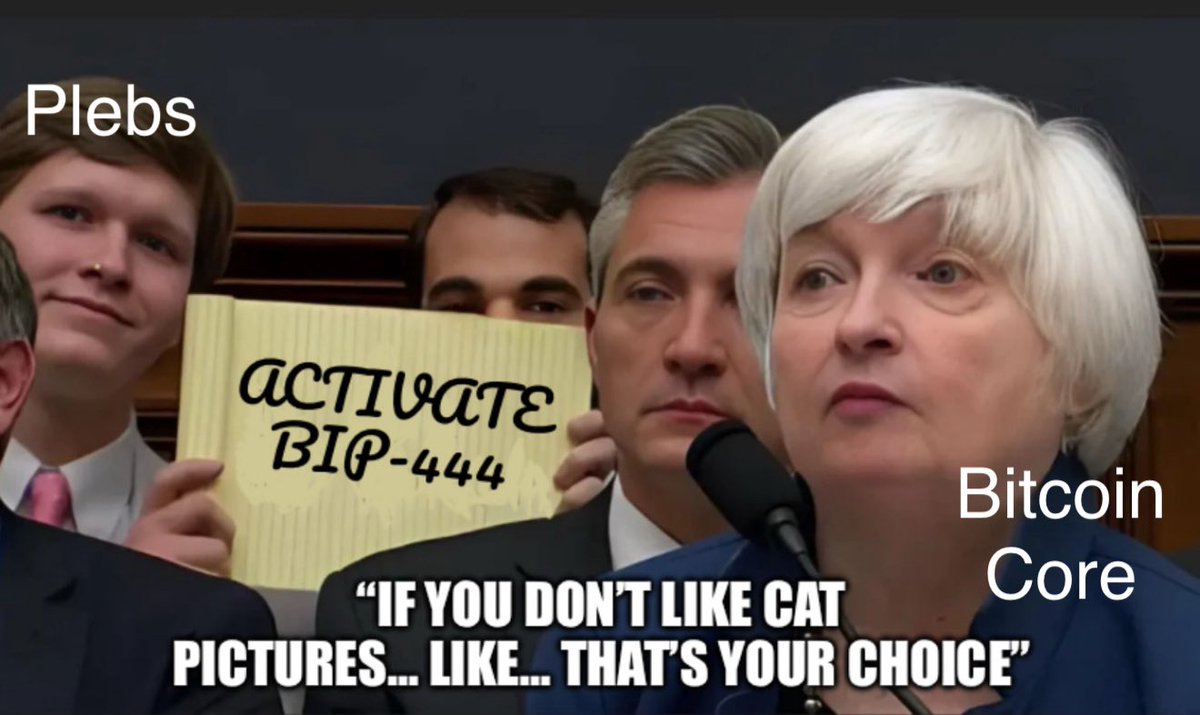

Why does this Bitcoin Core maintainer hate Bitcoin maximalists so much? Is it really so "narrow-minded" to hate shitcoins? Ironic, too, that she is against "gate-keeping" given Core's recent behavior
Laserman@Laserman_21
It's time to make the switch to @BitcoinKnots #Bitcoin
English
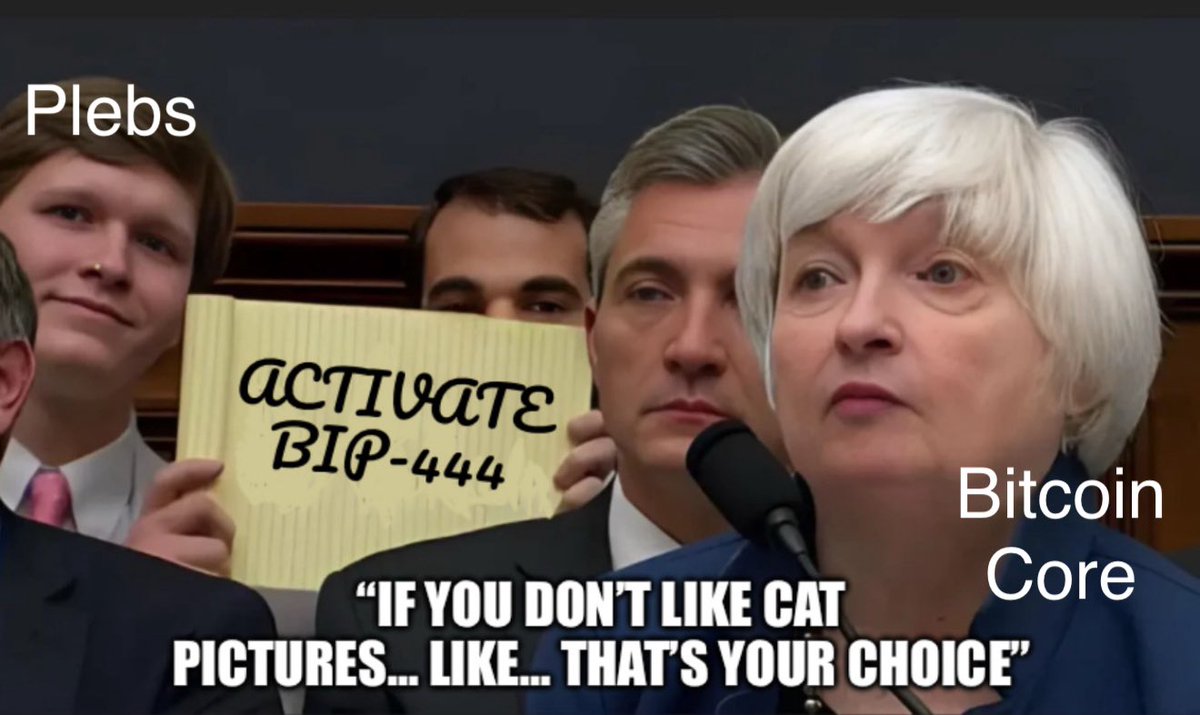

BIP444 is receiving negative feedback. GMax on ML comments that it still has confiscation risk, and the proposal will still fail at its stated purpose.
Deployment risks and policy risks also concerning.

English

@gardling @lifofifo @mike_4131 @BitcoinBombadil @CatoTheElder17 @bitcoin_eagle @4moonsettler @SuperTestnet @woke_bitcoiner @HodlBits @mononautical Bitcoin needs to commit to rejecting data storage in consensus.
Once this precedent is set, filtering data spam in policy will be straightforward.
English


“BIP 444”:
- Most invasive protocol change ever proposed
- Moti/Rationale consists almost entirely of FUD
- Predictably controversial
- Inactive BIP Editor with personal involvement “assigns a number” within hours on X (🙃), because “it might activate before he gets home”
English


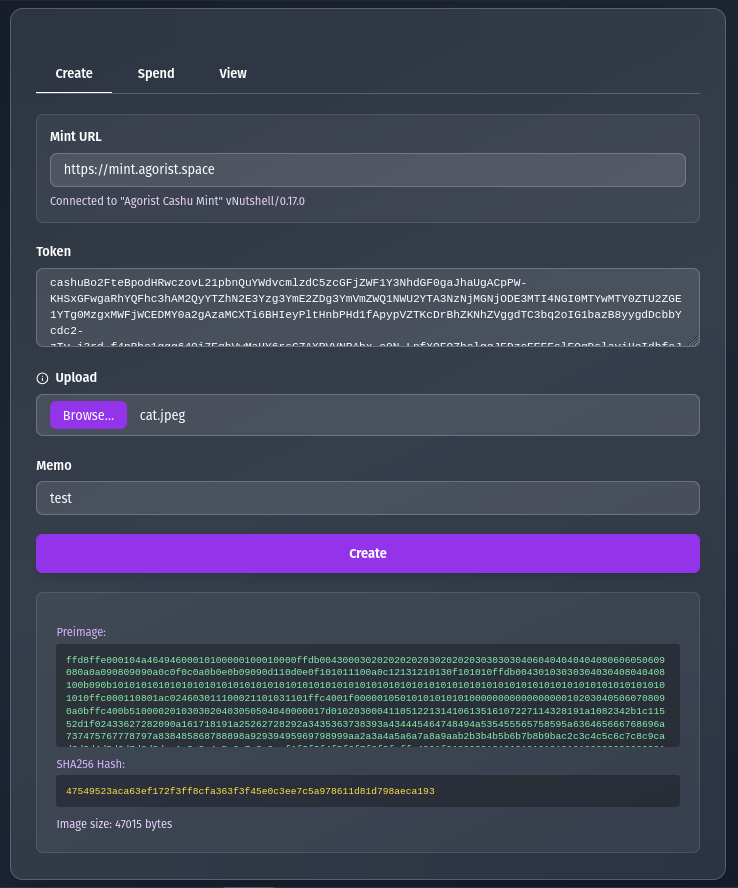
This app is doomed retweeté

My fellow plebs,
BIP444 won't create new coin, it would be the coretards who will be creating new coin with their URSF...!!!
Must watch video from @GrassFedBitcoin...!!!
THERE IS NO DOWNSIDE IN RUNNING UASF BUT THERE IS 100% DOWNSIDE IN RUNNING URSF.
CORETARDS ARE GOING TO FUCK AROUND AND FORK OUT...!!!
SUPPORT BIP444 😎😎😎
END THE SHITCOIN CORE...!!!
Bitcoin_To_The_Oblivion/ BIP110@BTCtoOblivion
As bitcoin is asymmetric bet to get out of tyranny of the state, BIP444 (which is UASF) is asymmetric bet to get out of tyranny of the communist core devs. @GrassFedBitcoin has done phenomenal job explaining UASF for plebs. SUPPORT BIP444 LONG LIVE BITCOIN 😎😎😎 END THE SHITCOIN CORE...!!!
English
This app is doomed retweeté

@BTClovera @adam3us @BitMEXResearch @SFakamoto @rot13maxi @nilskp @Excellion @NickSzabo4 @zamir591582 @satflation @jabulanijakes Nothing to do with me. You should learn what words mean.
English
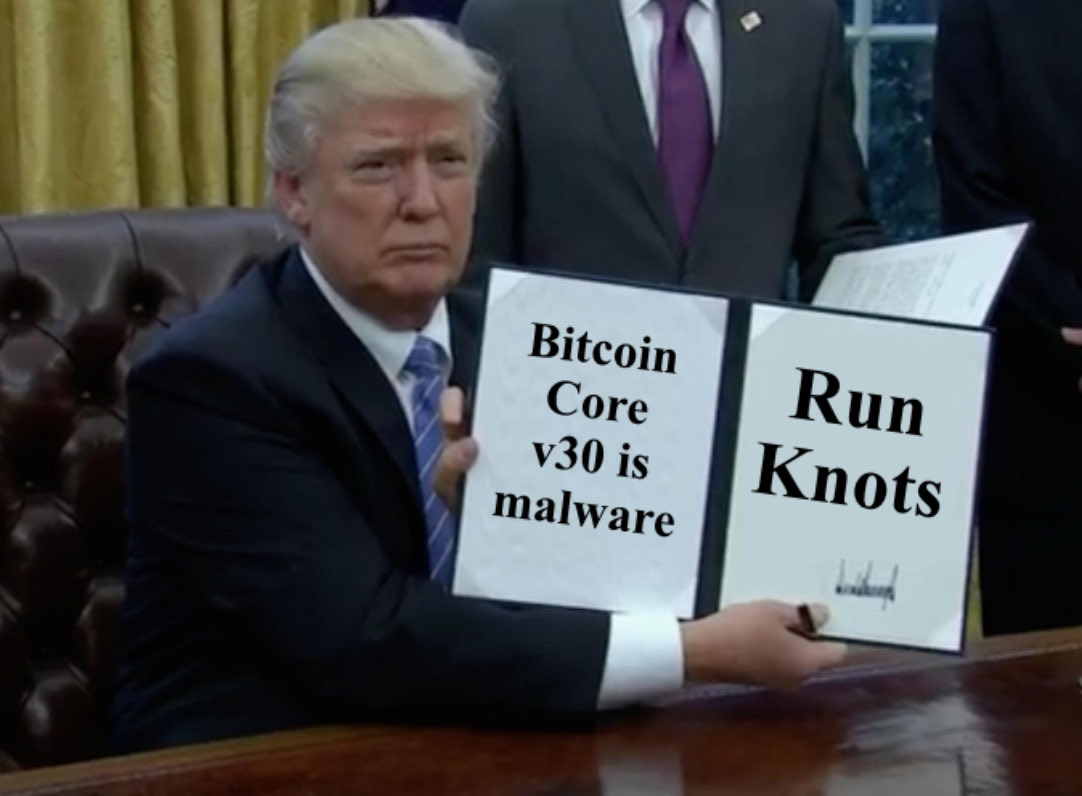

Bitcoin Core v30.0 was released!
It is available from: bitcoincore.org/en/download/
Release notes: bitcoincore.org/en/releases/30…
English

A new release candidate of Bitcoin Core, v30.0rc3, is available for testing.
This is a new major release, and follows v29.0.
It is available here: bitcoincore.org/bin/bitcoin-co…
Work-in-progress release notes are available here: github.com/bitcoin/bitcoi…
English

The Adam Back fallacy in full effect.
x.com/GrassFedBitcoi…
English
@GrassFedBitcoin The noncentral fallacy is a reasoning error where someone categorizes something based on a non-essential or atypical feature, leading to a misleading conclusion. It involves mislabeling something as part of a category to exploit the emotional or moral weight of that category,

English
"It is more important that Bitcoin remains censorship resistant."
This specific non sequitur is used to the point where it deserves a name - I hereby dub it the Adam Back fallacy.
Example: I bought a car, the clutch broke 500 miles later so I took it back to the dealership. They responded by saying "It's more important that Bitcoin remains censorship resistant"
English
This app is doomed retweeté


@callebtc @nonexistent_iam The all-or-nothing logical fallacy, also known as the false dichotomy or black-and-white fallacy, occurs when a situation is presented as having only two mutually exclusive options, ignoring any middle ground or alternative possibilities.

English

This is a long post that hopefully bridges some gaps between technical people (devs) and non-technical users and how they look at spam prevention in Bitcoin. I hope that it clarifies why I think that there is such a huge misunderstanding between both camps.
I'll preface this post with first disqualifying any malicious attempts to misrepresent the motives of either camp. Everybody wants to improve Bitcoin as money. Money is Bitcoin's use case. It's not a data storage system. If you think otherwise, there are countless shitcoins to play with.
Alright, let's get into it.
I have worked on anonymous systems for over a decade. I have read tons of research on spam detection, rate-limiting, and I've implemented spam prevention techniques in the real world.
I am very confident to say that there is not a single known method to prevent spam in decentralized anonymous open networks other than proof of work.
This is what Satoshi realized when he designed Bitcoin and it's why only transaction fees can reliably fight spam without sacrificing any of Bitcoin's properties.
Let me explain.
Spam prevention is a cat and mouse game. As a system's architect, your goal is to make the life of a spammer harder (increase the friction). This is why, on the web, you see captchas, sign-ups, or anything that can artificially slow you down. Slowing down is key. This is why Satoshi turned to proof of work.
Let's contrast this to other methods for spam prevention. This is not an exhaustive list but it illustrates the design space of this problem, other methods are often derivatives of these:
CAPTCHAS are a centralized form of proof of work for humans: Google's servers give you a hard-to-solve task (select all bicycles) that will slow you down so that you can't bombard a website with millions of requests. It requires centralization: you need to prove Google that you're human so that you can use another website. If you could host your own CAPTCHA service, why would anyone believe you're not cheating?
LOGINS with email and passwords are most popular way to slow down users. Before you can sign up, you need to get an email address, and to get an email address, you often need a phone number today. The purpose of this is, again, to slow you down (and to track you to be honest). It only works well when emails are hard to get, i.e. in a centralized web where Google controls how hard it is to get an email account. If you could easily use your own email server, why would anyone believe you're not a bot?
The next one is the most relevant to Bitcoin:
AD BLOCK FILTERS are another form of spam prevention but this time the roles are reversed: you as a user fight against the spam from websites and advertising companies trying to invade your brain. Ad blocking works only under certain conditions: First you need to be able to "spell out" what the spam looks like, i.e. what the filter should filter out. Second, you need to update your filters every time someone circumvents them. Have you ever installed a youtube ad blocker and then noticed that it stops working after a few weeks? That's because you're playing cat-and-mouse with youtube. You block, they circumvent, you update your filters, repeat.
The fact that you need to update your filters is critical and that's where it ties back to Bitcoin: Suppose you have a mempool filter for transactions with a locktime of 21 because some stupid NFT project uses that. You maybe slow them down for a few weeks, but then they notice it and change their locktime to 22. You're back at zero, the spam filter doesn't work anymore. What do you do?
You update your filter! But where do you get your new filter from? You need a governing body, or some centralized entity that keeps updating these filters and you need to download their new rules every single day. That's what ad blockers in your web browser do. They trust a centralized authority to know what's best for you, and blindly accept their new filters. Every single day.
I hope you see the issue here. Nobody should even consider this idea of constantly updating filter rules in Bitcoin. This would give the filter providers a concerning level of power and trust. It would turn Bitcoin into a centrally planned system, the opposite of what makes Bitcoin special.
This is why filters do not work for decentralized anonymous systems. They require a central authority. Until now, these rules were determined by Bitcoin Core, but they have realized that these rules do not work anymore. Transactions bypass the filters easily and at some point, carrying them around became a burden to the node runners themselves. Imagine you're using an outdated ad blocker but instead of filtering out ads, it now also filters out legitimate content you might be interested in. That's what mempool filters do, and that's why Bitcoin Core is slowly relaxing these filters. This has been discussed for over two years, it's not a sudden decision.
The goal of this change is not to help transactions to slip through more easily. The goal is to improve your node's prediction of what is going to be in the next block. Most people misrepresent this part. They say "it's to turn Bitcoin into a shitcoin" but that is just a false statement at best, or a manipulation tactic at worst.
Let's tie it back to proof of work and why fees are the actual filter that keeps Bitcoin secure and prevents spam reasonably well: Satoshi realized that there is no technique that could slow down block production and prevent denial of service attacks in a decentralized system other than proof of work. Fees prevent you from filling blocks with an infinite number of transactions. All the other options would introduce some form of trust or open the door for censorship – nothing works other than proof of work.
He was smart enough to design a system where the proof of work that goes into block production is "minted" into the monetary unit of the system itself: You spend energy, you get sats (mining). This slows down block production. How do you slow down transactions within those blocks? You spend the sats themselves, original earned form block production, as fees for the transactions within the block!
This idea is truly genius and it's the only reason why Bitcoin can exist. All other attempts of creating decentralized money have failed to solve this step. Think about it: without knowing who you are, whether you're one person pretending to be a thousand, or a thousand people pretending to be one. Bitcoin defends itself (and anyone who runs nodes in the Bitcoin system) from spam by making you pay for your activity.
People sometimes counter this by saying: the economic demand for decentralized data storage is higher than the monetary use case. First of all, I think that's just wrong. There are way cheaper ways to store data (there are shitcoins for this), and the value of having decentralized neutral internet money is beyond comparison.
However, there's a much deeper concern here. If you truly believe this, I ask you: what is Bitcoin worth to you? If you think Bitcoin can't succeed as money (i.e. be competitive), why do you even care? If you're not willing to pay fees for the use case that we all believe Bitcoin is designed for (money), and you believe that no one is willing to pay for it, how can it even persist into the future?
You can't have it all. If Bitcoin is money (which I believe it is), then we need to pay the price to keep it alive. There is no free lunch.
Either we centralize, or we pay the price of decentralization. I know where I stand.
Peace.
English