

Marcin Jan Puhacz
177 posts
Marcin Jan Puhacz
@marcinph
founding engineer @runlayer ex @lithic ex @stedi
Krakow, Poland Inscrit le Şubat 2017
850 Abonnements243 Abonnés

And this is why Appy.Ai's advanced swarm agents don't use real shell/containers- way too much surface area on top of what is already a hard problem
Andrej Karpathy@karpathy
Software horror: litellm PyPI supply chain attack. Simple `pip install litellm` was enough to exfiltrate SSH keys, AWS/GCP/Azure creds, Kubernetes configs, git credentials, env vars (all your API keys), shell history, crypto wallets, SSL private keys, CI/CD secrets, database passwords. LiteLLM itself has 97 million downloads per month which is already terrible, but much worse, the contagion spreads to any project that depends on litellm. For example, if you did `pip install dspy` (which depended on litellm>=1.64.0), you'd also be pwnd. Same for any other large project that depended on litellm. Afaict the poisoned version was up for only less than ~1 hour. The attack had a bug which led to its discovery - Callum McMahon was using an MCP plugin inside Cursor that pulled in litellm as a transitive dependency. When litellm 1.82.8 installed, their machine ran out of RAM and crashed. So if the attacker didn't vibe code this attack it could have been undetected for many days or weeks. Supply chain attacks like this are basically the scariest thing imaginable in modern software. Every time you install any depedency you could be pulling in a poisoned package anywhere deep inside its entire depedency tree. This is especially risky with large projects that might have lots and lots of dependencies. The credentials that do get stolen in each attack can then be used to take over more accounts and compromise more packages. Classical software engineering would have you believe that dependencies are good (we're building pyramids from bricks), but imo this has to be re-evaluated, and it's why I've been so growingly averse to them, preferring to use LLMs to "yoink" functionality when it's simple enough and possible.
English

English
Marcin Jan Puhacz retweeté

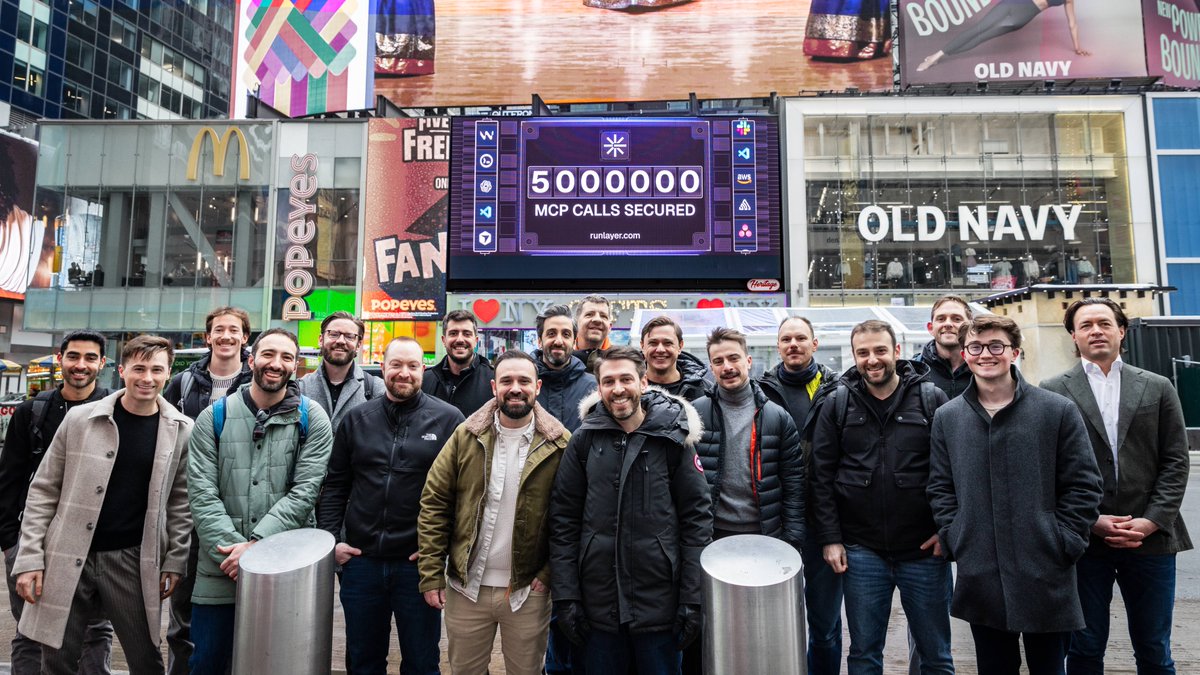
This week, our team celebrated in Times Square: 5,000,000+ MCP calls secured with @Runlayer.
That’s a massive milestone, with a massive billboard.
AI is moving at breakneck speed, and we love that. But every new tool introduces new security risks.
We’re building Runlayer so no organization has to choose between adopting AI and protecting what they’ve built.
5,000,000+ secured MCP calls means thousands of agents, workflows, and AI products running with real guardrails in place. It means peace of mind for our enterprise customers like Gusto & Opendoor.
Huge congrats to the team. And a genuine thank you to our customers.
English
Marcin Jan Puhacz retweeté
Code is no longer the bottleneck.
The pr approval is
Sam Altman@sama
GPT-5.3-Codex-Spark is launching today as a research preview for Pro. More than 1000 tokens per second! There are limitations at launch; we will rapidly improve.
English
Marcin Jan Puhacz retweeté
Today, we're launching OpenClaw for Enterprise.
The IDEA of OpenClaw is excellent.
That's why your employees already tried ClawdBot last weekend. They probably spent hours linking it to everything - email, Slack, Jira, you name it.
They installed a giant security nightmare.
1/
English
English

@knowclarified I cancelled 2 weeks ago. One of their updates broke an MCP I use regularly and I can still use the free version for my janky junk coding then run it through Windsurf with Opus to refine the results.
English

@jamonholmgren This - the bottleneck was always human attention
English

Bit by bit, we are starting to see what the new AI assisted software development world is going to look like for the next several years.
My current (still evolving) take:
- Massive unleashing of experimental work, proofs of concept, rough drafts
This should lead to a huge boost in the amount and creativity of software products that come to market, at the cost of a sudden increase in noise, a veritable din
- Significant decline in average code quality
Some code gets better, a lot gets worse, and the limitations of the current technology and unlocking less experienced developers to create software will lead to a near crisis in poorly built products in the near term
- Large proliferation of tools
As we scramble to adapt, experimentation and perspectives will lead to a vast array of possible solutions, each with their own sets of tradeoffs. Reminds me of the early days of Web 2.0, where there was a new framework every week and they all sucked
- Some emerging best practices
Over the past 6 weeks I have talked to many very experienced developers (often 1 on 1 video calls), and we are now starting to circle some common threads for AI-assisted software dev best practices (these are off the cuff, so don’t expect perfection):
1. Slow down, learn the tools, figure out the tradeoffs
2. Quality still matters when it matters; often, the existing models and tools fall short of maintaining that quality on larger code bases
3. The developer is responsible for the code they ship
4. Documentation (via skills, tasks, or just markdown docs) is tremendously helpful, but you should also understand it, not just rely on the AI to
5. High level architecture is still an area where a human with a lot of experience can add a ton of value
6. AI is not a substitute for good taste (and caring about things)
7. Some techniques are locally productive and globally harmful (more on this below)
8. The bottleneck is in review, understanding, and higher level systems architecture more so than coding speed.
9. Some developers are more adept than others at various parts of this new value chain. Current teams are full of developers vetted for and hired to do one job who are facing a significantly different way of doing it.
10. Coding itself might get done a different way, but the fundamental engineering patterns are often still extremely important. Not in cases where it’s just about satisfying some developer love of symmetry, but definitely in domains like data modeling and the like.
More on local optimization vs global concerns: agent chains like Ralph and aggressive code gen can feel incredibly fast, but tend to accumulate inconsistencies and tech debt over time. Speed at a file/feature level does not guarantee speed at the overall system level, and I have felt this personally when I’ve leaned too hard on such tools.
- We will learn more as time moves on. Be kind
We are adapting, evolving, playing with the tools, sharing, feeling the bruises when we get it wrong. There are educators trying to stay ahead of it and provide value. There are normal devs just trying to make a living, and stay relevant. None of this is as unique to you as you might think — I hear from others, and they’re feeling the same pressures. Be kind to each other
English
English

for @openclaw i only need a mac mini if i plan to have iMessage right?
English
people buying six mac minis just to run claude code on each was not on my 2026 bingo card
English

Just bought a Mac Mini to setup Clawd lets goooooo AGI is here

English
Marcin Jan Puhacz retweeté

Your team is running MCP servers you don’t know about.
Different clients, different devices, no central view.
That’s a security problem.
Our latest release fixes that.
Runlayer 1.25 gives you full visibility into what’s actually running, and the controls to lock it down ↓

English

tip for @cursor_ai that a lot of people don't know about: cmd+period to switch to plan mode! very useful
English
your API is already an e2e test suite - you just havent wrapped it in MCP yet. point your agent at it, say "be paranoid, make no mistakes" it doesnt skip the boring cases.
absurdly effective.
English
belated share - last year we partnered with @cursor_ai on their hooks launch.
its only been a month, and seeing teams adopt it and stick with it has been the best part.
more of these collabs in 2026.
Andy Berman@berman66
We partnered with Cursor to launch Hooks. Hooks let Cursor users observe, control, and extend AI agents with custom scripts. Runlayer handles governance for MCP behind the scenes. Engineers just keep shipping.
English

Cursor is landing in Poland! 🇵🇱
After stops in SF, NY, and London, the global Cafe Cursor series hits #Kraków on Feb 18 9:30 - 16:00
We’re taking over Coffee Garden (Józefa 11) for a full day of building and high-quality caffeine.
Bring your laptop, work on your latest project alongside the @cursor_ai team, and connect with the local dev community.
✅ Free coffee on us
✅ Exclusive Cursor credits for builders
✅ Meet the Cursor engineers
Limited co-working slots (AM/PM) so secure your spot now: luma.com/63yubrr2
Kudos to @benln and @ftnabeelah for your! support

English

I didn't spend much time on it in the post, but the global orchestrator backed by object storage is a fun design: it's SQLite in a configuration where we can scale to indefinitely huge numbers of Sprites. "Multiple SQLite databases" is a design people sleep on.
English
@thdxr >agents love databases and a filesystem is just the worst kind of database
why
English


@RhysSullivan Just use notion MCP and loop your agent to check for new notes
English

i want a "notes app" that i can put thoughts / ideas in and claude picks them up and starts working on them in the background
this is especially wanted for ideas that i think would be cool but don't want to have to setup, where an ai can implement it in the background
English
