

Test test
62 posts

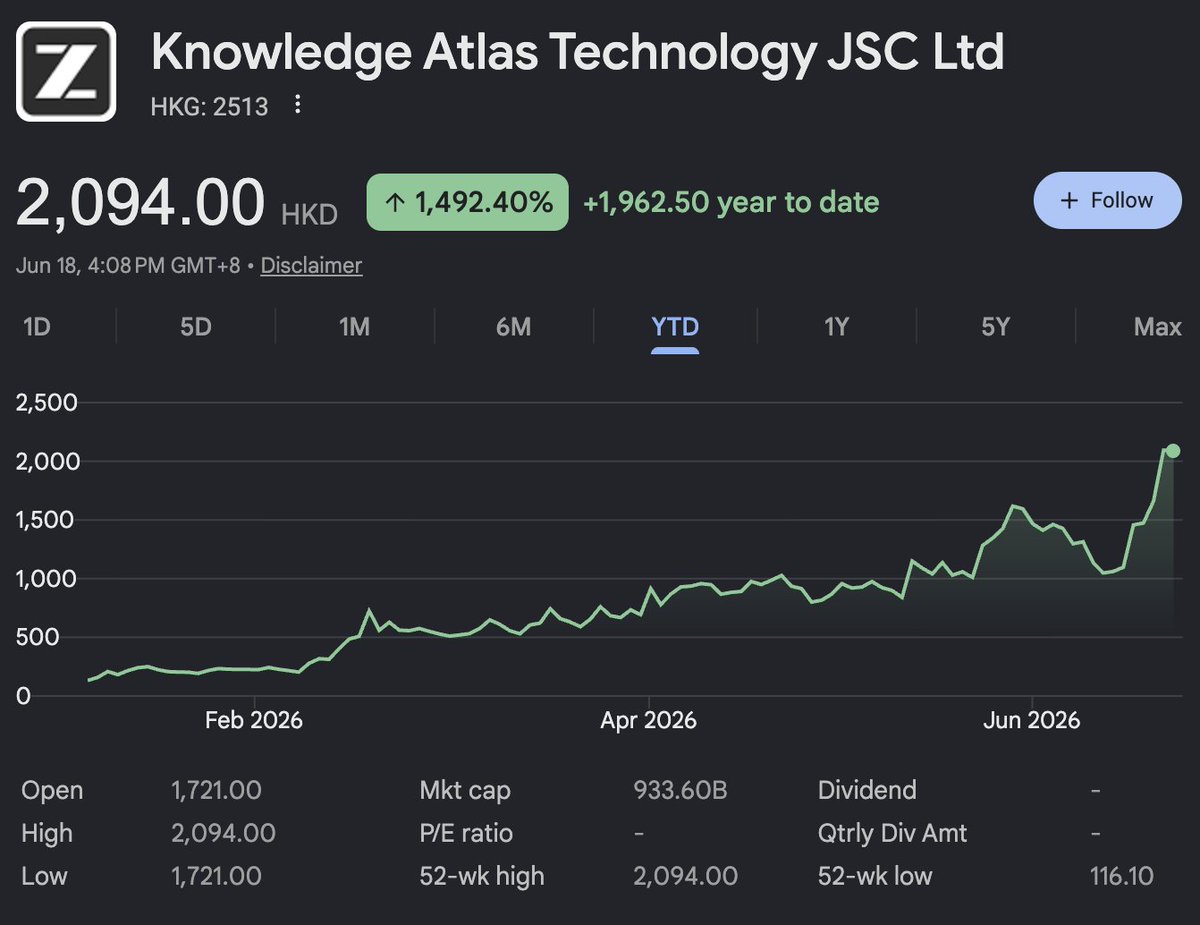
Kinda wild that a Chinese frontier lab was my best performer this year.
Still kicking myself for not sizing heavier when Minimax was trading at a higher market cap than Zhipu.
KawzInvests@KawzInvests
GLM-5.1 just scored 45.3 on the coding benchmark. Claude Opus 4.6 scored 47.9. The gap is 2.6 points. The valuation gap is not 2.6 points.😂 Zhipu AI (HKG: 2513) is up 31% and the market is just now noticing that Chinese labs are shipping models at performance parity with frontier Western labs at a fraction of the valuation. This is the Chinese AI arbitrage thesis playing out in real time. DID YOU LISTEN NEPHEW? 😂😂😂
English

@ScarcityTrade x.com/SouthernValue9…
I’ve been waiting for
An additional catalyst for mirae corp and this speculation may just do it for me…
SouthernValue@SouthernValue95
Heard today that $GOOG is evaluating procuring DRAM from Chinese vendors. Maybe for devices? Would be significant if for cloud.
English

@aleabitoreddit $lpk is ripping!!!! I didn’t see any big news other than sdax inclusion and some potential institutional ownership
English

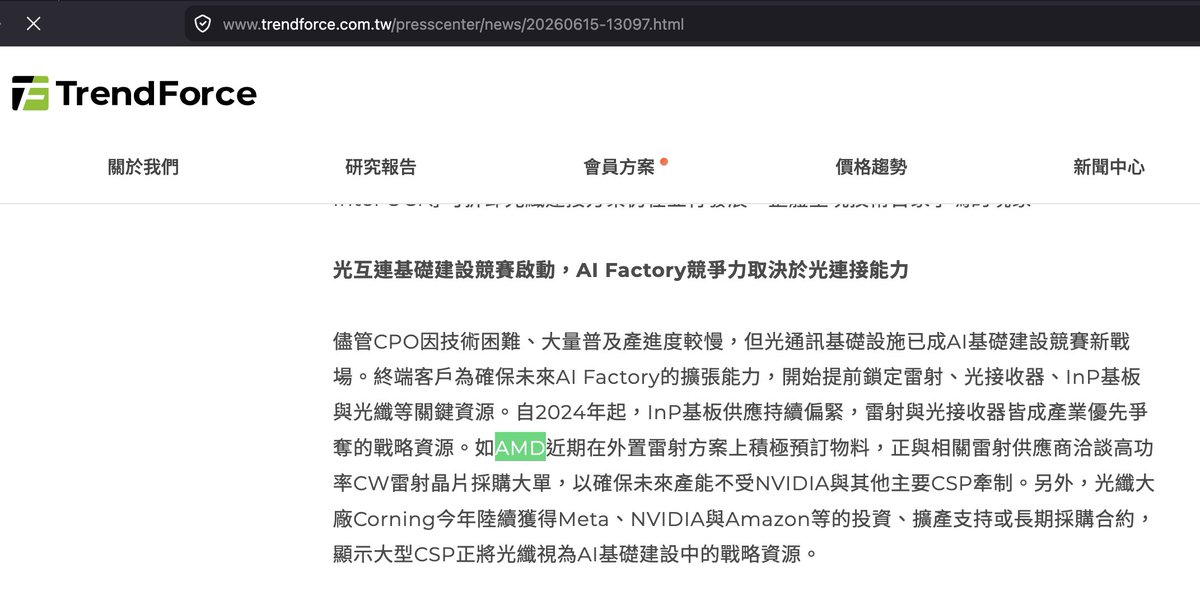
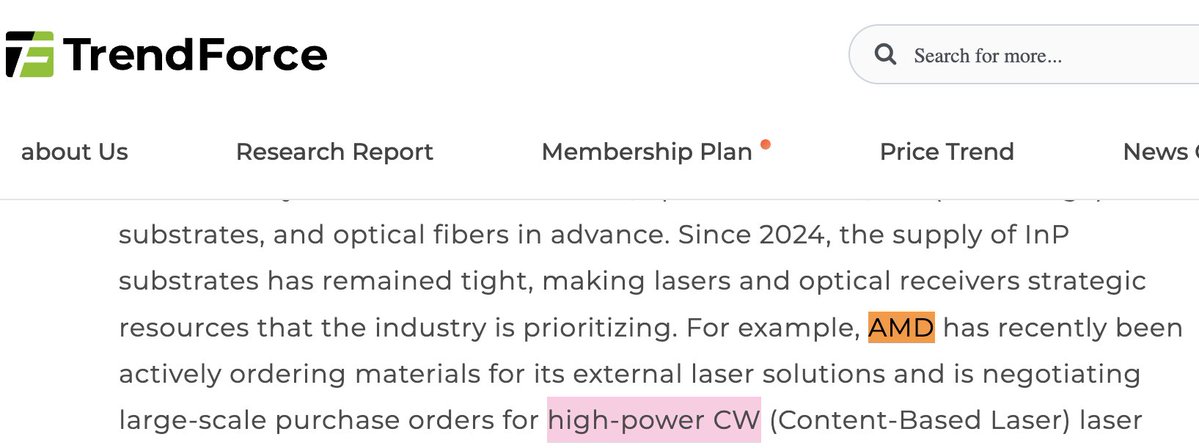
Trendforce reports that $AMD is actively trying to secure CW laser supply with multiple major procurement orders...
Is probably just the start of the bottleneck?
There's not much independent capacity in Western supply chains left other than $SIVE or $AAOI and maybe Macom.
Especially after Lumentum/Coherent got locked up with multi-year agreements with Nvidia. (disclosure, own Sive and aaoi)
Lumentum is already CW laser constrained and is likely buying off Japanese companies like Sumitomo/Furukawa if I had to guess per ER, and those are probably running at max capacity.
From the Trendforce report, this is:
"to ensure that its future capacity will not be constrained by NVIDIA and other major Cloud Service Providers (CSPs)."
I wouldn't be surprised if other hyperscalers like Amazon, Microsoft, and others saw Nvidia / AMD signing LTAs, and are trying to secure capacity next.
A lot of it is game theory on not getting choked out by competitors, and looks like AMD is tipping the first domino after Nvidia.
But my opinion is that this just goes and show how invaluable this CW laser chokepoint is and the companies are inside it.
English

@bubbleboi What does that mean? As in their won’t be shortages anymore?
English

Indium Phosphide is just the beginning wait until GaN & SiC start getting flooded.
RJC@RJCcapital
[DigiTimes]: China approves first exports of Indium Phosphide (InP) substrate in 2026 which should help alleviate bottlenecks in the optical communications market. Very bullish development for $AXTI digitimes.com.tw/tech/dt/n/shwn…
English

hey @jukan05 how late am I to the 800V power-semi trade?
> seems to be one of the most crowded narratives in semis right now and the names already ran 75–210% YTD before pulling back from parabolic June spike
> am I buying the second leg of a consensus narrative at triple-digit sales multiples after a 3x? 😭😭
> what gives exposure to a timeline pull-forward without handing me a busted parabola at 100x sales 😭 maybe $POWI ??
English
@RJCcapital So hard to enter a position that is up over 4000% in a year mentally
English

[DigiTimes]: China approves first exports of Indium Phosphide (InP) substrate in 2026 which should help alleviate bottlenecks in the optical communications market.
Very bullish development for $AXTI
digitimes.com.tw/tech/dt/n/shwn…
RJC@RJCcapital
$AXTI shares are down ~30% after a below-expectations pre-announcement of earnings, but the prior earnings do not change the thesis around InP shortages. I have initiated a position. AXT is one of the few pure-play suppliers of indium phosphide (InP) substrates, a critical material for high-speed optical communications, silicon photonics, and AI datacenter interconnects, and InP supply constraints are emerging as a structural bottleneck in the AI build-out. If demand for InP remains tight and the company’s role in easing that bottleneck stays intact, the fundamental thesis remains unchanged. For investors with a long horizon and conviction in optical/AI infrastructure demand, this sell-off may present an entry point. cc: @aleabitoreddit
English
I don't care about the $SPCX IPO. I want SK Hynix on Nasdaq.
English

China's control over InP exports threatens AI data centre rollout (Reuters).
With 70%+ control over global output.
Just as a reminder on beneficiaries:
-> JX Advanced Metals: ~10% InP share
-> $AXTI: InP >50% Q1'26 rev
-> $LITE: maybe the cleanest large cap beneficiary
-> $COHR: ~1 yr early to 6-inch InP production
-> $IQE: InP is "material growth driver throughout 2026 and beyond"
Sumitomo Electric win in non-Chinese InP but they're so huge that InP revenue is basically a rounding error to them.
Personally treating $AXTI as a trading vehicle separately to my core hold rn after taking decent profits over the past few weeks.
As core holds, I have preference to $LITE / $COHR / $IQE over $AXTI for InP-thematic exposure w/ less regulator risks.
- $LITE for lower China supply beta.
- $COHR for higher InP permit torque if u want it.
- $IQE for the most asymmetry

English
@aleabitoreddit Talk to me about msscorp, and why it’s taken a particular beating
English
Basically this… and it’s how cycles work.
Retail was early and completely frontran institutions on next architectural shifts.
There was close to 0 US institutional ownership on $SIVE.
And now you see active institutions like JP Morgan, Fidelity Research, and others on the cap table.
Happened last year with $NBIS.
> I called out close to <30% institutional accumulation and said they wanted more shares.
> institutions bought up majority of the float
> bunch of negative articles back then, now it’s positive and ATHs.
Two years before it was $RKLB
> Was long at $16, but institutional analysts kept giving record low PTs and told retail to sell, although it had such a high reusable rocket rate.
> retail sold, institutional ownership stocked up
> now it’s ATHs
I expect Foci (3363) to be a bottleneck for both $NVDA and $TSM optical programs and now there’s firms implying you to sell that at $2.5B valuations alongside $HIMX.
So if you see negative sellside reports or an uncanny wave of negative news, if’s a good signal they need liquidity.
Recently some smaller hedge funds have been so desperate that they’re likely even using bot farms on X that told retail to sell lol… which I’ve uncovered recently.
Regardless, it’s also why I spend a lot of time doing research on individual names so people can build their own conviction in the face of noise.
Unfortunately, it’s just a part of life how the modern liquidity cycles/transfers of US retail -> Institutions work.
They don’t work in the best interest of retail investors.
Cyberpunk Sense 👑@napoleon21st
This really is making me wonder. What happened is retail based on @aleabitoreddit and some other frontier analysts front ran the optics/photonics cycle. Then we started seeing statements that $JPM Fidelity etc have been buying $SIVE Now we start hearing a narrative saying "you know what? You're WAY too early with that stuff. You should sell it." So they want us to sell it right as they're accumulating it 🤔
English
@aleabitoreddit What will you be buying? Taiwan stocks are being bludgeoned recently, most notably MSSCORP?
English
CPO scale out earlier than expected:
> Foxconn: est. units register upward and optical switches shipped early to $NVDA
CPO scale up timelines from $LITE Mizuho Technology Conference today:
“The company expects to start shipping Scale-Up optical products in the second half of 2027, with formal volume ramp-up in 2028”
SVP $NVDA networking: “We’re going to ramp up CPO second half of this year”. No delay indications.
I’m gonna go ahead and trust industry projections. Where they all reiterate faster timelines for scale out CPO H2 onward. And scale up CPO H2 2027 onward (with main growth happening 2028)
Over a questionable motive analyst firm that said $MU had no share of HBM4 Rubin (causing a selloff)
Where micron went out shortly later to into enter mass production. (Triple digit return shortly after)
I think people going long on temporary bridge architectures from this incorrect report won’t be too happy.
Appreciate the buying opportunity though.


English
@AstuteKara Honestly I’m thinking about to stop loss on MssCorp and to buy LuxNet 4979 or Lite-On 2301…
English
The Taiwan stock market surged 1,201 points today, yet foreign investors recorded the 8th largest net selling (-NT$91.7 billion) day in history. 😱😱
Massive foreign capital is flowing out of Taiwan…
Hopefully they’re just raising cash to participate in the SpaceX IPO. 🚀😱

English

$DGXX scores a massive win by securing $NVDA highly anticipated, next-gen Vera Rubin platform early.
This $35 million deal is a phenomenal move for three major reasons:
Future-Proof Monopoly: They bypass current Blackwell limits to offer unmatched 288GB HBM4 power by Q1 2027.
Massive Margin Growth: Booking this ultra-premium capacity via NeoCloudz will drive skyrocketing, high-margin AI revenue.
Flawless Financial Health: Funding this entire next-gen revolution purely from cash on hand proves incredible liquidity and zero debt risk.

English
@TesttestI23 @PepInvestStocks lol very likely touch touch the limit down! Will bounce back very quickly.
English
Why this is an absolute goldmine for $SIVE and $SOI:
Compute is scaling faster than data can move.
Silicon Photonics is no longer a "future tech“, it is the only way to feed Next-Gen Blackwell/Rubin ultra-clusters without melting the grid.
$SIVE Being validated in the $NVDA ecosystem means guaranteed, parabolic volume scaling. "Beyond imagination" means their order books are locked for years.
$SOI You cannot build SiPh without Silicon-on-Insulator wafers.
Serenity@aleabitoreddit
On top: $NVDA CEO also called out Silicon Photonics (optical networking) with memory. Stating that Nvidia would require “supply volumes beyond imagination”. What a bullish read through on the SiPH supply chain from $SIVE (now upstream Nvidia ecosystem) to $SOI
English