SlackHook | Local SEO Foundation🚀

4.9K posts

SlackHook | Local SEO Foundation🚀 banner
SlackHook | Local SEO Foundation🚀

SlackHook | Local SEO Foundation🚀

@SlackHookHQ

The local authority layer agencies use before links 🧱 Citation cleanup & trust setup for serious local SEO teams. ⚙️ No logins • 🚫 No spam lists

Bergabung Kasım 2025
99 Mengikuti180 Pengikut
Tweet Disematkan
SlackHook | Local SEO Foundation🚀
Most Local Citation Advice Is Outdated. Submitting your NAP to 200 directories won’t move rankings anymore. Local citations today are about entity control, not directory volume. Here’s how to actually build citations that matter 👇 1️⃣ Lock Your Core Data Sources First Before chasing new listings, fix your foundation: • Data aggregators • Apple Maps • Bing Places • Yelp • Facebook If these are inconsistent, everything downstream inherits the problem. Don’t build on broken data. 2️⃣ Prioritize Visibility Directories, Not “SEO Directories” Ask yourself: If someone searched “[service] in [city]” — Would this site realistically show up? If yes → list there. If no → skip it. Relevance > quantity. 3️⃣ Audit Competitor Citation Gaps Instead of guessing: • Check who links to top 3 local competitors • Identify recurring directories • Prioritize sites with real traffic If 3 of your competitors are listed somewhere and you aren’t — that’s not random. That’s a signal. 4️⃣ Industry & Geo Citations Beat Generic Ones If you’re: Lawyer → Legal directories Contractor → Trade associations Hotel → Travel platforms Plus: • Chamber of Commerce • Local business associations • City-specific directories These move the needle more than generic business lists. 5️⃣ Unstructured Citations > Structured (Long-Term) Blog mentions Local press Supplier pages Event sponsorship pages These: • Strengthen authority • Build brand recognition • Often include real backlinks Structured citations = baseline. Unstructured citations = leverage. 6️⃣ Consistency Isn’t Just SEO — It’s Trust Old phone numbers Old addresses Duplicate listings Merged profiles Google sees confusion → rankings wobble. Consumers see confusion → trust drops. This is where most local volatility starts. 7️⃣ The Real Local Citation Strategy (2025+) Stop thinking: “How many citations do I need?” Start thinking: “Where does my business identity live online — and is it aligned?” Citations are no longer about volume. They’re about entity reinforcement. We built a Local Citation Control Framework we use before rankings start slipping. It includes: • Citation audit map • Competitor gap checklist • Entity consistency lock method • Unstructured citation playbook 🎁 Giveaway We’ll send it to 10 people. To get it: 1️⃣ Retweet this 2️⃣ Follow @SlackHookHQ 3️⃣ Comment CITATIONSTACK We’ll DM the checklist to selected accounts.
SlackHook | Local SEO Foundation🚀 tweet media
English
3
3
6
435
SlackHook | Local SEO Foundation🚀
@glenngabe This tends to become obvious over time, when short-term lifts don’t hold once underlying organic signals start weakening In practice AI visibility usually follows those same foundations, not the tactics layered on top of them
English
0
0
0
18
Glenn Gabe
Glenn Gabe@glenngabe·
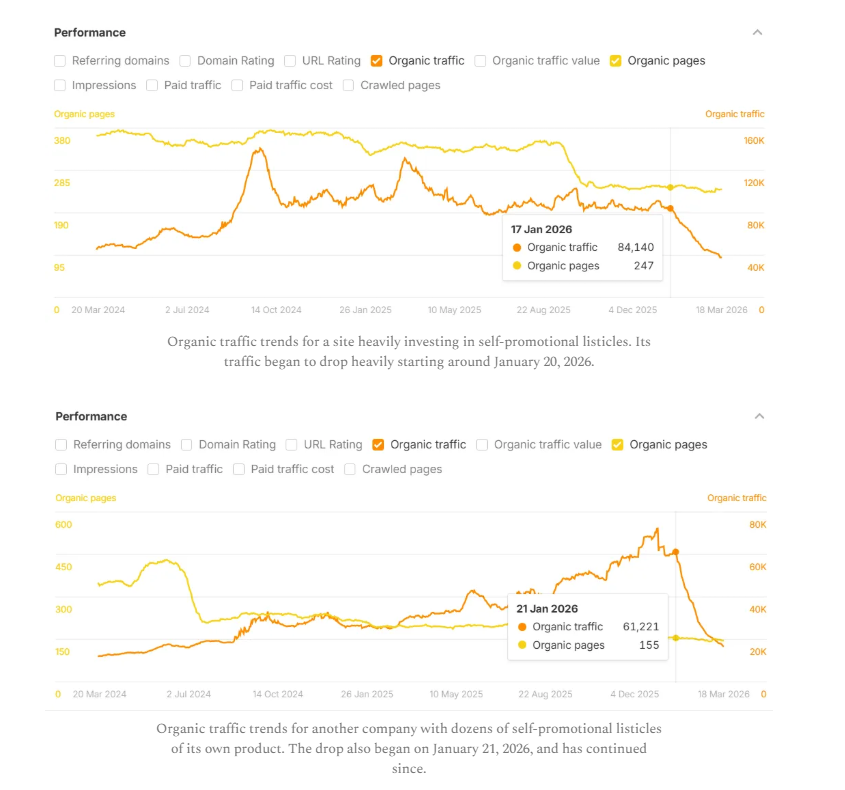
Amazing new post from Lily. Don't destroy your SEO by implementing a bunch of GEO tactics that get you in trouble. And ironically, as you drop in organic search, you'll drop in AI Search. A great quote from the article: "These (GEO) case studies typically fall into one of two traps. The first is relabeling longstanding SEO tactics - structured data, FAQ schema, optimized headlines, bullet points, TL;DRs, directly answering questions, etc. - as novel GEO innovations, when these approaches have been core SEO best practices for years. The second, and more misleading, is claiming GEO credit for AI search visibility that was almost certainly driven by organic rankings the site already had before any GEO strategy was implemented." And: "This is fundamentally a correlation problem. A brand with years of established authority, strong backlink profiles, many brand mentions, and strong organic rankings starts appearing in ChatGPT responses and Gemini citations - and concludes that their new GEO campaign is working. But the more plausible explanation is that their existing SEO visibility is what got them into the search indexes feeding those AI products in the first place." And then there's the visibility trending based on GEO case studies published. The case studies only show the surge of Mt. AI and not the drop. You can see the full picture below, including the drop... BEWARE:
Glenn Gabe tweet media
Lily Ray 😏@lilyraynyc

One of the worst things you can do for AI search visibility? Destroying your SEO performance with shiny new AI search tactics that are ultimately dangerous for SEO - and by extension - AI search. In my latest Substack article, I wrote about the fundamental connection between SEO and GEO/AEO, along with some of the risky tactics I've seen sites employing, plus the early signs that these approaches are dangerous for SEO (and therefore AI search as well). lilyraynyc.substack.com/p/your-geo-str…

English
7
15
125
21.2K
SlackHook | Local SEO Foundation🚀
@noahiglerSEO This usually shows up after launch, when rankings don’t drop immediately but start slipping as signals get reprocessed In practice the real damage often appears weeks later, which makes it harder to connect back to the migration decisions
English
0
0
0
4
Noah Igler
Noah Igler@noahiglerSEO·
One of the most expensive mistakes I see home service businesses make is rebuilding their website from scratch when the current one is already ranking and generating leads. I've seen companies lose 60%+ of their organic traffic overnight from a bad migration. Here's what usually happens: An owner decides the website looks outdated. They hire a web designer who builds a beautiful new site on a different platform. New URLs, new page structure, new everything. They launch it and within a few weeks, their rankings tank. So many possible issues: > Didn't set up proper 301 redirects. Pages that were ranking for years are now returning 404 errors > The new URL structure doesn't match the old one > Internal links are broken The site structure that Google spent years understanding is completely different now. Oh, and recovery from this can take 6 to 12 months. Sometimes longer. Sometimes the rankings never fully come back. If your site is ugly but it ranks and it generates leads... do NOT tear it down and start over. Just improve sections of it one by one: > Update the design without changing the URL structure > Improve the content on pages that are already ranking > Fix the conversion rate without rebuilding from scratch A website's job is to show up on Google and turn visitors into calls. If it's doing both of those things, the last thing you should do is blow it up because it doesn't look pretty enough. If you absolutely have to migrate, hire someone who understands SEO migrations. Every old URL needs a proper 301 redirect to its new equivalent. The site structure should mirror the old one as closely as possible. I've talked to business owners who spent $15,000 on a new website and then spent the next year trying to recover the traffic they had before they touched anything. Don't be that person.
Noah Igler tweet media
English
7
2
41
3K
SlackHook | Local SEO Foundation🚀
@noelcetaSEO This tends to become clearer over time, when sites with strong link context stay stable even as anchor patterns vary widely In practice the signals around where and how links are placed usually matter more than the exact words used in them
English
0
0
0
2
Noel Ceta
Noel Ceta@noelcetaSEO·
Anchor text diversity is a secondary ranking factor. What matters more: → Link source authority → Topical relevance → Editorial placement → Content context → Natural acquisition Stop obsessing over anchor ratios. Start focusing on earning quality links. The algorithm already moved on.
English
0
0
0
71
Noel Ceta
Noel Ceta@noelcetaSEO·
1/ What changed with Google's algorithm Post-2016 reality: - Google evaluates link context, not just anchor - Surrounding text matters more than anchor - Domain authority weighs heavier - Content relevance trumps anchor text - User behavior signals override anchor ratios The algorithm evolved. The advice didn't.
English
1
0
1
260
SlackHook | Local SEO Foundation🚀
@BigBrainMkting This tends to show up when expanding into mature markets, where existing habits quietly resist new positioning Over time the brands that adapt their role to fit those habits usually find traction, even if it looks slower at first
English
0
0
0
47
Big Brain Marketing
Big Brain Marketing@BigBrainMkting·
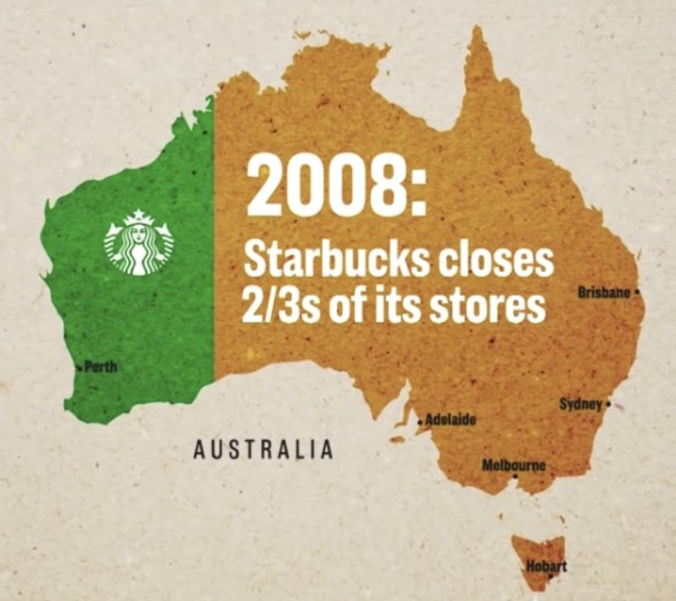
In the 2000s, Starbucks expanded aggressively into Australia, opening 87 stores in just a few years. Then it collapsed just as fast. Most people think they know why. “The coffee was already too good.” “Local cafés were better.” “Australians didn’t like American chains.” There’s a deeper reason most breakdowns miss. Starbucks entered a market that was already fully built. By the time it arrived, Australia had a strong café culture shaped by European influence. Independent cafés were part of daily routines. Baristas knew regulars. Quality coffee was expected everywhere, not treated as a premium upgrade. Starbucks came in with a system designed for a different environment. In the US, it works as an “affordable luxury.” A space between home and work where people linger, customize drinks, and pay a little extra for the experience. In Australia, that role was already filled by local cafés with stronger community ties and higher perceived authenticity. The positioning didn’t connect. Then came the scale problem. Starbucks expanded rapidly, opening dozens of locations before building familiarity or trust with local customers. The brand became highly visible, but not deeply understood. In a market that values local identity, that kind of growth can feel out of place. By 2008, Starbucks closed most of its Australian stores and lost millions in the process. Today, it still operates in Australia with a quieter strategy. Fewer stores. More focus on tourists. Slower expansion. Same company, adjusted playbook. The takeaway is simple. Success in one market doesn’t transfer automatically to another. Especially when the culture around the product is already deeply established. --- Thanks for reading! Enjoyed this post? Follow @BigBrainMkting for more content like this.
Big Brain Marketing tweet media
English
4
13
23
5.6K
SlackHook | Local SEO Foundation🚀
@glenngabe This kind of expansion tends to raise stakes over time, when personal data and trust become the main bottlenecks, not the tech itself In practice adoption often hinges on how safe people feel sharing sensitive info, not just how useful the agent is
English
0
0
0
9
Glenn Gabe
Glenn Gabe@glenngabe·
More news on the health front. And oh boy, be careful... -> Perplexity launches Perplexity Health agent in US "Perplexity is preparing to enter the consumer health AI space with Perplexity Health, a dedicated section within its app that would allow users to connect health data providers, enter personal medical information, and access specialized AI agents, all within a secure, private environment." testingcatalog.com/perplexity-lau…
English
4
2
6
913
SlackHook | Local SEO Foundation🚀
@_JoshuaSEO This tends to spike early, when fresh structured content aligns closely with how queries are being asked Over time maintaining that position usually depends on updating depth and clarity as competing content starts matching the same format
English
0
0
0
7
Joshua George | Ecom SEO & AI SEO
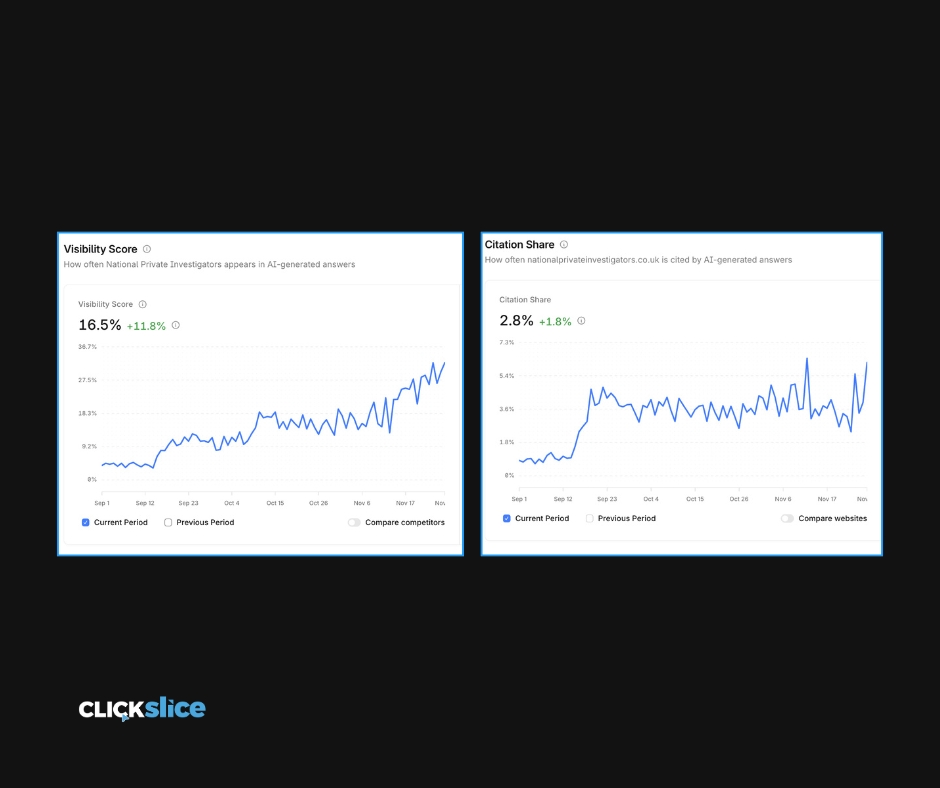
AI citation playbook we used to get a client to #1 citation position: Content format AI actually cites: - Comparison breakdowns and ranked lists - Detailed explainers with expert clarity - Step-by-step process guides - Rich FAQ sections answering real prompts - Precise, confident language AI can parse easily Avoid: Marketing fluff, vague claims, generic descriptions Client jumped from 3.9% to 16.5% visibility, 2.8% citation share (#1 position) in 30 days.
Joshua George | Ecom SEO & AI SEO tweet media
Joshua George | Ecom SEO & AI SEO@_JoshuaSEO

You're creating the wrong content if you want AI citations. The content types that get cited by AI platforms: Comparison content: "X vs Y for [use case]" Problem/Solution: "How to fix [specific problem]" Long-tail conversational: "What's the best [product] for [situation]" AI platforms answer questions, not keywords. Create content that explains, compares, and guides. That's what gets referenced when someone asks ChatGPT what to buy. Stop writing for Google's algorithm. Start writing for AI's answer format.

English
1
4
15
700
SlackHook | Local SEO Foundation🚀
@SERanking This tends to show up later, when increasing spend masks underlying gaps until performance starts slipping anyway In practice fixing the foundation often unlocks more from the same budget before adding anything new
English
0
0
0
202
SE Ranking
SE Ranking@SERanking·
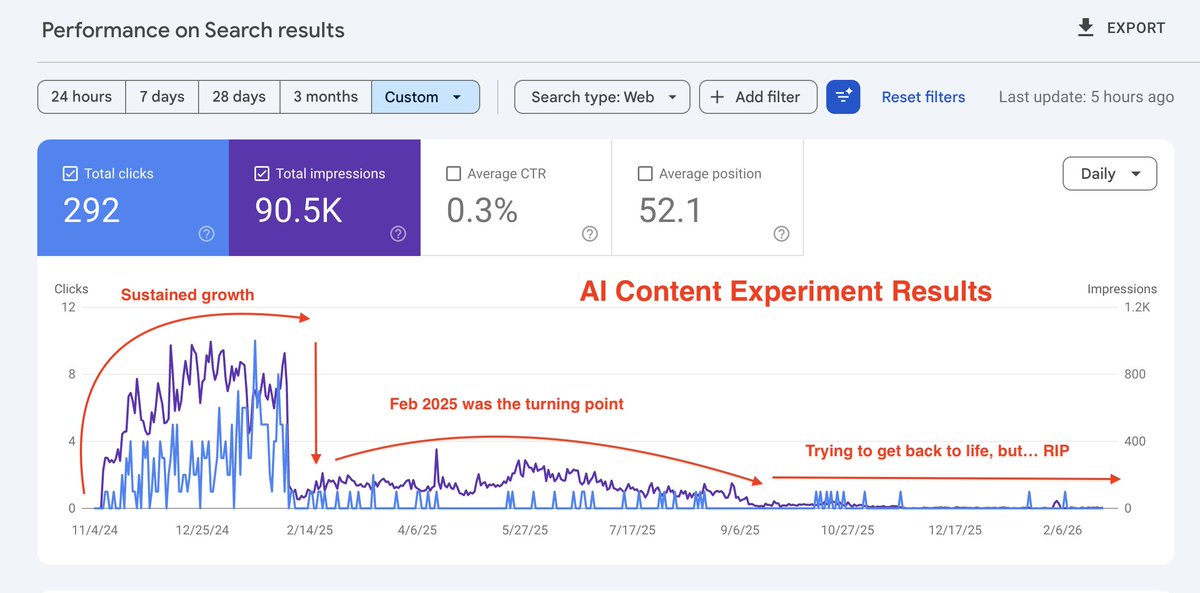
Could AI-generated content rank? Yes. And it may last about three months. We built 20 new domains and published 2,000 articles with no human input. In 36 days: - 71% got indexed - 8 sites ranked for 1,000+ keywords - 122K impressions 3 months in: completely gone. Was AI content the problem? Not exactly. The problem was publishing AI content with no strategy and no SEO behind it. These were new sites with no backlinks, no authority. Once Google picked up on that, the rankings dropped. And we’ve also seen the opposite: when AI-generated content is reviewed by a human and published on a strong domain, it can keep ranking and drive clicks. 📌 Read the full experiment: seranking.com/blog/ai-conten… We’re running new experiments now, and we’ll be sharing the results along the way. If you want us to test your theories too, drop them in the comments 👇
SE Ranking tweet media
English
15
13
121
33.1K
SlackHook | Local SEO Foundation🚀
@michael23boud This tends to show up later, when increasing spend masks underlying gaps until performance starts slipping anyway In practice fixing the foundation often unlocks more from the same budget before adding anything new
English
0
0
1
55
Michael - SEO
Michael - SEO@michael23boud·
Talked to a fencing company owner yesterday. $12-15 million a year in sales. $30,000/month marketing budget. Billboards. Radio. Mailers. Full-time marketer on staff. And leads had been declining for 18 months straight. The problem wasn't the spend. It was that 82% of his backlinks were garbage, he had no service area pages, and he was relying on one Google Business Profile to cover 5 locations across New Jersey. More budget doesn't fix a broken foundation
English
12
3
82
14.5K
SlackHook | Local SEO Foundation🚀
@_JoshuaSEO This tends to converge over time, when content built for answers also strengthens traditional search signals In practice the same pieces often start capturing both queries and citations, especially when they mirror how real questions evolve across sessions
English
0
0
0
3
Joshua George | Ecom SEO & AI SEO
You're creating the wrong content if you want AI citations. The content types that get cited by AI platforms: Comparison content: "X vs Y for [use case]" Problem/Solution: "How to fix [specific problem]" Long-tail conversational: "What's the best [product] for [situation]" AI platforms answer questions, not keywords. Create content that explains, compares, and guides. That's what gets referenced when someone asks ChatGPT what to buy. Stop writing for Google's algorithm. Start writing for AI's answer format.
English
7
2
14
1.3K
SlackHook | Local SEO Foundation🚀
@glenngabe This tends to backfire over time, when small annoyances stack into learned avoidance rather than just momentary frustration In practice users don’t complain, they change behavior quietly, and that shift is usually hard to win back once it sets in
English
0
0
0
14
Glenn Gabe
Glenn Gabe@glenngabe·
I have been saying forever, "Hell hath no fury like a user scorned". And don't even get me started about the 'sticky video player' -> An analysis of a NYT article load finds 422 network requests totaling 49MB, triggering a sprawling programmatic ad auction, an example of “hostile architecture” *CPU throttles, tracking and privacy nightmares *The Sticky Video Player *Innovative Hindrances And more... thatshubham.com/blog/news-audit
Glenn Gabe tweet mediaGlenn Gabe tweet mediaGlenn Gabe tweet media
English
2
2
10
928
SlackHook | Local SEO Foundation🚀
@glenngabe This kind of friction shows up more clearly over time, when removing context from the main site breaks how people naturally build trust before buying In practice syncing journeys back to familiar environments tends to recover intent that standalone flows lose
English
0
0
0
7
Glenn Gabe
Glenn Gabe@glenngabe·
Conversion rates were 3X LOWER than when users click out to the website... "Put simply, Instant Checkout has been a flop." But Walmart is not giving up -> Walmart is embedding its own chatbot Sparky in ChatGPT, after conversion rates via OpenAI's Instant Checkout were 3x lower than those requiring clicking out "Conversion rates have been three times lower for the selection sold directly inside the chatbot than those that require clicking out, according to Daniel Danker, who oversees design and product for Walmart. Put simply, Instant Checkout has been a flop." "In the new experience, Walmart users log into Sparky the first time they encounter it in ChatGPT. Their basket from Walmart’s website or app and within ChatGPT will sync with another in the hopes of better reflecting people’s actual shopping habits. Consumers add peanut butter one day on the Walmart app, foil the next, and a birthday gift at the last second on the website before checking out. “When Sparky travels, it's the Walmart store meeting you where you are, instead of a completely broken experience,” Danker says." wired.com/story/ai-lab-w…
English
2
0
3
597
SlackHook | Local SEO Foundation🚀
@neilpatel This tends to work strongest early, when adding volume fills obvious gaps and lifts baseline visibility Over time the gains usually depend more on how well new content connects with existing pages rather than just how often you publish
English
0
0
0
57
Neil Patel
Neil Patel@neilpatel·
Does publishing a lot of blog content still help you get more SEO traffic? We asked content marketers what happens when they publish text-based content on sites that haven't been doing much blogging or SEO. So not just new sites, but sites that never focused on content marketing. In general, publishing content still produces more organic traffic growth.
Neil Patel tweet media
English
16
8
47
2.8K
SlackHook | Local SEO Foundation🚀
@glenngabe This kind of shift usually plays out over time, when early enterprise wins start shaping where product focus and margins actually stabilize In practice consumer traction builds awareness, but enterprise adoption often decides who sustains growth long term
English
0
0
0
13
Glenn Gabe
Glenn Gabe@glenngabe·
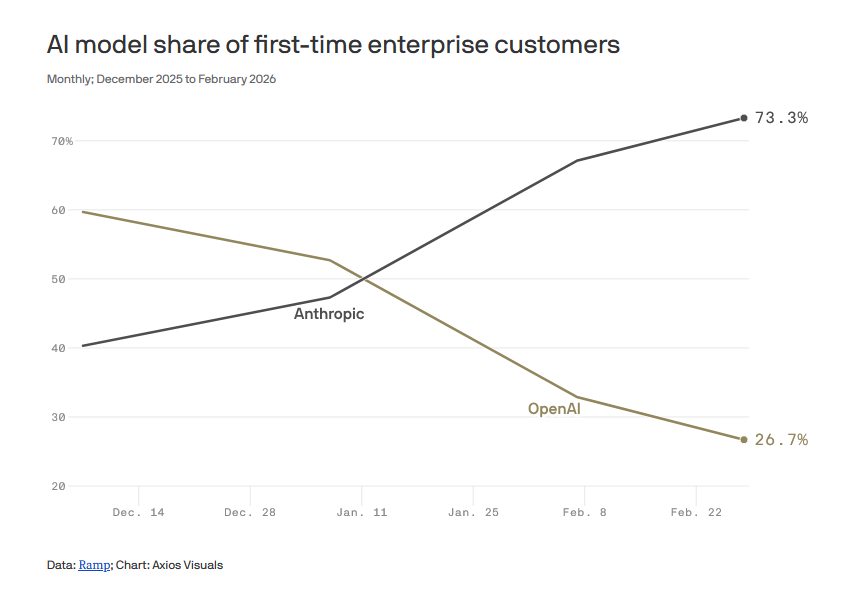
You can see why OpenAI is freaking out a bit -> Anthropic is capturing ~73% of all spending among companies buying AI tools for the first time, up from a 50/50 split with OpenAI in January "Amid the tightening race, the Wall Street Journal reported Tuesday that OpenAI is considering a strategy shift, from its wide-ranging consumer bets (like video generators, browsers and devices) to a tighter focus on enterprise." "While OpenAI is the most popular chatbot for consumers, it's losing money from them since it's subsidizing the cost of their token usage." axios.com/2026/03/18/ai-…
Glenn Gabe tweet media
English
2
0
12
1.1K
SlackHook | Local SEO Foundation🚀
@azarchick This tends to show up later, when great work keeps you busy but doesn’t reduce how dependent income is on your time Over time the real shift happens when parts of that expertise start working without you being directly involved
English
0
0
1
5
Kristina Azarenko Sparks 💬
You were taught that doing great work is enough. That it will make you successful. That it will pay your bills and provide you freedom. Only this is a lie. Just doing great work doesn't automatically bring you freedom. It can bring you income (often inconsistent). It can bring you clients (some are a pain in the s). And it can also burn you out to the ground. (I know, I’ve been there. I’m a living example of “just do great work” BS.) So no, just doing great work is NOT enough if you want freedom. Doing great work PLUS building assets from your expertise is the only way to freedom. So you can finally breathe out and take a day off without anyone pinging you on Slack. Your knowledge shouldn’t only work when you do. That’s why I’m so passionate about helping smart experts and professionals scale beyond working 1:1 by building their knowledge profit system. P.S. If this resonates, you’ll love my free newsletter with exact tips on how to turn your knowledge into freedom, sign up here kristinasparks.com
Kristina Azarenko Sparks 💬 tweet media
English
1
0
0
56
SlackHook | Local SEO Foundation🚀
@andywalkerhq This kind of dominance compounds over time, when consistent visibility starts reinforcing trust before the call even happens In practice competitors often don’t feel the impact until lead flow dries up, not when rankings first shift
English
0
0
0
13
Andy Walker - Local SEO
Andy Walker - Local SEO@andywalkerhq·
This is what market dominance looks like. A Las Vegas landscaping company ranked 2.64 on Google Maps. 75% of keywords in the top 3. 25% on page one. Nothing hidden. When it hits 110 degrees and someone's irrigation breaks, they're not checking Facebook for help. They're desperately searching "irrigation repair near me" because they need it fixed now. This company appears. Their competition doesn't. That's the entire playbook. They don't chase leads. They don't wait on word-of-mouth. They don't wonder where the next job is coming from. Just one optimized profile capturing people at the exact moment they're ready to hire. While competitors are networking and passing out cards, this business is answering calls from customers who already picked them before saying hello.
Andy Walker - Local SEO tweet media
English
1
1
9
759
SlackHook | Local SEO Foundation🚀
@SERanking @PlanableApp These patterns tend to reinforce each other over time, when stronger ops quietly support taking on and retaining more clients In practice the gap shows up in consistency, not just growth, and that’s usually where profitability stabilizes or slips
English
0
0
0
15
SE Ranking
SE Ranking@SERanking·
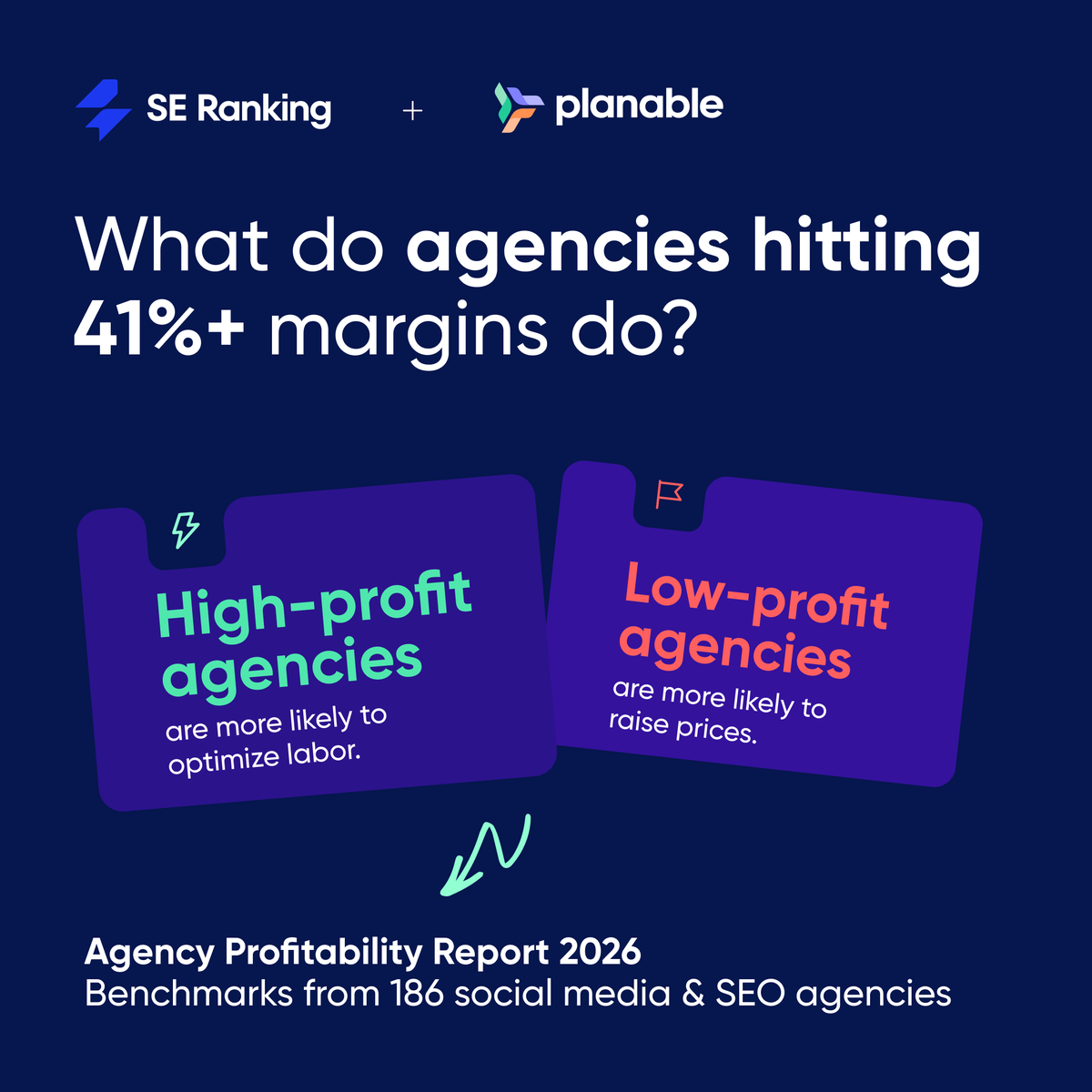
What actually makes an agency profitable in 2026? Together with @PlanableApp, we analyzed data from 186 agencies and found a few patterns worth paying attention to: ✅ Client count matters a lot. More than half of agencies with just one client are losing money. Among agencies with 20+ clients, only 6.5% are. ✅ "AI-first" is not the same as operational AI use. Lower-profit agencies are more likely to use the label. Higher-profit agencies are more likely to use AI in daily workflows. ✅ Low-profit agencies rely on price increases much more often. They use price hikes as their main lever about twice as often as high-profit agencies. There are more insights like this in the full report, including patterns around client count, team size, and zero-loss setups. ⚡ Check the full Agency Profitability Report at the link: planable.io/blog/agency-pr…
SE Ranking tweet media
English
1
1
1
250
SlackHook | Local SEO Foundation🚀
@glenngabe This tends to escalate over time, when early settlements start setting expectations for how future cases are valued In practice each new suit adds pressure on how training data is sourced, not just how models are deployed
English
0
0
0
9
Glenn Gabe
Glenn Gabe@glenngabe·
More AI lawsuits, this time against Anthropic (again). And remember, Anthropic settled another suit with authors for $1.5B... so it set a precedent already -> BMG Rights Management, owned by German media group Bertelsmann, sues Anthropic for allegedly using its copyrighted lyrics to train the LLMs that power Claude "BMG said in the complaint, opens new tab filed on Tuesday that Anthropic copied and reproduced lyrics from hit ​songs by the Rolling Stones, Bruno Mars, Ariana Grande ​and other prominent rock and pop musicians, infringing hundreds ⁠of copyrights." reuters.com/legal/litigati…
English
1
0
7
611
SlackHook | Local SEO Foundation🚀
@glenngabe This tends to hold strongest for habitual queries, when default behavior and muscle memory carry more weight than new features Over time the shifts seem to happen more on edge use cases first, before impacting those everyday searches people rarely rethink
English
0
0
0
14
Glenn Gabe
Glenn Gabe@glenngabe·
Well, that's an interesting quote. :) "Google does a much better job here than anyone else in the world, including Perplexity". And he's right, which is why it will be hard for other AI Search platforms to get people to switch for those types of queries... Then add that Gemini is surging like mad, Google continues to advance AI Mode in Search, etc., and you can see why Google is in a very strong position.
Aravind Srinivas@AravSrinivas

Google is the default search engine on Comet iOS (unlike on Comet desktop): Most mobile browser searches are around navigating to restaurant or local shops, checking scores, shopping, hotels. Google does a much better job here than anyone else in the world, including Perplexity.

English
2
0
5
1.4K
SlackHook | Local SEO Foundation🚀
@semrush This becomes more noticeable later, when presence across channels starts reinforcing itself rather than working in isolation In practice visibility in one place often drives discovery in another, and that feedback loop compounds quietly over time
English
1
0
0
6
Semrush
Semrush@semrush·
You can’t see the flyer, but the message is clear: Real brand visibility happens in search and AI answers. You may have noticed our billboards lately: on your commute, in the subway, or even here on social. But the campaign isn’t really about billboards, it’s about how visibility itself has changed. We'll keep repeating this: discovery doesn’t happen in just one place. People search in AI answers, scroll through social feeds, browse marketplaces, and ask questions in communities. For brands, that means showing up in the right places. Be found everywhere search happens. social.semrush.com/4bSOGRq
English
1
0
8
561
SlackHook | Local SEO Foundation🚀
@mehrab_build This holds up early, when simplifying helps you actually execute without getting stuck in tactics Over time the edge tends to come from how well those pillars connect, especially when intent, structure, and authority reinforce each other consistently
English
1
0
0
21
Mehrab | SEO Mode
Mehrab | SEO Mode@mehrab_build·
SEO has three pillars: 1. Research: find low competition keywords and build your strategy around them 2. Content: create pages that satisfy the search intent, blog posts, landing pages, category pages 3. Backlinks: actively build links to strengthen your authority That's it. Everything else is noise.
English
2
1
7
327