GenZ Investor@investingbyGenZ
$MTCH has seen strong momentum recently, fueled by rising investor expectations as new CEO Spencer Rascoff puts much more emphasis on fixing Tinder – winning back user trust and especially rebalancing toward more female users.
- Rascoff, who took over Match Group in Feb 2025 and personally took charge of Tinder last July, has publicly said winning over women is his “primary focus” and that Tinder needs to reach gender parity to break the user decline.
- Tinder still drives ~54% of group revenue, but monthly active users have fallen from a peak of 65.4m in 2021 to 50.5m in 2025, with roughly 75% of users now being men – a clear product/market imbalance.
- Rascoff is backing words with investment: user “givebacks” and new product pushed up to $60m this year (vs ~$15m in 2025), ad spend raised to $230m (vs $180m), plus new features like double dates, video calls and shared‑interest matching, and a refreshed leadership team including a new CTO.
- Early traction: annual user declines have narrowed from ~ -11% when he started to ~ -8.5% last quarter, with a stated goal of flat user growth by end‑2027. Meanwhile Hinge keeps compounding (operating income $74m in 2023 → $166m in 2025) and gives $MTCH a genuine second growth engine if Tinder takes longer to turn.
(source: FT.com)
My view: I remain a shareholder. I believe online dating is here to stay as a core way people meet, and $MTCH will continue to play a central role in the space – either through its existing family of apps (Tinder, Hinge, etc.) or new ones they build or buy over time. The Rascoff era looks like a real attempt to rebuild an “innovation muscle” at Tinder that atrophied during its years of easy profit, and I think the focus on women users specifically is exactly the right lever – fix that, and the whole funnel improves.
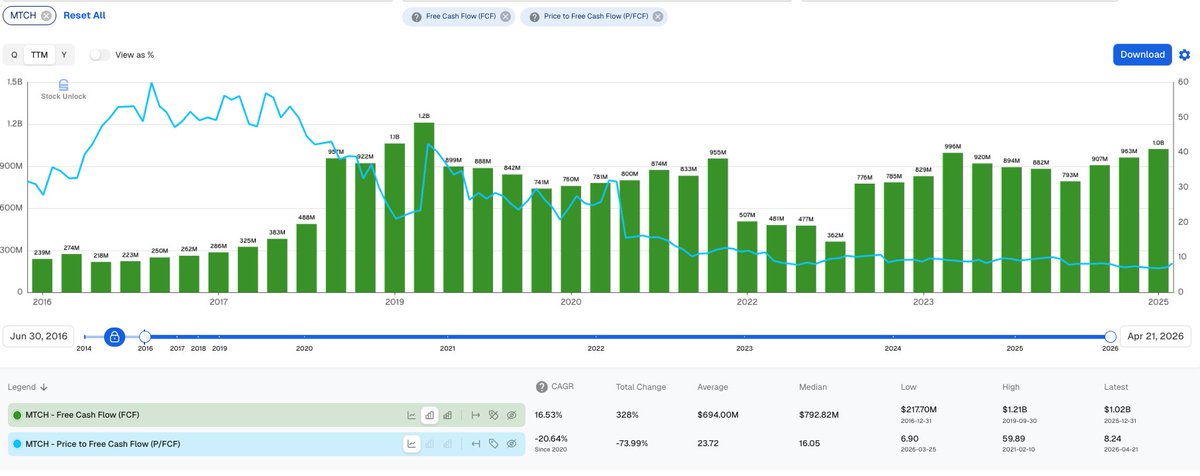
On top of all that, the stock trades at a mere ~8x P/FCF, which is a pretty low bar for a company with Tinder + Hinge’s scale, brand and cash generation. Even if the Tinder turnaround takes longer than hoped, I’m happy to keep collecting the value returned through aggressive buybacks and dividends at this multiple, while keeping optionality on a successful reacceleration.