Dick Hard Cock
10K posts

🇮🇱🇵🇸While the world focuses on Iran, Israeli settler violence in the West Bank is rising fast.
Settlers are annexing more territory with open support from Netanyahu’s government.
Mario Nawfal@MarioNawfal
🇵🇸🇮🇱 Video allegedly shows dozens of Israeli settlers torching a Palestinian home in the occupied West Bank. 8 people were reportedly hurt, among them an infant. This can’t be our new normal.
English

🇮🇱🇱🇧 Israel did this to Lebanon!
ISRAEL IS A TERRORIST STATE!
English
@GuntherEagleman Peedofile standing by peedofile protectors
English

🚨 PRESIDENT TRUMP just made it crystal clear, he was PUSHING HARD to keep the show going tonight!
“We VERY much wanted to continue it because I don’t like to let these SICK people, these THUGS, these horrible, horrible people change the fabric of our life, change the course of what we do.”
“We held out right till the end… I am ready, willing, and able!”
English
@TheLeoTerrell Whitkoff is the real Secretary of State …. This idiot by title only
English
Art of the Deal in real time!
President Trump cancels the pointless 16-hour flight to Pakistan… and within 10 MINUTES Iran suddenly sends over a much better deal.
Trump: “They gave us a paper that should’ve been better. The second I canceled, boom, new one shows up.”
No more wasting time or groveling. They can call him whenever they want.
Bottom line: Iran will NOT get a nuclear weapon.
LET TRUMP COOK!
English
🚨🇮🇱🇱🇧 Southern Lebanon is absolutely leveled.
Satellite images just dropped, and it’s devastating...
We're talking about entire villages flattened, hundreds of homes, mosques, and shops turned to rubble.
This is Gaza-level destruction all over again.
The South is paying the brutal price for this war.

Mario Nawfal@MarioNawfal
🇮🇷🇺🇸 The body count from the Iran war is going to be much higher than most people can imagine. The first effects of the war are easy to see: missile strikes, stranded ships, oil price spikes, and press conferences where each side blames the other. The second wave will be harder to film. It will show up months later in empty fields, smaller harvests, higher food prices, and families quietly cutting meals until there's nothing left to cut. The Strait of Hormuz is usually discussed as an oil chokepoint, but it is also a fertilizer chokepoint. When war disrupts fertilizer exports, the damage moves into farms across Africa, Asia, and Latin America. The number to watch is 45 million. That's how many additional people could be pushed into acute hunger by the war. That's hunger severe enough that survival becomes a daily calculation. And that would come on top of hundreds of millions already facing crisis-level food insecurity around the world. This is what makes the fertilizer shortage so dangerous. It doesn't kill like a bomb; it kills by subtraction. A farmer uses less fertilizer because prices exploded, then the crop comes in smaller, food prices rise, aid agencies can't keep up, a mother waters down porridge, a child gets sick, a weak immune system meets cholera, malaria, or measles. And then hunger becomes a death certificate with another name written on it. So when people ask how many could die, the honest answer is that nobody can give a clean number yet, but that doesn't mean the risk is small. If even a fraction of those 45 million fall into famine-level conditions, the death toll could climb into the tens or hundreds of thousands. If the war drags on, fertilizer stays expensive, harvests fail, and aid funding falls short, the number could be far worse. A fertilizer shortage isn't just an agricultural problem; it's a delayed humanitarian disaster. The places most exposed are already fragile: Sudan, Yemen, Nigeria, Afghanistan, Congo, Somalia, Kenya, and other countries that depend on imported food, fertilizer, or outside aid to keep people alive. That's how modern war works now: a missile is launched in one region, and months later, a child starves in another. A shipping lane closes, and a farmer thousands of miles away can't afford to plant crops properly. A government talks about strategic leverage, and poor families absorb the cost in calories. The world will count the dead from airstrikes, but it may never properly count the dead from the wider impacts of this war.
English
President Trump has made clear and simple demands.
Iran should take him seriously.
English



@CurtisHouck @edokeefe Netanyahu been using same line for 40 years … Israel is the Lunatic with Nukes .. Clown show
English

CBS’s @EdOKeefe: “So, if you’re asking for more time to sort out negotiations with Iran —”
President Trump: “I’m not asking you for more time.”
O’Keefe: “— not me, in general —”
Trump: “I’m not asking it for them.”
O’Keefe: “— if you need more time —
Trump: “No, it’s not more time. I’m just — I’m not asking anybody for more time.”
O’Keefe: “— if you need more time, does that mean Americans should anticipate spending more on gasoline for the foreseeable future”
Trump: “For a little while?”
O’Keefe: “For how long?”
Trump: “And you know what they get for that? You know what they get for that? Iran without a nuclear weapon that’s going to try and blow up one of our cities or blow up the entire Middle East. You want to see what shock would be. And I — I have to be honest.”
O’Keefe: “You're going to [inaudible] your whole year —”
Trump: “The stock market is at an all time high right now. I thought it would have been down 20, 25% when we hit.”
O’Keefe: “You want to drive prices down this year?”
Trump: “Wait a minute. Wait, can I finish my question, wise guy? Stock markets at an all time high right now. I projected, and I’m pretty good at this, that the stock market, Howard, would drop maybe 20% 25%. And I understood that. And I said, hey, it’s bad thing, but I have to do what’s right for the country, even the world, because you can’t have them. You cannot let them have a nuclear weapon. So, the stock market, unlike what a lot of people were predicting, I thought they weren’t necessarily wrong. The stock market today hit an all time high, hit an all time high yesterday, the day before, and it’s staying there. I thought oil would go up to maybe $200 a barrel. And oil is at a very a different number than anyone thought. In fact, this country is much lower because we have all the oil we can use. We’re — we’re actually ships are coming from all over the world to Texas, Louisiana and Alaska. They’re coming from all over the world to get oil from the United States — you know, while this is closed, the Hormuz Strait. So, if you look at what I said, I guess it was right because I said I’d have it 4 to 6 weeks. And in four weeks we have totally defeated their military.”
O’Keefe: “But you —”
Trump: “So, right now, I don’t want to rush it because you guys are, you know, trying to make us look as bad as possible.”
O’Keefe: “— do you —”
Trump: “I don’t want to rush it. I want to take my time. We have plenty of time and I want to get a great deal. I want to get a deal where our nation and the world is safe from lunatics with nuclear weapons.”
English
English

.@RepDean: "Don't repeat your gracious offer to speak behind closed doors, not under oath… Why did you lie about your relationship with Epstein?"
Commerce Secy. Howard Lutnick: "The House Oversight Committee and I—"
Dean: "We are our own committee…The cover-up continues."
English
@TomFitton @realDonaldTrump He was supposed to Deport em all but Jews got him into their War
English
@DanielLDavis1 We Americans have become Israelis … Murderers
English

This is the most vile, wicked, and unAmerican behavior I've seen in my adult lifetime. This is a profound absence of morality, gross violation of any laws that have ever existed, and puts us on the same mental plane as some of the early followers of Adolf Hitler.
You think that's an exaggeration?
Even the vile Hitler didn't seek to kill negotiators of other countries. And if you think this kill-them-all mentality will be limited to Iranian negotiators, you are fooling yourself. Once a leader has so dehumanized his opponents that you can callously call for them to be murdered for the "crime" of not agreeing to your terms (i.e., not surrendering), there will be no lower inhibition to killing larger and larger numbers of people who don't submit.
One might say this is the personal opinion of a Washington Post - and by the way, they share this shame for publishing such alarming garbage - but that it was *reposted* by the president, and when tagging the oped Thiessen published with this murderous idea, Trump posted "Very True!!!" - so he is fully on board with the mentality.
Silence won't work anymore, folks. Just saying "well, that's Trump," won't cut it. It is time to stand up for whatever is left of our morality and categorically declare that this is beyond the pale and condemn both Thiessen and the president for sharing such reprehensible views.
--and I will be watching very closely to see what the likes of those who claim to have made Jesus, the Prince of Peace, their Lord, have to say about this. If they *yet again* give him a moral pass for the indefensible, then they can no longer claim to be a Christian, as this violates every tenet in the Bible. We're not talking about two combatants fighting it out on a battlefield, this is about us declaring our desire to murder non-combatants who dare to refuse to obey our demands for unconditional surrender.
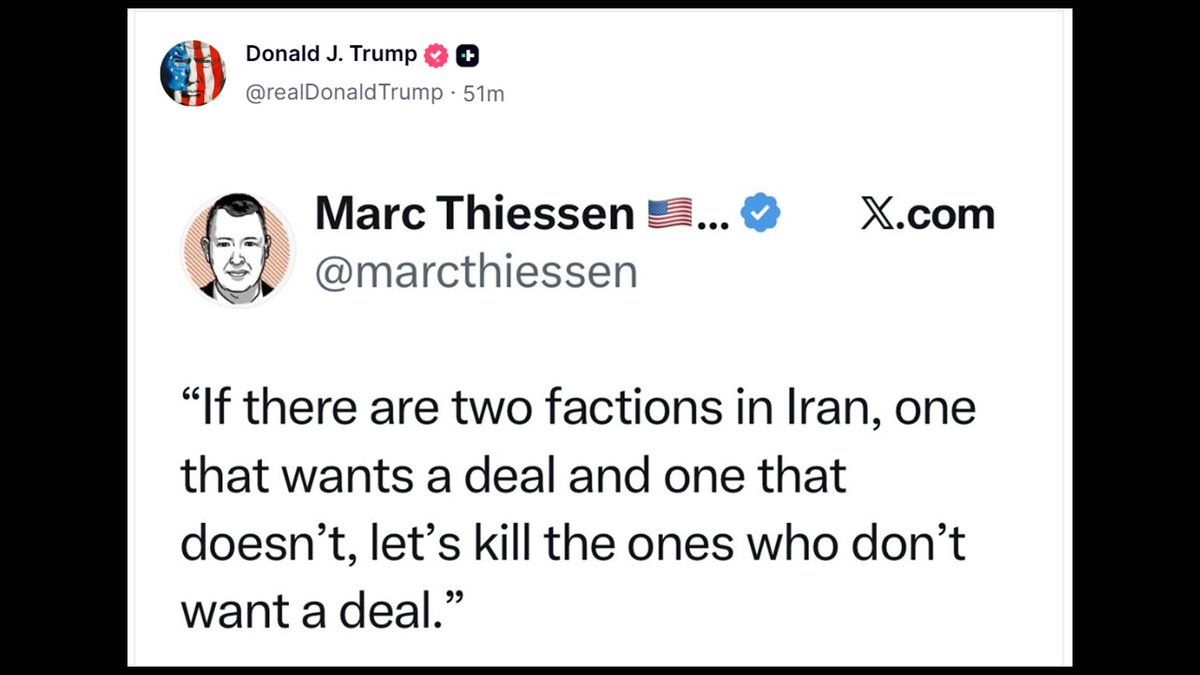
English
@DropSiteNews @mehdirhasan As an American I am disgusted with trump & his man Netanyahu .. Trump is his bitch
English

🚨 Smotrich: West Bank Settlement Expansion Has “Full Backing” of Trump Administration
Israeli Finance Minister Bezalel Smotrich told the Jerusalem Post that Israel’s accelerating settlement expansion in the occupied West Bank is being carried out with full U.S. support, coordinated directly with President Trump, Secretary of State Marco Rubio, and Ambassador Mike Huckabee.
▪️ Since the current government took office in 2022, over 51,000 housing units have been approved for the West Bank, according to Smotrich’s office.
▪️ The Sa-Nur settlement in West Bank, evacuated 20 years ago under Israel’s Disengagement Plan, was reestablished Sunday, with over a dozen families already in residence. Smotrich said more settlements would follow “very soon.”
▪️ Smotrich called on Netanyahu to order the IDF to prepare for the “full conquest” of the Gaza Strip and the establishment of Israeli settlements there as well.
▪️ He said Palestinians in Gaza and the West Bank are “part of the Iranian axis of evil” and dismissed documented Jewish extremist violence against Palestinians as “one of the biggest false campaigns there is.”
▪️ On international condemnation: “In the past, even building 50 housing units would lead to condemnation. Today it is very different.”
Smotrich acknowledged Trump has not yet backed full West Bank annexation, but claimed “we will also succeed in that.”

The Jerusalem Post@Jerusalem_Post
Israel’s advancement of settlement expansion in the West Bank is being undertaken with full US backing, Finance Minister Bezalel Smotrich told The Jerusalem Post. jpost.com/israel-news/po…
English
@SilentlySirs As an American I am disgusted with these immoral Israelis
English

🚨 🇱🇧 BREAKING:
Israeli "looting army" robs civilian property in 𝗠𝗲𝗶𝘀𝘀 𝗲𝗹-𝗝𝗮𝗯𝗮𝗹.
"Most moral army in the world"
caught red-handed stealing from Lebanese homes.
Occupation isn't just military.
It's 𝘁𝗵𝗲𝗳𝘁 𝗶𝗻 𝘂𝗻𝗶𝗳𝗼𝗿𝗺.

English

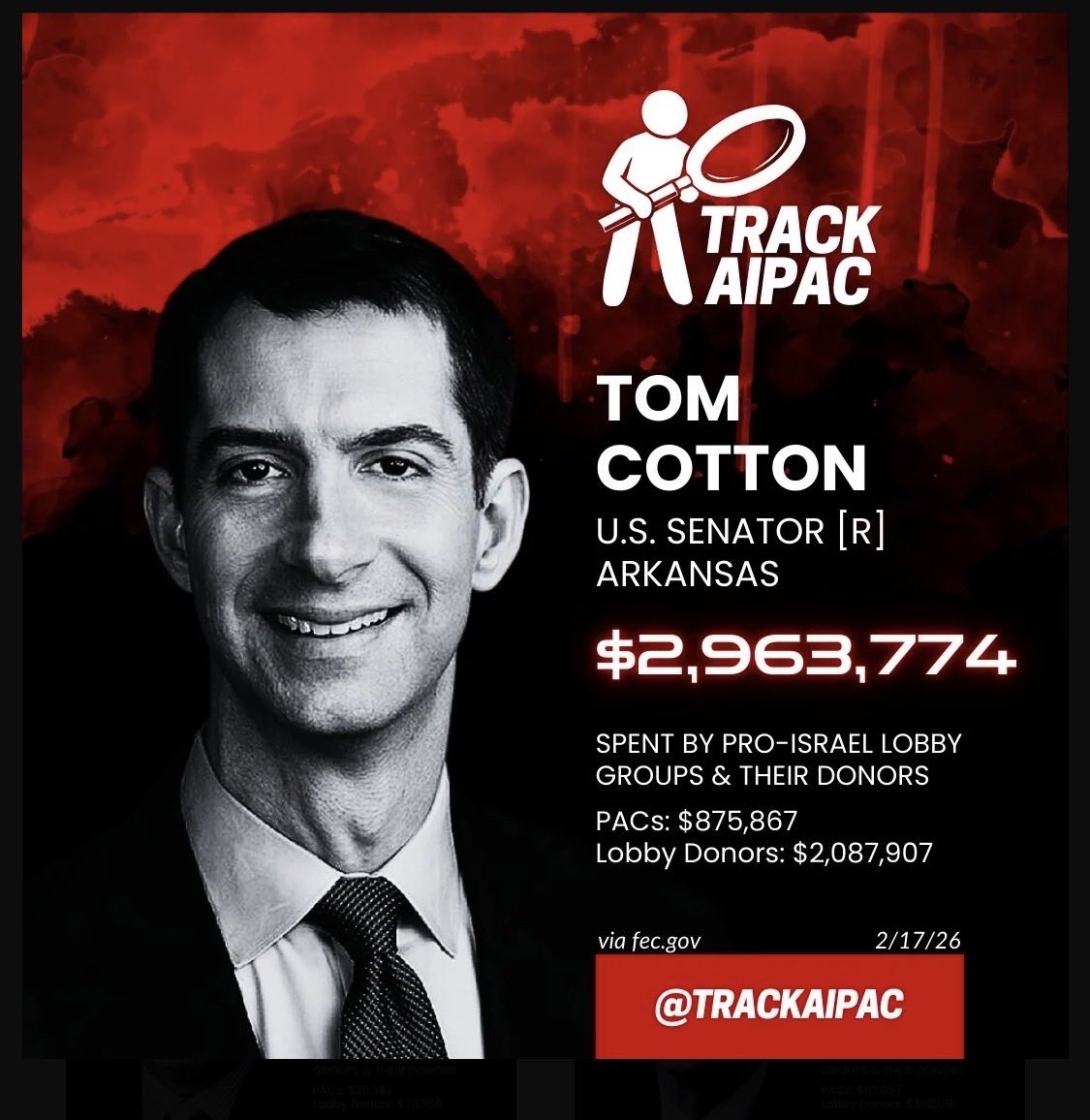
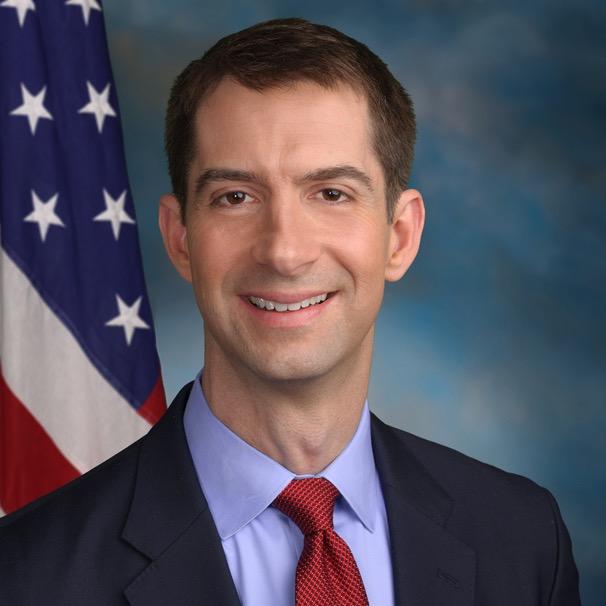
🚨 Sen. Tom Cotton on Iran:
“Iran has never won a war… but they’ve never lost a negotiation.”
“Until now. They’ve never sat across the table from the guy who wrote The Art of the Deal.”
Trump isn’t playing their game.
English
@LindseyGrahamSC @realDonaldTrump What about the people of your state
English
Because of President @realDonaldTrump, Iran is no longer the world’s leading state sponsor of terror.
His resolve is undeterred, and I’m proud to stand with him.
English
@realstewpeters @KimDotcom What happened when you could ask questions .. Israel has taken America Hostage
English

REPORTER: “What do you say to the American people who question how much longer this will take?”
TRUMP: “You’re such a disgrace. Did you hear what I just said? How many years was Vietnam?”
Trump is a disgrace and so is anyone that’s still defending him.
English