ROBA & ASSOCIATES LLP

649 posts

ROBA & ASSOCIATES LLP banner
ROBA & ASSOCIATES LLP

ROBA & ASSOCIATES LLP

@AssociatesRoba

A Broader Perspective | Law Firm

Madonna House, Westlands. 가입일 Temmuz 2025
190 팔로잉5.9K 팔로워
고정된 트윗
ROBA & ASSOCIATES LLP
ROBA & ASSOCIATES LLP@AssociatesRoba·
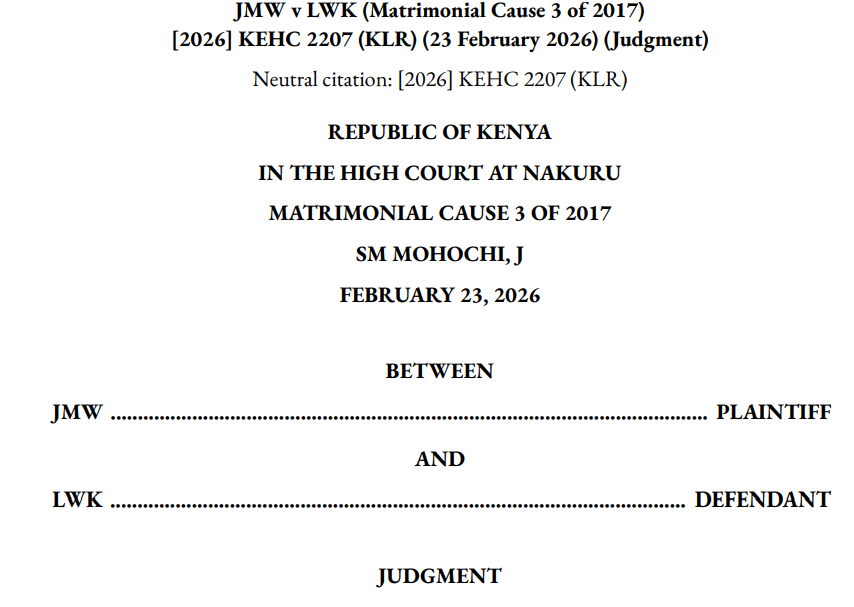
🚨🔥BREKING: WOMAN WINS BIG AFTER DIVORCE- HIGH COURT AWARDS HER MOST OF THE PROPERTY AFTER PROOF WAR In JMW v LWK [2026] KEHC 2207 (KLR), the High Court in Nakuru has delivered a jaw-dropping matrimonial property ruling after a collapsed marriage between two police officers; one a decorated international marathon star. During their union (2009–2014), a portfolio of land parcels, plots, and rental developments was acquired, some in his name, some in hers. After separation, the husband claimed he funded everything. The wife fired back: her marathon prize money, millions from Dubai, Chicago, Tokyo and London, plus salary and rental income built the empire, with funds often passing through his accounts because he managed her finances. What followed was a full courtroom audit of their lives: bank trails, land records, vehicle searches, and testimony exposing who really paid. Justice Mohochi turned to Sections 2, 6 and 7 of the Matrimonial Property Act, which say matrimonial property must be divided according to each spouse’s contribution: both money and non-monetary effort. The husband’s case collapsed under scrutiny: sales he relied on didn’t match official records, assets he claimed to have sold were still in his name, and key explanations contradicted documents. The wife, on the other hand, produced clear proof of income and deposits. The Court found she was the true financial engine of the marriage. Verdict: most properties remain hers outright; the matrimonial home is shared 80% to her, 20% to him for limited non-financial input; assets he secretly sold during the case were treated as his portion so he would not benefit from breaking court orders. For ordinary Kenyans, this judgment lands like thunder. Marriage is not a lottery ticket to half of everything; you must prove what you contributed. Courts will follow receipts, bank trails, and credible evidence, not assumptions or emotions. This decision reinforces a hard truth in Kenyan law: property division is about contribution, not titles, not gender, not who shouts louder. Big win for spouses who can prove their input; brutal wake-up call for anyone relying on “tulijenga pamoja” without evidence. In divorce court, vibes don’t count, proof does. ⚖️🔥 @Thuranira_1 @georgediano @MarthaKarua @NelsonHavi kindly retweet. #ProtectTheVoteKE Nairobi Hospital #MainaAndKingangi #ProtestForProfit
ROBA & ASSOCIATES LLP tweet media
English
4
44
111
11.4K
ROBA & ASSOCIATES LLP 리트윗함
ROBA & ASSOCIATES LLP
ROBA & ASSOCIATES LLP@AssociatesRoba·
🚨🚨 BREAKING: LONG-TIME OCCUPANT WINS AS COURT OF APPEAL CANCELS RIVAL TITLE AND RESTORES LAND TO ORIGINAL HOLDER In Mburu v Kariuki & another [2026] KECA 529 (KLR), the Court of Appeal has delivered a dramatic victory to a man who had occupied and developed a Kikuyu plot since 1998, only to be violently displaced years later by a rival armed with fresh allocation papers. The original buyer had fenced the land, built rental units, paid rates, and remained in open possession for years. Then, without warning, the local authority revoked the initial allocation, renumbered the plot, reallocated it, and a new “owner” stormed in, demolished structures, evicted tenants, and took over. Both parties walked into court holding documents. But only one had the history of possession. The Court of Appeal tore into the process behind the later title and found it fatally defective. The council had revoked the earlier allocation without notice, without a hearing, and without proof of lawful procedure. This was a direct violation of natural justice and constitutional property protections. The judges emphasized that administrative power over land is not absolute and cannot be exercised secretly to dispossess an existing holder. Applying settled land law principles, the Court held that a later title built on an unlawful foundation cannot defeat an earlier lawful interest. Even though the trial court had cited the wrong statutory provisions, the ultimate conclusion was correct: the first allocation remained valid because it was never lawfully extinguished. For the ordinary Kenyan, this ruling lands like a thunderclap. It is a massive win for people who bought land early, developed it, and later watched “new owners” emerge from paperwork. At the same time, it is a brutal warning to buyers: a title deed or allocation letter is only as strong as the process that created it. If the chain behind it is rotten, the document can collapse overnight; even years later. The Court has effectively said: possession plus lawful origin beats paper acquired through a tainted process. In Kenya’s volatile land market, that is both reassurance and terror in equal measure. ⚖️🔥 Kindly retweet widely🙏 @georgediano @MarthaKarua @NelsonHavi @Thuranira_1 #EndTimesDetails #TalaMoneyMarch2026 #NikoKadi #TukoKadi DCP Sold Riggy G
ROBA & ASSOCIATES LLP tweet media
English
1
10
22
1K
ROBA & ASSOCIATES LLP 리트윗함
ROBA & ASSOCIATES LLP
ROBA & ASSOCIATES LLP@AssociatesRoba·
Follow us for immediate follow back. Like retweet and reshare🙏🙏
English
1
1
2
468
ROBA & ASSOCIATES LLP 리트윗함
Ndong@Conslaw
Ndong@Conslaw@Ndonglaw043·
There is a very dangerous trend being set by the Court of Appeal on unfair termination that will eventually hit a blow to the weaker party in employment, always the employee. The test is twin. Both procedural fairness & substantive test. That is, was there a valid reason to terminate & whether the procedures were duly followed. The problem is, courts are reversing compensatory awards given purely on the basis of procedural flaw if the termination had a valid reason they say. What this essentially does is to Depart from the rules of Natural justice where ONE MUST be heard, it matters not if the outcome would have been the same. Once hearing is flawed, it should never matter if there was a VALID TERMINATION REASON. The CoA has severally recently reversed many ELRC decisions because they argue, the valid reason to terminate is a test of the reasonable employer & they have greatly lowered the safeguards protecting the Employee. ✅️✅️
English
3
16
41
3.6K
ROBA & ASSOCIATES LLP
ROBA & ASSOCIATES LLP@AssociatesRoba·
Find the link to the decision here: @2026-02-23" target="_blank" rel="nofollow noopener">new.kenyalaw.org/akn/ke/judgmen…
English
0
1
3
780
ROBA & ASSOCIATES LLP 리트윗함
ROBA & ASSOCIATES LLP
ROBA & ASSOCIATES LLP@AssociatesRoba·
🚨🔥BREKING: WOMAN WINS BIG AFTER DIVORCE- HIGH COURT AWARDS HER MOST OF THE PROPERTY AFTER PROOF WAR In JMW v LWK [2026] KEHC 2207 (KLR), the High Court in Nakuru has delivered a jaw-dropping matrimonial property ruling after a collapsed marriage between two police officers; one a decorated international marathon star. During their union (2009–2014), a portfolio of land parcels, plots, and rental developments was acquired, some in his name, some in hers. After separation, the husband claimed he funded everything. The wife fired back: her marathon prize money, millions from Dubai, Chicago, Tokyo and London, plus salary and rental income built the empire, with funds often passing through his accounts because he managed her finances. What followed was a full courtroom audit of their lives: bank trails, land records, vehicle searches, and testimony exposing who really paid. Justice Mohochi turned to Sections 2, 6 and 7 of the Matrimonial Property Act, which say matrimonial property must be divided according to each spouse’s contribution: both money and non-monetary effort. The husband’s case collapsed under scrutiny: sales he relied on didn’t match official records, assets he claimed to have sold were still in his name, and key explanations contradicted documents. The wife, on the other hand, produced clear proof of income and deposits. The Court found she was the true financial engine of the marriage. Verdict: most properties remain hers outright; the matrimonial home is shared 80% to her, 20% to him for limited non-financial input; assets he secretly sold during the case were treated as his portion so he would not benefit from breaking court orders. For ordinary Kenyans, this judgment lands like thunder. Marriage is not a lottery ticket to half of everything; you must prove what you contributed. Courts will follow receipts, bank trails, and credible evidence, not assumptions or emotions. This decision reinforces a hard truth in Kenyan law: property division is about contribution, not titles, not gender, not who shouts louder. Big win for spouses who can prove their input; brutal wake-up call for anyone relying on “tulijenga pamoja” without evidence. In divorce court, vibes don’t count, proof does. ⚖️🔥 @Thuranira_1 @georgediano @MarthaKarua @NelsonHavi kindly retweet. #ProtectTheVoteKE Nairobi Hospital #MainaAndKingangi #ProtestForProfit
ROBA & ASSOCIATES LLP tweet media
English
4
44
111
11.4K
ROBA & ASSOCIATES LLP
ROBA & ASSOCIATES LLP@AssociatesRoba·
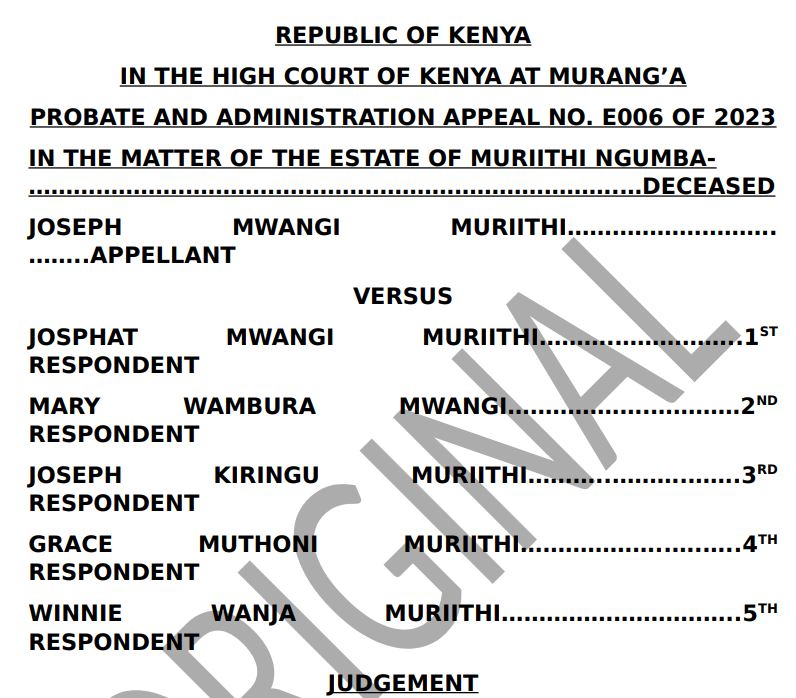
🔴 High Court Clarifies Two Powerful Rules in Succession: Customary Law Still Matters, and Courts Can Correct Their Own Slips. In Joseph Mwangi Muriithi v Josphat Mwangi Muriithi & 4 Others, a family battle erupted over land belonging to a man who died in 1980, before the Law of Succession Act came into force. The deceased had two wives and two parcels of land. One parcel had already been given to the second household, registered in the name of a son to hold in trust. The other parcel remained in the deceased’s name and was used by the first household. Years later, the first son obtained a grant of administration and had that remaining parcel transferred to himself. Decades after that, the children of the second house rushed to court claiming they had been disinherited and asked the magistrate’s court to revoke the grant issued in 1984. The High Court took a cold, methodical look at the facts and the law. First, it reminded everyone that when a person dies before 1 July 1981, distribution of the estate is governed not by the Succession Act but by customary law, thanks to Section 2(2). Under Kikuyu customary inheritance, a polygamous man’s property is divided between houses, not between individual children. Each wife represents a house, and each house gets an equal share regardless of how many children are in it. Since the deceased had already effectively distributed the two parcels to the two houses during his lifetime, the court found that no house had been disinherited at all. The attempt to reopen the distribution decades later collapsed. The judgment also dealt with a procedural twist that lawyers love arguing about. The magistrate had initially delivered a ruling dismissing the revocation application, then two days later corrected the ruling saying it had accidentally failed to reflect the court’s real intention. The appellant claimed that the court had no power to revisit its decision. The High Court disagreed. Relying on Rule 73 of the Probate and Administration Rules and the long-standing “slip rule” principle, the court held that a judge may correct an accidental error or omission to give effect to the court’s true intention. Courts exist to do justice, not to be trapped by their own typographical mistakes. The jurisprudential lesson is blunt. In Kenyan succession law, timing matters. If death occurred before the Succession Act, customary law still governs distribution. And on the procedural side, courts retain inherent power to fix accidental slips so that justice reflects intention rather than clerical error. Family land fights already stretch across generations. The law is not eager to reopen them unless there is real injustice. @georgediano @NelsonHavi @MarthaKarua @Thuranira_1 @joshuamalidzo #RevvvishaNaKCB2026 #FeelTheRoar Sleeping Warrior Blessed Sunday
ROBA & ASSOCIATES LLP tweet media
English
0
63
133
12K
ROBA & ASSOCIATES LLP
ROBA & ASSOCIATES LLP@AssociatesRoba·
🔴 ERC Drops a Hard Rule: The State Cannot Take Back Salary for Work It Accepted During Vetting In Magambo v Attorney General & 2 Others, a police officer continued serving and earning his salary for over two years while waiting for the outcome of a vetting review. Then suddenly, he was informed that his review had failed years earlier, and the government attempted to recover nearly KSh 3 million from his terminal benefits for the salary he had already earned. The Court rejected that move outright: if the State allows you to continue working and takes the benefit of your service, it cannot later claw back the salary because of its own administrative delay. Here’s the deeper constitutional point. The Court found that the failure to communicate the decision for years violated the officer’s rights to fair labour practices and fair administrative action under the Constitution. The result: the government was ordered to refund the KSh 2.9 million and pay KSh 2 million in damages. This means that bureaucratic silence is not a legal shield. If the State delays communicating a decision but keeps taking your labour, the law will treat that delay as its responsibility, not yours. ⚖️ Retweet widely🙏 #SpecialWordSession #MainaAndKingangi Tunataka Power
ROBA & ASSOCIATES LLP tweet media
English
1
26
56
3.7K
YEGON
YEGON@B76046Benson·
@AssociatesRoba This decision highlights a critical point in land law: adverse possession presupposes the existence of a registered owner. Without one, limitation cannot run. It also raises deeper questions about land regularisation where communities have occupied land for decades.
English
1
0
1
35
ROBA & ASSOCIATES LLP
ROBA & ASSOCIATES LLP@AssociatesRoba·
🚨🔴Brutal Truth From ELRC: You Can’t Claim Adverse Possession Without a Title. In Amuma & 7 Others v Haganda Private Ranching Company Ltd & 3 Others (ELC 198 of 2018), over 2,500 residents of Garsen argued they had lived on the land for decades and therefore owned it through adverse possession. The Court shut that argument down for one brutal reason: you cannot claim adverse possession where no registered title exists. A mere letter of allotment, even from the 1970s, is not ownership. Without a registered proprietor, time never starts running, and the doctrine collapses. Here’s the twist many people miss: the Court essentially found that neither the company nor the residents own the land. With no completed allotment and no title on record, the land effectively sits as public land under Article 61 of the Constitution. Translation: thousands may be living there, but legally the land still belongs to the State. The real battle therefore isn’t adverse possession, it’s whether the community can secure recognition through settlement or regularisation processes before the State or another claimant moves in. ⚖️ #KRABodyCam #MainaAndKingangi NTSA
ROBA & ASSOCIATES LLP tweet media
English
7
71
128
8.5K
Degrata
Degrata@Degrata254·
Mtu aneza change birthday certificate names of a kid who is 6 years old?
English
69
60
689
55.9K
ROBA & ASSOCIATES LLP
ROBA & ASSOCIATES LLP@AssociatesRoba·
@KevmanXII Exactly. Adverse possession only runs against a registered private proprietor, not against the State. If the land is public, time cannot run against the government under the Limitation of Actions Act. ^PB
English
0
0
1
213
Kevlar
Kevlar@KevmanXII·
@AssociatesRoba So, in other words, adverse possession is against other persons who legally own the land, just not the State? 🤔
English
2
0
1
229
Thuranira
Thuranira@Thuranira_1·
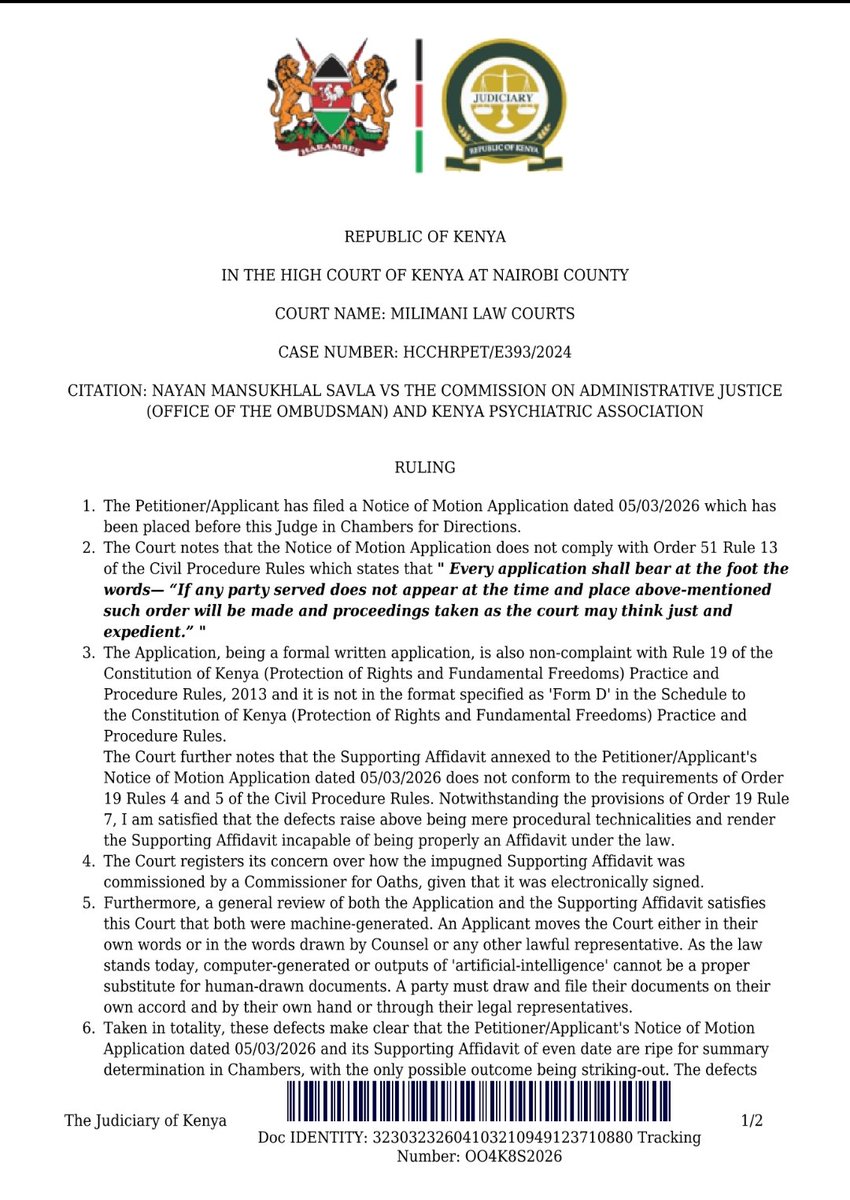
THE HIGH Court strikes out AI-generated application.The Court struck out a Notice of Motion after finding the supporting affidavit had an electronic signature, raising doubts about how it was properly commissioned by a Commissioner for Oaths. Even more striking, the Court noted that the application appeared to be machine-generated using AI, stating that AI outputs cannot substitute documents drawn by a party or their advocate. The entire application was therefore struck out, though the applicant may file a fresh compliant one.
Thuranira tweet mediaThuranira tweet media
English
8
38
126
15.9K