0xJason

991 posts

0xJason

0xJason

@Jason0x1

Web3 Artist Discord : json39536

가입일 Ağustos 2017
272 팔로잉322 팔로워
고정된 트윗
0xJason
0xJason@Jason0x1·
gmum guys @get_optimum I built a game called Mum Jump World! Explore platforming levels, collect logos, avoid or defeat enemies and reach the end of each zone. Compete for the highest score on the leaderboard! How to Play • Upload your PFP and enter your operator name • Navigate through levels, jump and survive Controls ← → / A D — Move SPACE / ↑ — Jump 🎮 Play now: mumjumpp.vercel.app My current high score: 13000 Ready for an adventure? Don't forget to share your score! @cryptooflashh @shariaronchain @tgogayi @aqccapital @CryptoSundayz @TheBl0ckBoy
English
20
0
24
295
S H A HE D (build szn)
S H A HE D (build szn)@shahed05miazee·
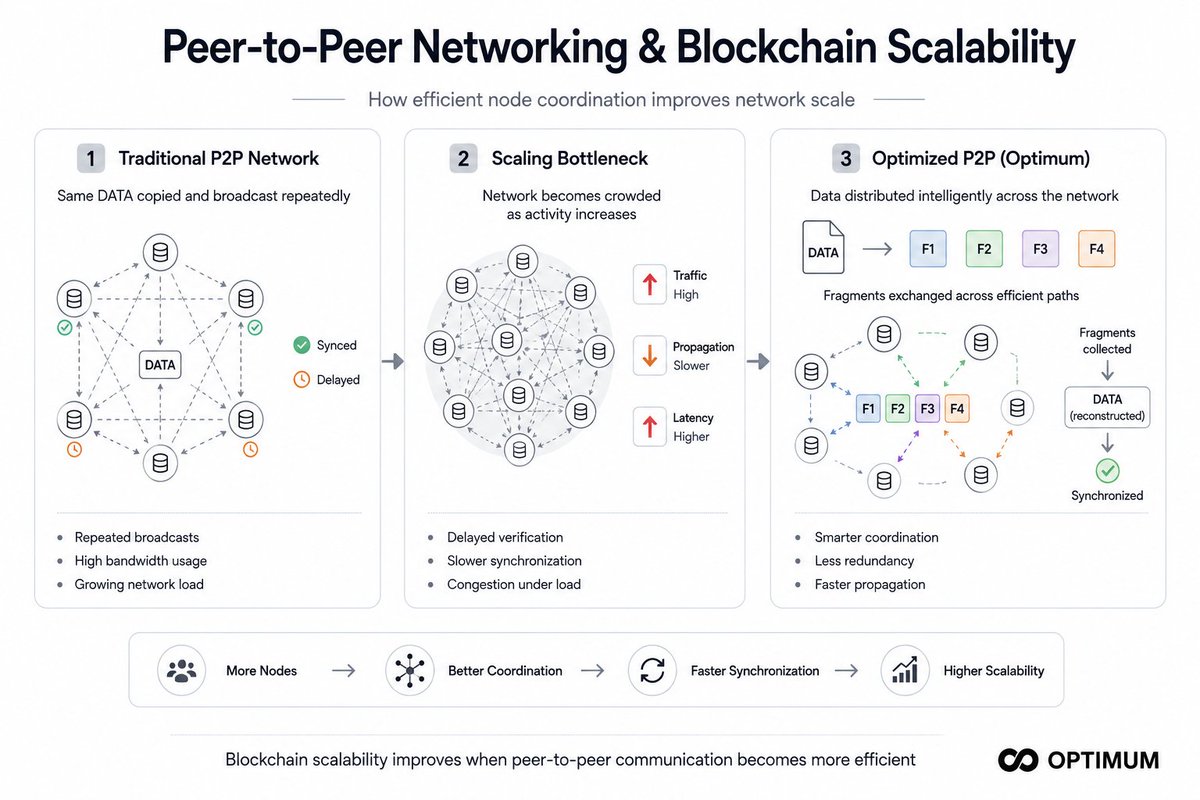
When people talk about blockchain scalability, most of the attention goes to execution. Faster blocks. Higher TPS. Cheaper transactions. But there’s another layer quietly carrying the whole system. Peer-to-peer networking. Because blockchains do not run from a central server. Every validator and node depends on receiving information from other nodes across the network. Blocks. Transactions. State updates. Synchronization messages. Everything moves through peer-to-peer communication. At smaller scale, traditional P2P models work well. Nodes receive data and forward it to others until the network becomes synchronized. But as throughput grows, this model starts becoming expensive. The same information gets copied and retransmitted again and again. That creates unnecessary traffic. More traffic means: • more bandwidth consumption • slower propagation • delayed verification • reduced efficiency under load Eventually the network spends too much effort distributing data instead of processing it. That’s why networking is becoming a scalability problem, not just an infrastructure detail. The role of peer-to-peer networking is no longer simply connecting nodes. It’s about coordinating information efficiently. That means: • reducing redundant transmission • improving propagation paths • keeping nodes synchronized faster • delivering data with less overhead Optimum explores this layer through optimized networking approaches. Instead of relying only on repeated broadcasting, data can be distributed more intelligently across multiple paths. Nodes exchange useful information instead of duplicating everything. This helps the network stay coordinated even as activity increases. Because blockchain scalability is not only about producing more blocks. It’s also about helping those blocks move efficiently between thousands of participants.
S H A HE D (build szn) tweet media
English
19
0
21
127
0xJason
0xJason@Jason0x1·
proof of art
English
0
0
0
11
0xJason
0xJason@Jason0x1·
Could Ethereum's biggest scaling bottleneck be bandwidth? Everyone talks about faster execution, higher TPS and lower fees. But none of that matters if blocks and blobs can't move efficiently across the network. As Ethereum scales, data availability increases. So do the bandwidth requirements needed to keep thousands of nodes synchronized. That's why Optimum caught my attention. Instead of building another chain, it's focused on the layer most people ignore: data propagation. Because the next phase of scaling may not be about producing more data. It may be about moving it faster. @get_optimum
0xJason tweet media
0xJason@Jason0x1

Everyone talks about scaling blockchains. Few talk about scaling the networks that move the data. As Web3 grows, data transmission is becoming a critical bottleneck. Optimum is tackling this challenge with advanced network coding designed to improve speed, reliability and efficiency across decentralized systems. The next leap in blockchain performance may not come from execution. It may come from communication. @get_optimum

English
3
0
2
17
Ope (Ø,G)
Ope (Ø,G)@realbiyi·
Happy weekend 🫶 Me showing up to Sunday service and realizing the pastor has gold grills and looks half asleep @just_t00ns
Ope (Ø,G) tweet media
English
12
0
15
109
Mohammed Asif
Mohammed Asif@stupidoasif·
Injective achieved 21.8K code commit in one year and ranked second overall for all L1 blockchains based on public data from Token Terminal. It outperformed both Ethereum's 19.0K and Cardano's 13.0K. Commits indicate every modification in the repositories of a project and measure real results, not marketing efforts. The price activity does not play a role here at all. Teams at this level consistently address protocol needs, ship upgrades, and build the base layer that future applications will rely on. Recent Vulcan mainnet upgrade, optimizing the chain for perpetuals, stablecoins, and asset tokenization. Developers migrate toward chains whose codebases see continual improvements. With capital returning to the space, better networks attract more deployments. @injective
Mohammed Asif tweet media
English
14
2
58
1.2K
saze(revival arc)
saze(revival arc)@sazexbt·
speed is money, blah blah, you've heard it a thousand times. but what does it actually mean when people say Optimum is speeding up blockchain? --- >let's break things down! right now, when validators on a blockchain need to share data blocks, transactions, state updates they do it the old way. Send the full data. Wait. Confirm. Repeat. works but it's slow, and it doesn't scale. @get_optimum changes this with RLNC (Random Linear Network Coding) - a data propagation technique where instead of sending the same full chunk of data over and over, nodes send small, random coded pieces. any node that collects enough of these pieces can reconstruct the full data- faster, with less bandwidth wasted. think of it like a puzzle. Instead of waiting for one person to hand you the complete picture, ten people each give you a few random pieces - and you finish it way quicker. --- this means: -blocks reach validators faster -less time wasted on redundant data transfers -lower latency across the network -more transactions processed per second So when Optimum talks about speed - it's not marketing noise. its a fundamental fix to how data moves through a blockchain. speed isn't just money. It's the foundation everything else is built on. @get_optimum @cryptooflashh @shariaronchain @tgogayi
saze(revival arc) tweet media
Optimum@get_optimum

English
14
0
27
563
BlockWeb
BlockWeb@marurlemo·
Good Morning! gQuip, CT 🦋 Security is only part of the equation. Integrity is the foundation. Quip @quipnetwork validators are designed with that distinction in mind. Their role goes beyond confirming transactions. They verify the correctness of computation itself, ensuring that every output can be trusted not just recorded. Because in advanced systems, a valid transaction doesn’t always mean a valid result. That’s the gap Quip closes. Validators enforce: • Verifiable execution • Consistent outcomes • Tamper-resistant computation This shifts the focus from activity to accuracy. From “Did it happen?” to “Was it done right?” In a quantum-enabled future, that difference becomes everything. Quip validators don’t just secure the network. They secure its integrity.
BlockWeb tweet media
English
27
2
34
280
Syed Tanveer Shah
Syed Tanveer Shah@SyedTanvee42325·
The Human made the Ai 🫢 The future of trading probably isn't human vs AI. It's humans working alongside AI. @RAFA_AI is building tools that can help traders move faster while staying focused on risk and execution.
Syed Tanveer Shah tweet media
English
14
0
15
53
0xJason
0xJason@Jason0x1·
@M3rik00 This quantum-hybrid routing is game-changing
English
0
0
0
1
M𝑒r𝑖kO
M𝑒r𝑖kO@M3rik00·
One subtle idea in Quip's design is that not all compute is created equal. A CPU might be the best choice for one workload. A GPU might dominate another. For certain optimization problems, quantum hardware may eventually have an advantage. Most compute platforms today force users to choose the infrastructure first and solve the problem second. @quipnetwork reverses that process. You bring the problem. The network determines which available architecture is best suited to solve it. That may sound like a small distinction, but it fundamentally changes how computational resources are accessed and utilized. The workload becomes the focus, not the hardware.
M𝑒r𝑖kO tweet media
English
22
4
42
220
Hitesh
Hitesh@HiteshKhambe·
𝗪𝗛𝗬 𝗧𝗘𝗟𝗘𝗢𝗣𝗘𝗥𝗔𝗧𝗜𝗢𝗡 𝗜𝗦 𝗖𝗥𝗜𝗧𝗜𝗖𝗔𝗟 𝗙𝗢𝗥 𝗣𝗛𝗬𝗦𝗜𝗖𝗔𝗟 𝗔𝗜 Building a robot is only part of the challenge teaching it to operate in the real world is often much harder 𝗥𝗲𝗮𝗹 𝗲𝗻𝘃𝗶𝗿𝗼𝗻𝗺𝗲𝗻𝘁𝘀 𝗮𝗿𝗲 𝗺𝗲𝘀𝘀𝘆 : ➣ Lighting changes ➣ Objects move unexpectedly ➣Tasks vary from one situation to another ➣ Edge cases appear constantly This is where teleoperation becomes valuable By allowing humans to guide robots through real world tasks, teleoperation helps generate high quality training data while improving system performance 𝗕𝗲𝗻𝗲𝗳𝗶𝘁𝘀 𝗶𝗻𝗰𝗹𝘂𝗱𝗲 : ➣ Better data collection ➣ Faster learning cycles ➣ Reduced failure rates ➣ Improved real world adaptability The goal isn't just to control robots remotely. Its to create a feedback loop where every interaction helps robots become more capable over time Hardware provides capability Experience creates intelligence 𝗟𝗶𝗻𝗸𝘀 : Discord : discord.gg/prismaxai X : x.com/PrismaXai Website : app.prismax.ai/fleet @PrismaXai @realAltcoiner @vivianrobotics @MaxC16134
Hitesh tweet media
English
16
0
17
47
Crybabe
Crybabe@0xCrybabe·
Gmum🤍 Caught a gem from research engineer @GrundeiMoritz He unpacks why Random Linear Network Coding is built for blazing fast data delivery breaking complex design into something that just clicks. If you geek out over how networks cheat latency, this one’s for you. x.com/get_optimum/st… @get_optimum @MurielMedard @tarunchitra x.com/get_optimum/st…
Crybabe tweet media
Crybabe@0xCrybabe

Gmum🤍 The new Wall Street isn’t on Wall Street anymore. It’s being built on Ethereum brick by brick, block by block and last week we got the actual architects in one room. Not the speculators. The institutions. The liquidity engines. The infra that’s quietly rewiring global finance. This was Top of the Block, live with the heavyweights themselves: @BitMNR @1kxnetwork @Auros_global @BlockdaemonHQ If you care about where smart money is actually moving behind the scenes, this is the one space you don’t want to sleep on. The energy was different 🔥 @get_optimum @MurielMedard @tarunchitra

English
20
0
28
238
Phazee🌸💜
Phazee🌸💜@phazeeconcepts·
𝗮𝗻 𝗮𝘀𝘀𝗲𝘁 𝘄𝗶𝘁𝗵 𝗮𝗻 𝗲𝘅𝗽𝗶𝗿𝗮𝘁𝗶𝗼𝗻 𝗱𝗮𝘁𝗲 𝗶𝘀 𝗻𝗼𝘁 𝗮𝗻 𝗶𝗻𝘃𝗲𝘀𝘁𝗺𝗲𝗻𝘁, 𝗶𝘁’𝘀 𝗮 𝘁𝗶𝗰𝗸𝗶𝗻𝗴 𝘁𝗶𝗺𝗲 𝗯𝗼𝗺𝗯. unpopular opinion: buying a sports NFT because you think it’s going to "go up next season" is a massive trap. YES! Because when the tournament ends, the hype dies, and you’re left holding an illiquid digital cardboard box of dead capital while everyone moves on. That’s the exact flaw @CUPcards_sol was built to destroy on Solana. Here’s the shift 🔻🧵
Phazee🌸💜 tweet media
English
31
6
50
513
Dream (❖,❖)
Dream (❖,❖)@dream_07a·
Everyone is focused on the next move for $SPCX But the bigger story might be the infrastructure making these markets accessible on chain. Through the @injective ecosystem and platforms like @HelixMarkets traders can access perpetual markets with a fully on chain experience, combining speed, transparency, and advanced trading functionality What stands out isn't just the asset itself. It's the idea that more financial markets are gradually moving on hain giving users greater access and control than traditional systems ever could. The future of finance won't be defined by a single token. It will be defined by the infrastructure powering the next generation of markets. Curious to hear your thoughts Is $SPCX still flying under the radar, or are more traders finally starting to pay attention? $INJ bullish
Dream (❖,❖) tweet media
Dream (❖,❖)@dream_07a

What you guys think about @injective A lot of people think Injective is just another Layer 1 blockchain. It isn't. Injective built fro Finance Instead of giving developers only a blockchain Injective provides the infrastructure they need from the start. Things like an on chain orderbook, cross chain connectivity, EVM support, AI builder tools, and customizable modules are already part of the network. This means developers can spend less time building the basics and more time creating products that people actually use, whether it's a decentralized exchange, a lending protocol or tokenized real world assets. In simple words $INJ isn't trying to be everything for everyone. It's focused on becoming the best place to build the future of finance on chain. That's what makes Injective different

English
34
5
48
640
ROCKET 🚀
ROCKET 🚀@Soliu90741·
wen add me to private TG? @just_t00ns or until I cut this thing off?? Dem br0s t00ns
ROCKET 🚀 tweet media
English
12
0
12
58
💢 𝐌 𝐀 𝐗 💢
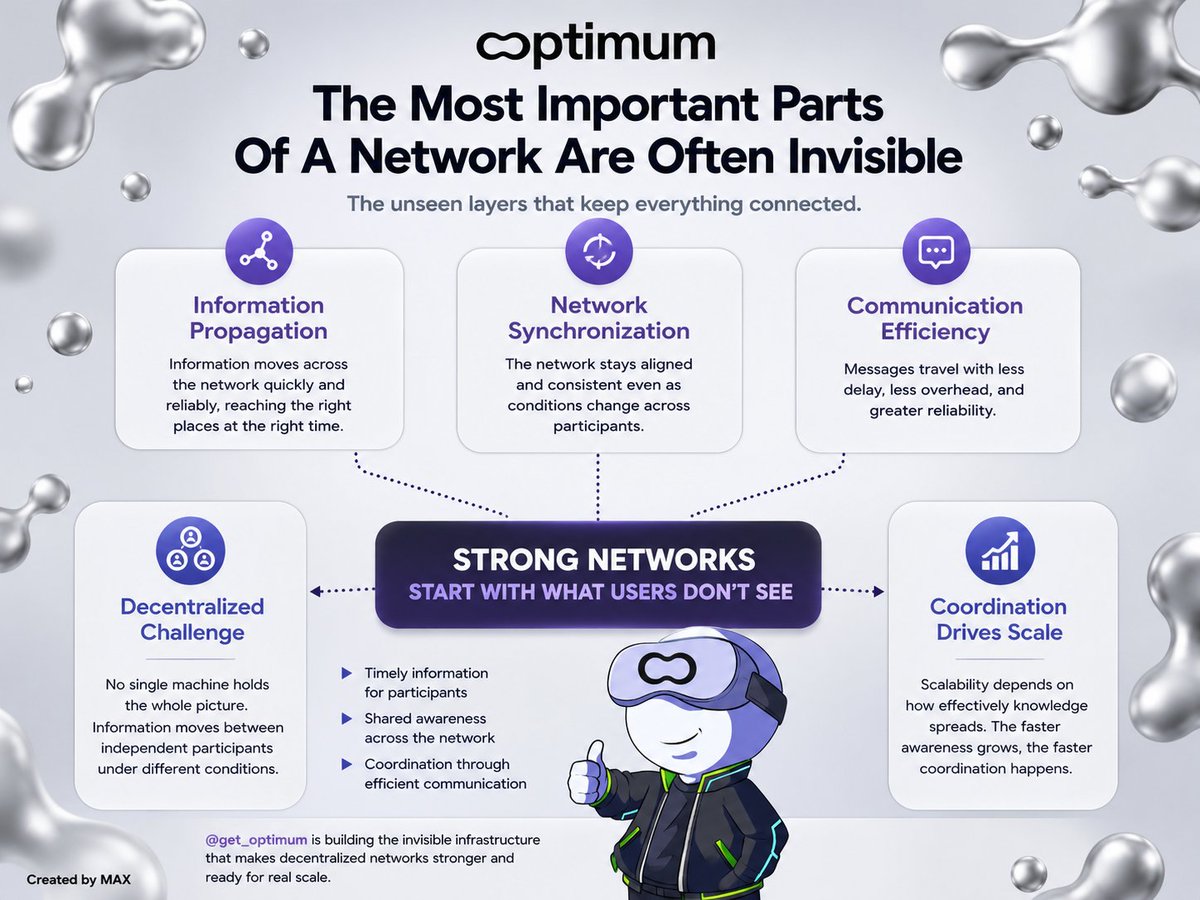
𝐓𝐡𝐞 𝐌𝐨𝐬𝐭 𝐈𝐦𝐩𝐨𝐫𝐭𝐚𝐧𝐭 𝐏𝐚𝐫𝐭𝐬 𝐎𝐟 𝐀 𝐍𝐞𝐭𝐰𝐨𝐫𝐤 𝐀𝐫𝐞 𝐎𝐟𝐭𝐞𝐧 𝐈𝐧𝐯𝐢𝐬𝐢𝐛𝐥𝐞 A lot of people evaluate technology by looking at what users can see. The interface. The features. The experience. But some of the most important improvements happen in places users never notice. ◆ information propagation ◆ network synchronization ◆ communication efficiency Nobody talks about these things when everything is working normally. Yet they often determine whether a system can support growth or not. 𝐃𝐞𝐜𝐞𝐧𝐭𝐫𝐚𝐥𝐢𝐳𝐞𝐝 𝐍𝐞𝐭𝐰𝐨𝐫𝐤𝐬 𝐒𝐡𝐚𝐫𝐞 𝐀 𝐃𝐢𝐟𝐟𝐞𝐫𝐞𝐧𝐭 𝐂𝐡𝐚𝐥𝐥𝐞𝐧𝐠𝐞 In decentralized environments, there is no single machine holding the entire picture. Information is constantly moving between independent participants operating under different conditions. ▸ participants need timely information ▸ networks need shared awareness ▸ coordination depends on communication The network only works when participants can coordinate around the same information. 𝐂𝐨𝐨𝐫𝐝𝐢𝐧𝐚𝐭𝐢𝐨𝐧 𝐃𝐫𝐢𝐯𝐞𝐬 𝐒𝐜𝐚𝐥𝐚𝐛𝐢𝐥𝐢𝐭𝐲 That means scalability is not simply about processing more transactions. It's also about how effectively knowledge spreads throughout the system. @get_optimum is focused on that challenge. The faster participants become aware of new information, the faster they can coordinate around it. And coordination, more than raw computation, is often what determines how large a distributed system can become. @aqccapital |@CryptoSundayz |@shariaronchain |@cryptooflashh | @tgogayi
💢 𝐌 𝐀 𝐗 💢 tweet media
English
18
0
29
177
Pinku Neel
Pinku Neel@pinku_neel71449·
Blockchain performance is often discussed in terms of throughput, execution, and scalability. However, one important factor is frequently overlooked: geography. Validators are distributed across different regions, and information does not reach every node simultaneously. When new blocks are propagated, variations in network latency can lead to synchronization delays, redundant retransmissions, and inefficiencies in coordination. @get_optimum approaches this challenge at the networking layer by improving how information propagates across the network. Rather than relying on repeated transmission of identical data through the same paths, the protocol enables more efficient distribution across multiple routes. This helps nodes acquire the information they need more effectively, maintain alignment with the broader network and reduce the impact of geographic distance on coordination. The objective is not to eliminate distance, but to minimize the friction it introduces into decentralized systems. @MurielMedard @blockchainjeff @shariaronchain
Pinku Neel tweet media
Pinku Neel@pinku_neel71449

Most blockchain discussions revolve around speed, scalability, and consensus. Yet one of the most important layers often goes unnoticed: how data moves across the network. That’s what makes @get_optimum particularly interesting. Led by MIT professor @MurielMedard, a pioneer in network coding research, Optimum brings decades of proven data transmission theory into blockchain infrastructure. Its core innovation, Random Linear Network Coding (RLNC), enables data to be transmitted more efficiently by reducing redundancy while improving reliability across distributed networks. Rather than building another blockchain, Optimum is addressing a challenge every blockchain faces: moving information faster, smarter, and with less overhead. The more I explore the project, the more it feels like a bridge between rigorous academic research and practical Web3 infrastructure. Sometimes the most impactful innovations are not the ones users interact with directly, but the ones quietly making the entire ecosystem work better. @blockchainjeff @shariaronchain

English
13
0
13
54
Elias
Elias@TheAvatarHQ·
Three years ago, a legend was born on Polygon. 🟪🐸 Through every pump and every dip... $APEPE has remained a community-first meme. To celebrate its 3rd birthday, I made the legend aura farm for 34 seconds. ⚡🌩️ Happy Birthday, @APEPE_MEME! Here's to many more years of memes, builders, and good vibes. Drop a 🐸 and wish the legend a happy birthday in the comments! 🎉 @0xPolygon #APEPECreator #Polygon
English
21
1
25
291
Khaled Bin Himel
Khaled Bin Himel@web3himel·
What happens when nodes receive blockchain data at different speeds? @get_optimum focuses on one of the most overlooked challenges in blockchain infrastructure: inconsistent data delivery across the network. When nodes receive blocks and transactions at different times, the network can become less efficient, creating delays that affect validators, consensus, and overall performance. 1. Uneven Network Visibility: Blockchain networks rely on nodes having access to the same information as quickly as possible. Geographic Delays: Nodes located in different regions may receive new blocks at different times due to network latency. Propagation Variance: Data travels through multiple peer to peer connections, causing some nodes to learn about new information faster than others. Temporary Information Gaps: During propagation, portions of the network may be operating with different views of the current blockchain state. As networks grow larger, maintaining consistent information distribution becomes increasingly difficult. 2. Consensus Efficiency Can Be Impacted: Consensus mechanisms depend on validators and nodes receiving timely information. Delayed Block Reception: Validators that receive blocks later have less time to verify and react to new network activity. Synchronization Challenges: Nodes must continuously update their local state as new transactions and blocks arrive. Increased Communication Overhead: Additional messages may be required to ensure all participants eventually reach the same state. The faster information spreads, the more efficiently the network can coordinate. 3. Optimizing Data Distribution: Improving blockchain performance often begins with improving how information moves between participants. Faster Propagation Networks: Reducing transmission delays helps nodes stay synchronized regardless of location. Efficient Data Transport: Advanced networking approaches can improve delivery reliability while minimizing the effects of packet loss and congestion. Better Network Coordination: When nodes receive data more consistently, the network can operate with greater efficiency and stability. @get_optimum is building infrastructure designed to accelerate blockchain data movement, helping information reach participating nodes faster and more reliably across decentralized networks. As blockchain ecosystems continue to scale, the speed and consistency of data propagation may become just as important as transaction execution itself.
Khaled Bin Himel tweet media
English
12
0
14
117
AJMUL
AJMUL@riyadhisla58886·
Security. Yield. Utility. not a tagline. an architecture. most protocols optimize for one and sacrifice the others. @ConcreteXYZ built infrastructure where all three exist simultaneously. qualified custody + automated yield + composable ctAssets. this is what DeFi should have always looked like. 🟩
AJMUL tweet media
English
3
0
5
40