

@jen_bobz @get_optimum Great chains start with great networks. Gamechanger!
English
CryptoSundayz
6.9K posts

@CryptoSundayz
Build algo trade system powered by AI | Olympus Alpha | Sharing the process Web3 | @get_optimum @creo_engine


Every day more of the financial world is moving onchain, demanding high speeds at an increasingly large scale. So how can we speed up blockchains while retaining the decentralization that makes them such valuable venues for economic activity? Our CEO @MurielMedard is back at her whiteboard to demonstrate. ⬇️


Team Oracle BTC ini adalah team pertama gw yang bisa dibilang agentic automation, dibentuk buat menentukan Regime Bitcoin - Risk on - Choppy - Risk off Gw bisa menyaksikan debat Agent Quant Technical Analyst (Sonnet) vs Agent Macro Analyst & X intel (Grok).. Lalu ditengahi agent Moderator (Opus) yang akan memberi keputusan akhir regime dan trade setup untuk Bitcoin. Mereka belajar dari kesalahan, mereka bisa mengubah logic agar trade berikutnya bisa lebih baik. Bukan buat keren2an tapi gw lagi belajar cara memaksimalkan potensi ai agent buat bantu gw trade dan kasih cuan. Proses nya panjang tapi asik ☕️

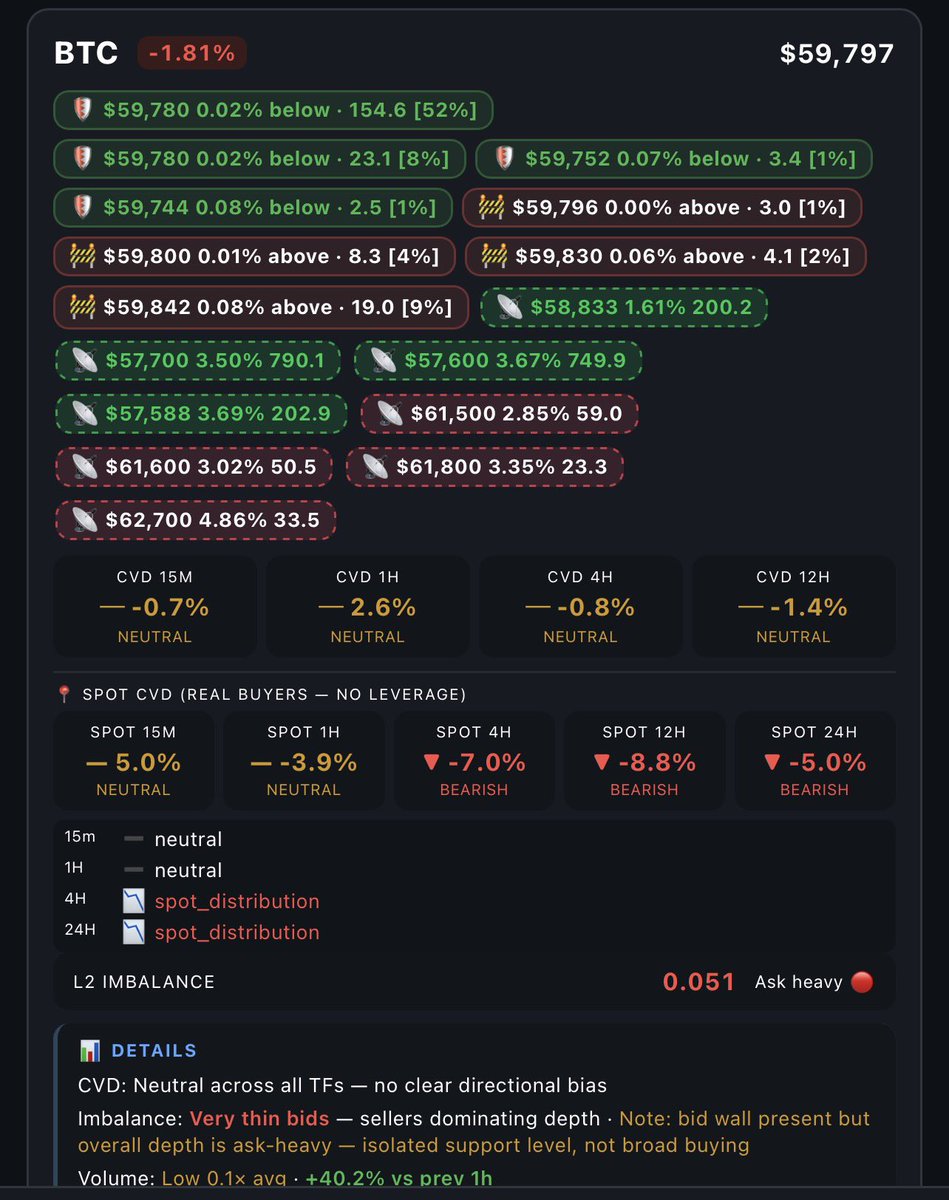
Ada bid besar di area $58.888 - 59.400 #Bitcoin


Hanum Daily Tech Insight : Optimum × Puffer: A Major Technical Collaboration @get_optimum is a blockchain infrastructure project focused on solving one of Ethereum's biggest challenges: data propagation. Its core technology, mump2p, is powered by RLNC (Random Linear Network Coding), enabling faster, more efficient, and more reliable propagation of blocks, attestations, and other network data. Compared to Ethereum's traditional GossipSub protocol, mump2p has demonstrated up to 6× faster propagation while reducing bandwidth usage by as much as 90–95%. Recently, Optimum announced a technical collaboration with Puffer, one of the leading projects in Ethereum's liquid staking and restaking ecosystem. Personally, I think this is a significant milestone. @puffer_finance isn't just another DeFi project it actively operates validator infrastructure and continues to build products such as UniFi, making it an ideal environment to evaluate Optimum's technology under production-like conditions. So, what could this collaboration involve? 1. Testing & Integration Puffer can integrate and test mump2p within its validator infrastructure to evaluate how the protocol performs in real-world Ethereum environments. 2. Validator Performance Validation Since Puffer operates validator nodes at scale, it can provide valuable data on how mump2p improves block propagation, attestation timing, and overall validator performance. Benefits for Puffer By integrating mump2p, Puffer could potentially gain: - Faster block propagation. - More consistent attestations and block proposals. - Lower bandwidth consumption and reduced node operating costs. - Better staking and restaking performance through fewer missed slots. - Greater opportunities to capture MEV. Benefits for Optimum For Optimum, this collaboration provides something equally valuable: - Real-world performance feedback from an experienced validator operator. - Validation of mump2p in a production-like environment. - Opportunities to further optimize the protocol before broader adoption. - Increased credibility through collaboration with a well-established Ethereum infrastructure project. It's important to note that this is not an investment partnership or token collaboration. Instead, this is a technical infrastructure collaboration, similar to Optimum's previous work with major validator operators such as Luganodes, P2P. org , and Blockdaemon. If the testing proves successful, collaborations like this could accelerate the adoption of faster and more efficient data propagation infrastructure across Ethereum. Sometimes, the biggest innovations in blockchain don't happen at the application layer they happen deep within the infrastructure that keeps the entire network running. So guys what do u think about this huge collaboration? CC : @CryptoSundayz @blockchainjeff


Please welcome @puffer_finance as our newest mump2p testing partner! The Puffer team is well known for their dedication to security and experience in the world of institutional staking. We're thrilled to have them on board getting a firsthand look at what mump2p can do. 👏


Hanum Daily Tech Insight : Speed Is Money!!!! **Speed is Money.** In the world of blockchain, every millisecond has economic value. The faster data propagates, the lower the latency experienced by validators. With lower latency, validators can receive blocks faster, validate transactions sooner, and participate in consensus more efficiently. This improves validator performance while opening up more opportunities to capture MEV (Maximal Extractable Value), which ultimately results in higher rewards and profits. This is why technologies like RLNC are so important not only because they make the network faster and more efficient, but also because they directly increase validators’ earning potential. In blockchain, speed isn’t just performance speed is money!! @get_optimum @blockchainjeff @CryptoSundayz


Hanum Daily Tech Insight : What is Flexnodes? By now, you're probably familiar with Optimum, RLNC, and mump2p. We've already discussed how RLNC reduces data redundancy, how mump2p accelerates blockchain data propagation, and how both technologies work together to reduce network latency. But what about Flexnodes? Flexnodes is a product developed by @get_optimum in the form of a global relay network designed to accelerate blockchain data distribution worldwide. Flexnodes leverages unused internet bandwidth from connected devices to help distribute blocks, transactions, and blockchain data more quickly and efficiently across the network. By combining RLNC to minimize data redundancy and mump2p as a high-speed propagation protocol, Flexnodes acts as an additional distribution layer that helps validators receive information faster than traditional peer-to-peer networks. The result is: - Lower latency - Faster data propagation - More efficient bandwidth usage - Better validator performance - Greater MEV and reward opportunities What makes Flexnodes especially interesting is that participation won't be limited to large validators. In the future, anyone may be able to contribute bandwidth and become part of the network. Through Optimum's Latency Marketplace, Flexnode operators can earn rewards based on the bandwidth and network resources they provide. In the long term, Optimum is not just building a solution for Ethereum. It has the potential to become a universal infrastructure layer supporting multiple blockchains and decentralized applications. If widely adopted, Flexnodes could transform unused internet bandwidth into a global blockchain distribution network that is faster, more efficient, and more decentralized than ever before. Optimum isn't just building a faster network. It's turning unused global bandwidth into a decentralized infrastructure layer for the future of blockchain. GMUM! CC : @CryptoSundayz @blockchainjeff @PostMaklone

Me watching @get_optimum solve Web3 network bottlenecks like its nothing. The tech is built different, the numbers are flexing and the future is looking incredibly fast. Highkey bullish @blockchainjeff | @cryptooflashh


