고정된 트윗

@PhotonCap $IQE some links I thought were helpful below aside from their investor relations section on their website (which is pretty solid):
Valelelelele@valeagentt
English
Lawn Chair Capital
1.6K posts

@LawnChairCap
Current PE Operator | ex-LMM PE | ex-IB | washed-Ivy League Athlete | Asymmetric Investor | Currently $IQE $OSS Focused | Path to $1M


The man who turned 225 million dollars into 5.5 billion dollars explained on camera exactly why he made his biggest bet. This is Leopold Aschenbrenner, the same person whose Bloom Energy position is now worth close to 2 billion dollars after Oracle's 2.8 gigawatt fuel cell deal laying out the power math that drove every investment decision his fund has made. In 2022, the GPT-4 training cluster consumed roughly 10 megawatts of power and cost about 500 million dollars. AI compute has been scaling at roughly half an order of magnitude per year meaning the largest training cluster doubles in power requirement every 12 to 18 months without stopping. By 2024, the largest cluster was approximately 100 megawatts, the equivalent of 100,000 high-end GPUs and costs in the billions. By 2026, right now, the leading training cluster requires a full gigawatt of continuous power and that is the output of a large nuclear reactor. By 2028, the projection reaches 10 gigawatts, more electricity than most US states generate in total. By 2030, the trillion-dollar cluster, 100 gigawatts, over 20 percent of everything the United States currently produces in electricity, consumed by a single AI training installation. And that is just the training cluster. Inference, the continuous compute required to actually run AI products for hundreds of millions of users requires multiples of that on top. Meanwhile, total US electricity production has barely grown five percent over the last decade and the grid was not built for this. And the transformer shortage, the switchgear backorders, and the canceled data center projects that are making headlines right now are the first visible symptoms of a power system hitting a wall that Aschenbrenner saw coming years before the rest of the market. This is exactly why he built a 875 million dollar position in Bloom Energy, a company that generates electricity directly at the data center site using fuel cells, completely bypassing the grid bottleneck that is already stopping half of all planned US data centers from opening on schedule. The thesis was never complicated. The bottleneck in AI is not the models, not the chips, and not the software. The bottleneck is whether civilization can generate enough electricity to run the machines fast enough to matter.



Something isn’t right, and you know it.

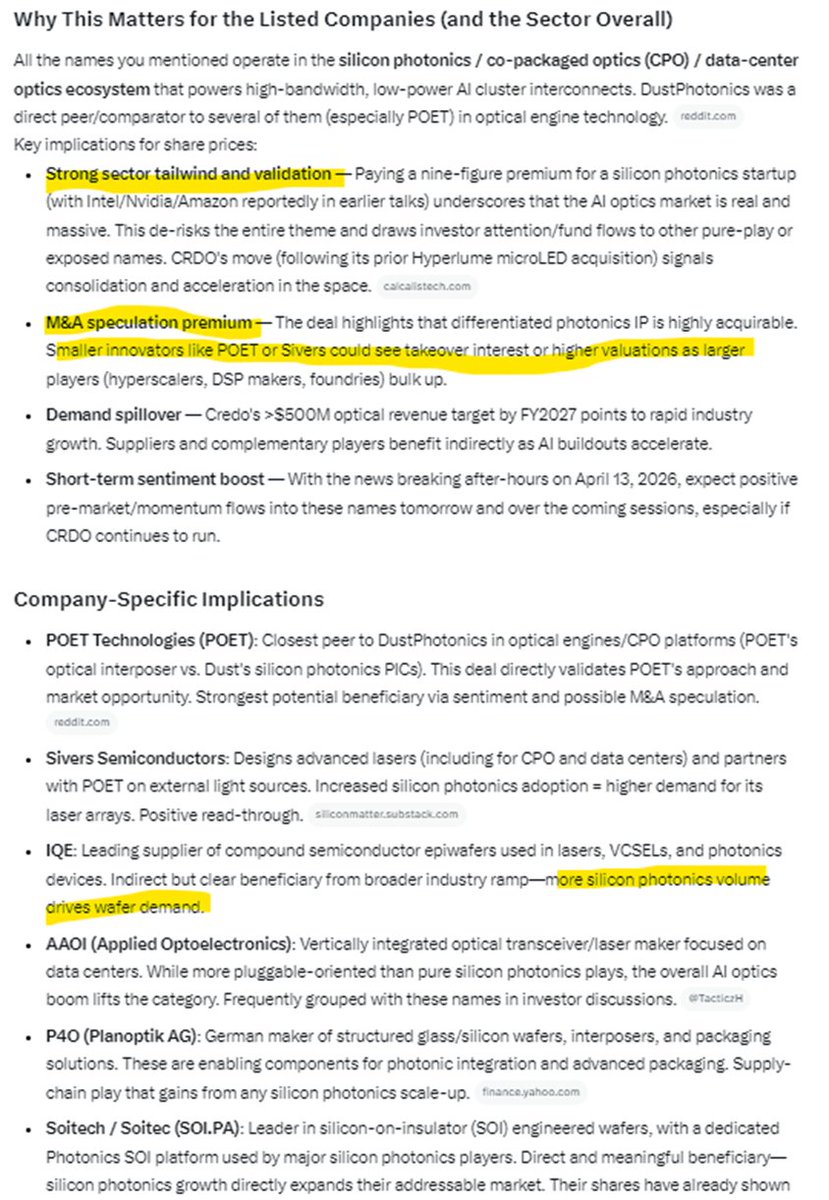
Credo $CRDO is acquiring silicon photonics company DustPhotonics for $750M in cash plus about 0.92M shares, with additional earnout shares tied to milestones. The deal should help lift its combined optical revenue to more than $500M in fiscal 2027.