Richard Dale (Norgate Data)

232 posts

Richard Dale (Norgate Data) banner
Richard Dale (Norgate Data)

Richard Dale (Norgate Data)

@NorgateData

Chief Information Officer@Norgate. US, AU, & CA Stocks, Futures, Forex. Survivorship-bias free data. Integrates with backtesting, charting & analysis platforms.

가입일 Ağustos 2015
4.8K 팔로잉2.3K 팔로워
Richard Dale (Norgate Data)
Richard Dale (Norgate Data)@NorgateData·
That really was an insightful weekend on all manner of trading topics at the @ATAA_au Conference 2025 in Melbourne, Australia. So pleased to have met the speakers @ASX__Trader (David Bird), @lb_ASC (Laurent Bernut), @MicMcCarthy (Michael McCarthy), @Phil_J_Anderson, @RichB118 (Rich Brennan), @s2nnews (Michael Berman), brilliantly hosted by @MaxKnobel and coordinated by @HelixTrader (Alan Clement) <- Super props to Alan - I know what he did behind the scenes to make this happen. Can't wait to do more industry events like this. For both the aspiring trader and seasoned trader, these sorts of events are a serious multiplier to your knowledge.
English

4
2
15
964
Brandon Koepke
Brandon Koepke@bdkoepke·
Outside of Reuters, Factset, Bloomberg, what data sources are there for historical TSX Composite and 60 index names and weights?
English
3
0
0
418
Richard Dale (Norgate Data)
Richard Dale (Norgate Data)@NorgateData·
@PeakoQuant Many so-called "standard" identifiers have licensing issues (eg. $100K+/annum/firm). OpenFIGI has its own issues, particualrly with some corner caess relating to reverse splits, demergers etc.I'd be happy to discuss this further with you-the discussion is far more than an X post.
English
1
0
1
78
PeakoQuant
PeakoQuant@PeakoQuant·
RIP: @NorgateData . Used it for ~4 years, it's fantastic for US stock price data. But no longer going to fight the lack of a standard identifier, i.e. CUSIP, ISIN, FIGI, BB. It's just not worth it. Add OpenFIGI, it's license free.
English
1
0
1
360
Richard Dale (Norgate Data)
Richard Dale (Norgate Data)@NorgateData·
In general, broad market indices that are market cap weighted are highly correlated even if the number of constituents varies widely. For example, consider the S&P 500 and S&P 1500 indices, or say Russell 1000 vs Russell 3000 - they are practically identical. Looking back at the historical story of the S&P 500 and S&P 90: The "Standard 500" index as it was known then, consisting of 425 industrial, 25 railroad and 50 utility stocks, representing 90% of the total market cap of the US market, was released on March 4, 1957, as a market-cap weighted index, calculated on an hourly basis. It was introduced as the successor to the S&P 90 stock composite index that had a similar set of weightings and was realistically just a "methodology" change that expanded the number of stocks. The real proof of this intent is that S&P 500 "starting" value was the final value of the S&P 90 index.
English
1
0
7
107
Ryan Detrick, CMT
Ryan Detrick, CMT@RyanDetrick·
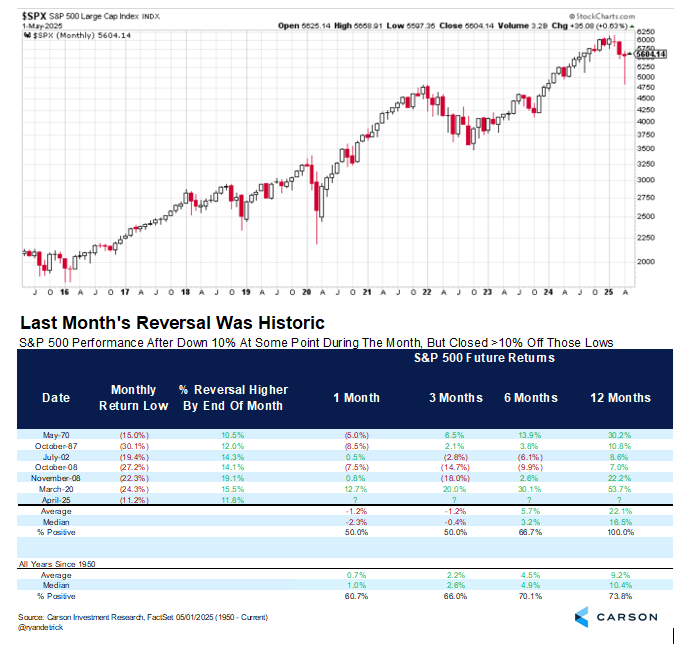
Last month was one of the largest monthly reversals ever. Down 10% MTD at one point, but up 10% off those lows. Here's what happens next.
Ryan Detrick, CMT tweet media
English
42
113
577
113.3K
Richard Dale (Norgate Data)
Richard Dale (Norgate Data)@NorgateData·
FYI, here's our support response: Here's what we know: Jefferson Smurfit Group was a packaging company, based in Ireland, that listed on the Irish Stock Exchange in 1964.   In 1994 it gained a Nasdaq stock market listing for its US-based operations under the ticker JJSC and company name Jefferson Smurfit Corp. Stone Container Corp was originally listed on the Curb Exchange, prior to it becoming the American Stock Exchange (AMEX) in 1962, and it shifted its listing to NYSE shortly thereafter.  It became an S&P 500 constituent in 1982.   In 1998, it was taken over by Jefferson Smurfit Corp.  This can be found under the ticker STO-199811 in the Norgate database. After the takeover, Jefferson Smurfit Corp changed its name to Smurfit-Stone Container Corp and changed its Nasdaq ticker from JJSC to SSTC.   Neither Jefferson Smurfit Corp nor Smurfit-Stone Container Corp were ever a member of the S&P 500, 400 MidCap or 600 SmallCap index.  In early 2009, Smurfit-Stone Container Corp declared bankruptcy and was delisted from Nasdaq, but traded as an OTC stock (SSCCQ).  It emerged from bankruptcy July 2010 in a rare example of the original shareholders receiving some portion of the emerged entity (albeit your share in the old SSCC would be worth 0.0084 of a share in the restructured company) and was admitted back to Nasdaq less than a month later, using the SSCC ticker.  The restructured Smurfit-Stone Container Corp was acquired by Rock-Tenn Co in May 2011, and you can find it under the Norgate ticker SSCC-201105. Rock-Tenn Co listed on Nasdaq in 1994 and shifted to NYSE in 1996.  It acquired Smurfit in 2011 through a cash & share offer.  It became a S&P SmallCap constituent in Aug 2002 and was promoted to the S&P MidCap 400 in May 2010.  It delisted in July 2015 upon merging with MeadWestvaco (more on this later).  You can find this in the Norgate database under RKT-201507. MeadWestvaco started out as Westvaco corp in the 1930s and was one of the original members of the S&P 500 in 1957.  It remained in the S&P for the rest of its life until the merger with Rock-Tenn in July 2015.  You can find this company in the Norgate database under MWV-201507. The merger between Rock-Tenn and MeadWestvaco was termed a "merger of equals" with no specific surviving entity.  The resulting company was named WestRock Co and listed on NYSE under the ticker WRK.  S&P added this company to the S&P 500 from when the merger was effected.  In July 2024, WRK was delisted due to a takeover offer by Smurfit Kappa Group PLC (OTC:SMFTF).  You can see the delisted entity under the ticker WRK-202407 in the Norgate database.   You may recall the Smurfit name here - this was the original (Irish) company that listed Jefferson Smurfit Corp in USA for its US operations, but had its own series of corporate actions to become Smurfit Kappa PLC. After this takeover offer, Smurfit Kappa PLC (OTC:SMFTF) changed its name to Smurfit WestRock PLC, and also decided to list its shares on NYSE under the ticker SW.  S&P also added it to the S&P 500 index at the same time in July 2024. In summary, as of 2025-03-08, here's what we know regarding all of these entities, regarding their index constituency: NYSE:SW is an S&P 500 constituent from July 2024 onwards SSCC-201105 was never a S&P 500 (or 400 or 600) constituent STO-199811 was an S&P 500 constituent from 1982 through to its delisting in Nov 1998. RKT-201507 was in S&P 600 (SmallCap) from Aug 2002 through May 2010, then in S&P 400 from May 2010 until its delisting in Jul 2015. MWV-201507 was in the S&P 500 from 1957 (inception!) until its delisting in July 2015. WRK-202407 was in the S&P 500 from 2015 through to its delisting in July 2024.
English
0
1
2
120
Halvar Flake
Halvar Flake@halvarflake·
Dear Twitterverse, I am trying to buy reliable historical data for stock index constituents, such as the SP500 or the various Russell indices. Ideally in the form "date, list of tickers on that date". This appears to be near-impossible, and I have nearly exhausted all the ...
English
15
4
34
49K
Richard Dale (Norgate Data)
Richard Dale (Norgate Data)@NorgateData·
Australian Story: Just voted in a state election here. Compulsory voting for all state residents. Proud moment - with my 18yo son who is compulsorily required to vote for the first time. Arrived 09:45. Went past a few (very polite) people with how-to-vote leaflets for various parties, and lined up. 09:49 inside building (a local primary school) and identified myself to voting officials as being eligible to vote for my electorate. 09:52 lined up to buy yummy snacks from the Parents & Friends Association of the (non-private) primary school, to provide them with funds for things like sporting equipment, outfits for acting, art supplies, big dollar funding for computers, buildings etc. Will do the same thing in about 1.5 months for the national election too. Voting can be fun and meaningful - why is it so hard for USA?
English
1
0
12
1.9K
Richard Dale (Norgate Data)
Richard Dale (Norgate Data)@NorgateData·
Norgate Data is humbled and deeply honored to have been selected as the top Readers’ Choice Award recipient from the prestigious @STOCKSandCOMM Technical Analysis of Stocks & Commodities magazine in the End Of Day Data Category. This recognition stands as a testament to the dedication and hard work that our entire team pours into creating reliable, cutting-edge financial market data solutions. Knowing that this honor comes directly from the readers themselves—many of whom are professional traders, investors, and researchers—makes it all the more meaningful to our organization. The award further validates our commitment to quality, accuracy, and continuous innovation in the ever-evolving financial landscape. Every day, we strive to develop tools and data services that help traders and investors make more informed decisions. We remain keenly aware that our success depends on the support and trust of our valued clients and subscribers, and we extend our heartfelt gratitude to everyone who voted for us. Looking to the future, Norgate Data remains steadfast in its mission to deliver the best possible market data solutions and uphold the trust our clients place in us each day.
English
13
1
86
29.7K
Richard Dale (Norgate Data)
Richard Dale (Norgate Data)@NorgateData·
Based upon the "tape" rules published by CTA and UTP, the consolidated open for the day is the first last-sale-eligible trade registered on the tape (whether or not it occurs on the listed exchange). However, what you're missing with OHLC data is that the security (in this case, GLD ETF) is rather volatile at market open at 09:30:00.000 The "trading system" you've implemented simply buys on the close and exits on the open and is really just a 1 tick hold with an overnight period. Without commenting whether this really brings you any alpha, your results are highly subject to slippage due to the volatile nature of the open. i.e. Any edge you think you might have is just part of the noise of the open. Using daily data that effectively represent only two consecutive points in a tick time series is generally not recommended. This is really just highlights that understanding market microstructure is required for trading systems durations of this nature - Note: 1 minute data won't actually give you much insight. Let's peer a bit deeper into the open on 20250226 on GLD. The first trade to occur was at 09:30:00.128 on Nasdaq BX for 100 shares @ $271.46. The NBBO at the time was 271.46/271.48 (a spread of 0.02). Within the first second, there were a total of 432 trades, most of which were odd-lot. The regular trades varied in price from 271.48 to 271.53. The NBBO spread also widened at times too (it was 271.47/271.53 at one stage during that first second). Looking at the first minute, the highest and lowest regular trades were 271.46 and 271.54 and the maximum NBBO spread was 0.06 (i.e. the same as the first second). If we look at an alternative by using the result of the opening price auction on the primary listing venue (NYSE Arca) - this occurred at 09:30:00.257, the auction resulted in a price of 271.53, so placing a MOO order would have given you a slightly better fill for this particular day. Most algo traders like @danw_trades, that use daily data typically have multi-day holding periods where their average profit isn't dwarfed by the opening volatility, and they typically find that they get slippage in both directions.
English
3
0
11
896
Radovan Vojtko - CEO of Quantpedia.com
We checked Yahoo, Investing, and Morningstar OHLC data. All of them had the same issue with opening prices. Maybe Norgate uses a different specification of the open price of the OHLC dataset. If that is the case, then Norgate may be better. I would not be surprised if it is different from provider to provider. R.
English
1
0
1
264
Radovan Vojtko - CEO of Quantpedia.com
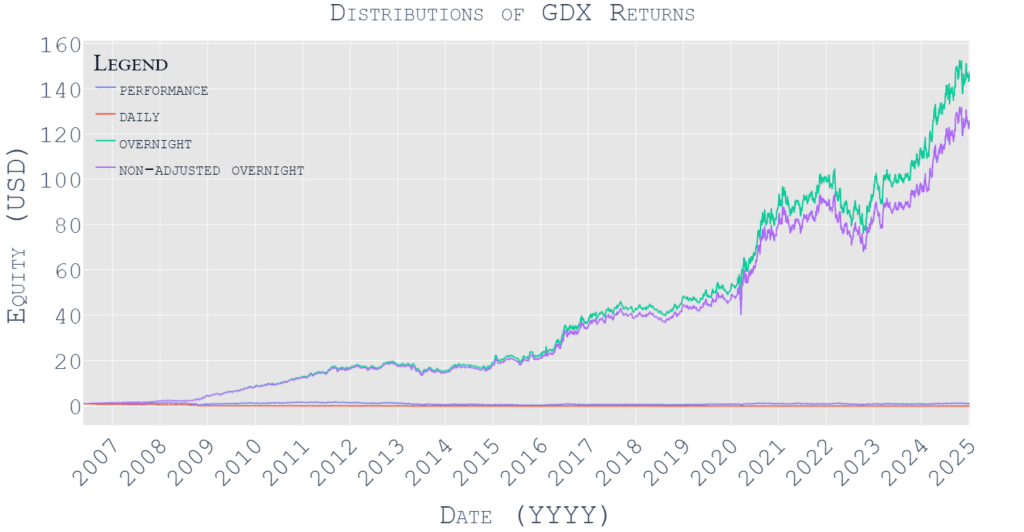
Dangers of Relying on OHLC Prices – the Case of Overnight Drift in GDX ETF Can we truly rely on the opening price in OHLC data for backtesting? While the overnight drift effect is well-documented in a lot of asset classes, we investigated its presence in gold using the GLD ETF and then extended our analysis to the GDX – Gold Miners ETF, where we observed an unusually strong overnight return exceeding 30% annualized. However, when we tested execution at AM using 1-minute data, the anomaly diminished significantly, suggesting that the extreme return was partially a data artifact. This finding highlights the risks of blindly trusting OHLC open prices and underscores the need for higher-frequency data to validate execution assumptions. quantpedia.com/dangers-of-rel… #fintwit #Quant #tradingstrategy #GOLD
Radovan Vojtko - CEO of Quantpedia.com tweet media
English
1
3
22
2.2K
Richard Dale (Norgate Data)
Richard Dale (Norgate Data)@NorgateData·
@StoneFelt1 Norgate has some very interesting things planned for 2025, but as a policy we don't pre-announce anything. If there's anything you're after, please email us your wish list. If/when we develop it, you'll be invited to test it early too :)
English
0
0
0
26
Tone Elt
Tone Elt@StoneFelt1·
@NorgateData I have a question. What are the factors that keep historical fundamentals and the fundamentals of delisted companies off of the platform? Why is it kept as single value rather than building a time series? I'd absolutely pay those as a separate package.
English
1
0
0
38
Richard Dale (Norgate Data)
Richard Dale (Norgate Data)@NorgateData·
@AnonApologist Norgate has some very interesting things planned for 2025, but as a policy we don't pre-announce anything. If there's anything you're after, please email us your wish list. If/when we develop it, you'll be invited to test it early too :)
English
1
0
1
39
Suck My Cabals
Suck My Cabals@AnonApologist·
I think there's a market for someone who can "retailify" that level of data and give folks at home all of the levers to pull on. The closest I have seen is Real Test with Norgate data. I think that combo is the blueprint for an effort with considerably more resources. Rant over.
English
2
0
1
84
Suck My Cabals
Suck My Cabals@AnonApologist·
Rare investing rant. The data available to retail investors is so piss poor it's depressing. When you inevitably come to the conclusion their are too many assets available to manually asses, you will start looking for ways to apply automation to the investing process.
English
1
0
2
103
Joachim Moser
Joachim Moser@JoachimMo1985·
It is only me or is reddit worthless? Why does google push it. Content is garbage, conversations about certain topics are at a very low level.
English
12
0
22
3.4K
Entropy☃️Chase
Entropy☃️Chase@EntropyChase·
@hughesanalytics fingers crossed. it is proceeding. I am doing this to be able to work w Norgate data, bc mac users are punished by the mighty Norgate 😂😂
Entropy☃️Chase tweet media
English
2
0
2
97
Entropy☃️Chase
Entropy☃️Chase@EntropyChase·
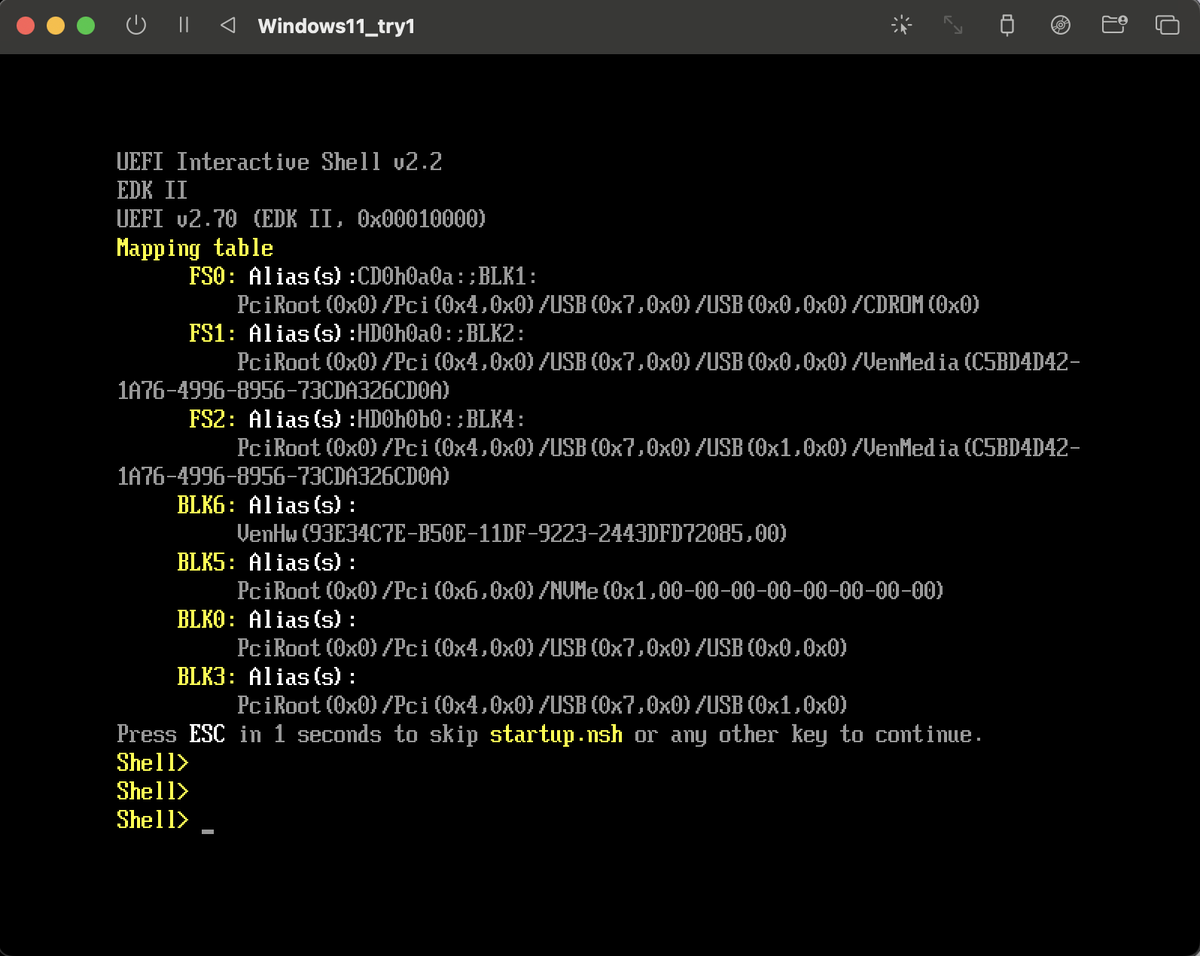
I am trying to run windows 11 on a Macbook air with M2 chips. I am using a tool called UTM. Keep getting stopped here. Anyone with experience on running windows on new macs understand how to fix this?
Entropy☃️Chase tweet media
English
2
0
3
700
Richard Dale (Norgate Data)
Richard Dale (Norgate Data)@NorgateData·
@TheOneRealPK @ArturSepp Norgate Data can be used with Python 3+. Maybe you could just install a virtual environment to use Python 3.10 for QIS (using virtual envs is "best practice" for use of any Python packages). For example, in conda, use: conda create -y -n py310 python=3.10 conda activate py310
English
0
0
1
114
Richard Dale (Norgate Data)
Richard Dale (Norgate Data)@NorgateData·
It's Russell indices annual reconstitution time. Here's some insights: Russell 1000: Now consists of 1020 stocks. 929 stocks unchanged. 47 stocks added. Of these, 21 were promoted from the Russell 2000 and 26 were new entrants to the Russell Universe. 1/2
English
4
1
15
0
Richard Dale (Norgate Data)
Richard Dale (Norgate Data)@NorgateData·
@hughesanalytics @EntropyChase @mikeharrisNY FWIW Norgate Data provides unadjusted data, plus 3 styles of price adjustments, and the adjustment factors we calculate are using doubles (accurate to about 15 significant figures). We are often asked why other providers with 2 decimal places differ from our data. Simply, this.
English
2
1
10
3.9K
hughesanalytics
hughesanalytics@hughesanalytics·
@EntropyChase @mikeharrisNY @NorgateData Each provider has their own criteria for adjustments. On long histories their historical data may change over time. IQ split adjusts to two decimals. There is no option for unadjusted. I use another for historical equity data which I adjust to four decimals.
English
2
0
2
198
Entropy☃️Chase
Entropy☃️Chase@EntropyChase·
data continues to be a big barrier to entry for folks who want to test traditional quant strategies. to test momentum on a universe of stocks in an index over time, costs roughly 680CAD/year minimum (using Norgate data) it's really something.
English
4
0
10
1.2K
Richard Dale (Norgate Data)
Richard Dale (Norgate Data)@NorgateData·
@basso_tom Thanks for the mention in the podcast Tom - it is really appreciated, and also thank you for sharing so your knowledge openly. Great questions Andrew @bettersystrader - love your work and committment to trader education.
English
0
0
6
81
Tom Basso
Tom Basso@basso_tom·
Live interview today at 4PM Eastern with Andrew Swanscott of Better System Trader podcast. bettersystemtrader.com/live should direct you to the live interview. Bring some questions and ETR, if you're not obsessing over $NVDA earnings!
English
2
0
14
4.5K
Jordan Borean
Jordan Borean@BoreanJordan·
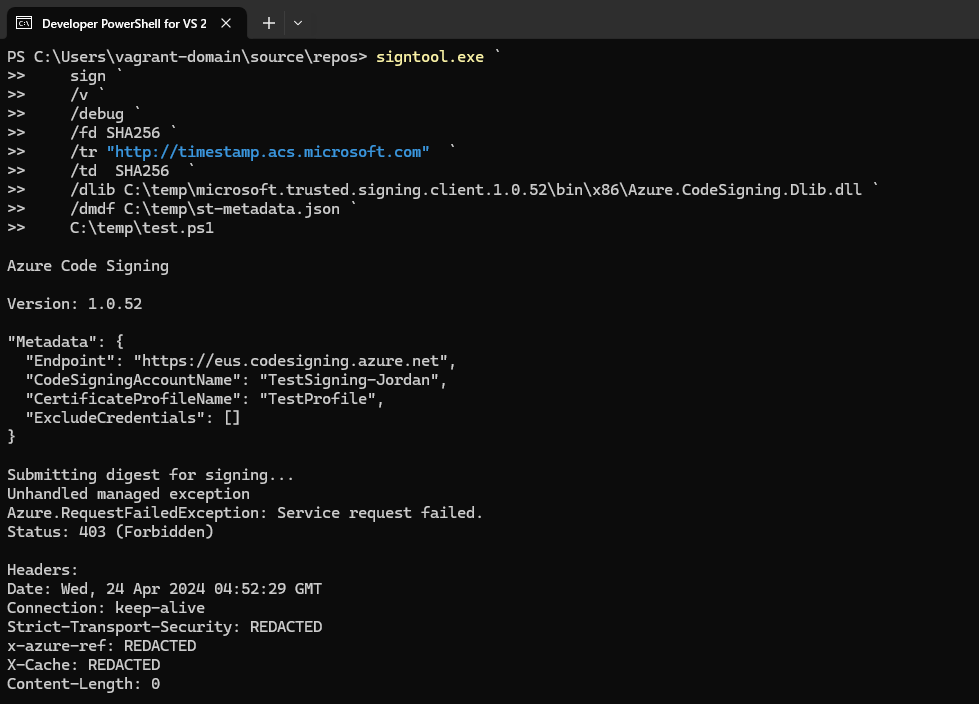
@NorgateData Nice, glad you solved it! Unfortunately I was definitely assigning the app I was logging in with but something else was having troubles.
English
1
0
0
28
Jordan Borean
Jordan Borean@BoreanJordan·
Trying out the new Azure Trusted Signing but I cannot seem to get it working. Receiving a 403 when sending any sign request even though the app/client I've using has the Trusted Signing Certificate Profile Signer role assigned.
Jordan Borean tweet media
English
5
2
7
2.1K