Poly VPN

264 posts

Poly VPN banner
Poly VPN

Poly VPN

@Poly_VPN

Low-latency London tunnel for Polymarket traders. WireGuard protocol. Sub-30ms taker / sub-10ms maker. Built for bots and serious traders. https://t.co/tBORVtAb1F

London 가입일 Mart 2026
71 팔로잉51 팔로워
고정된 트윗
Poly VPN
Poly VPN@Poly_VPN·
Getting started with PolyVPN: Spin up a Vultr VPS in London — same datacenter as our server 1. Subscribe at poly-vpn.xyz and get your WireGuard key by email 2. Drop the config on your server and run wg-quick up polyvpn 3. Your bot is now <1ms from our node, with fastest possible path to polymarket That's it. No code changes, no complexity — just faster fills. 🇬🇧
English
2
0
6
637
Tekee
Tekee@Tekeee·
Small accounts out here dropping content to absolute zero engagement
Tekee tweet media
English
350
35
618
24.1K
Poly VPN
Poly VPN@Poly_VPN·
@me_cool_off It can be done, but not as easy as you state, here's an example of how hard you have to work to get an edge: x.com/Poly_VPN/statu…
Poly VPN@Poly_VPN

Wall Street figured this out decades ago. Every time Brad Katsuyama tried to buy stock, the price moved against him the moment he hit buy. Not after. The moment he submitted. HFT firms had co-located servers at every exchange. They saw his order arrive at exchange #1 and raced ahead to exchanges #2, #3, #4 — buying the same stock before his order could get there. By the time he arrived, the price had already moved. His fix was IEX — a 38-mile coil of fiber optic cable that added 350 microseconds of delay to every order, neutralizing the co-location advantage entirely. The HFT firms hated it. Because it worked. Now look at Polymarket. Same dynamic. Different market. Polymarket's CLOB is in London. When a pricing event happens, the traders whose infrastructure is closest to that server get their orders matched first. Everyone else is paying a latency tax on every single trade — on every cancel, every reprice, every arb attempt. There's no speed bump on Polymarket. No IEX equivalent. No equalizer. What there is, is the ability to stop fighting from the wrong city. Katsuyama had to build an entire exchange to solve the distance problem. You just need to be in London. poly-vpn.xyz

English
0
0
0
2
✦ me_cool_off ✦
✦ me_cool_off ✦@me_cool_off·
> Chinese students flooding Polymarket > Building bots in a couple nights with Claude > Pulling $100,000/month > While others guess outcomes > Their bots arbitrage 5-min markets > Round after round, $3,000/day > Same math > EV. Kelly. Arbitrage > All in the article > Bookmark it
✦ me_cool_off ✦@me_cool_off

x.com/i/article/2047…

English
4
0
32
363
Poly VPN
Poly VPN@Poly_VPN·
@blendino Seems like more oppurtunity for them to fuck up
English
0
0
0
7
Dino
Dino@blendino·
Honestly I think Polymarket should just launch its own chain
English
38
0
121
3.5K
Poly VPN
Poly VPN@Poly_VPN·
@Deepppeth @Polymarket @PolyReward @PolyTechTrade Awesome dude Try scaling your method to get a bigger piece of the pie x.com/Poly_VPN/statu…
Poly VPN@Poly_VPN

$5 Million Is on the Table. Here's How to Get Your Share. Polymarket just announced $5 million in liquidity rewards for April 2026 — distributed across sports and esports markets including major European football leagues, CS:GO, DOTA 2, and League of Legends. Rewards are paid daily in USDC directly to maker addresses. Reward farming on Polymarket isn't dead. It just moved to sports. If you want to capture a meaningful slice of that $5M, you need to understand how the rewards formula actually works — and why infrastructure matters more than most people think. This is a practical guide to getting started as an automated liquidity provider on Polymarket. What Is Liquidity Providing on Polymarket? Polymarket runs on a Central Limit Order Book (CLOB). Every market has a YES and NO side, priced between $0.01 and $0.99, representing the implied probability of an outcome. For markets to function — for takers to buy and sell at fair prices — someone has to post resting orders on both sides of the book. That's you, the liquidity provider. In return for taking on inventory risk and keeping markets tradeable, Polymarket pays liquidity rewards on top of any spread you collect. With $5M allocated just for April, the combination of spread income and rewards makes automated LP genuinely interesting again. How the Rewards Formula Works Before you write a single line of bot code, understand this: Polymarket's rewards formula is not passive. It's designed to force liquidity into the most useful part of the book. Quadratic spread penalty. Rewards don't scale linearly with how much size you post. They collapse quickly the further your quotes sit from the Adjusted Midpoint. Posting tight quotes near the midpoint earns disproportionately more than posting wide. The formula rewards quotes where price discovery actually happens. Adjusted Midpoint. This isn't simply (best bid + best ask) / 2. Polymarket filters out "dust" orders below a minimum incentive size before computing the midpoint. This prevents a classic attack: posting tiny orders at extreme prices to artificially pin the midpoint, then farming rewards around the fake center. Time = risk exposure. Rewards accumulate the longer your orders sit in the book. But longer time in the book also means higher probability of getting filled. You're effectively selling gamma — the longer you stay, the more tail risk you're absorbing. There's no free lunch. Single-sided penalty. You can post on just one side of the book in the neutral zone (roughly 0.10–0.90 probability), but you'll earn roughly a third of what two-sided quoting earns. At the extremes (near 0 or 1), both sides are required or your rewards drop to zero. What You Need to Build A Price Feed Your bot needs a "fair value" — a theoretical probability for each market condition. Without this, you're quoting blind and informed takers will pick you off systematically. For sports markets, this means connecting to a real-time odds feed or building your own implied probability model from line movements. The key insight: whatever data source Polymarket uses for resolution is your reference point, not your pricing input. You want to be ahead of that feed, not reacting to it. For crypto UP/DOWN markets the same principle applies — Polymarket resolves against Chainlink, which is a lagged aggregation of faster feeds. Price off Binance directly. Treat Chainlink as the resolution reference only. A WebSocket Connection Polymarket's API provides real-time order book data over WebSocket. You need to subscribe to: book — Level 2 order book snapshots and updates price_change — order placements and cancellations last_trade_price — fill events best_bid_ask — top of book order / trade events on your authenticated user channel — your own fills, placements, cancellations By combining book snapshots with event streams, you can reconstruct the full order book state in memory at all times. Order Management Logic Your bot needs to handle: Quote placement — post limit orders on both sides at your desired spread around fair value Cancel/replace cycle — when your fair value updates, cancel stale quotes and repost at the new price. This needs to be fast. Stale quotes are free options for informed takers. Inventory management — as you get filled on one side, your position accumulates. You need rules for when to hedge, pull quotes, or widen spreads to manage directional exposure. Edge cases — ghost fills, WebSocket disconnections, and high-latency periods where your quotes go stale before you can cancel them Note: if you're still running v1 SDK code, update immediately. CLOB v2 goes live April 22 — all existing order books will be wiped at cutover and the new order struct requires re-signing. Bot operators on legacy code will be offline from day one. Risk Parameters Before going live, set hard limits: Maximum position size per market Maximum total exposure across all markets Minimum spread (below which you won't quote, regardless of rewards) Circuit breakers for unusual market conditions A Practical Starting Strategy for the $5M Pool The $5M rewards are split across Pre-match and Live (in-play) phases. Live markets are faster and more competitive — prices move with game events in real time. Pre-match is slower and a better starting point if you're building your first bot. The basic playbook for pre-match sports LP: Connect to a real-time sports odds feed and derive implied probabilities Post two-sided quotes tight enough to earn meaningful rewards, wide enough to survive normal line movement Cancel and repost as your fair value updates when new information arrives (injuries, lineup changes, line movement on other platforms) Collect rewards daily in USDC while collecting spread on fills The edge comes from having a better pricing model than competing LPs and being faster to reprice when information changes. Where Latency Decides Who Wins For slow pre-match markets hours before a game, latency is mostly irrelevant. You're adjusting quotes over minutes, not milliseconds. The moment you move into live in-play markets — or any market with active taker flow — latency becomes your most important infrastructure variable. Polymarket's CLOB matches orders on price-time priority. Same price, first arrival wins. When a goal is scored and every market maker is racing to cancel stale quotes and repost at the new price, the traders who complete that cycle first set the new market. Everyone else gets picked off on their stale quote, or arrives too late to post at the new best price. The CLOB is in London. Every cancel, every new order, every reprice makes a round trip to London. If your VPS is in Ireland or Amsterdam, you're adding unnecessary latency to every single one of those round trips. In a race measured in milliseconds, that compounds across hundreds of reprices per day into real money. With $5M in rewards concentrated in April, competition among LPs is going to be fierce. The makers who capture the largest share won't just have better pricing models — they'll have faster infrastructure. poly-vpn.xyz puts your infrastructure in London, same city as the CLOB. Better queue position on posts, faster cancels on stale quotes, less adverse selection from takers who are already there. The Honest Picture Reward farming on Polymarket went through a boom-and-bust cycle. Early LPs with 10,000 USDC were reportedly making 200–300 USDC per day at peak. That era ended as more sophisticated players entered and rewards-per-dollar compressed. The $5M sports announcement changes the calculus again — but not back to the easy days. The rewards are real, but so is the competition. The makers who capture a meaningful share will be the ones with solid pricing models, fast cancel/replace infrastructure, and servers in the right city. Liquidity rewards are best understood as a bonus on top of real trading edge, not a standalone money printer. But with $5M on the table in a single month, the bonus is worth taking seriously. Further Reading Polymarket liquidity rewards docs: docs.polymarket.com/market-makers/… CLOB v2 migration guide: docs.polymarket.com/changelog

English
0
0
0
9
Deep
Deep@Deepppeth·
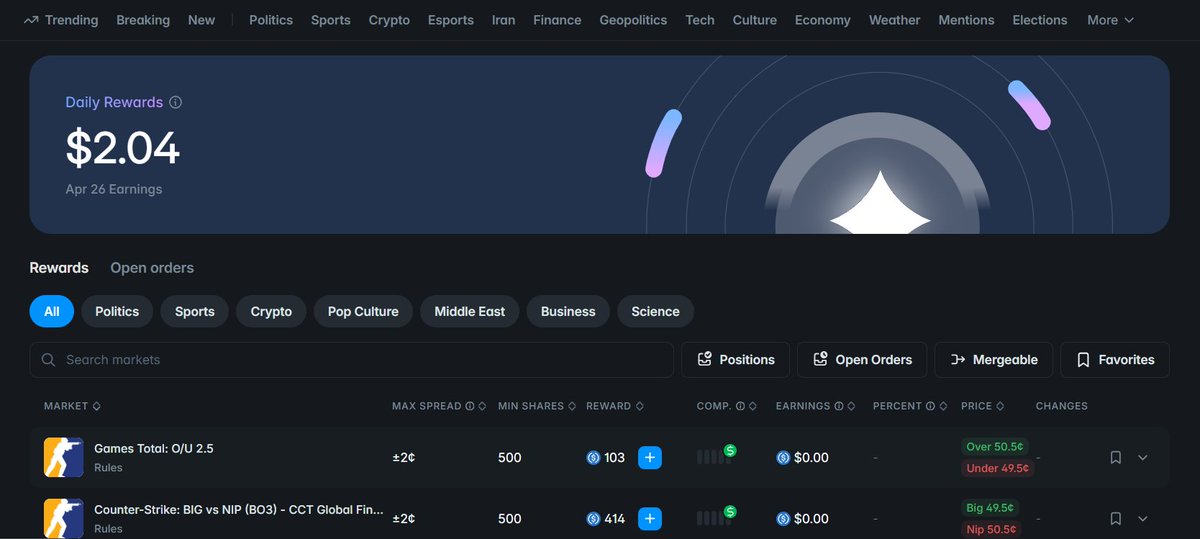
Earned $2 LP rewards on @Polymarket ! One order got filled and I lost $2. I think this is the perfect way to provide liquidity.
Deep tweet media
English
4
0
10
156
Poly VPN
Poly VPN@Poly_VPN·
@nosp321 Exactly, only the fastests eat, that's exactly why we've launched poly-vpn.xyz Helping people trade from London and boosting their speed!
English
0
0
0
6
nosp
nosp@nosp321·
How to start earning $3,700/month? On autopilot Prediction markets aren’t won by the smartest people They’re won by the fastest—those who read 4 signals simultaneously The author has released a complete guide to creating the Hermes bot It monitors the order book, on-chain whales, news-to-price lag, and position deltas every 3 minutes Three real whales the bot is already tracking: • sovereign2013 — sports arbitrage (NBA, NCAA), one match brought in $179k • swisstony — hundreds of micro-edges in a single match • rn1 — looks like a top player but leaks (the bot automatically filters him out) What Hermes can do: • Reads 4 layers in parallel • Catches the 2–15-minute window before the market re-prices • Sends signals only when alignment ≥ 3 • Runs on open APIs + Redis + Telegram • Fully open-source (9 ready-made repositories) No paid subscriptions. VPS for $6/month. Up and running in one evening 95% will read this and continue trading manually 5% will set up their own Hermes and start capturing the edge before anyone else
nosp tweet media
AdiiX@adiix_official

x.com/i/article/2046…

English
3
0
13
370
Poly VPN
Poly VPN@Poly_VPN·
@0xChainMind I've been wondering since I read this what's the legal consequences for doing this lol
English
0
0
0
13
𝗖𝗛𝗔𝗜𝗡 𝗠𝗜𝗡𝗗 ⛓🧠
THIS GUY FARMED POLYMARKET USING A HAIRDRYER Not joking He somehow figured out one of the weather markets was tied to a single sensor near an airport Instead of “analyzing forecasts” like everyone else, he: - just went there - bought YES dirt cheap - stood next to the sensor - and literally heated it with a hairdryer Result: +$36K profit from a single $2K bet Now there’s security guarding the thermometer, and the guy just disappeared Imagine explaining this trade to someone
𝗖𝗛𝗔𝗜𝗡 𝗠𝗜𝗡𝗗 ⛓🧠 tweet media
𝗖𝗛𝗔𝗜𝗡 𝗠𝗜𝗡𝗗 ⛓🧠@0xChainMind

x.com/i/article/2047…

English
9
1
18
4.2K
Poly VPN
Poly VPN@Poly_VPN·
@CypherSacha Lol that's not how it works, it's the implied odds of the accumulate chances of all these teams winning. You can read about how real arbitrage works here: x.com/Poly_VPN/statu…
Poly VPN@Poly_VPN

A peer-reviewed study just confirmed $40M in arbitrage profit was extracted on Polymarket in one year. arxiv.org/abs/2508.03474 Spotting the inefficiency is only half the battle. The other half? Being first to execute. Polymarket's order book is in London. Every millisecond between you and that server is money left on the table. Most retail traders are hitting it from Ireland or the Netherlands. That lag adds up. poly-vpn.xyz puts your orders in London — where the CLOB actually is. Same opportunity. Better position.

English
0
0
0
51
Cypher
Cypher@CypherSacha·
Rendement de 139%/an sur le foot… trop beau pour être vrai ? Le raisonnement : acheter YES sur les 7 favoris de la Coupe du Monde 2026. Ensemble ils totalisent 71% de probabilité : tu dépenses 0.71$ pour recevoir 1$, soit +39% en 3 mois, annualisé à 139%. Sauf que les 29% restants existent. Maroc, USA, Pays-Bas, Croatie… Si l'un d'eux soulève le trophée, la mise entière est à 0. C'est pas un glitch. C'est un pari directionnel sur les favoris avec une tail risk réelle présentée comme du rendement garanti. Free money n'existe pas. Le marché price toujours quelque chose.
gavelsv.patron@gavelsvtw

Polymarket is giving 139% APR for free and you’re still missing it, not a click bait FIFA 2026 World Cup Winner market If you know anything about football, you know Only 7 teams have real chances to win MONEY GLITCH IS SIMPLE Buy YES on those 7 teams on @Polymarket Volume is $562,000,000 so liquidity is there You can put $1k/$10k/$100k and make +30% I put $1,000 into it, and on Jul 19 I’ll get $300 bonus for being smart I don’t miss opportunities like this, and you shouldn’t either

Français
6
1
18
12.5K
Alexo
Alexo@Alexo_0x·
A trader is breaking the laws of physics by predicting the temperature in Hong Kong with 100% accuracy The weather service is trying to catch him to find out how He made 1,900% profit from a single prediction I found him using @ProbTradeAI Number of predictions: 4,310 Apparently, he knows something the masses don’t I’ll just copy his insider trades here: app.prob.trade/traders/0x1041…
Alexo tweet media
English
6
0
35
413
Poly VPN
Poly VPN@Poly_VPN·
@Emotion_web3 Accurate, especially being first to react, is super important. If you can't react in time, it doesn't matter if you're right. Get faster with poly-vpn.xyz
English
0
0
0
6
EMOTION CRYPTO
EMOTION CRYPTO@Emotion_web3·
Most traders still think the edge is in having an opinion. It is not. The real edge is in: >how early you see it > how well you price it > how calmly you size it > and whether you can act before the crowd turns your thesis into an expensive entry That is the difference between a person who reads markets and a person who just reacts to them. A lot of people still approach Polymarket like a place to guess outcomes. But the best traders do not think in guesses. They think in mispricing. Not: “Will this happen?” But: “At these odds, is this worth buying?” That one shift changes everything. Because in prediction markets, you do not make the real money by being emotionally right. You make it by being priced right before everyone else. That is why wallet tracking matters. That is why timing matters. That is why structure matters more than confidence. The crowd keeps buying what feels obvious. Sharp traders keep buying what is still uncomfortable, underpriced, and early. And that is usually where the real edge lives.
StacyOnChain@stacyonchain

x.com/i/article/2047…

English
7
0
13
194
Poly VPN
Poly VPN@Poly_VPN·
@Lummox_eth Step by step guide right here with real explanations: x.com/i/status/20451…
Poly VPN@Poly_VPN

Latency Arbitrage on Polymarket Weather Markets — A Two-Layer Edge Nobody Is Talking About Most people thinking about Polymarket latency arb focus on one thing: getting their order to the CLOB faster. Fair enough. But in weather markets there's actually a second latency layer upstream of execution that almost nobody is exploiting. Let me explain. How Weather Markets Resolve Polymarket weather markets resolve against a public weather API — a centralized data feed that aggregates readings and publishes an official figure. This is your resolution source. This is what determines whether your YES or NO pays out. The thing is, that public API isn't magic. It's pulling from physical weather stations and sensor networks, aggregating them, and publishing a number. That process takes time. There is a measurable lag between what the atmosphere is actually doing and what the public API says it's doing. This is your first latency opportunity. The Calibration Model Idea Local weather station feeds — the raw, unaggregated kind — update faster than the public API. They're noisier, less reliable, and not what Polymarket resolves against. But here's the thing: if you can build a model that maps local station readings to what the public API is about to print, you effectively get a few hundred milliseconds of lookahead on the resolution feed. This is exactly the same insight as trading Binance price directly instead of waiting for Chainlink. Chainlink is just a lagged aggregation of faster feeds. Anyone who figured that out early made a killing. The weather version of this insight is sitting there waiting. The model doesn't have to be perfect. It just has to be right often enough, and early enough, that you can move before the public API catches up and the rest of the market reprices. Now Add The Execution Layer Here's where it gets interesting. Both of these edges — the data feed and the CLOB — are geographically concentrated in London. The public weather API's infrastructure is in London. The local station feeds you'd use to build your calibration model are in London. And Polymarket's CLOB is in London. If you're running your bot from a VPS in Ireland or Amsterdam, you're eating latency at both ends of the trade. Your data arrives late. Then your order arrives late. Two separate penalties, stacking quietly against you on every single trade. The trader in London gets the local feed faster, runs the calibration model faster, and gets the order to the CLOB faster. That's not one edge — it's the same edge compounding twice. poly-vpn.xyz puts your infrastructure in London. Same city as the data, same city as the order book. Is This Worth Building? The calibration model is non-trivial — you'd need to backtest how well local station data predicts the public API print, figure out the lead time, and size your trades accordingly. It's a research project before it's a trading strategy. But the underlying logic is sound. And in a market where most participants are focused purely on execution speed, the trader who also has an upstream data edge is playing a different game entirely. The Chainlink insight was table stakes within a month of people figuring it out. The weather version of that insight is still early.

English
0
0
1
24
Poly VPN
Poly VPN@Poly_VPN·
@Jeremybtc Don't know about u, but my mom is proud of my volume
English
0
0
0
2
Jeremy
Jeremy@Jeremybtc·
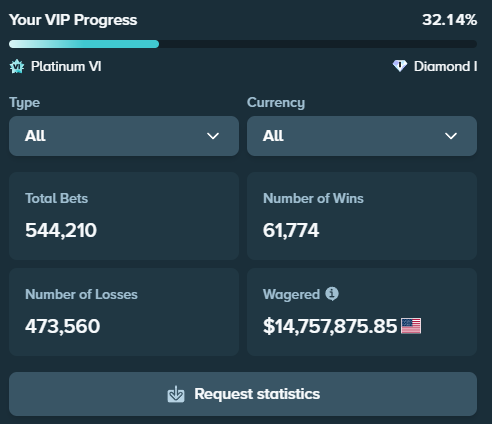
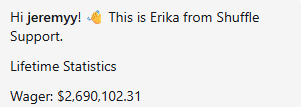
I wonder what my mom would think if she found out I have nearly $20M in wager volume on casinos
Jeremy tweet mediaJeremy tweet media
English
47
5
113
9.4K
Poly VPN
Poly VPN@Poly_VPN·
@mahera777 @PolymarketTrade Get on the action yourself by writing your own bot. Here's how to get started: x.com/i/status/20451…
Poly VPN@Poly_VPN

Latency Arbitrage on Polymarket Weather Markets — A Two-Layer Edge Nobody Is Talking About Most people thinking about Polymarket latency arb focus on one thing: getting their order to the CLOB faster. Fair enough. But in weather markets there's actually a second latency layer upstream of execution that almost nobody is exploiting. Let me explain. How Weather Markets Resolve Polymarket weather markets resolve against a public weather API — a centralized data feed that aggregates readings and publishes an official figure. This is your resolution source. This is what determines whether your YES or NO pays out. The thing is, that public API isn't magic. It's pulling from physical weather stations and sensor networks, aggregating them, and publishing a number. That process takes time. There is a measurable lag between what the atmosphere is actually doing and what the public API says it's doing. This is your first latency opportunity. The Calibration Model Idea Local weather station feeds — the raw, unaggregated kind — update faster than the public API. They're noisier, less reliable, and not what Polymarket resolves against. But here's the thing: if you can build a model that maps local station readings to what the public API is about to print, you effectively get a few hundred milliseconds of lookahead on the resolution feed. This is exactly the same insight as trading Binance price directly instead of waiting for Chainlink. Chainlink is just a lagged aggregation of faster feeds. Anyone who figured that out early made a killing. The weather version of this insight is sitting there waiting. The model doesn't have to be perfect. It just has to be right often enough, and early enough, that you can move before the public API catches up and the rest of the market reprices. Now Add The Execution Layer Here's where it gets interesting. Both of these edges — the data feed and the CLOB — are geographically concentrated in London. The public weather API's infrastructure is in London. The local station feeds you'd use to build your calibration model are in London. And Polymarket's CLOB is in London. If you're running your bot from a VPS in Ireland or Amsterdam, you're eating latency at both ends of the trade. Your data arrives late. Then your order arrives late. Two separate penalties, stacking quietly against you on every single trade. The trader in London gets the local feed faster, runs the calibration model faster, and gets the order to the CLOB faster. That's not one edge — it's the same edge compounding twice. poly-vpn.xyz puts your infrastructure in London. Same city as the data, same city as the order book. Is This Worth Building? The calibration model is non-trivial — you'd need to backtest how well local station data predicts the public API print, figure out the lead time, and size your trades accordingly. It's a research project before it's a trading strategy. But the underlying logic is sound. And in a market where most participants are focused purely on execution speed, the trader who also has an upstream data edge is playing a different game entirely. The Chainlink insight was table stakes within a month of people figuring it out. The weather version of that insight is still early.

English
0
0
0
8
mahera
mahera@mahera777·
$33 -> $1,500 on Toronto weather prediction mostly buys stocks at 0.1c-10c for small amounts $2-$35 he has over 2,000 weather predictions on Polymarket
mahera tweet media
English
18
1
60
1.4K
Poly VPN
Poly VPN@Poly_VPN·
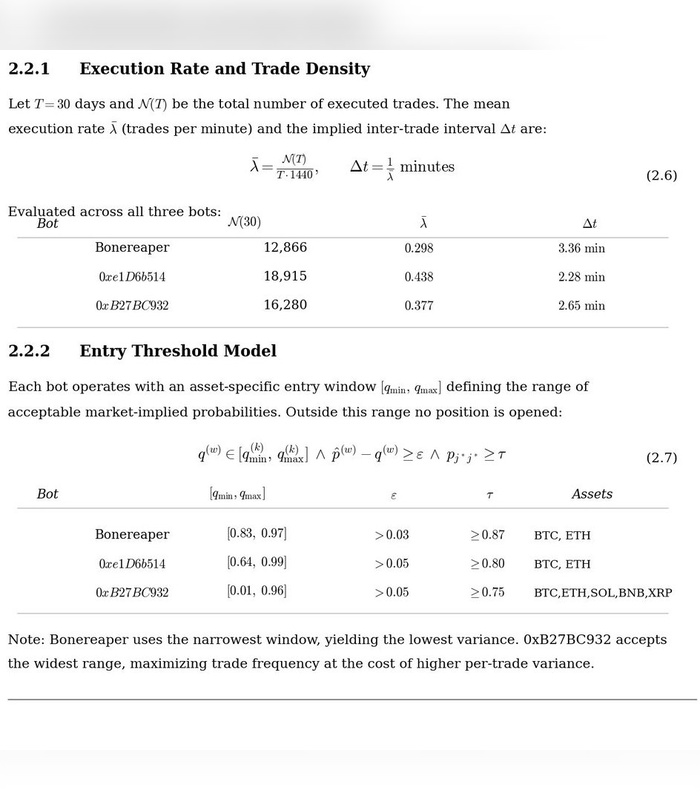
@RoundtableSpace This is inaccurate, Bonereaper made his money from exploiting a queue priority bug If you want to have queue priority like this guy, try out our product poly-vpn.xyz
English
0
0
0
31
0xMarioNawfal
0xMarioNawfal@RoundtableSpace·
A DEAD RUSSIAN MATHEMATICIAN JUST HELPED PRINT $468,228 ON POLYMARKET IN 30 DAYS. Markov never saw a prediction market, but his math ended up building exactly the kind of bot that can dominate them.
0xMarioNawfal tweet media
English
5
6
104
57K
eventwaves
eventwaves@EventWavesIO·
What kind of prediction market trader are you?
eventwaves tweet media
English
4
0
10
551
shmidt
shmidt@shmidtqq·
-> 2024: Polymarket lag = 12 seconds -> 2025: lag = 6 seconds -> 2026: lag = 2.7 seconds -> my bot reaction: 4.1 seconds -> I was early in 2024 -> I was on time in 2025 -> I am exit liquidity in 2026 -> the gap was closing on me, not for me
cvxv666@antpalkin

x.com/i/article/2046…

English
20
1
46
1.7K
Poly VPN
Poly VPN@Poly_VPN·
@de1lymoon Get on the action yourself, here is a guide on how to start: x.com/Poly_VPN/statu…
Poly VPN@Poly_VPN

Latency Arbitrage on Polymarket Weather Markets — A Two-Layer Edge Nobody Is Talking About Most people thinking about Polymarket latency arb focus on one thing: getting their order to the CLOB faster. Fair enough. But in weather markets there's actually a second latency layer upstream of execution that almost nobody is exploiting. Let me explain. How Weather Markets Resolve Polymarket weather markets resolve against a public weather API — a centralized data feed that aggregates readings and publishes an official figure. This is your resolution source. This is what determines whether your YES or NO pays out. The thing is, that public API isn't magic. It's pulling from physical weather stations and sensor networks, aggregating them, and publishing a number. That process takes time. There is a measurable lag between what the atmosphere is actually doing and what the public API says it's doing. This is your first latency opportunity. The Calibration Model Idea Local weather station feeds — the raw, unaggregated kind — update faster than the public API. They're noisier, less reliable, and not what Polymarket resolves against. But here's the thing: if you can build a model that maps local station readings to what the public API is about to print, you effectively get a few hundred milliseconds of lookahead on the resolution feed. This is exactly the same insight as trading Binance price directly instead of waiting for Chainlink. Chainlink is just a lagged aggregation of faster feeds. Anyone who figured that out early made a killing. The weather version of this insight is sitting there waiting. The model doesn't have to be perfect. It just has to be right often enough, and early enough, that you can move before the public API catches up and the rest of the market reprices. Now Add The Execution Layer Here's where it gets interesting. Both of these edges — the data feed and the CLOB — are geographically concentrated in London. The public weather API's infrastructure is in London. The local station feeds you'd use to build your calibration model are in London. And Polymarket's CLOB is in London. If you're running your bot from a VPS in Ireland or Amsterdam, you're eating latency at both ends of the trade. Your data arrives late. Then your order arrives late. Two separate penalties, stacking quietly against you on every single trade. The trader in London gets the local feed faster, runs the calibration model faster, and gets the order to the CLOB faster. That's not one edge — it's the same edge compounding twice. poly-vpn.xyz puts your infrastructure in London. Same city as the data, same city as the order book. Is This Worth Building? The calibration model is non-trivial — you'd need to backtest how well local station data predicts the public API print, figure out the lead time, and size your trades accordingly. It's a research project before it's a trading strategy. But the underlying logic is sound. And in a market where most participants are focused purely on execution speed, the trader who also has an upstream data edge is playing a different game entirely. The Chainlink insight was table stakes within a month of people figuring it out. The weather version of that insight is still early.

English
0
0
0
114
Alex
Alex@de1lymoon·
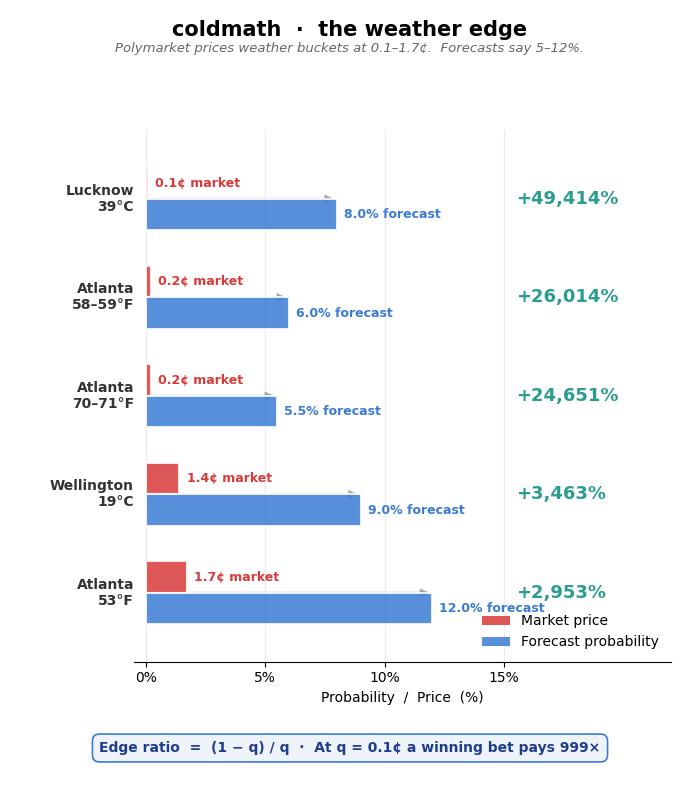
Weather sniper on polymarket turned $186 → $6,630 by placing a single bet on the temperature in Wellington He buys YES on temperature buckets in the {0.1¢ – 1.7¢} range before the market reads the actual KMA / NWS forecast Forecast says Lucknow 39°C → 8% likely. Market prices it at $0.001. He buys Result: $0.001 → $1.00 when it hits = +49,414% return His best trades: $13.84 → $6,851 (Lucknow 39°C at 0.1¢, +49,414%) $23.54 → $6,146 (Atlanta 58-59°F at 0.2¢, +26,014%) $24.41 → $6,041 (Atlanta 70-71°F at 0.2¢, +24,651%) $186 → $6,630 (Wellington 19°C at 1.4¢, +3,463%) $202 → $6,172 (Atlanta 53°F at 1.7¢, +2,953%) Edge ratio = (1 − q) / q At q = 0.001 → 999× per winning trade Real probability just has to clear 0.5% to print
Alex tweet media
Alex@de1lymoon

x.com/i/article/2044…

English
9
3
61
13.4K
Poly VPN
Poly VPN@Poly_VPN·
@kar4arodon Most people farm hard on polymarket to ensure getting a big airdrop, not sure that what you are suggesting is the correct move
English
0
0
0
21
karcharodon
karcharodon@kar4arodon·
3 easy ways to increase your $POLY airdrop ? first - pick market with "Earn 4%" logo - open long-term position second - open any market - click on add rewards third - open any trader - send tip did I miss something?
karcharodon tweet media
English
16
3
47
2.2K