Ares D Moon

2.5K posts

Ares D Moon banner
Ares D Moon

Ares D Moon

@aresdmoon

Optimizing Web3 community health through education, support, and strategic engagement. Empowering decentralized voices to build together. Make it meaningful.

First account : @arianlicia 가입일 Aralık 2023
261 팔로잉259 팔로워
고정된 트윗
Ares D Moon
Ares D Moon@aresdmoon·
🎨 From Sketch to Keychain: A DIY Journey!🛠️ Ever wanted to bring your favorite character designs to life? Check out how these custom keychains were made from scratch. Best keychain ever! @get_optimum 🔑⛓️ And just like that, they’re ready to clip onto your backpack and show off!
English
25
0
51
448
Ares D Moon
Ares D Moon@aresdmoon·
@get_optimum @sajidazouarhi Ethereum’s blockspace market design is fundamentally sound. To unlock its true capacity, the network must eliminate the cost of uncertainty. When hedging is no longer rational, the market can finally clear on true value.
English
0
0
0
10
CrownA..👁️
CrownA..👁️@CrownA18·
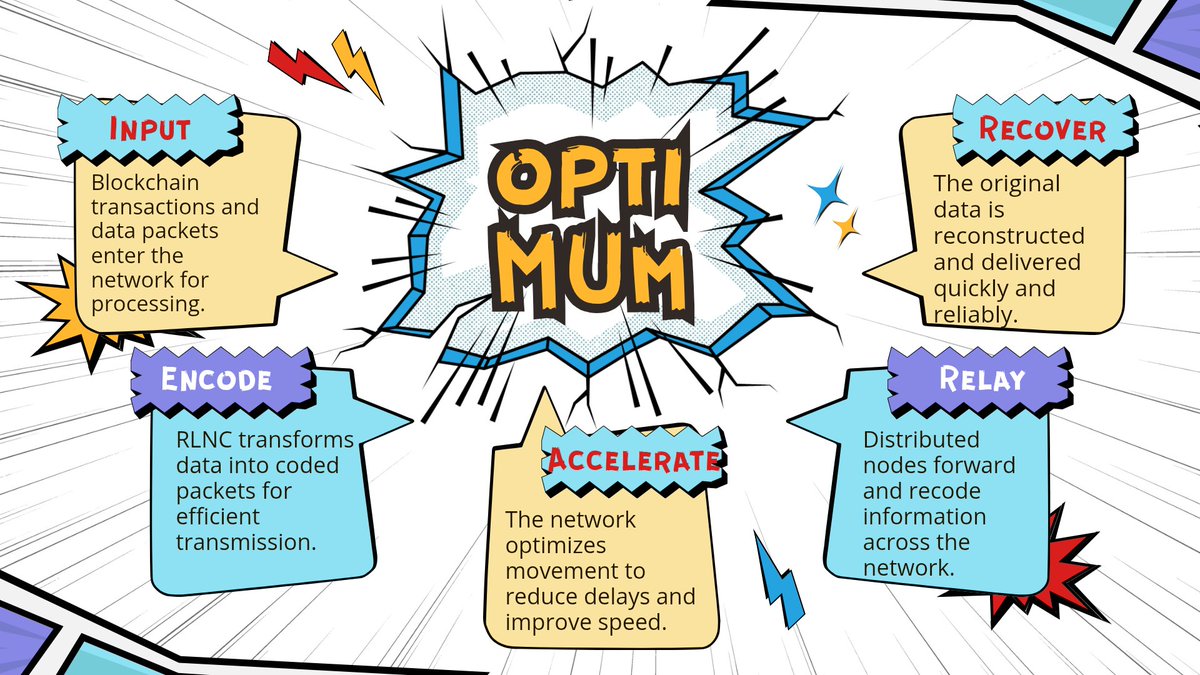
☀️ gmum Happy new week Optimum fam. ☀️ Starting the week with a reminder of how the network works. ☀️ Input → Encode → Accelerate → Relay → Recover. ☀️ Turning complex data movement into faster, smarter, and more efficient delivery across the ecosystem ⚡️
CrownA..👁️ tweet media
CrownA..👁️@CrownA18

Optimum is making data move faster and smarter. It helps reduce delays and improve the way information travels across networks. Better speed, smoother delivery, and stronger infrastructure for the future.

English
4
0
8
122
Ares D Moon
Ares D Moon@aresdmoon·
🎨 From Sketch to Keychain: A DIY Journey!🛠️ Ever wanted to bring your favorite character designs to life? Check out how these custom keychains were made from scratch. Best keychain ever! @get_optimum 🔑⛓️ And just like that, they’re ready to clip onto your backpack and show off!
English
25
0
51
448
Nero.eth🦇
Nero.eth🦇@CryptoShmon·
In the rhythm of the future - simultaneously with Optimum ⚡️ The project is building the first high-performance memory infrastructure for blockchains, accelerating data transfer and scaling RLNC network technology to make Web3 fast and ready for mass use. This art perfectly conveys the dynamism and speed that are at the heart of the Optimum ecosystem. @get_optimum
Nero.eth🦇 tweet media
English
4
0
18
87
callmehannn
callmehannn@callmehannnnnnn·
gMum @get_optimum The Optimum team realized that every blockchain eventually faces the same problem, slow data propagation Even if execution becomes faster, networks still struggle if validators cannot communicate quickly enough And CoFounders @kentlinyy left Harvard, MIT, and Meta to build Optimum Make blockchains scale faster without sacrificing decentralization is the optimum goal
callmehannn tweet media
callmehannn@callmehannnnnnn

gMum @get_optimum If @ethereum ever wants to reach massive global adoption, it needs much higher throughput. The biggest problem is moving data fast enough across the network Using RLNC powered propagation, Optimum helps Ethereum spread data faster and more efficiently without sacrificing decentralization The goal for Ethereum is faster block propagation, lower network latency, higher Ethereum throughput and stronger validator efficiency and staking performance In short, scaling Ethereum to global levels may require better infrastructure and that’s the problem Optimum is solving

English
14
0
24
212
Ceejay
Ceejay@Ceee_jeay·
Quantum computing isn’t magic, and post quantum security isn’t only about replacing old encryption. Both are deeply connected by one thing, coding. Quantum computers are powerful, but qubits are unstable and easily affected by commotion. To make quantum computers work at scale, they need strong error correction codes. On the security side, today’s encryption mostly protects a small key. But in a post quantum world, attackers become more powerful, so security needs to go beyond just protecting one lock. That’s where coding theory comes in. Instead of protecting only the key, codes help protect the structure of the data itself. Quantum computing needs coding to survive. Post quantum security needs coding to scale. Same math, different problems. @get_optimum is focused on the missing infrastructure layer, reducing communication delays so advanced computation, coordination and security systems can operate seamlessly in real time. I learnt alot from this professor. gmum @Isaacjohnibiam @JimmyHope_
Muriel Medard@MurielMedard

Many people talk about quantum (PQ) computing like it's mystical. It isn't. It's math. The way we will secure data against it is also math, specifically, coding theory. Let me explain what that means, because much of the current PQ conversation is missing some important context. ​ Quantum computers work on qubits rather than bits. A bit is 0 or 1. A qubit can be described as something that can be 0, 1, or a distribution between them. That extra room is where the power comes from: a quantum computer is probabilistic, not deterministic, and it can solve specific problems that today's machines cannot. ​ The challenge is that as you compute, the qubits degrade. The state doesn't stay constant. Without robust, efficient error correction, a quantum computer can't scale. Error correction is a coding problem. So coding is one of the largest open obstacles to making quantum computing real at all, which is why so much of the heavy investment in this space is, at its core, an investment in better codes. ​ That same math is what protects us on the other side. To see why, the analogy I keep coming back to is a door and a lock. Every cryptosystem you use today protects a large surface (say a megabit of data) with a tiny key, say 128 or 256 bits. The lock is a small fraction of the door. That arrangement works against a classical attacker because they have to break the lock; there's no other way in. ​ A quantum attacker doesn't have that constraint. They can probe non-deterministically; they don't need to break the lock at all. They can look for a weak point anywhere on the surface of the door and punch a hole through it. You may not even know which part of your data they saw, maybe nothing important, maybe exactly what you wanted to hide. ​ Almost the entire PQ conversation today is about reinforcing the lock. Replace ECDSA, replace the key-exchange primitive, swap in a lattice-based KEM. That work matters and it should continue. But it is still a small reinforced patch on a very large door. ​ The real question is how you reinforce the whole door. The math for that has existed since the 1970s: the McEliece cryptosystem, the granddaddy of post-quantum schemes, and the main one I personally trust. It has withstood half a century of attacks by cryptographers without a fundamental break—a track record little else in this space comes close to. ​ The problem with McEliece is not security. It is pain. Applying it to a full payload is, if you forgive the grim comparison, like chemo: it kills the tumor and almost kills the patient. That is why nobody deploys it broadly. The lock is small enough to absorb the cost; the door is not. ​ This is where coding solves the second half of the problem. The construction my collaborators and I developed, HUNCC (Hybrid Universal Network Coding Cryptosystem), splits the data into coded pieces and applies the expensive PQ encryption to only a small fraction of them, maybe a few percent, or less. An attacker who breaks in sees a system of equations with one unknown they cannot recover. One unknown in a coded system is a hyper-strong key, and the protection lives everywhere on the data, not just at the lock. ​ The point is not that this replaces ML-KEM or any other PQ KEM. It doesn't, and I wouldn't claim it does. The point is that coding is what makes post-quantum security something you can actually deploy at speed, across the whole door, without paying the chemo cost everywhere. ​ Coding is what is currently blocking quantum computing from becoming real, and coding is what will make quantum safety real. The math has been here for fifty years. What we have been missing is the path from correct-but-unusable to correct-and-fast. ​ More to come.

English
13
0
22
162
OG
OG@OGgrinding·
HOW @get_optimum IS DELIVERING NETFLIX LEVEL SMOOTHNESS TO BLOCKCHAIN NETWORKS
OG tweet media
English
4
0
6
66
Kadji
Kadji@foldercrypto_·
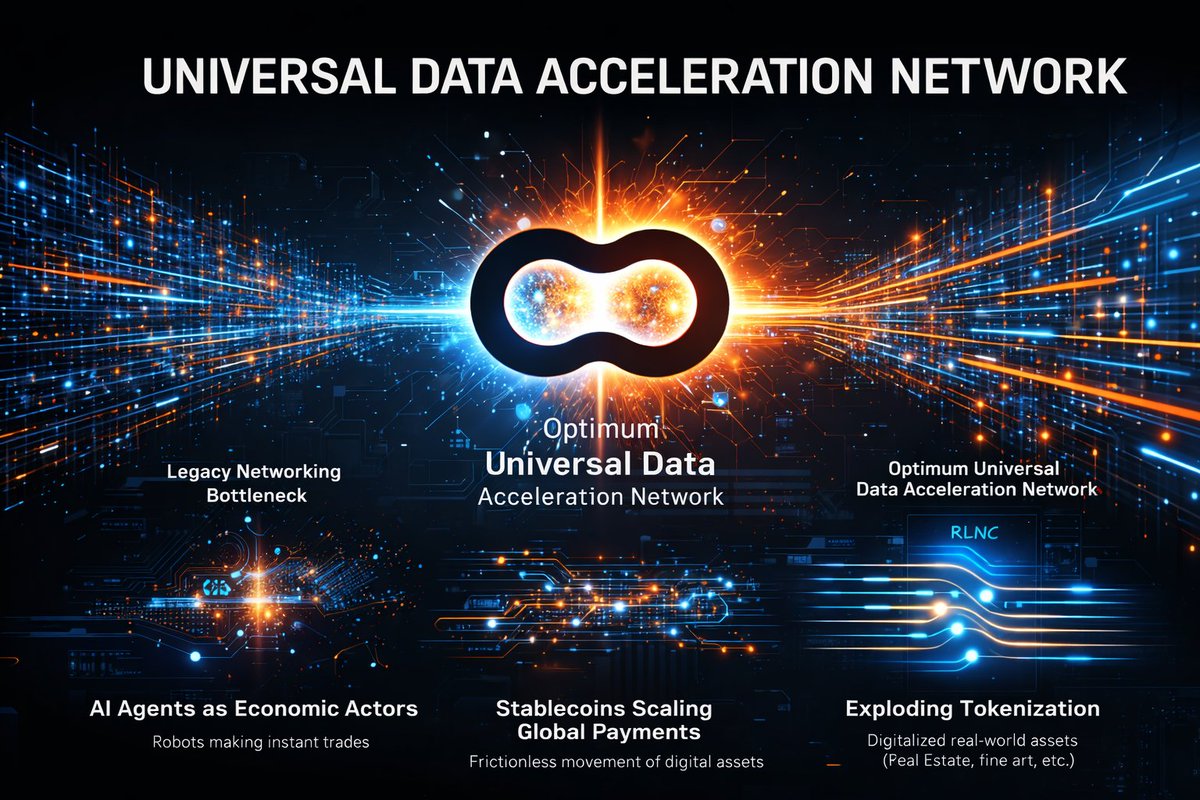
gmum fams @get_optimum AI agents are becoming full-time economic actors. Stablecoins are rapidly scaling global payments. Tokenization is breaking down the walls of traditional finance. But there is a silent bottleneck: the legacy networking infrastructure that wasn't built for the speed of on-chain finance. While everyone focuses on the application layer, Optimum is solving the fundamental physics of the blockchain: latency. By leveraging Random Linear Network Coding (RLNC), optimum building the Universal Data Acceleration Network to ensure the decentralized world runs at the speed of light not the speed of outdated protocols. Don't let infrastructure latency kill the next wave of innovation. The future of finance needs a faster foundation.
Kadji tweet media
English
1
0
0
33
Clutch
Clutch@Clutchcrypto_·
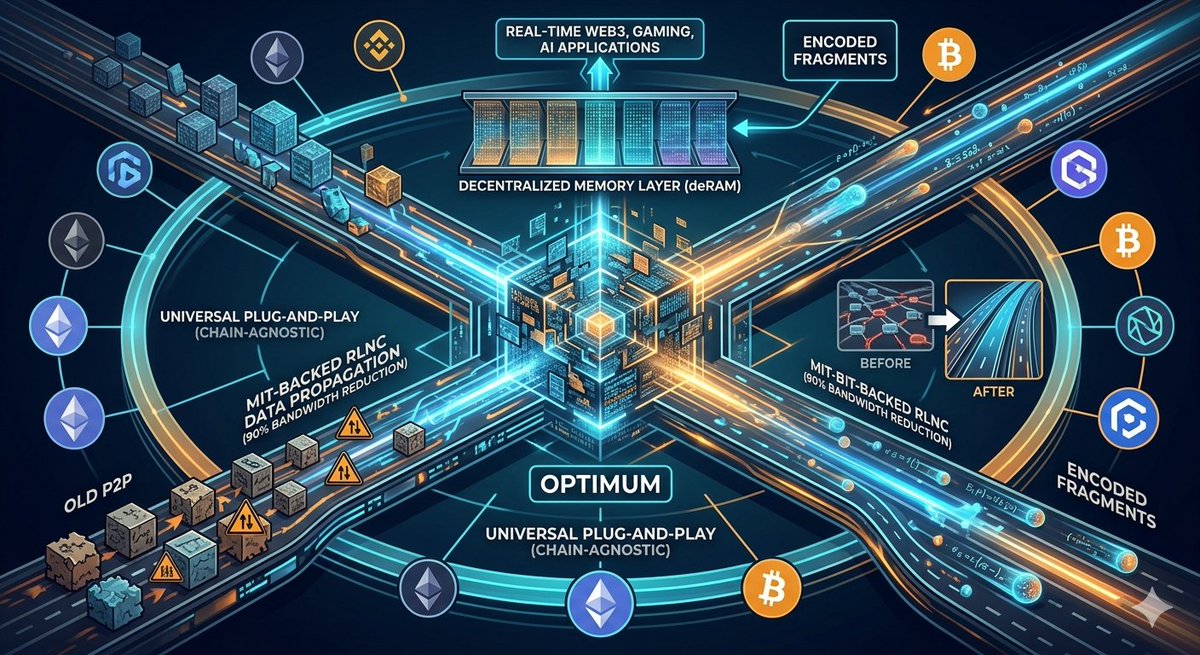
A list of @get_optimum core importance to the blockchain ecosystem. ✦ 90% bandwidth reduction ✦ 6x to 20x faster block propagation ✦ Decentralized memory tier (deRAM) ✦ Protected validator yields ✦ Lowers hardware barriers ✦ Universal, chain agnostic setup
Clutch tweet media
English
33
0
38
207
jepannyaa (❖,❖)
jepannyaa (❖,❖)@jepannyaa·
blockchain propagation problems are not only about speed. Traditional redundancy systems send fixed data pieces across the network. As the network grows larger, many nodes receive the same pieces repeatedly from different peers. More traffic does not always mean more useful information. RLNC from @get_optimum uses a different approach. Instead of forwarding fixed fragments, the network sends randomized combinations of data. The result is that almost every packet carries new information. That is the hidden advantage many people do not notice. RLNC is not only about recovering lost data. It is about making every transmission more useful while data is still moving across the network. Less overlap. Less wasted bandwidth. Better scalability for decentralized systems. In simple terms: Traditional systems move copies. RLNC moves information smarter.
jepannyaa (❖,❖) tweet media
English
14
0
28
235
0xRz (evm/acc) (❖,❖)
@get_optimum Engineered for the Future. Behind every speed, there is a system working with precision. Behind every innovation, there is unseen optimization. This is not about working harder it’s about working smarter, more efficiently, and more measurably.
0xRz (evm/acc) (❖,❖) tweet media
English
14
0
18
152