Christina Noren

8.2K posts

Christina Noren banner
Christina Noren

Christina Noren

@cfrln

founding VP PM to IPO @Splunk, late 90s @MSN, 4 IPOs, art tech martyr, anti-statist, artist, patron, INTP 8w7, US ‘citizen’ born NL, recent widow of Paul Boutin

Southern California 가입일 Eylül 2012
2K 팔로잉1.3K 팔로워
a16z
a16z@a16z·
"There's something about this culture of young people coming up where they're not afraid of hard work. They're not afraid to pop a Zyn and work at the factory all day." Why @KTmBoyle is bullish on Zoomers: "The best quote that summarizes why I'm so bullish on the Zoomers is Alysa Liu after winning her gold. She said, 'I love to struggle. It makes me feel alive.'" "It's the opposite of the morose theater kid vibes that we got from the millennial generation, where everything was very different in how they operated." "Like Jack Hughes—they get their teeth knocked out, they come back and say, 'It's not even a question. Of course I got my teeth knocked out. It's hockey.'" "And that means we're seeing totally different companies than we saw out of the Facebook diaspora—which was very much the Harvard dorm room—I like to work on my computer, I like to build apps. It's a totally different style of founder." "The next generation is so patriotic and bullish on the American project. I think this generation cares a lot about the country. And it shocked us. @davidu and I talk about this all the time—for some of these young people, they were not born on September 11th. They have no recollection of the things that the millennials remember, or anyone older than us remembers, but they care about the country." "They look up to people like @elonmusk, to people like Alex Karp. They look up to people who've been doing the hard thing for 20, 30 years and they want to do it too." "It's a different generation of founder that we've had the privilege of seeing very, very early on. I think the rest of the country is going to define tech and Silicon Valley by these people for the next 10–20 years." From @nypost
tae kim@firstadopter

“I love struggling, actually. It makes me feel alive” – Alysa Liu

English
42
46
568
320.9K
Christina Noren
Christina Noren@cfrln·
I completed more credits than any other student in the history of what was then Dominican college the oldest liberal arts institution in California, historically a women's college but 25% men by the time I was there class of 93. I graduated with two summa cum laude degrees at 18. All of my notes were handwritten, and I can't read my own handwriting. The act of writing while listening was what I needed to have the ideas settle in my brain. Same extended to the required program manager internal classes at Microsoft in 1997. My house is filled with completely illegible notebooks.
English
0
0
2
85
Steven Sinofsky
Steven Sinofsky@stevesi·
Even though I helped with creation of note-taking software, I never believed in using a computer to take notes in real time. It takes too much cognitive load to do so AND pull of distraction means you just don't listen. Also a good story on "bundling". …rdcoresoftware.learningbyshipping.com/p/072-notes-on…
Brandon Luu, MD@BrandonLuuMD

Students who took notes by hand scored ~28% higher on conceptual questions than laptop note-takers. Writing forces your brain to process and compress ideas instead of copying them.

English
7
1
25
3.9K
More Perfect Union
More Perfect Union@MorePerfectUS·
Billionaire Marc Andreessen says he has "zero" introspection, and that the idea itself is a modern invention.
English
1.7K
553
4.6K
8.7M
Christina Noren 리트윗함
Dustin
Dustin@r0ck3t23·
Andrew Ng just revealed why the AI companies throwing the most compute at the problem are going to lose. The winner of the intelligence race won’t use the most compute. They’ll waste the least. Ng: “Most of your high-dimensional data lies on a lower-dimensional subspace. It’s just a fact of life.” Here’s what that means in practice. You have a 10,000-dimensional dataset. Every dimension dragged through every calculation. Every training cycle hauling dead weight the model will never use. Ng: “You’re carrying around these 10,000-dimensional examples throughout your whole training process.” That bloat isn’t just inefficient. It’s a tax on every computation you run. Memory bandwidth. Network bandwidth. Computational speed. All of it eaten by dimensions that contribute nothing to intelligence. They contribute noise. The insight that separates the architects from the arms race: that 10,000-dimensional dataset is almost entirely captured by a much smaller subspace. The signal lives in a fraction of the space you’re paying to process. Compress it. 10,000 dimensions down to 1,000. Ng: “You can run your learning algorithm on a much lower-dimensional set of data and it may be much more efficient.” Same hardware. Same budget. A fraction of the friction. Brute force is the strategy of whoever has the deepest pockets. Compression is the strategy of whoever actually understands the problem. The companies that master this don’t just build faster models. They build models that find more truth in less data than anything scaling blindly ever will. Intelligence was never about processing everything. It’s about knowing what to cut.
English
137
312
2.2K
213.6K
Christina Noren
Christina Noren@cfrln·
@LouisAnslow @TaylorLorenz A man who rose from mayor to governor after a massive extramarital, affair scandal that ruined the life of his affair partner wants to legislate morality. when will the US population realize both parties want to legislate their version of morality while being hypocritical?
English
0
0
0
86
Sar Haribhakti
Sar Haribhakti@sarthakgh·
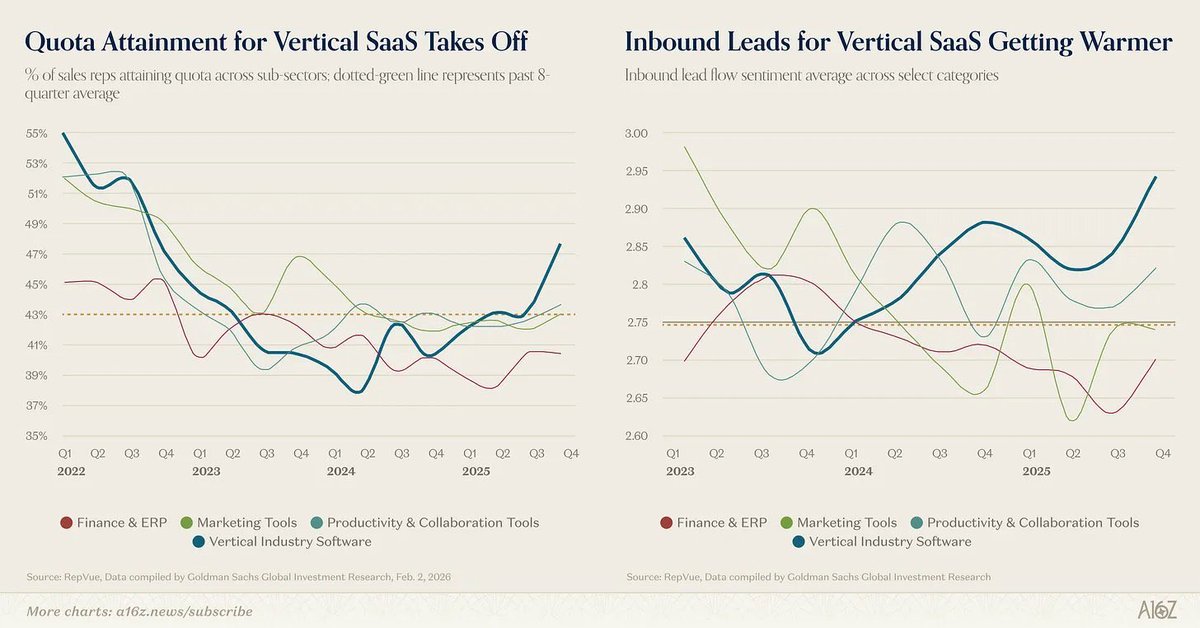
Clearest charts I have ever seen to support the SaaS is dead narrative via @a16z
Sar Haribhakti tweet media
English
32
29
552
110.4K
Christina Noren
Christina Noren@cfrln·
@stevesi The first thing I learned joining Microsoft in 1997 was to be much briefer. My original boss there told me explicitly that my emails were way too long. Today Claude and ChatGPT are making everything much longer and introducing a rhythm that is artificial.
English
0
0
3
149
Steven Sinofsky
Steven Sinofsky@stevesi·
Over generations of making Microsoft Office one thing we learned is that the easier we made it to create a certain kind of cool looking document (via templates, content, formatting wizards or UX) the less “valuable” or “differentiated” that document type became. When everyone can blow out an org chart in no time then org charts become less valuable. If everyone can make a red/yellow/green cells in Excel then they just become expected and lose their differentiation. This dynamic goes as far back as laser printers or color inkjet or even the first fancy “2 1/2 D charts”. If you’re one-shotting some quick deck in an AI then you can bet the process / collaboration value of that deck is rapidly declining. In knowledge and information work, only the differentiated survives. The baseline keeps moving up.
English
38
45
625
46.4K
Christina Noren
Christina Noren@cfrln·
@aservais1 One of the major problems with the art 'market' is that its participants simultaneously over value and under value its importance in the world.
English
0
0
0
25
Christina Noren
Christina Noren@cfrln·
@erikbryn @Nouriel @FT I think the discussion is muddled because most ordinary people's experience with AI is with very primitive customer service agent replacements and chatbots and image generators. AGI is nowhere near, but AI enterprise bots can do a lot that humans were used as bots to do before.
English
0
0
0
165
Erik Brynjolfsson
Erik Brynjolfsson@erikbryn·
Since my op-ed in the @FT was published on Monday (ft.com/content/4b51d0…), there’s been a growing debate about whether we’re beginning to see evidence that AI is boosting productivity. First, let me be clear that the aggregate productivity data by itself is far from definitive. Even with the new revisions, there is certainly a lot of noise in US productivity numbers. No doubt lots of other factors are at work. That said, my growing confidence that AI is powering higher productivity draws on evidence from a variety of sources: 1. The stunning capabilities of AI. If anything, I think the past decade of impressive improvements in machine learning and generative AI are still underrated. We are in the early stages of a massive economic transformation: digitaleconomy.stanford.edu/research-area/… 2. A growing number of micro studies document double-digit productivity gains in specific applications. @alexolegimas has a great catalog in his blog post: aleximas.substack.com/p/what-is-the-… 3. My discussions with power users who use AI for coding, customer service, research and other applications, as well as more and more business executives, convince me that the facts on the ground are (finally) changing. 4. Data from our Canaries in the Coal Mine paper show employment changes in occupations most affected by AI: digitaleconomy.stanford.edu/publication/ca… 5. And now, inklings in the aggregate productivity data are also telling the same story. These are all consistent with the hypothesis that AI is beginning to have a positive impact on productivity. The FT put a more definitive headline on my recent piece than I would have liked, but my bet (longbets.org/868/) is that we're likely to see more and more evidence as time goes on, barring some other shocks (e.g. macro mismanagement, trade wars, etc). As each quarter goes by and we see more data, I continue to update my views. No doubt, I'm currently out of sync with a lot of mainstream economists on this topic, but that’s ok by me.
English
27
106
381
87.6K
wombot 👀
wombot 👀@_colourmeamused·
My most controversial urbanist opinion is cycling is not a load bearing mode of transport. I’m not opposed to bike infra, build it whatever I respect the good intentions, it’s great for a couple of kms if it’s flat and the weather is nice. But you can’t build society around it.
English
51
5
219
18.8K
Christina Noren
Christina Noren@cfrln·
@tomfgoodwin internal program manager school at msft 1997 taught us to enter a market minimally w v1, make v2 a viable substitute, then crush w v3. It did not teach taste, but economics.
English
0
0
0
18
Tom Goodwin
Tom Goodwin@tomfgoodwin·
When you think about it, Almost every single Microsoft product is substandard, yet here they are with 228,000 employees making $281.7 billion in revenue every year. The idea that people demand or use or appreciate great software just isn't true.
English
152
16
524
31.3K
denis tremblay
denis tremblay@denistremb34957·
@MyLordBebo Being able to work with Karp say a lot about Peter Thiel. And this observation say a lot about Palantir.
English
1
0
0
255
Lord Bebo
Lord Bebo@MyLordBebo·
🇺🇸 Palantir CEO Karp: “I love the idea of getting a drone and having lightly fentanyl-laced urine sprayed on analysts that tried to screw us.” He can barely sit still in the chair … wtf is he on
English
719
3.2K
9.8K
1.1M
Christina Noren
Christina Noren@cfrln·
we have a tax on unrealized gains in the US affecting the tech middle class - when we exercise options that are seen as compensation for low startup salaries and zero cash startup advisory and board seats, we are taxed based on latest 409a valuations. 30 years ago this was negligible. But today it is so massive that most options go unexercised. Primarily by the middle class without hereditary wealth.
English
0
0
1
52
Balaji
Balaji@balajis·
LIQUIDATION CONTAGION Wealth taxes are even worse than you think. Any asset held by Californian billionaires or Dutch citizens is now at risk of experiencing forced liquidation pressure. So: it’s not just that you don’t want to hold assets as a Dutchman. You also don’t want a Dutchman to hold your assets. Because the logic of forced liquidation is contagion. Let’s think it through. (1) First, suppose there is an asset with a total market cap of $10,000, with 10 shares total, of which 1 share each is held by 10 different holders, all in the Netherlands. To simplify the math, assume the Dutch holders bought those shares at par, or close to $0. (2) Now suppose today is the unrealized cap gains tax day, and the share price is $1,000 per share. Each Dutch guy is hit with a 36% tax, and owes $360. The first guy sells his one share, gets $1,000, and pays $360 in tax while retaining $640. (3) But the first guy’s sale reduces the market price to $960 per share. So when the second guy sells, he only retains $600 after paying $360 in tax. (4) Now assume that by the 7th guy, all the selling has pushed the share price to collapse to $200 per share. This is a very reasonable scenario if 60% of the cap table has suddenly been dumped. Indeed it might go much lower. (5) At $200 per share, the 7th guy actually has to go into debt to pay the tax as he owes $360. He sells his one share, pays all $200 of the proceeds in tax. And still owes $160 more in tax. (6) The 8th, 9th, and 10th guys are even more screwed. By the time they sell, the price will likely have crashed to $100 per share or less. As with the 7th guy, even 100% liquidation will not cover their tax burden. (7) So we immediately see many negative things about the Dutch unrealized cap gains tax bill. (a) First, it will cause large simultaneous forced liquidations. Everyone must sell 36% of their stake near the same time. (b) Second, it may be literally impossible to pay if a critical mass of the cap table is all subject to it at the same time. In the example above it was 100% Dutch holders, but has it been just 60% the result would have been much the same: a collapse in the share price. (c) Third, that means it would be disastrous to have too many Dutch citizens (or Californian billionaires!) on the cap table. Their forced sales will crash your share price. (d) So, you might have to start mass blocking those resident in wealth-taxing jurisdictions from investing in your companies. (e) This in turn makes the poor Western European guy even poorer, as he gets locked out of high growth assets. To be clear: I really do feel bad for the formerly Flying Dutchmen, now Crying Dutchmen. They invented much of modern capitalism. They founded New Amsterdam, now New York. They’ve punched way above their weight. I wish them only the best. Nevertheless…they should prepare for the worst. This may be a tough century for Western Europe. The first ones out might get to freedom, while the slowest may be stuck behind a new Iron Curtain, spending a century paying off the debts their states incurred over the last century. Because the long run fruits of Western Keynesianism are the same as Soviet Communism, in the sense of wealth seizure and pauperization. I mean, if you knew the future, you wouldn’t want to co-own a farm with a Russian in 1916. For similar reasons, you might not want to co-own a share of stock with Dutch national in 2026. Or with anyone in a seizure-curious jurisdiction…which unfortunately includes much of Western Europe, Canada, and Blue America. You instead want assets that are not held by those subject to forced liquidations. Now, I grant that this is an unusual way to rank assets…Dutch holders considered harmful?!? Yet it might sadly be necessary to minimize your exposure to liquidation contagion. PS: guess which crucial stock is most held by the Dutch? ASML. So: this unrealized cap gains tax may not literally be a communist plot, but it would have the same effect.
Balaji tweet media
English
345
860
4.4K
583.3K
Christina Noren
Christina Noren@cfrln·
@m2jr The US has such a tax and it has been killing me as someone who works in and for startups w equity incentive plans. Why call out NL?
English
1
0
0
951
Mike Maples, Jr
Mike Maples, Jr@m2jr·
Did the Netherlands really pass a 36% tax on unrealized capital gains? It strikes me as so crazy that I’m getting played by folks looking for clicks. Is that really happening?
English
23
1
188
58.7K
Christina Noren
Christina Noren@cfrln·
@adamhjk suspected as much thx for answering. We are all adapting to a new emerging ecosystem.
English
0
0
1
109
Adam Jacob
Adam Jacob@adamhjk·
@cfrln We shut the old System Initiative service down last week. This is what’s next. :)
English
1
0
1
227
Adam Jacob
Adam Jacob@adamhjk·
Swamp (swamp.club) is our new, open source, AI Automation framework. You tell Claude what you want to automate, and it uses Swamp to build you a repeatable workflow to do it. It extends itself, keeps track of all your data, and is super fun.
English
5
3
28
4K
Gil Dibner
Gil Dibner@gdibner·
Thought-provoking new post by Even Armstrong "Context is what gets the margin that SaaS lost The playbook for what happens next was written in 2003. (Nobody in Silicon Valley has read it because it wasn’t a tweet.) Clayton Christensen called it the Law of Conservation of Attractive Profits: when one layer of a value chain commoditizes, the adjacent layer de-commoditizes. IBM’s hardware commoditized, and value migrated to Intel and Microsoft. If applications and systems of record just become the cost of the tokens to create them, and are thus commoditized, the value must migrate to the layer between them. The reason is structural. At any point in time, there is one thing that is the main bottleneck in a technology stack. Everything else gets cheaper and more interchangeable so that bottleneck can be solved. Right now, the thing that matters most is the connection between how AI models are trained and the agent systems that actually use them. That’s where the real performance gains are. For that connection to improve, everything around it has to get out of the way. Databases become interchangeable inputs. Applications become disposable interfaces. Building software isn’t the hard part anymore. Directing it is. The context layer sits at the new bottleneck. Here’s the important part: the context layer doesn’t fully compete with existing software spend. It replaces coordination overhead that companies just accepted. It takes money from the payroll budget, not the IT one. If that sounds too clean, consider what the alternative looks like where you pay a bunch of MBAs to do fake email jobs and make slides, all just to make sure that your company doesn’t go off the rails."
Gil Dibner tweet media
English
18
23
272
39.2K
Christina Noren
Christina Noren@cfrln·
Window shade up or down on a plane? The etiquette debate rages on. - The Washington Post Bring an eye mask and let people who choose window seats enjoy the view. You don't need to deprive everyone around you of light and view to sleep in the dark. washingtonpost.com/travel/2026/02…
English
1
1
2
21.6K