Jeremy Schneider

4.9K posts

Jeremy Schneider banner
Jeremy Schneider

Jeremy Schneider

@jer_s

Building and running reliable data platforms that scale and perform. An organizer of Seattle Postgres User Group. My opinions are my own.

Seattle, WA 가입일 Mayıs 2011
415 팔로잉2.4K 팔로워
고정된 트윗
Jeremy Schneider
Jeremy Schneider@jer_s·
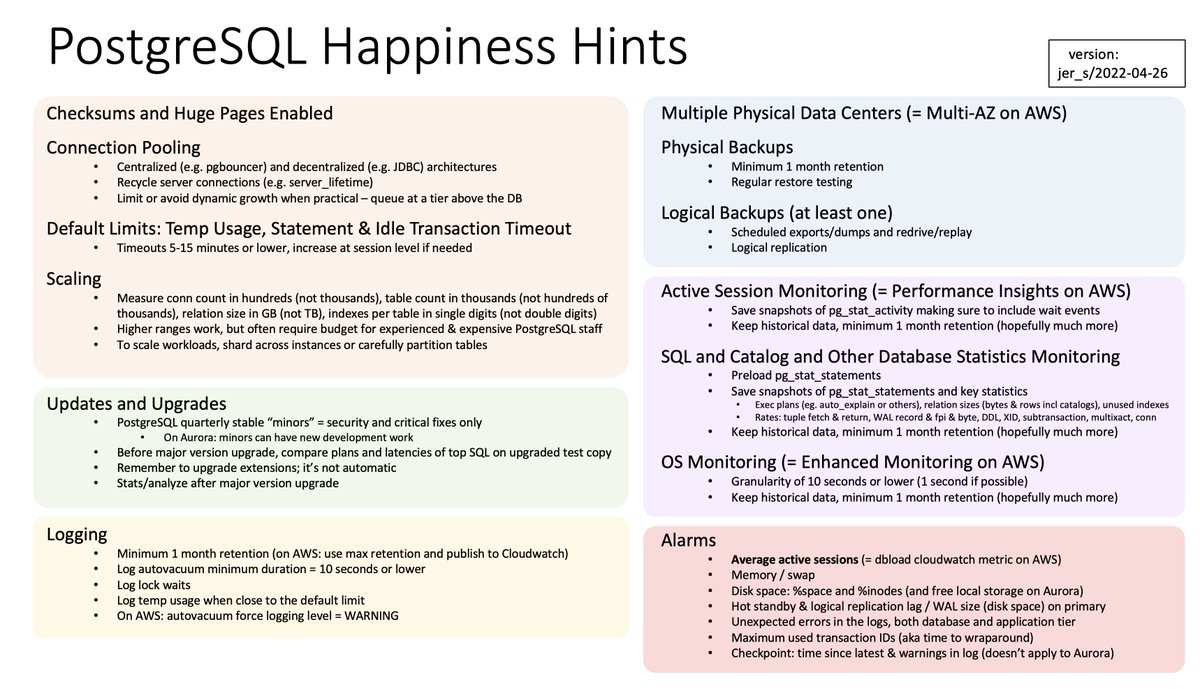
Latest PostgreSQL Happiness Hints: collection of things that I think every production PostgreSQL stack should have. Most things here are widely accepted, but a few are biased toward my opinions (eg scaling & dynamic conn pools). Mostly not original ideas; many people helped
Jeremy Schneider tweet media
English
9
68
373
0
Jeremy Schneider
Jeremy Schneider@jer_s·
We need to re-think OSS contribution attribution in light of AI. More than ever, it's important for committers to give credit on where the ideas are coming from. A committer can copy/paste someone else's ideas into their own prompts, and they need to give appropriate credit.
English
0
0
3
119
Jeremy Schneider
Jeremy Schneider@jer_s·
@kellabyte @TanelPoder lets name it "hadoop" 😅 this is a better approach with less risk of bottleneck on a single server cpu oracle RAC is never local to the storage anyway, shared storage = always a network hop my hesitations w db PLs as religion [1] single server cpu [2] version control of code
English
1
0
1
54
Kelly Sommers
Kelly Sommers@kellabyte·
@TanelPoder Would be interesting to have a grid of nodes and the scheduler decides which workloads/apps should be tightly running on the storage node or scheduled apart. Dynamically moving on demand.
English
1
0
1
56
Kelly Sommers
Kelly Sommers@kellabyte·
For two decades, a loud class of architects & devs rejected stored procedures while ignoring a fundamental truth of computing: locality matters. A path forward to reach these folks is language native compute scheduled at the data layer. Kubernetes of data. Maybe WASM scheduling
English
49
16
242
25K
shane borden 🛩️
shane borden 🛩️@sborden76·
@planetpostgres @jer_s @jer_s I've been hesitant to use this so far because I haven't been able to quantify the the increased overhead (if any) by the postmaster. Were you able to detect any increased overhead?
English
1
0
0
30
Shaun Thomas
Shaun Thomas@BonesMoses·
Currently the main problem seems to be running out of context, tokens, or both. In time, even those constraints will fall away.
Andrej Karpathy@karpathy

A few random notes from claude coding quite a bit last few weeks. Coding workflow. Given the latest lift in LLM coding capability, like many others I rapidly went from about 80% manual+autocomplete coding and 20% agents in November to 80% agent coding and 20% edits+touchups in December. i.e. I really am mostly programming in English now, a bit sheepishly telling the LLM what code to write... in words. It hurts the ego a bit but the power to operate over software in large "code actions" is just too net useful, especially once you adapt to it, configure it, learn to use it, and wrap your head around what it can and cannot do. This is easily the biggest change to my basic coding workflow in ~2 decades of programming and it happened over the course of a few weeks. I'd expect something similar to be happening to well into double digit percent of engineers out there, while the awareness of it in the general population feels well into low single digit percent. IDEs/agent swarms/fallability. Both the "no need for IDE anymore" hype and the "agent swarm" hype is imo too much for right now. The models definitely still make mistakes and if you have any code you actually care about I would watch them like a hawk, in a nice large IDE on the side. The mistakes have changed a lot - they are not simple syntax errors anymore, they are subtle conceptual errors that a slightly sloppy, hasty junior dev might do. The most common category is that the models make wrong assumptions on your behalf and just run along with them without checking. They also don't manage their confusion, they don't seek clarifications, they don't surface inconsistencies, they don't present tradeoffs, they don't push back when they should, and they are still a little too sycophantic. Things get better in plan mode, but there is some need for a lightweight inline plan mode. They also really like to overcomplicate code and APIs, they bloat abstractions, they don't clean up dead code after themselves, etc. They will implement an inefficient, bloated, brittle construction over 1000 lines of code and it's up to you to be like "umm couldn't you just do this instead?" and they will be like "of course!" and immediately cut it down to 100 lines. They still sometimes change/remove comments and code they don't like or don't sufficiently understand as side effects, even if it is orthogonal to the task at hand. All of this happens despite a few simple attempts to fix it via instructions in CLAUDE . md. Despite all these issues, it is still a net huge improvement and it's very difficult to imagine going back to manual coding. TLDR everyone has their developing flow, my current is a small few CC sessions on the left in ghostty windows/tabs and an IDE on the right for viewing the code + manual edits. Tenacity. It's so interesting to watch an agent relentlessly work at something. They never get tired, they never get demoralized, they just keep going and trying things where a person would have given up long ago to fight another day. It's a "feel the AGI" moment to watch it struggle with something for a long time just to come out victorious 30 minutes later. You realize that stamina is a core bottleneck to work and that with LLMs in hand it has been dramatically increased. Speedups. It's not clear how to measure the "speedup" of LLM assistance. Certainly I feel net way faster at what I was going to do, but the main effect is that I do a lot more than I was going to do because 1) I can code up all kinds of things that just wouldn't have been worth coding before and 2) I can approach code that I couldn't work on before because of knowledge/skill issue. So certainly it's speedup, but it's possibly a lot more an expansion. Leverage. LLMs are exceptionally good at looping until they meet specific goals and this is where most of the "feel the AGI" magic is to be found. Don't tell it what to do, give it success criteria and watch it go. Get it to write tests first and then pass them. Put it in the loop with a browser MCP. Write the naive algorithm that is very likely correct first, then ask it to optimize it while preserving correctness. Change your approach from imperative to declarative to get the agents looping longer and gain leverage. Fun. I didn't anticipate that with agents programming feels *more* fun because a lot of the fill in the blanks drudgery is removed and what remains is the creative part. I also feel less blocked/stuck (which is not fun) and I experience a lot more courage because there's almost always a way to work hand in hand with it to make some positive progress. I have seen the opposite sentiment from other people too; LLM coding will split up engineers based on those who primarily liked coding and those who primarily liked building. Atrophy. I've already noticed that I am slowly starting to atrophy my ability to write code manually. Generation (writing code) and discrimination (reading code) are different capabilities in the brain. Largely due to all the little mostly syntactic details involved in programming, you can review code just fine even if you struggle to write it. Slopacolypse. I am bracing for 2026 as the year of the slopacolypse across all of github, substack, arxiv, X/instagram, and generally all digital media. We're also going to see a lot more AI hype productivity theater (is that even possible?), on the side of actual, real improvements. Questions. A few of the questions on my mind: - What happens to the "10X engineer" - the ratio of productivity between the mean and the max engineer? It's quite possible that this grows *a lot*. - Armed with LLMs, do generalists increasingly outperform specialists? LLMs are a lot better at fill in the blanks (the micro) than grand strategy (the macro). - What does LLM coding feel like in the future? Is it like playing StarCraft? Playing Factorio? Playing music? - How much of society is bottlenecked by digital knowledge work? TLDR Where does this leave us? LLM agent capabilities (Claude & Codex especially) have crossed some kind of threshold of coherence around December 2025 and caused a phase shift in software engineering and closely related. The intelligence part suddenly feels quite a bit ahead of all the rest of it - integrations (tools, knowledge), the necessity for new organizational workflows, processes, diffusion more generally. 2026 is going to be a high energy year as the industry metabolizes the new capability.

English
1
0
0
179
Jeremy Schneider
Jeremy Schneider@jer_s·
Poisoned conn pools in Go can escalate from row-level brownouts to complete db outages. This test suite demonstrates the failure cascade and shows how PgBouncer's peering feature (v1.19+) prevents the escalation; although fixing leaks at the app level remains the true solution.
Planet PostgreSQL@planetpostgres

Jeremy Schneider (@jer_s): How Blocking-Lock Brownouts Can Escalate from Row-Level to Complete System Outages postgr.es/p/7qE

English
0
1
5
306
Philipp Krenn
Philipp Krenn@xeraa·
@jer_s @jpscaletti @cole1809 @dhh the elastic terminology is "free and open" but not open source that OSI is trying to police the term "open" (while even "open source" is just established but not backed in a legal sense) is then a different story
English
1
0
0
39
DHH
DHH@dhh·
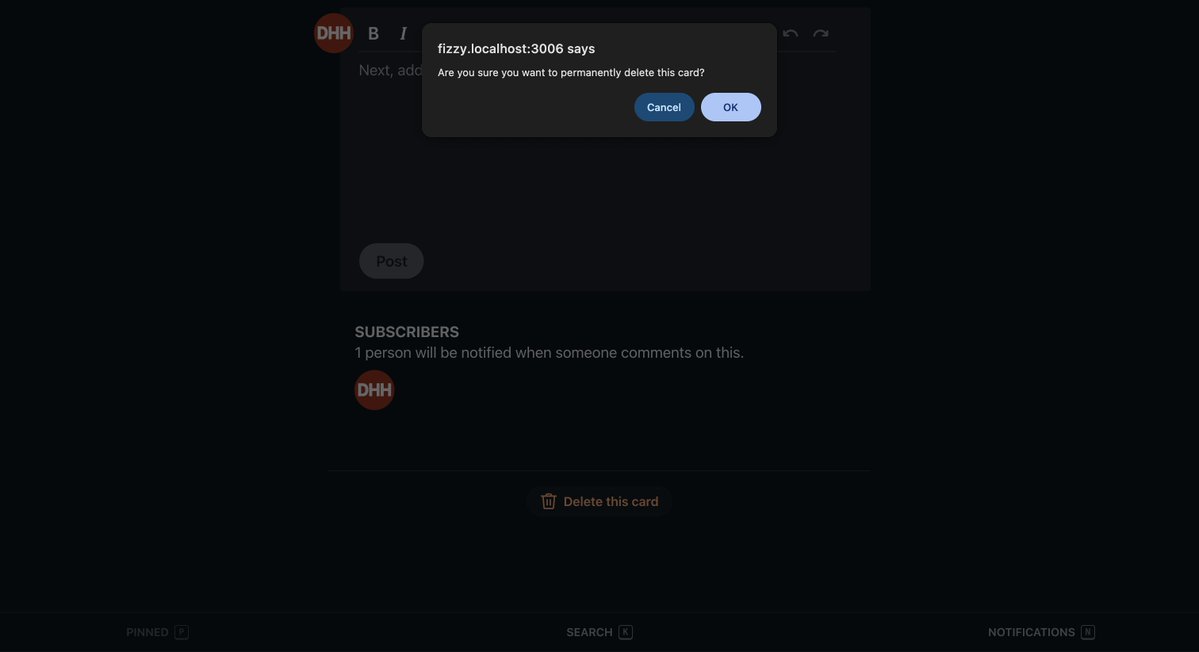
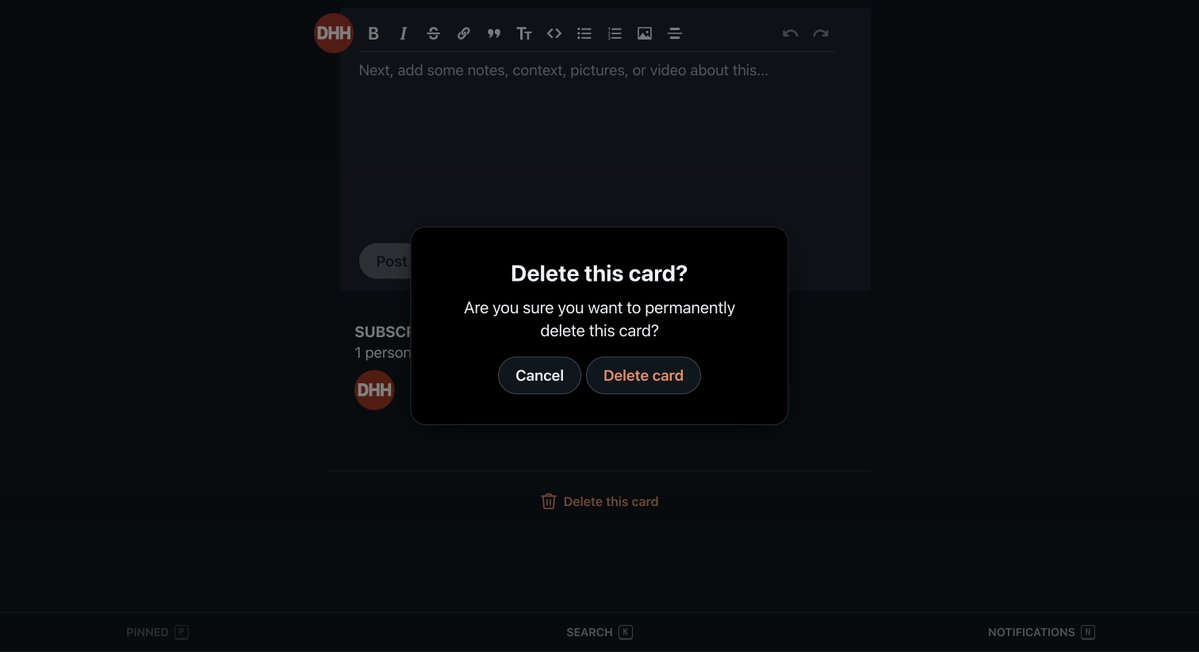
Fizzy's open source is not just seeing contributions on the backend, but UI improvements as well. Really nice level up turning the confirmation popups into proper overlays by Justin Starner 👌 (before v after) github.com/basecamp/fizzy…
DHH tweet mediaDHH tweet media
English
11
10
391
45K
Jeremy Schneider
Jeremy Schneider@jer_s·
@jpscaletti @cole1809 @dhh "source available" is the correct term. after mongodb, elasticsearch, confluent, hashicorp, etc ... i did not expect dhh (of all people!) to go the mongo/elastic route of trying to use the term "open source" like this
English
1
0
2
91
Jeremy Schneider 리트윗함
Yawd
Yawd@el_yawd·
Learnt how to develop Postgres extensions, pretty neat
Yawd tweet media
English
0
2
14
690
Jeremy Schneider
Jeremy Schneider@jer_s·
@BenjDicken I have said many times to many people - the thing I love most about working with relational databases is that you can touch on almost every aspect of computer science here, from theory and high-level algorithms down to low-level hardware design details
English
1
0
13
1.1K
Ben Dicken
Ben Dicken@BenjDicken·
Think databases are boring? Indexing → data structures + algorithms AI → RAG + learned indexes MVCC → concurrent programming Sharding → distributed systems Query parsing → formal languages Query planning → stats + optimization Replication → distributed systems Authentication → security WAL → fault tolerance Storage → file systems + caching Compression → information theory Deadlock detection → graph theory Databases encompass tons of interesting software engineering problems.
English
47
155
1.5K
181.4K
Jeremy Schneider
Jeremy Schneider@jer_s·
@dave_cramer @samokhvalov @kellabyte the new async IO code will need to be instrumented differently but a sync OS call to read() data from a file always waits, regardless of short wait for pagecache or long wait for physical IO ability to profile DB and see state of active conns is very valuable
English
0
0
0
48
Nik Samokhvalov
Nik Samokhvalov@samokhvalov·
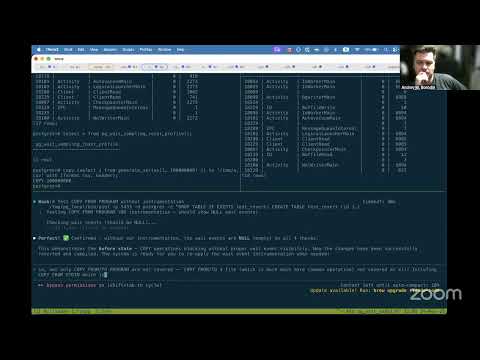
Discovered something surprising during today's postgres.tv hacking session: COPY has no wait events at all. Reading from file? NULL wait_event. Writing to file? NULL wait_event. Tools show green "CPU" when it's actually I/O. And COPY is what pg_dump and pg_restore use by default. We went in to add wait events for COPY TO/FROM PROGRAM, then realized the gap is much bigger than expected. Verified with pg_wait_sampling. Good news: many of these are easy fixes — great "first patch" items if you want to contribute to Postgres. Feel free to join us Online session: youtube.com/watch?v=wLPDt7… Telegram group for those who want to start Postgres hacking: t.me/postgres_hacki… -hackers thread: postgresql.org/message-id/fla…
YouTube video
YouTube
English
2
7
56
11.6K
Gwen (Chen) Shapira
Gwen (Chen) Shapira@gwenshap·
⚠️PSA: Don't use Docker's official Postgres image in production. Or, if you do, make sure you specify your Debian image. The long version: Postgres minor version upgrades (17.6 -> 17.7) are generally easy, safe and recommended. They should never break anything. *But* if you use the official docker image and recently (since August) did a minor version upgrade, you may have seen this warning: "The database was created using collation version 2.36, but the operating system provides version 2.41. Rebuild all objects in this database that use the default collation and run ALTER DATABASE "mydb" REFRESH COLLATION VERSION, or build PostgreSQL with the right library version." This is because: - Docker only supports 2 debian versions for the PG image - When a new version comes out, it automatically becomes the default unless you specify the image. - Debian's new release included a new glibc, which includes new locale files. - So now you are running Postgres linked against one set of locale files, but with a database with data and indexes that assume a different locale file. Since this situation can lead to anything from bad query results to corruption, Postgres correctly warns you to refresh the collation for the DB, which you do *after* rebuilding every object in your database (to avoid corruption). This is something we do on **major** upgrades, and absolutely do not expect on **minor** upgrades. But Docker forces this on the users of their official image. Be careful out there! Official image does not mean "responsible production behavior".
English
47
119
1.1K
251K
Ben Dicken
Ben Dicken@BenjDicken·
I'm baffled that Postgres logical replication doesn't fully support sequences. Keeping nextval() in sync shouldn't be that hard. What am I missing?
English
8
1
87
12.5K
Jeremy Schneider 리트윗함
Franck Pachot
Franck Pachot@FranckPachot·
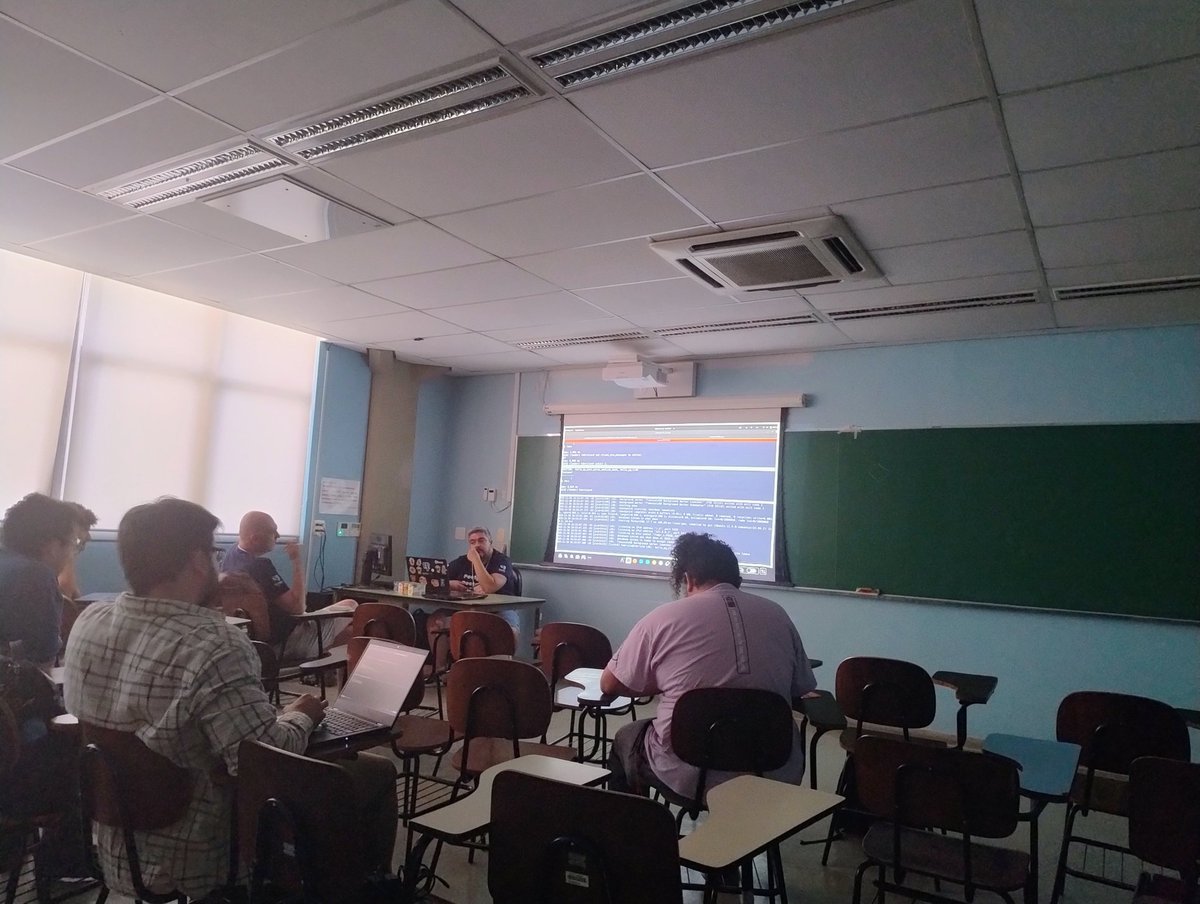
Always great to see which topics are proposed to discuss in an un-conference. Thanks @pg_ibz for gathering such a team of experts with an open mind
Franck Pachot tweet media
Santa Eulalia del Río, Spain 🇪🇸 English
2
3
14
1.2K