Sabitlenmiş Tweet

0K246Crypto.hl
1.2K posts

@0K246Crypto
Alpha hunter | Defi MAXI | @HyperliquidX REF LINK🔗https://t.co/sdrF9AYhKJ | Advisor🔍 @stillearly_ | NFA | monk mode



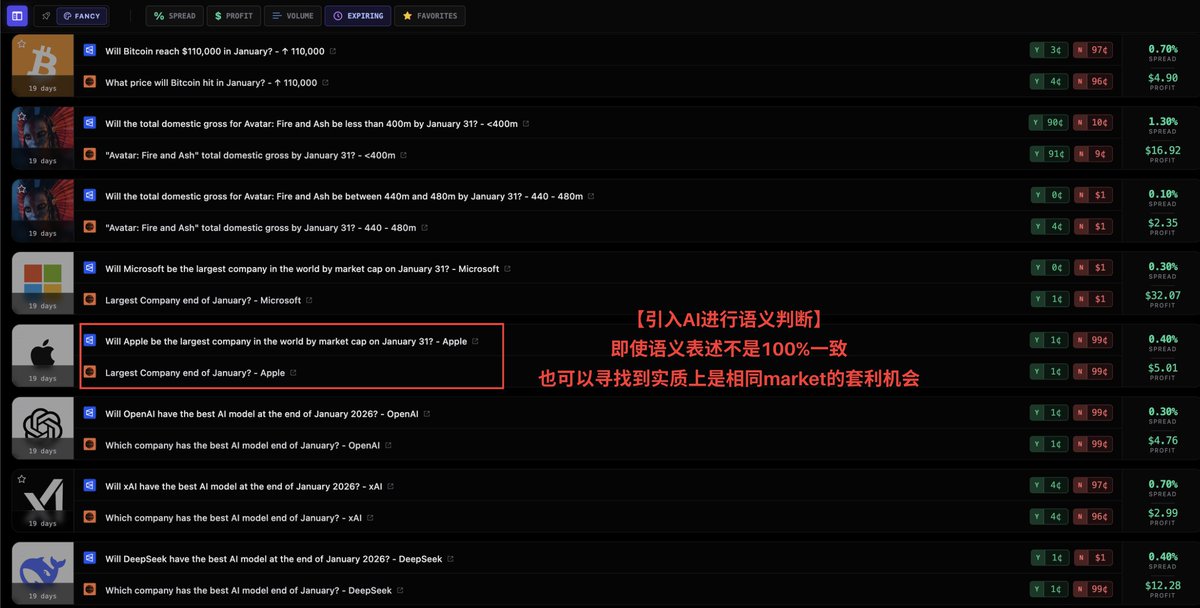


【既然有 cross-platform arbitrage ,就应该有 cross-platform merge!】 半夜看到一篇新鲜出炉的预测市场论文,我瞬间猪突猛进、脑洞大开! 论文题目是 Semantic Non-Fungibility and Violations of the Law of One Price in Prediction Markets 主要说的是因为不同预测市场的语义不可替代性(Semantic Non-Fungibility),两个经济上完全等价的合约,由于描述和规则的细微差异,无法被自动识别为同一资产,导致了流动性碎片化、套利空间被浪费等问题。 作者提出,建立一个共享的、机器可验证的语义基础,是实现价格收敛和流动性整合的先决条件。 但是呢,比较值得思考的地方来了🤔 ‼️研究发现,即使是语义上完全等价的市场,同一事件的价格也经常偏离。在考虑了交易费用和滑点后,平均价格偏差仍保持在 2-4% 左右 ,并且价格差异并非短暂的波动,而是持续存在的。 (这就是很多的 cross-platform arbitrage bot 以及聚合交易终端在做的事情,发现/列示这些机会。) ‼️那么,是什么造成了这种持续存在的、结构性的价格差异呢?这就是跨平台套利最大的问题 —— 资金占用成本过高 由于不同平台的合约无法互通(即不能在一个平台买入在另一个平台卖出并立即平仓),套利者必须在两个平台同时持有相反头寸,直到事件结算。因此资金会被锁定很长时间。 (比如举个例子,下图是 @youknow028 老师制作的,列示 polymarket 和 opinion 之间套利机会的网站。可以看到,即使按照结束时间排序,最近的也要 191 天才能结算。。。) 联想到既然 Polymarket 有 「1 Yes + 1 No = 1 USDC」 的 merge 法则,那是否可以把这个法则扩展到不同的预测市场之间呢? 尤其是,如果BSC上的几个预测市场台子 @opinionlabsxyz @0xProbable 发展得足够好,这个需求不会低。 剩下的有些地方还没想明白,就先写到这吧(咱也是梦到哪句写哪句。。。也不知道有没有团队在做这事儿了。。。

上周 @HyperliquidX 动态合集!
<产品 & 技术>
对 app.hyperliquid.xyz 菜单栏和组合保证金模式进行了多项界面优化。组合保证金目前处于pre-alpha 阶段,欢迎大家继续分享建议。

Hyperliquid is built on a foundation of onchain transparency. A recent article made several claims that are factually incorrect: + Solvency: Every dollar is accounted for; the author failed to count native HyperEVM USDC. + Integrity: Testnet functions are exactly that - testnet only for testing. They cannot be executed on mainnet. + Transparency: Hyperliquid is more transparent and decentralized than all other major venues for perps trading. The entire state is independently maintained by a permissionless validator set and verified through BFT proof-of-stake consensus by each node. Every order, trade, and liquidation is available in real time during execution. Anyone can run a node and index the chain’s state and transitions. No major perps platform comes close to this guarantee for users. See our response to the writer’s individual points below. Claim: The system is undercollateralized by $362M False: The Hyperliquid blockchain state is fully and verifiably solvent. The author excluded the HyperEVM USDC (a publicly announced and much anticipated integration), which exists in parallel to the Arbitrum bridge. Every USDC in circulation on HyperCore is accounted for transparently, by summing up the balances of arbiscan.io/address/0x2df1… and hyperevmscan.io/address/0x6b9e…. At the time of writing, this amounts to 3.989B + 362M = 4.351B USDC on HyperCore. USDC on the HyperEVM can be computed by subtracting 362M from the 421M on the HyperEVM USDC contract (hyperevmscan.io/token/0xb88339…), totaling another 59M USDC on HyperEVM. The sum of the Arbitrum bridge and native USDC balances can be compared against the sum of user balances on HyperCore. As highlighted in the introduction, this exercise of verifying complete system solvency against user balances is uniquely possible on Hyperliquid compared to competitors. The current Arbitrum bridge was an important stepping stone in bootstrapping the Hyperliquid network and will be deprecated as the migration to native USDC is complete, bringing Hyperliquid to parity with other major L1s. Claim: There is retroactive volume manipulation via TestnetSetYesterdayUserVlm False: This is a testnet-only function to allow for comprehensive testing. The author states that “the function’s presence is the problem…capability alone violates the trust model.” Testnet-only features that enable more rigorous testing of edge cases do not undermine the chain’s integrity. The fee schedule on Hyperliquid interacts in a complex way with inputs: user volume, aligned quote token status, maker vs taker, HIP-3, etc. It’s important to test these interactions on testnet, and therefore the testnet chain has a set of admin testing functions that do not exist on mainnet. The related TestnetAddMainnetUser action is to mark a testnet user as having corresponding mainnet state, to avoid DDOS and other attacks that are “free” on testnet. None of these functions are callable on the mainnet state. While the execution source is not available, anyone can verify every trade onchain by running a node, and sum up the values to confirm that volume numbers are reflected accurately in onchain state. Similar to onchain solvency verification against the sum of all user account values, this is possible on Hyperliquid but not on most competitive platforms. Given that this code path is entirely unreachable on mainnet, future development work will entirely compile out this testnet-only logic on mainnet nodes to avoid any possible misunderstanding or misinterpretation. Claim: Some users have special privileges such as fee exemptions or retroactive volume manipulation used to influence the airdrop False: Like system solvency, user balances, and individual trades, the fees paid by any address is available onchain. Each trade along with its fees paid or rebates received are transparently indexed by nodes, API servers, and third party analytics providers. There are no such mechanisms to distort fees, and no such mechanisms could have influenced the HYPE airdrop. Furthermore, the genesis distribution of HYPE is fully available onchain, and users can verify the historical behavior of every such address. Claim: “CoreWriter” godmode can mint tokens, move user funds without signatures, crash random validators and basically do whatever it wants False: The CoreWriter spec is fully documented here hyperliquid.gitbook.io/hyperliquid-do… and replicable in the open source HyperEVM execution. CoreWriter is a way for smart contracts on HyperEVM to send HyperCore actions as part of HyperEVM block execution. It supports various actions that are normally sent by EOAs such as staking and placing orders, but has no such features to “mint tokens, move user funds without signatures, crash random validators and basically do whatever it wants.” This is a fundamental misunderstanding of how HyperCore interacts with the HyperEVM. Claim: Chain can freeze via governance, and no undo function exists Misinterpreted: The chain freezes during network upgrades. There is no undo function because the validators adopt a new binary at that height. This is analogous to how other networks perform hard forks at future heights determined by social consensus. Suspicious activity on POPCAT in Nov 2025 did not cause the L1 to freeze, nor were any user funds frozen. The L1 was entirely operational, and any observer can see the blocks that were produced during this time. The Arbitrum bridge was automatically locked after the incident due to abnormal variation in account balances. As explained above, the Arbitrum bridge is not as secure as natively minted USDC, and therefore requires several conservative automated locking mechanisms as safeguards. The Arbitrum bridge’s locking mechanism is audited and open sourced, and the bridge is being deprecated with the transition to native USDC. Claim: A single private key can set any oracle price instantly: no timelock, no limits Misinterpreted: The author is likely mistaking the HIP-3 oracle updater logic with the validator-operated perps. HIP-3 oracle updates are indeed set by a single address, but this is up to the deployer to configure. The updater address need not be an EOA. For example, current HIP-3 deployers use a combination of MPC and CoreWriter architecture. For validator-operated perps, multiple validators can submit oracle price updates. The final prices are a robust weighted median across major centralized exchanges. There is no timelock and no limits explicitly because these limits make the system less, not more, safe. The events of 10/10 show the danger to solvency if ADL is not accurately triggered in a timely manner during high volatility. Hyperliquid was one of the only venues without performance degradation or a network outage during this time. If Mango Markets or a similar protocol with oracle rate limits were active during 10/10, they would have likely accrued bad debt. Further decentralization will involve other validators actively running independent and open-sourced oracle update binaries. Claim: 8 undisclosed addresses control all transaction submission False: Some transactions are already sent directly from the validators. Some such as orders are not, in order to minimize MEV, but a future upgrade will incorporate this logic for all transactions in a mechanism that is both MEV- and censorship-resistant. The careful consideration of MEV is in response to trader and researcher feedback based on predatory behavior observed on other chains. There is almost unanimous agreement that toxic transaction ordering degrades the end user experience. Ultimately, the validator set is permissionless, and there is no guarantee that validators in the mainnet set are always fully aligned with the ecosystem. A major milestone in decentralization will be solving this problem, including a multiple-proposer block building setup. Claim: There is a liquidation cartel with unfair advantages Misinterpreted: Only HLP may backstop liquidate users, and HLP subvaults are the only addresses in this set. However, depositing into HLP is permissionless, so HLP is a community-owned liquidity vault supporting the protocol. The fact that HLP has privileges is no different from other protocol liquidity vaults. Relatedly, all liquidations are first attempted against the order book, which handles the vast majority of liquidated positions without backstop liquidation. This allows users to keep any remaining collateral, and allows all other users to compete in providing the best price to the liquidation flow, benefitting the liquidated user. Claim: There is a hidden lending protocol with $1M+ supplied and no documentation False: Portfolio margin, borrow lend, and the HLP supplied value were all publicly announced and are currently in pre-alpha rollout. The current documentation can be found at hyperliquid.gitbook.io/hyperliquid-do… and has been progressively fleshed out over the past several weeks. Claim: ModifyNonCirculatingSupply allows changes to token supply False: The full supply of HIP-1 tokens on HyperCore is fixed at deployment. The non-circulating supply is a purely informational number that can optionally mark addresses as “non-circulating” for display purposes. Whether an address is marked as “non-circulating” does not affect execution. This is an example of onchain information that might make more sense offchain, but is not a vulnerability. Thank you to the author for spending the time to verify the execution of Hyperliquid. The fact that this investigation could be done at all proves the transparency and decentralization that Hyperliquid has already achieved. Concretely, Hyperliquid is the only major perps venue where the entire state and every input diff is transparently available to anyone running a node. A similar analysis on any of the other top perp DEXs is impossible. For example, Lighter uses a single centralized sequencer whose execution logic and ZK circuits are unavailable. Aster uses centralized matching and even offers dark pool trading, which is only possible with a single centralized sequencer without verifiable execution. Other protocols with some open source contracts do not have a verifiable sequencer. On Binance, Lighter, Aster, or similar exchanges, it is impossible for anyone other than the sequencer to see a full snapshot of onchain state including order books, positions, and other user information. The centralized sequencer can also upgrade its software without any constraints. On Hyperliquid, the entire state is onchain, which means there are 24 validators executing the same state machine under BFT consensus rules. There is plenty left to do on the journey towards greater decentralization, but it’s important to highlight just how far Hyperliquid and its ecosystem have come compared to competitors. Decentralization is progressive, and Hyperliquid will ultimately be fully open sourced. Hyperliquid is the most transparent of all major venues, even though this leaks advantages to competitors (all of whom are closed source), who can copy Hyperliquid’s innovations more easily. We think this is the correct tradeoff to balance value accrual to the community, speed of innovation, and upholding the values of defi. The HyperEVM execution is open source, and Sprites, an independent community member, maintains a full archival node that powers many important integrations. HyperCore will follow the same path as soon as it reaches feature completion.






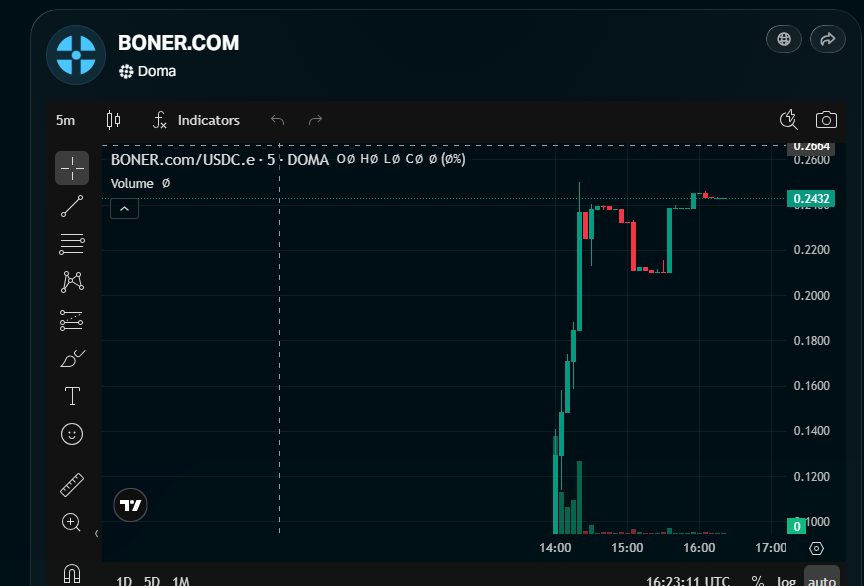
今晚射的好快, @domaprotocol 顶级域名。本来1000u能翻倍的,手慢了只赚了50%多一点儿。出本儿,剩下的死拿。撸平台积分。 目前榜上18000个账号,这点儿利润,死拿一周。积分进前200感觉问题不是很大。。


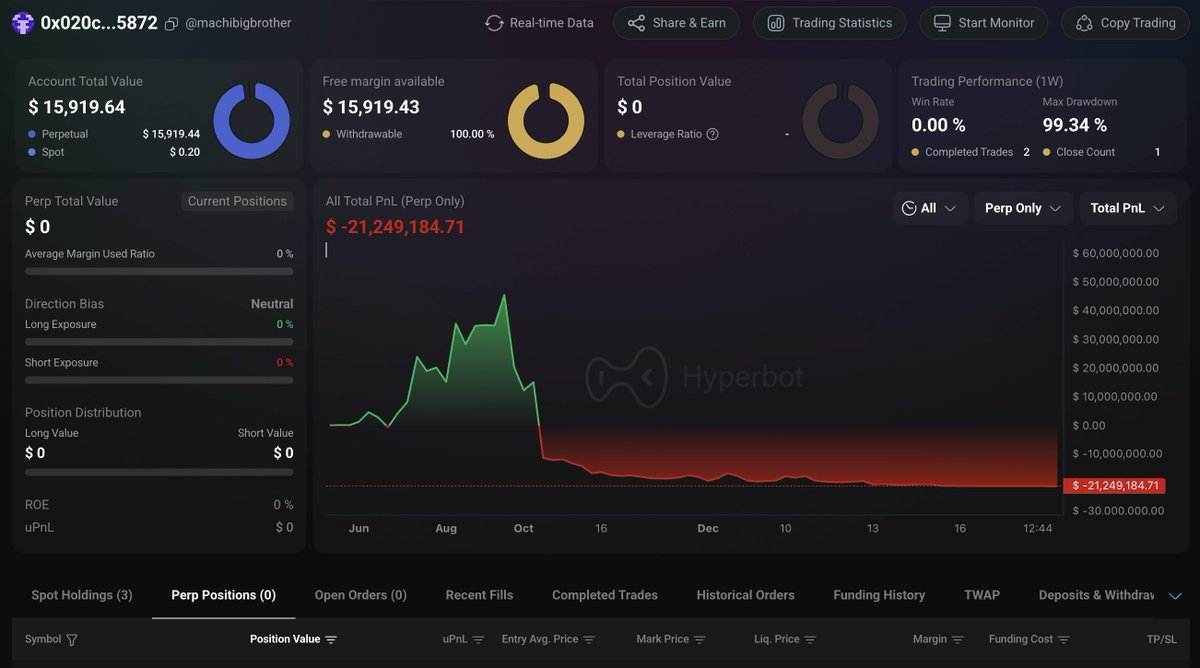
麻吉如此激进操作 是在洗钱么? 结论先说: 他就是纯粹的赌博,输红眼了,且目前尤作困兽斗! 洗钱的本质是把“非法所得”变成“干净资金” 在 Hyperliquid的操作,要么是将要清洗的“非法所得”,要么是已经洗完的“干净资金”。 1. 它不是入金的“非法所得”。 这地址已经是实名化了,如此实名操作“非法所得”,那这钱还需要洗么? 这不就没有意义了么?! 2. 当然它也就算不上是洗完后的“干净资金“。 很显然,这账户经受高额亏损,如果这是洗钱后的”干净资金“, 那这”洗钱“损耗可真大,消耗一千七百万,洗出来多少? 64w ? 而原本高点可以获利 45m,反而目前倒亏 17m。这样的亏损是实打实的。这才是这个地址交易的本质,单纯高杠杆交易造成巨大亏损,本身并不构成洗钱。 这样额度的亏损,他还能否云淡风轻? 除了早期其各种“收割”令其收获颇丰,也算是其“原始积累”,后续不论是Blur,BAYC,Pump,Hype,其收益均难以支撑目前的“挥金如土”。

注册 @TheoriqAI $wet 出本儿观察一两个小时看看。 开个小多单刷一下perp。 休息。打一会儿游戏。 回来还有三个项目要看