

glam
558 posts


Finally, the block building pipeline.
In Glamsterdam, Ethereum is getting ePBS, which lets proposers outsource to a free permissionless market of block builders.
This ensures that block builder centralization does not creep into staking centralization, but it leaves the question: what do we do about block builder centralization? And what are the _other_ problems in the block building pipeline that need to be addressed, and how? This has both in-protocol and extra-protocol components.
## FOCIL
FOCIL is the first step into in-protocol multi-participant block building. FOCIL lets 16 randomly-selected attesters each choose a few transactions, which *must* be included somewhere in the block (the block gets rejected otherwise). This means that even if 100% of block building is taken over by one hostile actor, they cannot prevent transactions from being included, because the FOCILers will push them in.
## "Big FOCIL"
This is more speculative, but has been discussed as a possible next step. The idea is to make the FOCILs bigger, so they can include all of the transactions in the block.
We avoid duplication by having the i'th FOCIL'er by default only include (i) txs whose sender address's first hex char is i, and (ii) txs that were around but not included in the previous slot. So at the cost of one slot delay, only censored txs risk duplication.
Taking this to its logical conclusion, the builder's role could become reduced to ONLY including "MEV-relevant" transactions (eg. DEX arbitrage), and computing the state transition.
## Encrypted mempools
Encrypted mempools are one solution being explored to solve "toxic MEV": attacks such as sandwiching and frontrunning, which are exploitative against users. If a transaction is encrypted until it's included, no one gets the opportunity to "wrap" it in a hostile way.
The technical challenge is: how to guarantee validity in a mempool-friendly and inclusion-friendly way that is efficient, and what technique to use to guarantee that the transaction will actually get decrypted once the block is made (and not before).
## The transaction ingress layer
One thing often ignored in discussions of MEV, privacy, and other issues is the network layer: what happens in between a user sending out a transaction, and that transaction making it into a block? There are many risks if a hostile actor sees a tx "in the clear" inflight:
* If it's a defi trade or otherwise MEV-relevant, they can sandwich it
* In many applications, they can prepend some other action which invalidates it, not stealing money, but "griefing" you, causing you to waste time and gas fees
* If you are sending a sensitive tx through a privacy protocol, even if it's all private onchain, if you send it through an RPC, the RPC can see what you did, if you send it through the public mempool, any analytics agency that runs many nodes will see what you did
There has recently been increasing work on network-layer anonymization for transactions: exploring using Tor for routing transactions, ideas around building a custom ethereum-focused mixnet, non-mixnet designs that are more latency-minimized (but bandwidth-heavier, which is ok for transactions as they are tiny) like Flashnet, etc. This is an open design space, I expect the kohaku initiative @ncsgy will be interested in integrating pluggable support for such protocols, like it is for onchain privacy protocols.
There is also room for doing (benign, pro-user) things to transactions before including them onchain; this is very relevant for defi. Basically, we want ideal order-matching, as a passive feature of the network layer without dependence on servers. Of course enabling good uses of this without enabling sandwiching involves cryptography or other security, some important challenges there.
## Long-term distributed block building
There is a dream, that we can make Ethereum truly like BitTorrent: able to process far more transactions than any single server needs to ever coalesce locally. The challenge with this vision is that Ethereum has (and indeed a core value proposition is) synchronous shared state, so any tx could in principle depend on any other tx. This centralizes block building.
"Big FOCIL" handles this partially, and it could be done extra-protocol too, but you still need one central actor to put everything in order and execute it.
We could come up with designs that address this. One idea is to do the same thing that we want to do for state: acknowledge that >95% of Ethereum's activity doesn't really _need_ full globalness, though the 5% that does is often high-value, and create new categories of txs that are less global, and so friendly to fully distributed building, and make them much cheaper, while leaving the current tx types in place but (relatively) more expensive.
This is also an open and exciting long-term future design space.
firefly.social/post/lens/8144…
English
Help me qualify for (3,3) on @blackhaven to get early access. Sign up through my link and grab yours before it's too late.
early.blackhaven.xyz/ref/0xGlamm
English

Nice seeing everyone alive on the tl for a whole 24 hours.
Back to your graves now.
Watcher.Guru@WatcherGuru
JUST IN: $140,000,000 worth of crypto longs liquidated in the past 60 minutes.
English

Nesting 2.0 is here.
Moonbirds, Mythics, and Oddities NFTs are getting $birb token through a new design mechanic that aligns holders with the long term growth of the ecosystem.
Deposit your NFT into the nesting protocol and receive a soulbound NFT of your birb while its nesting, no more stuck birbs on the marketplaces.
On the 28th of each month for the next 24 months, nested NFTs get to claim 1/24th of their respective allocations. If you nest for only part of the month leading up to your monthly claim on the 28th, you get pro rata that amount.
No need to rush, all NFTs who nest in the first 7 days are treated as if they have been nesting for the full month.

English
I want @pudgypenguins to win
I want @goodvibesclub to win
I want @Azuki to win
I want @BoredApeYC to win
I want @doodles to win
I want @quirkiesnft to win
I want @worldofwomenxyz to win
I want @re_generates to win
I want @ChimpersHQ to win
I want @moonbirds to win
I want @unofficialmfers to win
I want @MeebitsNFTs to win
I want @coolcats to win
I will work very very very very hard for @veefriends to win
English

We are revising our developer API policies:
We will no longer allow apps that reward users for posting on X (aka “infofi”). This has led to a tremendous amount of AI slop & reply spam on the platform.
We have revoked API access from these apps, so your X experience should start improving soon (once the bots realize they’re not getting paid anymore).
If your developer account was terminated, please reach out and we will assist in transitioning your business to Threads and Bluesky.
English

A new wallet was recently created March of 2025
It holds $11.3 Million Dollars of NFTs

English
Welcome to 2026! Milady is back.
Ethereum did a lot in 2025: gas limits increased, blob count increased, node software quality improved, zkEVMs blasted through their performance milestones, and with zkEVMs and PeerDAS ethereum made its largest step toward being a fundamentally new and more powerful kind of blockchain (more on this later)
But we have a challenge: Ethereum needs to do more to meet its own stated goals. Not the quest of "winning the next meta" regardless of whether it's tokenized dollars or political memecoins, not arbitrarily convincing people to help us fill up blockspace to make ETH ultrasound again, but the mission:
To build the world computer that serves as a central infrastructure piece of a more free and open internet.
We're building decentralized applications. Applications that run without fraud, censorship or third-party interference. Applications that pass the walkaway test: they keep running even if the original developers disappear. Applications where if you're a user, you don't even notice if Cloudflare goes down - or even if all of Cloudflare gets hacked by North Korea. Applications whose stability transcends the rise and fall of companies, ideologies and political parties. And applications that protect your privacy. All this - for finance, and also for identity, governance and whatever other civilizational infrastructure people want to build.
These properties sound radical, but we must remember that a generation ago any wallet, kitchen appliance, book or car would fulfill every single one of them. Today, all of the above are by default becoming subscription services, consigning you to permanent dependence on some centralized overlord.
Ethereum is the rebellion against this.
To achieve this, it needs to be (i) usable, and usable at scale, and (ii) actually decentralized. This needs to happen at both (a) the blockchain layer, including the software we use to run and talk to the blockchain, and (b) the application layer. All of these pieces must be improved - they are already being improved, but they must be improved more.
Fortunately, we have powerful tools on our side - but we need to apply them, and we will.
Wishing everyone an exciting 2026.
Milady.
English

Enough is enough!
We're paying tens of thousands of dollars for NFTs, but we still have to pay $40 for a snow globe... (I sold all my big Pudgys Nfts).
That's it for me; I won't be back until people holding NFTs in this market become important.
Goodbye.
Pudgy Penguins@pudgypenguins
Celebrate Pudgy Penguins with our new Snow Globe now available in the Pudgy Penguins online shop. shop.pudgypenguins.com
English




Is there anyone left ~(・・?)
Please say milady if you’re a real person on the internet . . .

English

Wow. Ebay sellers cancelling orders from days ago saying “out of stock”…
That is BS. They will 100% re-list later at a much higher price. If you list something and someone buys it for your asking price you need to honor it.
English


Unfortunately our 3rd party provider received too many requests resulting in downtime.
The $250M cap filled within 156 seconds upon resolution.
We've decided to increase the cap to $1B in an effort to give users access to USDm day 1.
Bridge will reopen at 11am EST.
English

S: Seville, Florence, Istanbul, Edinburgh
A: Granada, Trondheim, Madrid, Skiathos, Taipei
B: Chiang Mai, Paris, Boston, Salt Lake, Singapore, Hoi An, Langkawi
C: Rome, New York, Warsaw, Valetta, Bangkok
D: Portland, Saint Louis
E: Athens, Saigon, Phnom Penh, Kuala Lumpur
Filipino


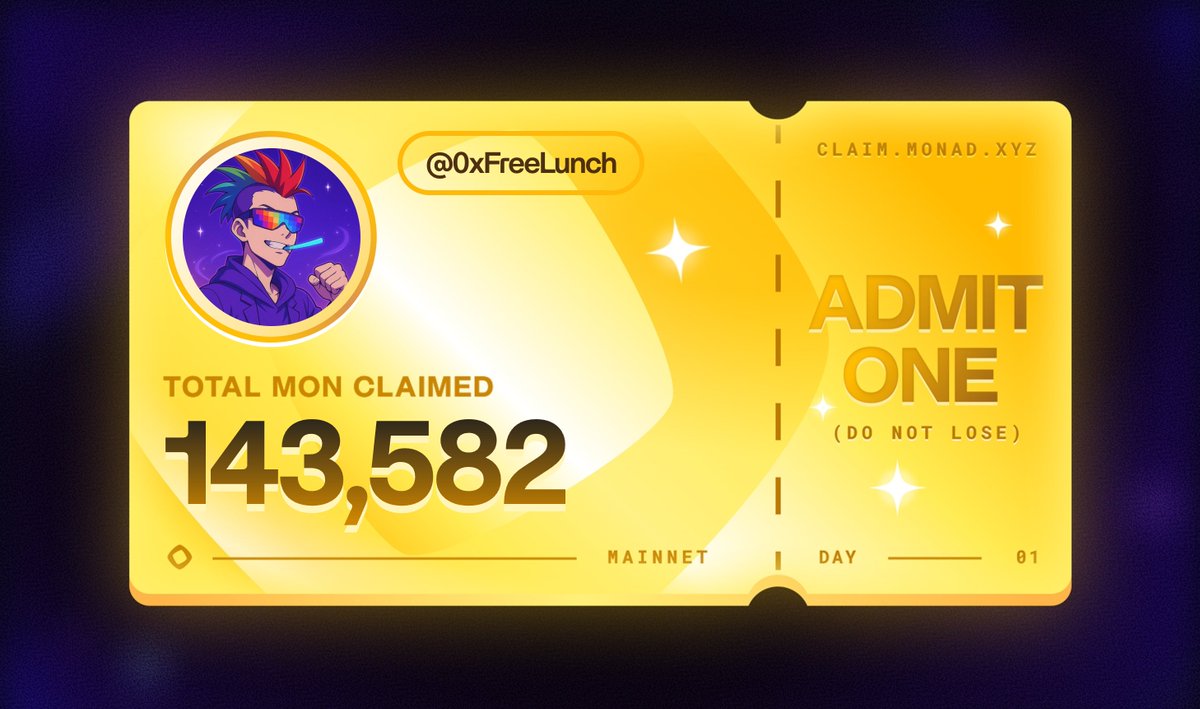
I have a question: Who made this PFP?
It looks pretty sick, but where was it from? It is not any of the PFPs I used on any platform.
@monad
English