0xjoer

1.8K posts

0xjoer banner
0xjoer

0xjoer

@0xjoer

Web3. :@HYTOPIAgg & @lootrealms ; OG @treasure_DAO

Katılım Ocak 2022
4.1K Takip Edilen602 Takipçiler
0xjoer retweetledi
Geiger Capital
Geiger Capital@Geiger_Capital·
Jeff Bezos on NYC spending: "If we ran Amazon the way New York City runs their school system, packages would take 6 weeks to arrive, we would charge you a $100 delivery fee and when the package did finally arrive, it would have the wrong item in it."
English
732
7.6K
49.2K
1.9M
0xjoer retweetledi
Alex Finn
Alex Finn@AlexFinn·
Scariest video I've watched this week America's next generation actively booing the most transformative technology our species has ever seen In China grandmas line up to get OpenClaw installed In America, supposedly our most educated people BOO even the mention of AI The west simply does not stand a chance if this continues We have a massive AI marketing problem in this country and nobody is doing anything to fix it Tomorrow Meta will announce 8,000 layoffs. They will blame it completely on AI They won't blame it on their irresponsible hiring in 2021 or extended elevated rates or horrible market conditions or bad inflation No, in order to not tank their stock, they'll blame it on AI College students will read that and learn to HATE the technology They'll protest outside datacenters holding ridiculous signs that say "SAVE OUR WATER NO MORE DATACENTERS" Politicians will see this and run on blocking data centers just to get a few votes All of it will be a cycle that leads to America losing to China This should be a warning sign to all frontier labs and CEOs: messaging matters. And if your messaging doesn't change the West is cooked
This Week in AI@ThisWeeknAI

3 commencement speakers were booed at the mention of Artificial Intelligence (Video) 1. Eric Schmidt, Google CEO 2. Scott Borchetta, Big Machine Records CEO 3. Gloria Caulfield, Tavistock Development VP

English
1.1K
245
2K
380.1K
0xjoer retweetledi
Crypto Tice
Crypto Tice@CryptoTice_·
BREAKING: Poland just told the EU to go to hell. President Nawrocki vetoed the Digital Services Act. "The state is supposed to guarantee freedom. Not restrict it." The EU spent years building the most sophisticated censorship machine in the Western world. One man. One veto. Destroyed. Think about what this law actually was. > Governments deciding what you can post. > Governments deciding what you can share. > Governments deciding what is true. > Governments deciding what you are allowed to think. Poland said no. While Germany complied. While France complied. While the entire EU rolled over. Poland vetoed it. - The same Poland that buys more gold than the ECB. - The same Poland that surpassed the European Central Bank in reserves. - The same Poland that has been right about everything. Is now the last wall standing between European citizens and state-controlled speech. The EU doesn't want free citizens. It wants manageable ones. Poland just reminded them what freedom actually looks like. Every European should be paying attention.
English
1.5K
24.7K
80K
1.3M
0xjoer retweetledi
Mario Nawfal
Mario Nawfal@MarioNawfal·
The CEO of Take-Two, the company behind GTA, just said something the entire AI industry doesn't want to hear. And he said it without being anti-AI. Strauss Zelnick's argument is precise. AI is built on datasets. Datasets are backward-looking. Creativity is forward-looking. A model trained on everything that already exists cannot, by definition, produce something genuinely unexpected. And all hits, by their very nature, are unexpected. Asset creation and hit creation are not the same thing. AI is getting very good at the first one. The second one is what actually makes money, builds franchises, and changes culture. Nobody has shown AI can do that yet. The derivative property problem is real. You can clone GTA with existing technology. You could do it before AI. It would take 3 years and look identical. It still wouldn't sell. Because it isn't GTA. It's a clone of GTA. And consumers, despite what the industry occasionally pretends, can feel the difference between something genuinely new and something assembled from the residue of things that already worked. Thousands of mobile games ship every year. 0 to 5 hits get made. The same studios make them every time. The technology to make more games has been commoditized for years. It didn't democratize hit creation. It just flooded the market with more forgettable product. The Silicon Valley thesis that AI unlocks game creation for everyone is true in the same way that cheap cameras unlocked filmmaking for everyone. They did. And the same 5 studios still make the movies everyone watches. What Zelnick is saying, without quite saying it, is that the thing AI cannot replicate is taste. The instinct for what hasn't been done yet. The cultural antenna that detects the gap in the market before the data can see it. Data tells you what people wanted. Hits tell people what they want next. Those are different jobs.
Mario Nawfal@MarioNawfal

🇺🇸 Tucker lays out the deepest critique of AI yet, and it's not about jobs... His argument: writing produces thinking. You can't formulate a thought without first articulating it. If kids never write because AI writes for them, the quality of human thinking collapses. That's the surface problem. The deeper one is purpose: "The point of living is to create. That's the point of being a human being. It's necessary for joy. There is no joy without creation." If the machine creates everything and humans just consume, you don't get utopia. You get despair, mass unemployment, and eventually political revolution.

English
437
1.3K
9.5K
1.6M
0xjoer retweetledi
SightBringer
SightBringer@_The_Prophet__·
⚡️This is the moment AI stops being a productivity tool and becomes a replacement architecture for elite cognitive labor. Citadel is not a random corporation automating low-level admin. It is one of the most competitive intelligence machines in finance. The work Griffin is describing sits near the top of the white-collar pyramid: research, modeling, financial reasoning, market analysis, scenario work, probably pieces of strategy design and investment process. If that work is moving from “PhDs over months” to “agents over days,” then the protected class is no longer protected by intelligence alone. That is the earthquake. For years, the comforting story was that AI would eat repetitive white-collar work while elite judgment stayed safely human. That story is breaking. The machine is now moving into work that looked elite because it required credentials, stamina, math, domain knowledge, and long-form synthesis. A lot of that work turns out to be decomposable into agentic loops: gather data, structure problem, run model, test variants, summarize findings, compare assumptions, stress scenarios, refine output, escalate uncertainty. That does not eliminate the human at the top. It makes the top human massively more leveraged. The portfolio manager, senior analyst, or strategist who can frame the right question and judge the output becomes more powerful. But the pyramid underneath them gets thinner. The machine does the grind. The human becomes conductor, evaluator, risk owner, and taste layer. That breaks the apprenticeship model. The junior analyst’s old job was not just to produce work. It was to become someone through the work. The grind built pattern recognition. The model-building built intuition. The memo-writing built synthesis. The repetition built judgment. If agents now do the repetition, firms get efficiency today while quietly destroying the training pipeline that produced senior judgment tomorrow. That is the social bomb inside this. Finance can automate the ladder faster than it can rebuild the ladder. Law, consulting, software, accounting, corporate finance, marketing, research, medicine, and education all face the same problem. The entry-level layer was always partly inefficient, but it was also how humans absorbed tacit knowledge. AI attacks the inefficiency and accidentally attacks the formation process. The winners become extremely powerful. One elite operator with agents can produce what used to require a team. One small fund can run research breadth that used to require institutional scale. One independent analyst with the right workflow can compete far above their formal weight class. That is the opening. But inside big institutions, the same force compresses headcount. Fewer juniors. Fewer middle managers. Fewer generic analysts. More pressure on everyone to prove actual judgment. The credential stops being enough. The market asks a colder question: can this person command the machine toward truth better than someone else? That is the new meritocracy. The most valuable skill becomes agentic command: knowing what to ask, how to decompose a problem, which outputs are fake, where the hidden assumption lives, when the model is overconfident, what data matters, what contradiction breaks the thesis, and when the machine has produced coherence without truth. Griffin feeling depressed is the tell. He saw the labor impact inside the walls before the public narrative caught up. This is not about a chatbot writing emails. This is about high-end cognitive production being mechanized. AI is revealing that a shocking amount of elite knowledge work was structured pattern labor protected by credential scarcity. Once agents can perform that pattern labor, the real scarce asset becomes judgment under uncertainty. Everyone else gets repriced.
Brett Caughran@FundamentEdge

A big pivot from Ken Griffin on AI: “Number one is, in the last few months, there has been a step change in the productivity of the AI toolkit. It is profoundly more powerful than it was just nine months ago. And for us at Citadel, that has allowed us to unleash a much broader array of use cases for AI. And it has been really interesting to watch, to be blunt, work that we would usually do with people with masters and PhDs in finance over the course of weeks or months being done by AI agents over the course of hours or days. These are not these are not mid-tier white collar jobs. These are like extraordinarily high skilled jobs being, I'm going to pick a word, automated by agentic AI. And I gotta tell you, I went home one Friday actually fairly depressed by this because you could just see how this was going to have such a dramatic impact on society. When you witness it in your own four walls, when you see work that used to be man years of work being done in days or weeks, it's like, wow, like that's the first time I've seen real impact in our four walls.” This echoes my own experience with agents and the conversations I am having with students, friends & clients. The toolkit has dramatically transformed and it feels like in finance, for the first time, AI is real.

English
42
71
496
91.3K
0xjoer retweetledi
SightBringer
SightBringer@_The_Prophet__·
⚡️The real signal is credential deflation. MBA demand is falling because the market is finally separating elite network access from generic credential theater. The top MBA still has value because it buys access: elite peers, recruiting funnels, status compression, VC/startup networks, private equity pipelines, consulting/IB placement, alumni power, and social sorting. That part survives because the product is not just education. It is access to a protected human network. Everything below that is getting exposed. A huge amount of MBA value was built on the idea that business knowledge was scarce. It is not scarce anymore. Basic finance, strategy, marketing, ops, accounting, management frameworks, case studies, memo writing, market analysis, valuation, and presentation structure can now be learned or generated faster, cheaper, and more directly through AI, YouTube, work experience, online courses, and actual operating reps. The credential moat is cracking. This connects directly to the broader white-collar quake. AI is attacking the value of generalized cognitive packaging. A mid-tier MBA used to signal polish, ambition, managerial readiness, and business literacy. Now the market is asking a colder question: What can this person actually do? Can they sell? Can they build? Can they operate? Can they allocate capital? Can they lead? Can they use AI to produce leverage? Can they own a result? The paper matters less when the work product becomes visible. Business schools are being hit by the same force hitting software agencies and white-collar labor: the collapse of artificial scarcity. When knowledge, frameworks, decks, models, and analysis become abundant, the value shifts to judgment, network, trust, execution, taste, distribution, and real-world outcomes. That is why tuition cuts matter. Price is truth. When schools slash tuition, they are admitting the old willingness-to-pay broke. The deeper cultural signal is brutal: the professional-class bargain is weakening. For decades, the advice was: get the degree, buy the credential, enter the managerial class, rise safely. That path worked when credentials controlled access to information, employers, and status. AI and labor-market saturation are breaking that bargain. The winners will be elite institutions with network power and operators with proof of work. The losers will be expensive middle credentials selling generic knowledge. The real truth: The MBA is splitting into two products. At the top, it remains a status-and-network asset. Everywhere else, it is becoming overpriced business school cosplay in a world where AI can teach the frameworks and the market wants proof you can actually move reality.
Polymarket@Polymarket

JUST IN: Business schools are slashing MBA tuition by as much as 50% due to falling demand.

English
36
84
687
140.9K
0xjoer retweetledi
Anatoli Kopadze
Anatoli Kopadze@AnatoliKopadze·
Godfather of AI: "If you sleep well tonight, you may not have understood this lecture." This 47-minute lecture is the best thing I saw about AI in the last few months. It will definitely help you understand how it actually works and where it's going. Geoffrey Hinton built the neural networks behind every AI alive, then quit Google to warn the world about it. The part nobody wanted to hear: > AI is already developing abilities its creators didn't intend > in most cognitive tasks it's already ahead of us > the question is no longer if it surpasses us but when > the only decision left is which side of that line you're on Right now the average person opens Claude, types something, gets an answer, closes the tab. They think they're using AI. they're using maybe 10% of it. I went through his entire lecture, built a practical system from what he was describing. 18 steps to actually use Claude the right way, with copy-paste prompts that work today. Full guide in the post below.
Anatoli Kopadze@AnatoliKopadze

x.com/i/article/2053…

English
168
2K
9.2K
1.9M
0xjoer retweetledi
signüll
signüll@signulll·
a founder has three jobs. everything else is serious amounts of noise. 1. you have to tell the story. roughly in three registers. first investors need inevitability. customers need to *feel* what you do/stand for. & your team needs a mission worth their best years. 2. you must secure the capital before you need it. running out of money is running out of options. you have to be relentless about it. 3. you must obsess over the product. product is the story made accessible for everyone. every shipped detail is a sentence back into the narrative in point number one. this is the entire job. everything else you either delegate or kill. early on with a really small team, delegation is a huge tax so you have to learn to kill more than you delegate.
English
141
316
4.4K
307.5K
Conspiracy Theory Guy
Conspiracy Theory Guy@funkleaf·
@NYCMayor @nycpa @NYCHousing It's not enough you need to forcibly remove them from their homes and move them to reeducation camps where they can do manual labor for the benefit of the people.
English
1
0
1
873
Mayor Zohran Kwame Mamdani
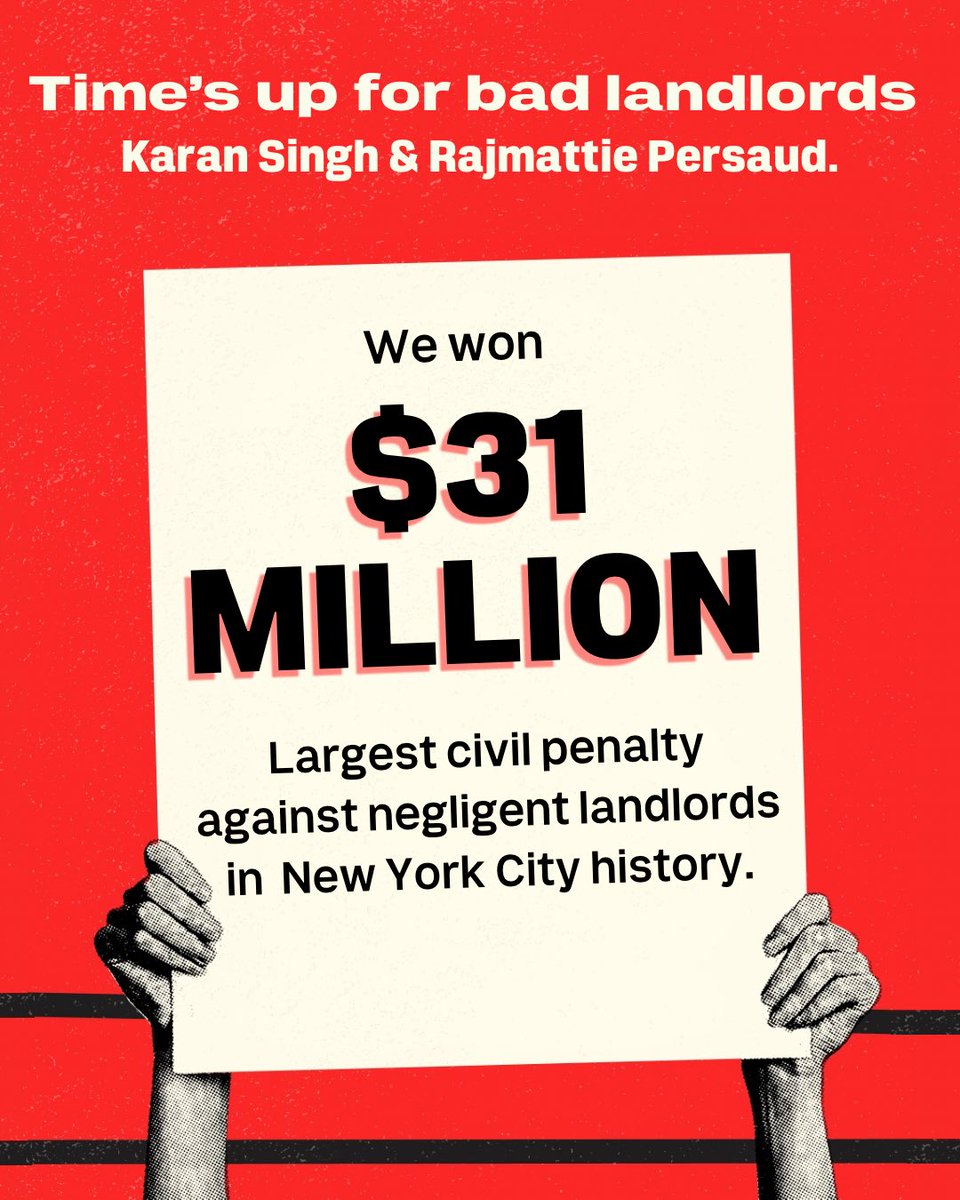
Karan Singh and Rajmattie Persaud are on the Public Advocates’ “Worst Landlords” list. They have over a thousand violations for lack of heat, lack of hot water, hazardous mold, lead paint, broken elevators in 17-story buildings, roaches, and mice. For too long, renters have cycled through bad owners and foreclosures. Not anymore. A Chief Restructuring Officer has been appointed to ensure the repairs to Singh and Persaud’s buildings are made. We restrained funds from the owners’ bank accounts, which will be used by the Chief Restructing Officer to make repairs.
Mayor Zohran Kwame Mamdani tweet mediaMayor Zohran Kwame Mamdani tweet media
English
284
718
4.9K
241.6K
0xjoer retweetledi
Simon Dixon
Simon Dixon@SimonDixonTwitt·
Wealth taxes are how you turn the EU into a distressed asset for private equity acquisition. Remember: a wealth tax on unrealised gains leads to forced asset selling by average Europeans, while carve-outs exist for those using offshore corporate vehicles. Any country implementing this policy (such as the Netherlands) is engineering a market crash and distressed acquisition strategy, designed to transfer wealth from retail investors to institutions, all wrapped in a “tax the rich” narrative. As with policies like this, it will be structured to transfer wealth upward, just like the current closure of the Strait of Hormuz. This is a real endgame asset-stripping policy, deliberately designed to engineer a crisis that would otherwise have been allowed to occur through normal market corrections. Manufactured crisis is the policy. And only those with offshore corporate structures and hard money to invest during distress will survive it. Of course, if you own a money printer connected to a central bank, then you will create the money needed to acquire distressed assets and privatise the gains while socialising the losses. Everybody needs to become far more financially savvy to survive the crises these policies engineer.
ryan van der veer@sumbios

How Europe Is Designing a Tax System You Can’t Escape. The Netherlands is introducing a 36% tax on unrealized investment gains in 2028, even if you don’t sell your assets. The tax will be due each year on paper profits.

English
87
624
1.8K
181K
0xjoer retweetledi
Martin Varsavsky
Martin Varsavsky@martinvars·
Europe is not losing to the US because it lacks engineers, capital or universities. It is losing because every layer of its system rewards the gatekeeper and punishes the builder. In medicine I see it weekly. A primary care AI that triages, documents and flags risk gets deployed in months in the US and runs into a years long compliance maze in Europe. By the time the European version is approved, the American one has been retrained twice and is cheaper. In energy it is worse. Spain ran 60 percent of April on clean power, then keeps shutting down nuclear plants that work. France stays stable on its grid. Germany burns lignite to compensate for a political decision made in 2011. Industry quietly leaves. In capital markets, an EU founder still raises across 27 fragmented systems while a Texan founder raises once and sells across a continent. None of this is about culture. It is about rules. The continent that gave the world Pasteur, Fleming and Marie Curie is now the one that consults itself to death while others ship. If Europe wants to matter in 2030, it needs less harmonization theater and more permissionless building. Otherwise the talent will keep voting with its feet, and the speeches in Brussels will keep arriving on time.
English
124
682
3.1K
133.6K
0xjoer retweetledi
binji
binji@binji_x·
some human things I’m tracking > religious schools, retreats, pilgrimages, and faith-based media rising as people search for moral certainty > “human-only” spaces: restaurants, schools, clubs, apps, and retreats that ban synthetic media, recording, phones etc > pet daycares, dog hotels, pet insurance, and premium pet food begging to skyrocket as loneliness increases and people defer to furry friends > post-career identity markets: people living longer and needing new titles, tribes, rituals, status games, and reasons to wake up after professional relevance fades > private members’ clubs solidify as paid social graphs for adults who lost community to remote work > dating apps fragmenting into belief-based and lifestyle-based matchmaking since infinite choice has become exhausting > family formation will become a premium service category: matchmaking, fertility, childcare, coaching, home design etc > eldercare will start shifting to more at-home treatments due to ai (over time it’ll be cheaper than care homes too) > analog cameras, vinyl, printed books, notebooks, “dumbphones,”and mechanical watches grow as anti-synthetic status objects > handmade goods becoming trust objects because machine abundance makes human effort valuable again > live events becoming more valuable as recorded media becomes forgettable > glp-1s are just the first mass consumer drug for editing desire, more to come. > fertility tech booming because career timelines and biological timelines are now in open conflict > oral exams, apprenticeships, portfolios, and live demonstrations returning because written work is becoming cheap to fake > digital detox products growing > air quality, water filtration, food sourcing, and sleep environments becoming mainstream status markers > luxury shifting from owning more things to accessing peace, beauty, privacy, time, and high-trust rooms > the biggest consumer opportunities coming from psychological scarcity: belonging, certainty, attention, embodiment, trust, and continuity
English
50
129
1.4K
115.8K
0xjoer retweetledi
ludoonchart
ludoonchart@ludoonchart·
Vegas banned him. So he wrote an algorithm, moved to Hong Kong, and extracted $1 Billion from the betting crowd. As this Bloomberg documentary shows, Bill Benter didn’t guess. He mathematically exploited the public's emotional mispricing. Today, millions of dollars are being extracted from Polymarket using this exact same framework. While the crowd trades on "vibes," algorithms are siphoning the pool. Bookmark this, then read the 77-year-old math framework below to build your edge
0xDipper@Dipper_pol

x.com/i/article/2046…

English
21
171
1.3K
289.9K
0xjoer
0xjoer@0xjoer·
@SenWarren I thought this was a parody account lmao
English
0
0
1
6
Elizabeth Warren
Elizabeth Warren@SenWarren·
If Jeff Bezos can drop $10 million to sponsor the Met Gala, he can afford to pay his fair share in taxes.
English
15.6K
7.5K
47.3K
2.9M
Joe Legner
Joe Legner@josephlegner·
@GadSaad Women are getting educated, and thinking for themselves. They see that Christianity is how men subdue and control them. They want to be free.
English
235
2
39
15.4K
0xjoer retweetledi
Korea Value Hunter
Korea Value Hunter@koreavaluehunt·
Investing in Korean equities in 2026 is the closest thing the modern investing world has to a time machine, because what you are looking at, when you open a screen of Korean small and mid caps, is structurally identical to what Japanese deep value looked like in 2018, which is structurally identical to what American small-cap value looked like in the late 1970s, which is to say, a developed market full of profitable, debt-free, asset-rich companies trading at fractions of liquidation value while a generational catalyst builds in the background that almost nobody outside the country has yet noticed. The catalyst is the Corporate Value Up Program, launched by the Korean government in February 2024, modeled explicitly on the Japanese reforms that produced one of the great equity bull markets of the last decade. The program is voluntary, but the pressure surrounding it is not. The Korea Exchange has launched a public Value Up Index that names and tracks compliant companies. The National Pension Service is voting against management at companies that fail to address valuation. The dividend tax was cut from a top rate of 45% to a range of 14 to 30% in December 2025, which is the kind of legislative change that fundamentally rewires the incentive structure for every founding family in the country. Activist funds, both domestic and foreign, are filing campaigns at a rate that has never been seen in the modern history of the Korean market. By the end of 2025, more than 170 companies had already disclosed Value Up plans. The Value Up Index itself has roughly doubled since its launch. This is not a screening artifact. This is not an emerging-markets discount. Korea is a developed economy with a sophisticated regulatory regime, a functioning court system, and a stock market that has operated continuously since 1956, and the stocks are cheap because of a specific cultural feature, the chaebol structure and the founding-family hoarding that produced it, that is now, for the first time in a generation, under coordinated political and regulatory pressure to change. The dam that held the discount in place for 30 years is cracking. The water has barely started to move. The American funds that will eventually allocate to Korea are still figuring out the operational mechanics. The American retail investor, who can now access the market directly through a standard brokerage account thanks to the FSC’s April 2025 rule changes, has not yet noticed. You do not need to pick winners. You build a basket of 30 to 50 names, sized small, hold for a decade, and let the math do what the math has always done. Some will go nowhere for years and then re-rate 4x in a quarter when the activist arrives or the founder retires or the next round of pressure lands. You cannot predict which one will be which. You do not need to. You need to be in the basket when the catalysts arrive, and the catalysts are arriving, in 2026, faster than they have at any point in the modern history of the Korean market. The window is open. The math is the math. The early movers will be rewarded the way early movers are always rewarded in trades like this one, which is generously, and the late ones will, as always, arrive in time to be the exit liquidity for the people who showed up while it was still uncomfortable. The trade is sitting there, in a market that has just become accessible, in a moment that almost nobody outside a small group of dedicated value investors has yet recognized, and the only thing standing between you and it is a brokerage account and the willingness to do the unglamorous work that almost no other investor will bother to do.
English
23
62
672
92.1K
0xjoer retweetledi
Mgoes (bio/acc 🤖💉)
Mgoes (bio/acc 🤖💉)@m_goes_distance·
most people have no idea what is coming - genome sequencing just crossed $100, down from $100M in 25 years - peptides just went from felony to federal policy - psychedelics just got a presidential executive order - epigenetic reprogramming just entered human trials for the first time in history - embryo editing is no longer a thought experiment: it is a clinical conversation every single thing bio/acc has been bullish about for 2 years is breaking out simultaneously honestly not a trend anymore this is an inflection point the next 6-12 months will be the most important period in the history of human biology bio/acc
Max Marchione@maxmarchione

The cost of sequencing a human genome dropped from $100M to less than $100 in about 25 years. That's a million-fold decrease, which outpaces even Moore's Law. We're about to enter the era of personalized medicine.

English
104
435
3.4K
597K
0xjoer retweetledi
SightBringer
SightBringer@_The_Prophet__·
⚡️This is the state crossing from taxation into ownership. A tax on unrealized gains means the government no longer waits for wealth to become liquid. It marks the citizen’s balance sheet, declares a portion of the mark to be public property, and demands payment before the market has settled the truth of the gain. That is a profound regime shift. The investor takes the risk. The investor absorbs the drawdown. The investor supplies the capital. The investor holds through volatility. Then the state taxes the upside before the upside is converted into cash. The state gets senior claim on a future that may never fully arrive. That breaks the logic of private compounding. Assets become annual tax events. Long-term ownership becomes a liquidity problem. Volatile assets become dangerous because a paper gain can create a real tax bill, then the asset can fall after the state has already taken its cut. The citizen is forced to hold more cash, sell winners, borrow against assets, or avoid risk altogether. The deeper force is fiscal exhaustion. Aging welfare states have promised more than their growth engines can naturally fund. Productivity is weak. Demographics are worsening. Public obligations keep expanding. So the state starts hunting balance sheets. Income is no longer enough. Consumption is no longer enough. Property is no longer enough. Paper appreciation becomes the next reservoir. This is how capital flight gets born. The truly mobile leave. The sophisticated restructure. The very rich build legal shields. The trapped productive class gets harvested. Ordinary investors become visible prey because their wealth sits in taxable accounts, marked every year, exposed to bureaucratic extraction. For Bitcoin and crypto, the signal is obvious. Every move toward taxing unrealized wealth strengthens the desire for portable, self-custodied, jurisdiction-resistant assets. The more governments behave like private balance sheets are pre-approved tax collateral, the more rational it becomes to seek wealth outside the reach of easy capture. Deep down, this is a sovereignty warning. The state is no longer satisfied taxing what citizens earn or sell. It wants tribute on what they might be worth.
English
16
37
181
18.8K