Max Martin

46 posts

Max Martin

Max Martin

@18MaxMartin

GTM @cognition + investing | prev Founding AE @HebbiaAI @GetBalanceHQ

Katılım Şubat 2025
438 Takip Edilen95 Takipçiler
Max Martin
Max Martin@18MaxMartin·
@rauchg How’s your training going? Bringing my purple belt to SF this week, let’s roll.
English
0
0
0
13
Guillermo Rauch
Guillermo Rauch@rauchg·
2026 is the year of Brazilian Jiu-Jitsu
English
59
12
270
29.9K
Max Martin
Max Martin@18MaxMartin·
Way too many people are cosplaying as "GTM experts" who’ve never actually sold anything
English
2
0
9
858
Max Martin
Max Martin@18MaxMartin·
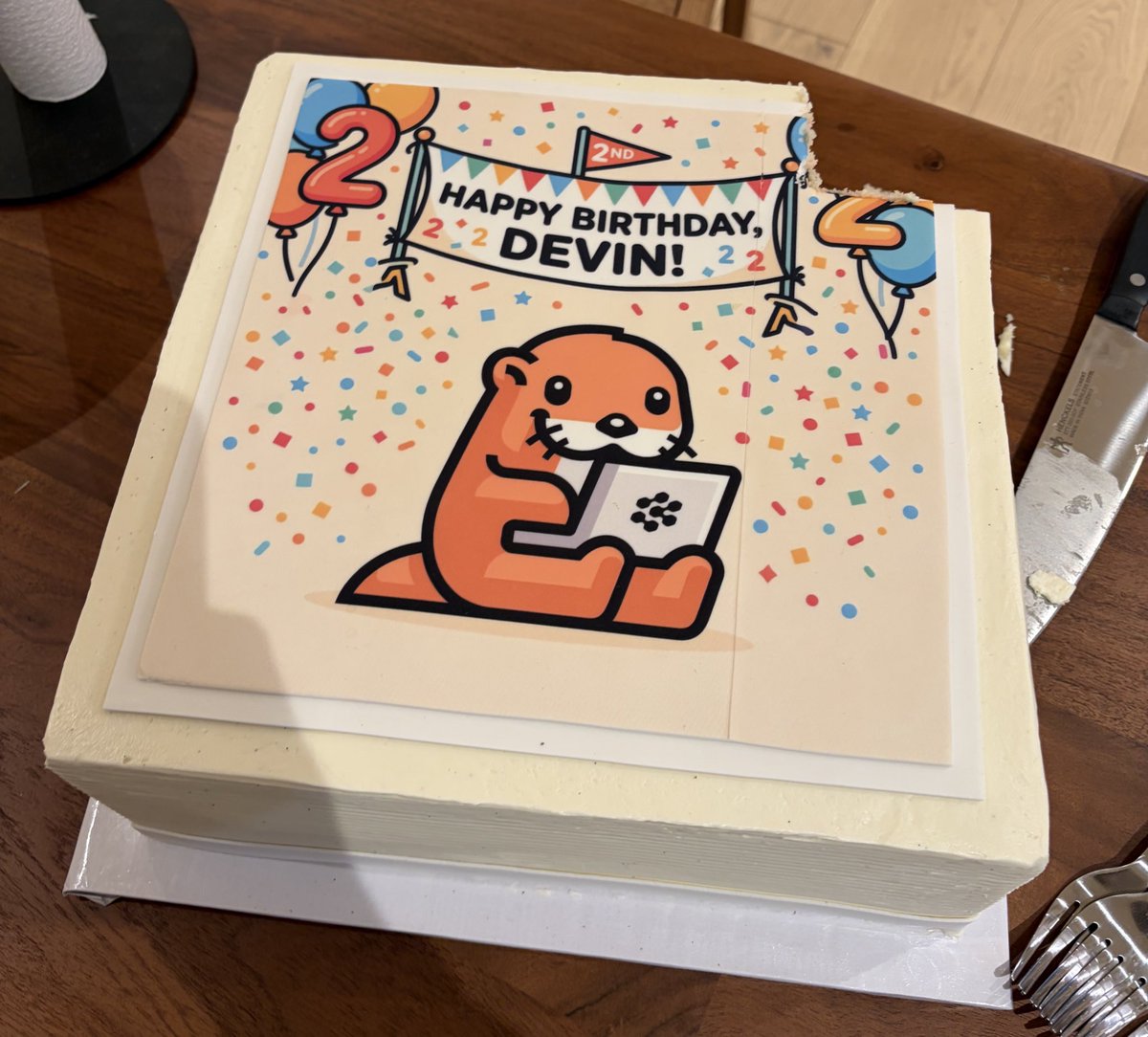
Everybody wish my boy a happy birthday
Max Martin tweet media
English
2
0
22
963
Max Martin retweetledi
nader dabit
nader dabit@dabit3·
This is how Devin works! You can pair program across the team or org, in Slack or Linear or any other interface. You can also start a session from an existing conversation, i.e. someone griping about a bug or design issue, then we can just hand it off to the agent with the conversation as context. We call them sessions x.com/dabit3/status/…
English
0
1
14
1.5K
Max Martin
Max Martin@18MaxMartin·
This is my right to win
Max Martin tweet media
English
0
0
1
98
Max Martin
Max Martin@18MaxMartin·
@yishan Pessimists sound smart, optimists make money
English
0
0
0
20
Yishan
Yishan@yishan·
I’m not saying this because I’m a Devin hater! It’s just a very challenging time, and I posit, uniquely so.
Yishan@yishan

A while ago I made a startup prediction that every AI application startup was likely to fail due to the rapid expansion of the foundational model providers. I'd like to elaborate on that, since many people interpreted it in only one way - and there are TWO main ways they are likely to be killed. The first one is like the quoted post below: a foundational model provider releases a new feature that does what the startup does, and the startup dies. Many people interpreted it that way, and so plenty of people offered their objections citing examples in the past where nimble startups had disrupted platform incumbents. The second cause is more subtle: the rapid expansion of capabilities by foundational model providers causes a roiling sea of constant market chaos that disrupts the orderly growth of small- and medium-sized startups. Large ships can survive a huge storm, small ships stand no chance just because the waves are too high. Some of the storm is caused by the large ships, but not necessarily even in a way that benefits them. They are struggling to keep up in their own race. Growing businesses prefer stability (or at least orderly chaos), and my claim is that the level of economic chaos and its rate of change is too high for application startups to survive. I mean, we're literally entering the Singularity now. The foundational model providers are throwing off so much overhang (untapped value) that individual programmers - their numbers unleashed by vibe coding - will be able to constantly disrupt growing startups as those startups try to make their way from small to medium and beyond: after their initial founding moment and achieving PMF, they now have to stabilize and scale by building distribution channels. This is where they will be constantly vulnerable. (God help them if they aren't unit profitable, and many AI startups have huge capex) One counter-argument was startups who represent a unique set of valuable training data. The thesis is that if you can discover, encode, and label a set of valuable training data that no one else has, you can create a service for that. Maybe. The question will be whether that's enough to sustain becoming a generational company. You might still be better selling out in 18 months for the bag of cash.

English
1
0
16
5.7K
Max Martin
Max Martin@18MaxMartin·
This is what it's all about
Max Martin tweet media
English
0
4
26
1.1K
Max Martin retweetledi
Cognition
Cognition@cognition·
Introducing Devin 2.2 – the autonomous agent that can test with computer use, self-verify, and auto-fix its work. Try it for free! We’ve also overhauled Devin from the ground up: - 3x faster startup - fully redesigned interface - computer use + virtual desktop ...and hundreds more UX and functionality improvements.

English
93
177
1.5K
510K
Max Martin retweetledi
The Hockey News
The Hockey News@TheHockeyNews·
Jack Hughes: the first player in hockey history to have a Bar Mitzvah and a Golden Goal! Pretty cool!
The Hockey News tweet media
English
348
1.2K
10.5K
1.9M
Max Martin retweetledi
Scott Wu
Scott Wu@ScottWu46·
Think of software engineering as a pipeline. Historically, the hardest part was writing the code itself. Not the case anymore - honest question: how much of your code do you actually have to type at this point? For us it's probably <10%. As agents get more capable, the bottleneck becomes less about writing code and more about two things: 1) making it easier for humans to understand, plan, and ask questions. 2) making it easier for agents to ingest all the real-world context surrounding your task. Hence, DeepWiki & DeepWiki MCP. There's a "nihilist" view that as AI gets better, interfaces won't matter anymore. I think the opposite is true - AI will soon be so good that the way you interact & knowledge-transfer will be the only thing that matters. Thanks @karpathy for the shoutout!
Andrej Karpathy@karpathy

On DeepWiki and increasing malleability of software. This starts as partially a post on appreciation to DeepWiki, which I routinely find very useful and I think more people would find useful to know about. I went through a few iterations of use: Their first feature was that it auto-builds wiki pages for github repos (e.g. nanochat here) with quick Q&A: deepwiki.com/karpathy/nanoc… Just swap "github" to "deepwiki" in the URL for any repo and you can instantly Q&A against it. For example, yesterday I was curious about "how does torchao implement fp8 training?". I find that in *many* cases, library docs can be spotty and outdated and bad, but directly asking questions to the code via DeepWiki works very well. The code is the source of truth and LLMs are increasingly able to understand it. But then I realized that in many cases it's even a lot more powerful not being the direct (human) consumer of this information/functionality, but giving your agent access to DeepWiki via MCP. So e.g. yesterday I faced some annoyances with using torchao library for fp8 training and I had the suspicion that the whole thing really shouldn't be that complicated (wait shouldn't this be a Function like Linear except with a few extra casts and 3 calls to torch._scaled_mm?) so I tried: "Use DeepWiki MCP and Github CLI to look at how torchao implements fp8 training. Is it possible to 'rip out' the functionality? Implement nanochat/fp8.py that has identical API but is fully self-contained" Claude went off for 5 minutes and came back with 150 lines of clean code that worked out of the box, with tests proving equivalent results, which allowed me to delete torchao as repo dependency, and for some reason I still don't fully understand (I think it has to do with internals of torch compile) - this simple version runs 3% faster. The agent also found a lot of tiny implementation details that actually do matter, that I may have naively missed otherwise and that would have been very hard for maintainers to keep docs about. Tricks around numerics, dtypes, autocast, meta device, torch compile interactions so I learned a lot from the process too. So this is now the default fp8 training implementation for nanochat github.com/karpathy/nanoc… Anyway TLDR I find this combo of DeepWiki MCP + GitHub CLI is quite powerful to "rip out" any specific functionality from any github repo and target it for the very specific use case that you have in mind, and it actually kind of works now in some cases. Maybe you don't download, configure and take dependency on a giant monolithic library, maybe you point your agent at it and rip out the exact part you need. Maybe this informs how we write software more generally to actively encourage this workflow - e.g. building more "bacterial code", code that is less tangled, more self-contained, more dependency-free, more stateless, much easier to rip out from the repo (x.com/karpathy/statu…) There's obvious downsides and risks to this, but it is fundamentally a new option that was not possible or economical before (it would have cost too much time) but now with agents, it is. Software might become a lot more fluid and malleable. "Libraries are over, LLMs are the new compiler" :). And does your project really need its 100MB of dependencies?

English
100
105
1.7K
408.3K
Andrej Karpathy
Andrej Karpathy@karpathy·
On DeepWiki and increasing malleability of software. This starts as partially a post on appreciation to DeepWiki, which I routinely find very useful and I think more people would find useful to know about. I went through a few iterations of use: Their first feature was that it auto-builds wiki pages for github repos (e.g. nanochat here) with quick Q&A: deepwiki.com/karpathy/nanoc… Just swap "github" to "deepwiki" in the URL for any repo and you can instantly Q&A against it. For example, yesterday I was curious about "how does torchao implement fp8 training?". I find that in *many* cases, library docs can be spotty and outdated and bad, but directly asking questions to the code via DeepWiki works very well. The code is the source of truth and LLMs are increasingly able to understand it. But then I realized that in many cases it's even a lot more powerful not being the direct (human) consumer of this information/functionality, but giving your agent access to DeepWiki via MCP. So e.g. yesterday I faced some annoyances with using torchao library for fp8 training and I had the suspicion that the whole thing really shouldn't be that complicated (wait shouldn't this be a Function like Linear except with a few extra casts and 3 calls to torch._scaled_mm?) so I tried: "Use DeepWiki MCP and Github CLI to look at how torchao implements fp8 training. Is it possible to 'rip out' the functionality? Implement nanochat/fp8.py that has identical API but is fully self-contained" Claude went off for 5 minutes and came back with 150 lines of clean code that worked out of the box, with tests proving equivalent results, which allowed me to delete torchao as repo dependency, and for some reason I still don't fully understand (I think it has to do with internals of torch compile) - this simple version runs 3% faster. The agent also found a lot of tiny implementation details that actually do matter, that I may have naively missed otherwise and that would have been very hard for maintainers to keep docs about. Tricks around numerics, dtypes, autocast, meta device, torch compile interactions so I learned a lot from the process too. So this is now the default fp8 training implementation for nanochat github.com/karpathy/nanoc… Anyway TLDR I find this combo of DeepWiki MCP + GitHub CLI is quite powerful to "rip out" any specific functionality from any github repo and target it for the very specific use case that you have in mind, and it actually kind of works now in some cases. Maybe you don't download, configure and take dependency on a giant monolithic library, maybe you point your agent at it and rip out the exact part you need. Maybe this informs how we write software more generally to actively encourage this workflow - e.g. building more "bacterial code", code that is less tangled, more self-contained, more dependency-free, more stateless, much easier to rip out from the repo (x.com/karpathy/statu…) There's obvious downsides and risks to this, but it is fundamentally a new option that was not possible or economical before (it would have cost too much time) but now with agents, it is. Software might become a lot more fluid and malleable. "Libraries are over, LLMs are the new compiler" :). And does your project really need its 100MB of dependencies?
English
300
775
7.3K
1.1M
Max Martin retweetledi
Devin
Devin@DevinAI·
わたしのたんじょうびだよ〜! 🎂
Devin tweet media
日本語
2
10
84
7.1K
Max Martin
Max Martin@18MaxMartin·
Proud to have partnered with Itaú on what’s probably the largest AI agent deployment ever...
Cognition@cognition

Brazil's largest bank, @itau, deployed Devin across their whole SDLC. This is one of the largest AI agent rollouts anywhere in global finance. Itaú has 17,000+ engineers and hundreds of thousands of repos (yes, even COBOL). Even with that scale, they achieved results like: • 5-6x faster migration projects • 70% of security vulnerabilities from static analysis auto-remediated • 2x'ed test coverage • 300k+ repos documented This really shows what's possible with AI software engineering agents at enterprise scale.

English
1
0
1
161