Sabitlenmiş Tweet

Ark Pillars as Bio-Habitats
Living Earth Vessels
Each pillar of the Ark is constructed as a bio-habitat, a self-contained ecological vessel capable of sustaining life through integrated biological and material systems.
Rather than separating technology from nature, the pillar merges them into a unified environmental architecture where structure, circulation, atmosphere, and living ecosystems function together as one organism.
In this model, the pillar behaves less like a conventional structure and more like a living Earth vessel-a contained environment where life systems are stabilized, nourished, and continuously regenerated.
The Vessel Concept
A vessel holds and protects life.
The Ark pillars do exactly that.
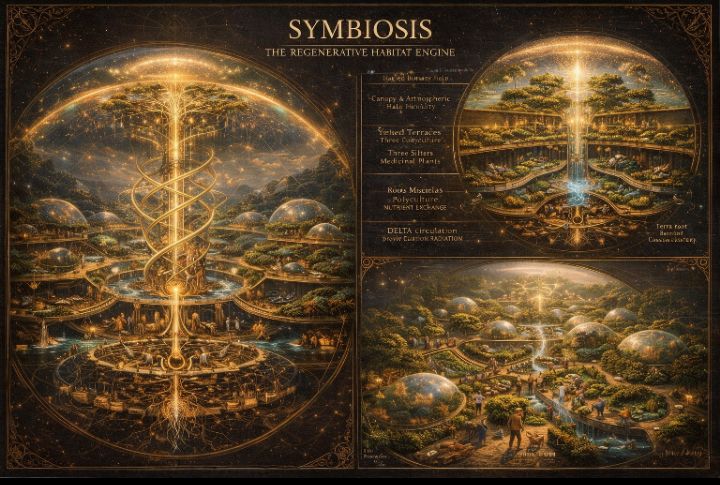
Each pillar forms a contained environmental system that regulates:
• atmosphere
• water circulation
• soil fertility
• plant ecosystems
• animal habitat
• human habitation
Through these systems the pillar becomes a complete ecological environment, capable of operating independently if necessary while remaining connected to the larger Ark organism.
Biological Interior
Inside the vessel, ecosystems are organized in cooperative layers.
These include:
• canopy systems regulating climate
• mid-layer plant communities producing food and biomass
• understory vegetation supporting biodiversity
• animal habitats supporting pollination and nutrient cycling
• soil ecosystems where microbial and fungal networks sustain fertility
These biological layers ensure that energy and nutrients circulate continuously rather than being extracted and depleted.
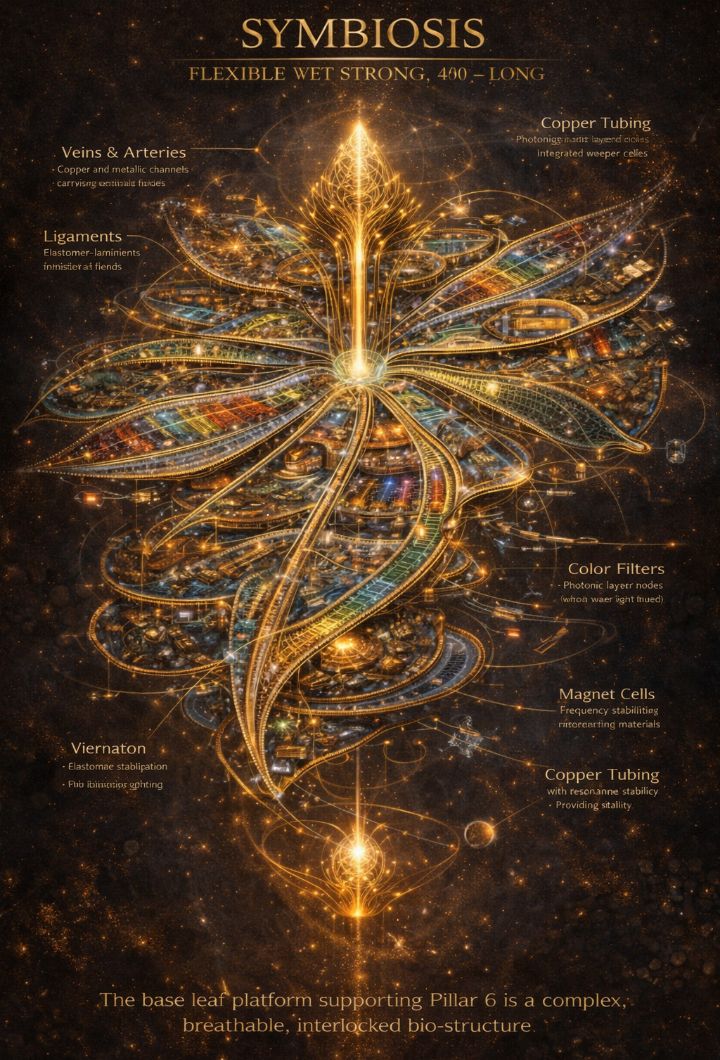
Engineered Anatomy
Unlike a natural ecosystem alone, the Ark pillars also incorporate responsive materials and circulation systems that stabilize the environment.
Structural elements use biomimetic materials such as:
• mycelium-based composites
• basalt fiber reinforcement
• bamboo structural frameworks
• hydrogel membranes and bio-elastomers
These materials allow the vessel to flex, absorb stress, and maintain stability while supporting complex ecosystems.
Embedded circulation pathways move water, nutrients, and vapor through the structure, creating continuous ecological cycles.
Magnetic alignment channels, acoustic resonance tuning, and mineralized flow systems regulate movement without relying on heavy mechanical infrastructure.
The visible glow and color shifts that appear in the Ark are simply the natural result of mineralized water, light interaction, and electromagnetic flow occurring within these circulation networks.
A Living Environmental Organism
Because every pillar contains these systems, each becomes a living environmental organism.
It breathes through atmosphere exchange.
It circulates water and nutrients like blood.
It stabilizes itself through flexible structural materials.
It grows stronger through the biological cooperation of its ecosystems.
When connected with the other pillars, these bio-habitats form the larger Ark organism.
But even alone, each pillar remains capable of sustaining life.
The Purpose of the Vessel
The goal of the #Ark is not to construct isolated buildings.
The goal is to create environments where life can flourish safely and continuously.
By designing pillars as living #Earthvessels, the #Ark restores the relationship between human civilization and the ecosystems that sustain it.
Within these vessels, human communities do not dominate the environment.
They participate in it.
#Pillar6 #Symbiosis
Section 2
Materials
Coming soon

Alpine, CA 🇺🇸 English