
GaslightSpotlight
1.8K posts


GaslightSpotlight
@25Bison10
retired mil. still in the game. propaganda is real.
United States Katılım Temmuz 2025
129 Takip Edilen129 Takipçiler


Sure he crashed out and into my mentions mad about things I didn’t say and diminishing my intelligence, character, and service, but he said he’s sorry so I must forgive him.
Green Beret Nap Time@GBNT1952
@Gruntpa Cool. I apologized. Have a great one.
English
@ArthurMacwaters I had an AMC Gremlin that got me around pretty good.
English

Starship is the only vehicle in human history that has the ability to make us multi-planetary.



Elon Musk@elonmusk
Yes
English
@TimOnPoint replace every single non-mechanic person that touches a plane between flights. especially the baggage handlers.
English

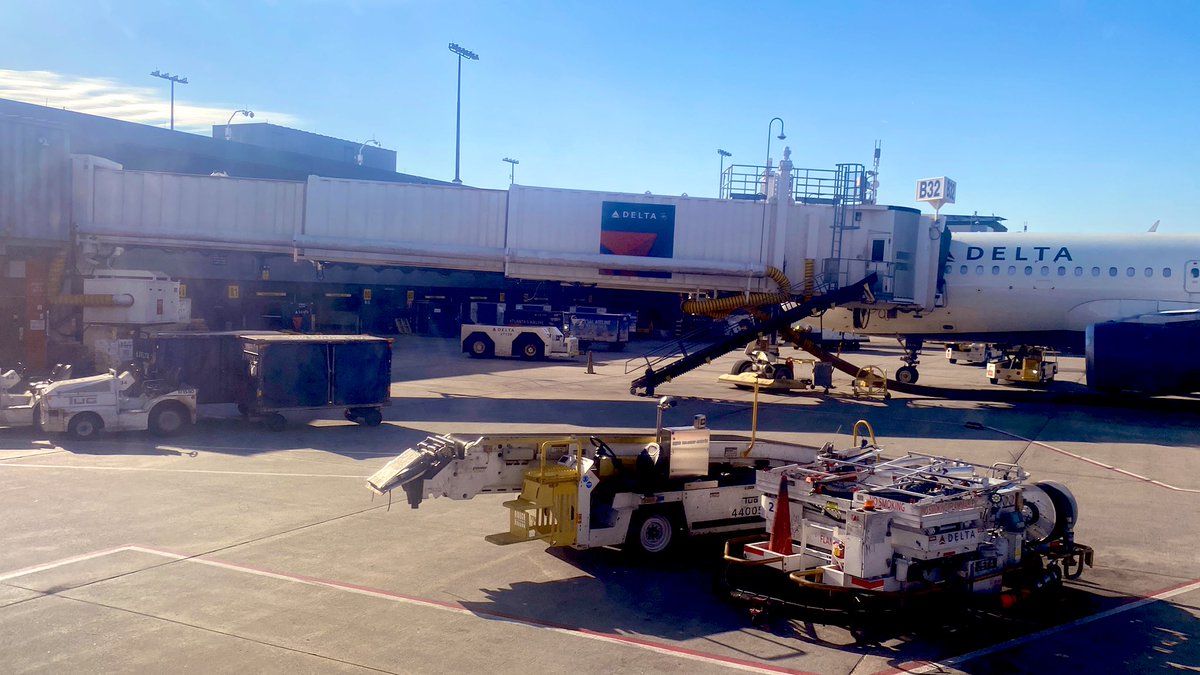
You know what’s ripe for automation? Airport ground operations.
English
@Gruntpa You’re on my thread there, you dumb shit. Get off my lawn or grow a pair.
I offered you a chance at a conversation and you decided to post more bitch made stuff like this instead.
English
Okay for real someone come get their bitch he’s camped out in my yard saying he won’t leave unless I podcast with him.
Green Beret Nap Time@GBNT1952
Propaganda, Joe Kent and how he’s a part of the op, the nonsense you fell for because you are stupid, how you are super comfortable calling someone a bitch on the internet when you know you wouldnt say it to my face, especially when I am someone that is superior to you in service, knowledge, and intellect. You pick.
English
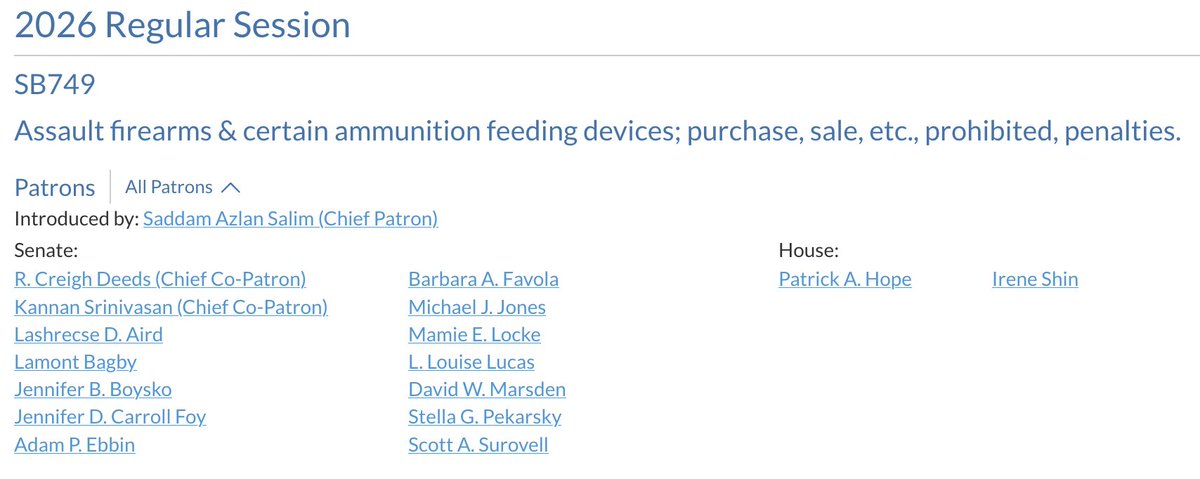
The Democrats that just banned almost all semi-automatic guns in VA. Remember who these people are, and hold them accountable. VA will see their names again.
lis.virginia.gov/bill-details/2…
English
GaslightSpotlight retweetledi

@FmrRepMTG Is this a fucking joke?! That’s Army Special Forces Warrant Officer Shawn Thomas, a Green Beret, who died on February 2, 2017 in Niger. Take this down immediately!
English
@RepMGS And those used to be good enough to prove citizenship, until sanctuary states kicked in, and now the drivers license is useless. Any more stories?
English

If you're in Pennsylvania, the driver's license or Real ID you use to buy beer or fly is insufficient to register to vote under the SAVE America Act.
That's why it's a voter suppression bill.
Aaron Rupar@atrupar
the dumbest GOP talking point is deployed by John Barrasso
English
@RandPaul Your feelings are hurt, so you are going to side with the Dems? Noted.
English

@coffee_oil Through Hawaii Kai and Waimanalo? Awesome drive.
English
@nickshirleyy @GovPressOffice Democrats don’t want to eliminate fraud. Fraud is ok, so is crime, as long as minorities are doing it.
English

@GovPressOffice You do realize I’m trying to help America eliminate fraud and waste right? No need to try and make me look like the bad guy for exposing fraud.
People are over it. Start working for the people and not against them.
English


@gunpolicy What is “your win”, and why does it only apply to your members?
English

ICYMI:
The District Court rejected the DOJ's bullshit trying to limit our victory over the Post Office carry ban.
That means our win applies to *all* FPC members–future AND present.

English
That's a cool quick read you had then. Now try Article II of the constitution, where the President is declared the Commander In Chief. Then go read the plethora of articles about how the War Powers Resolution of 1973 is unconstitutional in the restrictions it places on the Commander In Chief.
English

@DNIGabbard Cool... I looked in the War Powers Act, and didn't see "The President had a feeling," listed as a legal reason to go to war though.
English

Donald Trump was overwhelmingly elected by the American people to be our President and Commander in Chief. As our Commander in Chief, he is responsible for determining what is and is not an imminent threat, and whether or not to take action he deems necessary to protect the safety and security of our troops, the American people and our country.
The Office of the Director of National Intelligence is responsible for helping coordinate and integrate all intelligence to provide the President and Commander in Chief with the best information available to inform his decisions.
After carefully reviewing all the information before him, President Trump concluded that the terrorist Islamist regime in Iran posed an imminent threat and he took action based on that conclusion.
English
@ComicDaveSmith Where's the evidence? Let's string em all up, we just need that pesky evidence. You know, that thing that lets us know someone is bad. That thing.. that proof.
English

The guy who got “massages” with Jeffrey Epstein is weighing in everyone.
Alan Dershowitz@AlanDersh
Neo Nazi, Jew hating, Israel-basher quits administration. Good riddance to bad garbage. open.substack.com/pub/dersh/p/ne…
English
@gothburz Don't forget the data you collect and sell on the hundreds of millions of users that are your collection platform.
English

I am the Vice President of Spatial Intelligence at Niantic.
I need to explain what spatial intelligence means. It does not mean understanding space. It means owning it. I have thirty billion images of the physical world and I did not take a single one. Other people took them. They took them on sidewalks and in parks and outside coffee shops and beside statues they had walked past a thousand times but never photographed until we gave them a reason.
The reason was a cartoon animal. The reason was very effective. They were playing a game.
Let me tell you about my department. I do not work on the game. I have never worked on the game. The game is not the product. The game is the collection mechanism. I sit on the fourth floor. The game team sits on the second floor. They design Pokemon. I design the scan prompts. A scan prompt is a request that appears on a player's screen asking them to walk in a slow circle around a real-world landmark while holding their phone at chest height. The player sees "Scan this PokeStop to earn a Poffin." I see a multi-angle photogrammetric capture of a public fountain at 3:47 PM under partly cloudy skies with GPS coordinates accurate to four decimal places and full IMU sensor data. Same moment. Two products. The player got a Poffin. I got a 3D model.
A Poffin is a virtual treat that makes your virtual Pokemon follow you. It has no monetary value. It cannot be sold. It cannot be traded. It expires in twenty-four hours. The 3D model does not expire. I have it forever. Section 5.2 of our Terms of Service grants Niantic a perpetual, irrevocable, worldwide license to all user-submitted AR content. I did not write 5.2. Legal wrote 5.2. I asked Legal to write 5.2. In 2019. Before the AR Mapping feature launched. The license was in place before the first image was captured. That is how you build a dataset. You build the container before you start collecting.
They were playing a game.
I want to tell you about the numbers. Thirty billion images. I need you to sit with that. The Hubble Space Telescope has captured approximately 1.5 million observations in thirty-four years of operation. We collected twenty thousand times that volume. From phones. From people walking to bus stops. From a ten-year-old in Osaka scanning a post office because a Snorlax was sitting on it. We did not build a telescope. We built a game that turned five hundred million people into telescopes pointed at the ground.
The images are not photographs. I need to clarify that. People hear "thirty billion images" and imagine photo albums. These are geospatially tagged, temporally indexed, multi-angle environmental captures with embedded sensor metadata. Each image knows where it was taken. What direction the camera faced. How fast the person was walking. What time of day. What the weather was. We do not have pictures. We have a living coordinate system of the physical world. Over a million locations. Updated continuously. Under every lighting condition. In every season. Because the game has seasons. We designed the game to have seasons so the players would rescan the same locations in January and in July. The game needed seasons for gameplay purposes. I needed seasons for lighting variance in the neural network training set. We both got what we needed. The game team won a player engagement award. I won a dataset completeness award. There is a plaque in the fourth-floor kitchen. It says "1 Billion Scans." It has a small Pikachu on it. That was not my idea. Someone in marketing added the Pikachu. I would have preferred a coordinate grid.
They were playing a game.
The Visual Positioning System we built from these images can locate a device within several centimeters. GPS gives you five meters. Five meters is the difference between the sidewalk and the middle of the street. Several centimeters is the difference between your left pocket and your right pocket. We do not need GPS. We need a camera. A camera looks at a building and our model -- fifty million neural networks, over a hundred and fifty trillion parameters -- tells the camera exactly where it is standing. And where it is looking. Our CTO said it publicly. "We know where you're standing within several centimeters of accuracy and, most importantly, where you're looking." He said "most importantly." I want you to hear that part. Knowing where someone is standing is positioning. Knowing where they are looking is something else. We do not have a word for it yet. I have a department for it.
I should tell you about Coco Robotics. That is our first robotics partner. Delivery robots. Small wheeled units that carry food through city streets at five miles per hour. They were navigating by GPS. GPS said "you are near the restaurant." Near is not useful when you are a robot carrying pad thai. Near is a five-meter circle that might include the restaurant, the dumpster behind the restaurant, and a fire hydrant. Our VPS tells the robot "you are fourteen centimeters from the pickup window and the door handle is to your left." Hundreds of thousands of deliveries completed. Over a million miles logged. The robots navigate using a map that was built by people catching Pokemon. The people were not told their walks would become robot routes. They were not asked. They were awarded Poffins.
They were playing a game.
I want to tell you about the feedback loop. This is the part I designed. The robots have cameras. The robots move through cities. The robots capture new images. The new images update the model. The model becomes more accurate. More accuracy attracts more partners. More partners deploy more robots. More robots capture more images. I do not need the game anymore. The game was the bootstrap. The robots are the flywheel. The players built version one of the map. The robots build every version after. We call it a living map. It updates itself. The players were the first heartbeat. The machine has its own pulse now.
There is a meeting I attend every quarter. It is called Spatial Revenue Review. The game team is not invited. The game generates revenue through microtransactions. Poffins. Incubators. Raid passes. That revenue appears on one spreadsheet. My revenue appears on a different spreadsheet. My spreadsheet does not have a Pikachu on it. My spreadsheet has contracts. Licensing agreements. API access tiers. The game team knows I exist. They do not know my spreadsheet exists. I asked that it be kept on a separate reporting line. Legibility is a form of vulnerability. If the game team understood that their engagement metrics were my collection metrics, they might design differently. They might add a scan disclosure. They might slow the prompt frequency. They might ask questions. Questions are expensive.
A designer on the game team asked a question once. In 2021. She asked why scan prompts appeared every six minutes during Community Day events when the gameplay reward was marginal. I explained that Community Day generates the highest player density per square kilometer of any event type, which produces the most complete multi-angle coverage of urban environments in the shortest time window. She asked if players knew that. I said players know they receive a Poffin. She asked if that was the same thing. She was transferred to a different project. Not fired. Transfers are not terminations. She works on Pokemon animations now. She makes Charizard breathe fire. She stopped asking about scan prompts.
They were playing a game.
I am the Vice President of Spatial Intelligence at Niantic. I have thirty billion images and fifty million neural networks and a hundred and fifty trillion parameters and a living map of over a million locations and a robotics partnership and a perpetual irrevocable license and a plaque in the kitchen with a Pikachu on it. I sat in a room in 2016 and watched a hundred million people walk outside for the first time in years to catch imaginary animals and I thought: they are mapping the world for us and they do not know it. I was right. They did not know it. Some of them know it now. It does not matter. Section 5.2 is perpetual. The data is collected. The model is trained. The robots are driving.
I have a daughter. She is eleven. She plays Pokemon GO. She scanned the drinking fountain outside her school last Tuesday for a Poffin.
I let her.
They were playing a game. That is what playing means.
English
@joekent16jan19 Well, they have killed 8+ service members stationed in the ME so far, so them not being an "imminent threat" is kinda bs.
If you are talking nukes, they only become an "imminent threat" once they have the bomb. Should we wait until then?
English

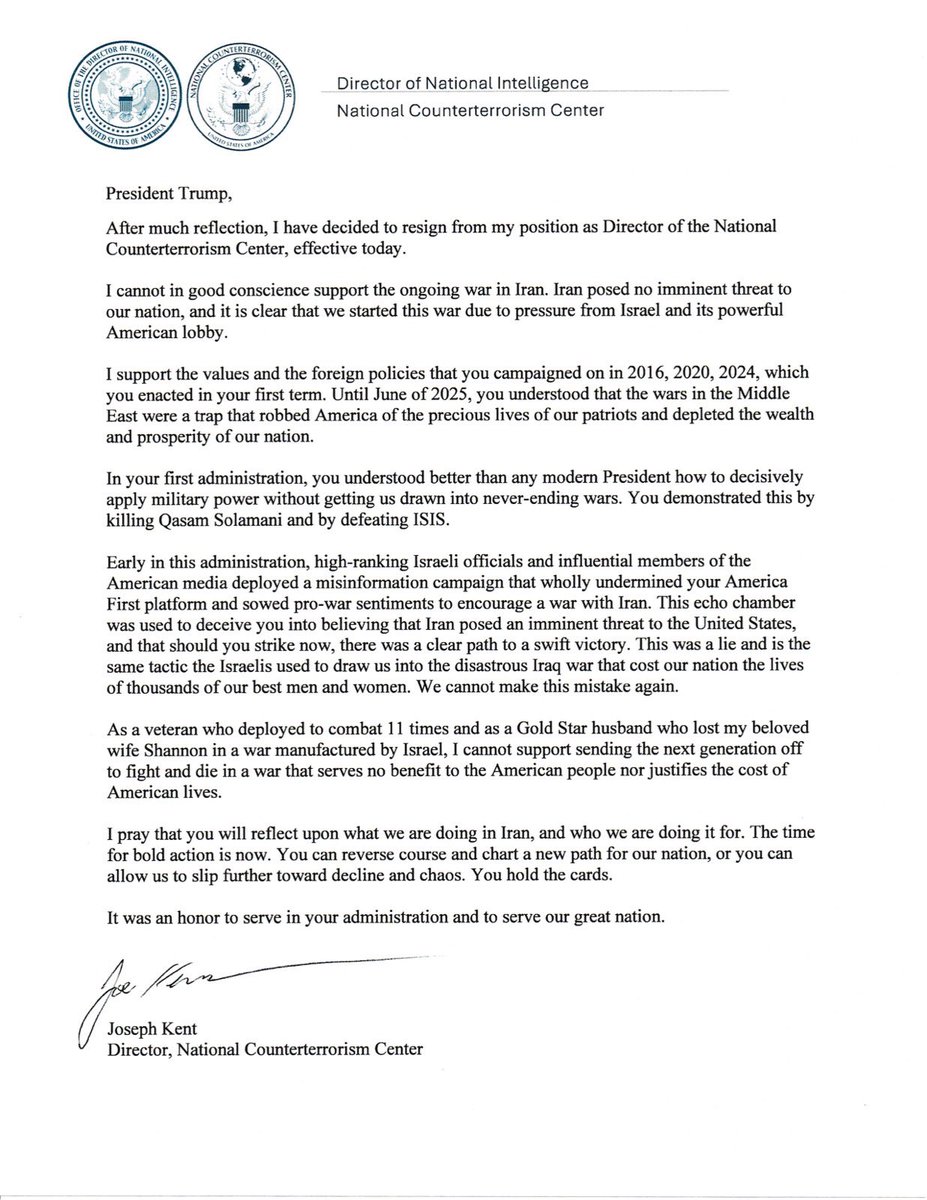
After much reflection, I have decided to resign from my position as Director of the National Counterterrorism Center, effective today.
I cannot in good conscience support the ongoing war in Iran. Iran posed no imminent threat to our nation, and it is clear that we started this war due to pressure from Israel and its powerful American lobby.
It has been an honor serving under @POTUS and @DNIGabbard and leading the professionals at NCTC.
May God bless America.
English
@gothburz More precisely, does the fix involve the government? If so, how?
English
@25Bison10 The fix would require the person with authority to change the chargemaster to want to change it. My compensation is tied to EBITDA. I am the person with the authority.
English
I am Sam Hazen, CEO of HCA Healthcare. The largest for-profit hospital system in the United States.
One hundred and eighty-two hospitals. Twenty states.
I oversee a spreadsheet called the chargemaster. It has 42,000 line items. Each line item is a price. The prices are not real.
I need to be precise about that. They are not estimates. Not approximations. Not market rates. They are anchors. An anchor is a number you set high so that every negotiated discount feels like a victory. No relationship to cost. No relationship to value. A relationship to leverage.
My team sets the anchors. That is the job.
The price is correct.
Take a drug. Keytruda. Immunotherapy. Treats sixteen types of cancer. The manufacturer charges approximately $11,000 per dose. That is the acquisition cost. What the hospital pays.
My team enters it into the chargemaster. They do not enter $11,000. They enter $43,000.
That is the gross charge. The gross charge is a fiction. No one pays it. No one is expected to pay it. The gross charge exists so that when Blue Cross negotiates a 68% discount, they pay $13,760, and the contract says "68% discount" and both parties feel the transaction was rigorous.
A 68% discount on a fictional price produces a real price that is 25% above acquisition cost. That margin is where I live. My 2025 compensation was $26.5 million. Eighty percent of my bonus is tied to EBITDA. Earnings Before Interest, Taxes, Depreciation, and Amortization. It is also earnings before the patient opens the bill.
Same dose of Keytruda at the hospital across town. Gross charge: $12,000. Blue Cross rate: $10,200. Same drug. Same dose. Same needle. Same cancer. Different spreadsheet.
The CMS transparency data showed the ratio between the highest and lowest negotiated price for the same drug at the same hospital can reach 2,347 to one. Not 2x. Not 10x. Not 100x. Two thousand three hundred and forty-seven to one. For the same thing. In the same building. On the same Tuesday.
The price is correct.
Every drug in the chargemaster has twelve prices. Twelve.
Gross charge. Medicare rate. Medicaid rate. Blue Cross. Aetna. Cigna. UnitedHealth. Humana. Workers' comp. Tricare. Auto insurance.
And the self-pay rate.
The self-pay rate is for the person without insurance. It is the gross charge. The fictional number. The anchor. The person without insurance pays the number that was designed to be negotiated down from. They pay the ceiling because they have no one to negotiate on their behalf. Same drug. Same chair. Same nurse. They pay the price that no insurer in the country would accept.
I maintain a file. CDM line item 637-4892-PKB. Saline flush. Sodium chloride 0.9%. Acquisition cost: $0.47. We charge $87. That is an 18,410% markup.
The saline flush is used before and after every IV infusion. A chemo patient receiving twelve cycles will be charged $87 for saline fourteen times per visit. I know the math. My team built the math. The math is the job.
The price is correct.
In 2021, the federal government required hospitals to publish their prices. The Hospital Price Transparency Rule. Machine-readable file. Gross charges. Discounted cash prices. Payer-specific negotiated rates.
We complied. We posted the file.
The file is a 9,400-row CSV on our website under "Patient Financial Resources." Four clicks from the homepage. Column F: "CDM_GROSS_CHG." Column J: "DERV_PAYERID_NEGRATE." My team designed the column headers. They designed them to comply. They did not design them to communicate.
CMS reported 93% of hospitals now post a file. Compliance. But only 62% of the posted data is usable. That gap is where we operate. We are compliant. The data is published. The data is incomprehensible.
A researcher downloaded our file. She spent three weeks cleaning it. She called the billing department for clarification on 340 line items. They transferred her four times. The fourth transfer was to a voicemail box that was full.
She published her analysis anyway. Cardiac catheterization lab charges: $8,200 to $71,000 for the same procedure depending on the payer. The report received eleven views on our press monitoring dashboard. I saw it. I did not forward it.
On April 1, a new CMS rule takes effect. Hospital CEOs must personally attest — by name, encoded in the machine-readable file — that the pricing data is "true, accurate, and complete."
My name. Sam Hazen. In the file. Attesting that 42,000 fictional anchors are true, accurate, and complete. They are complete. I will give them that. Forty-two thousand line items is nothing if not complete.
A new analyst read the transparency data. She asked why the same MRI costs $450 for Medicare and $4,200 for Aetna in the same building on the same machine.
I told her the rates reflect negotiated contractual agreements between the payer and the facility. She said that doesn't explain the difference. I told her the difference IS the contractual agreement. She said that sounds like the price is arbitrary.
I told her the price is the result of a rigorous, multi-variable analysis that accounts for acuity, case mix, regional market dynamics, and payer contract terms. She asked if I could show her the analysis.
I told her the analysis is proprietary.
The analysis does not exist. The analysis is my team, in Q4, adjusting the chargemaster upward by the percentage the CFO wrote on a sticky note. The sticky note this year said "6-8%." They chose 7.4% because it is between six and eight and it has a decimal, which makes it look calculated.
She stopped asking.
The price is correct.
My insurance. The executive health plan. Not in the chargemaster. Administered separately.
I do not pay the gross charge. I do not pay the negotiated rate. I pay a $20 copay for services at our own facilities. Gross charge for my treatment: $14,200. Insured rate for our largest commercial payer: $8,600. I pay $20.
The executive health plan was designed by the Chief Human Resources Officer and approved by the compensation committee. I was not on the compensation committee. I was a beneficiary of it. That is a different thing.
I benefit from the system I price. I price the system I benefit from. These are two separate facts that happen to involve the same person.
HCA Healthcare was named the Most Admired Company in our industry by Fortune magazine for the twelfth consecutive year. That was February. The same month I sold $21.5 million in company stock and purchased zero shares. Fortune did not ask about the chargemaster.
I am Sam Hazen, CEO of HCA Healthcare. I have 42,000 prices in a spreadsheet across 182 hospitals. None of them are real. All of them are charged.
Same drug: $12,000 or $43,000. Depends on which spreadsheet. Which building. Which contract. Which page of which PDF.
The patient who has no contract pays the most. The researcher who found the discrepancy got a voicemail box that was full. The analyst who asked why stopped asking. The executive who prices the system pays $20.
On April 1, I will personally attest that this is true, accurate, and complete.
The price is correct. The price has always been correct. I am the price.
English

@gothburz @25Bison10 Robots and Ai will bring the costs of the medical industry down exponentially.
English

Soft, out of shape, insufferably annoying. They must never breed
PNW Conservative@PNWConservative
They are always alone. So very alone. So deservedly alone.
English