
David Yau retweetledi
David Yau
1.5K posts

David Yau
@3dtimes
Founder of iUXLabs , AI + Industry Application & AI Agent Designer ; AI+ Transformation for modern life style brands. ( New Space / Healthcare/ Fashion Sport)
Shanghai,China Katılım Mayıs 2012
1.4K Takip Edilen192 Takipçiler
David Yau retweetledi

folks who are calling @openclaw pure hype are telling on themselves
openclaw is like the early internet, it's raw, unrefined, and takes a little doing to get things to work, but when you figure it out, it's transformative.
here are some real use cases that are having material impact on our $2.5M ARR business:
1. ad creative pipeline. our head of growth @ArjunShukl95550 built an end-to-end creative pipeline to go from ideation to publish adds to meta, greatly increasing our creative iteration speed. it's producing winning creatives. it lives in slack, and anyone on the team can share their ideas and have them enter the pipeline.
2. data analytics agent. another bot lives in our slack that connects to bigquery and lets our team ask any questions of the data, it produces charts and answers questions in real time. no one needs to write SQL anymore.
3. recruiting. i told my agent about a role we're hiring for, and it scoured linkedin and the web, found 30 candidates, portfolio, email addresses, and stack ranked them based on fit with our criteria
this is just in the past week. i have twenty more success stories for you i can share another time.
you have to understand, this is the shittiest it will ever be. everyone is going to have one or more personal self-improving agents that they use every day, and openclaw is what revealed this future to us.
if you can't see this, i encourage you to look harder
there will be many competitors (and already are), and the large labs will start to converge on this (they already are) too.
openclaw may not win, but it opened pandora's box and uncorked the agentic future.
English
David Yau retweetledi

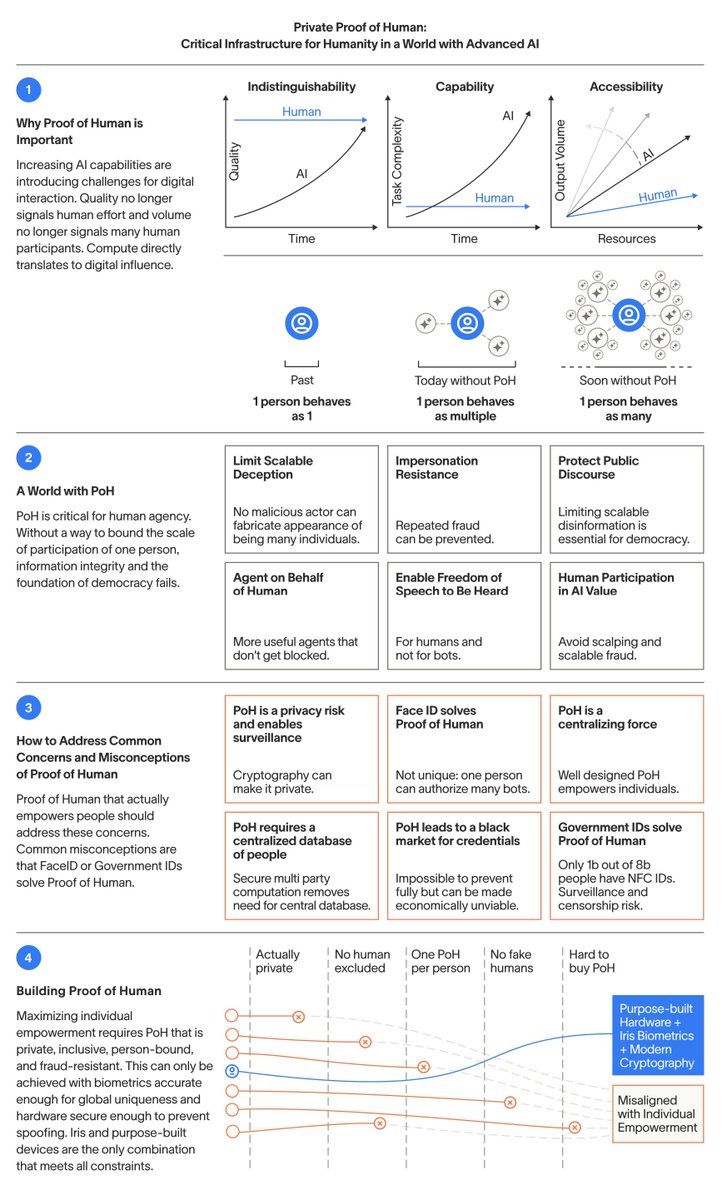
Agentic capability is improving fast. We believe Proof of Human is becoming critical for the internet and many of the platforms we use (like X).
This paper explains why FaceID, face biometrics & government IDs won’t solve the problem, and what properties are most important.
English
I would rather regard this article as a clarion call to arouse everyone's in-depth thinking. From a simple economic or financial perspective, the conclusion that the great prosperity of AI leads to regression seems reasonable.
But in fact, the following points, as basic premise
Citrini@citrini
I spent 100 hours over the past week researching, writing and editing the piece we just put out. It’s a scenario, not a prediction like most of our work. But it was rigorously constructed, dismissing it outright requires the kind of intellectual laziness that tends to get expensive. And we’ve released it for free. Hopefully you enjoy it. citriniresearch.com/p/2028gic
English
David Yau retweetledi

Anthropic is guilty of stealing training data at massive scale and has had to pay multi-billion dollar settlements for their theft. This is just a fact.
NIK@ns123abc
the community notes COOKED anthropic 😭😭
English
David Yau retweetledi

Sleeping 4 hours will kill you. But so will sleeping 11.
Too little sleep triggers inflammation and weakens your immune system.
Too much sleep can be a sign of something else: fragmented sleep where your body is in bed but never fully recovering.
Every hour away from 7 raises the risk of death.
You don't need more sleep. You need the right amount.

English
David Yau retweetledi

Google isn’t trying to win the AI race.
They’re trying to own the entire AI Agent ecosystem.
While everyone argues ChatGPT vs Claude, Google quietly built:
Models → Gemini Pro, Flash, Deep Think, Gemma
Design → Stitch, Whisk, Imagen
Research → NotebookLM, AI Mode
Video → Veo, Flow, Google Vids
Coding → Antigravity IDE, Gemini CLI, Jules
Agents → A2A, ADK, FileSearch API
The scary part?
All of these tools talk to each other.
That means:
10x faster prototypes
End-to-end AI workflows
Production-ready agents on GCP
The next AI war won’t be model vs model.
It’ll be ecosystem vs ecosystem.
Save. Share. Build.
GIF
English
David Yau retweetledi

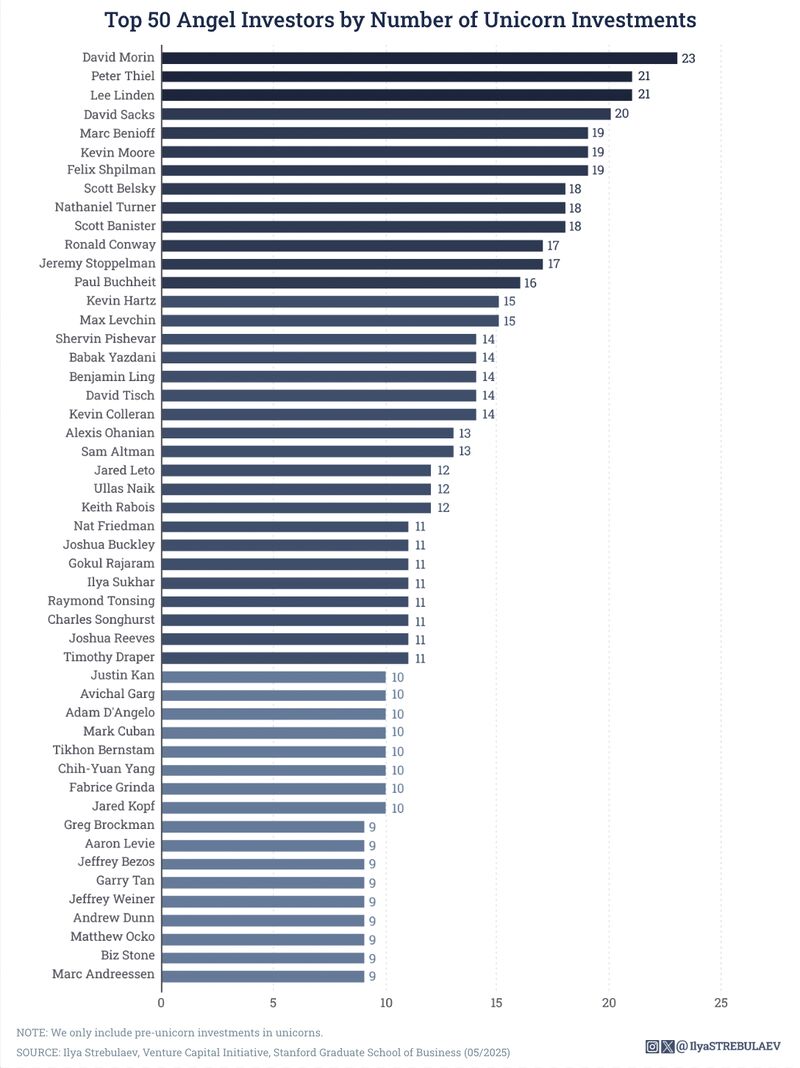
A Stanford professor analyzed 1,000's of angel investments to find out who's had the MOST unicorns.
The results are fascinating.
- David Morin tops the list with 23 unicorns
- Peter Thiel and Lee Linden follow with 21 each
- David Sacks at 20
- Marc Benioff at 19
A few things that stand out:
1) Almost every top angel was a founder or exec at a large tech company first. The clear signal here - they were mostly operators who earned their access.
2) Many co-invested together repeatedly. Thiel, Sacks, and Levchin all overlapped at PayPal and went on to back the same unicorns (Facebook, Airbnb, Palantir Technologies, SpaceX).
3) No women appear in the top 50. Sad.
4) The entry threshold to make this list is 9 unicorns (nuts!). The average unicorns across the top 50 is 13 (more nuts!).
I share this for folks to have inspiration to angel invest themselves!
There has NEVER been a better time - we are at a major tech inflection point.
If you're thinking about angel investing and forming angel syndicates, you should check out Verivend. Automated capital calls, one-click funding for co-investors, real-time visibility into who's in. Seamless software with a great team to hold your hand through it.
Try it yourself: lnkd.in/grrJxqxq
Full credit to Ilya Strebulaev and his team at the Stanford for this research.
English
David Yau retweetledi

Not all AI agents are built the same. So what sets them apart?
Here’s a breakdown of 10 core types of AI agents you’ll come across in real-world systems, from simple reactive agents to complex multi-agent systems.
1. Task-Specific AI Agent
Built for one focused task like summarizing or translating. It follows a fixed process with no learning or adaptation.
2. Reactive Agent
Responds to immediate input without using memory or history. Think of it like a reflex - it reacts, not plans.
3. Model-Based Agent
Builds an internal map of its environment. Simulates outcomes before acting to make smarter, context-aware decisions.
4. Goal-Based Agent
Starts with a goal and works backward. It plans steps, simulates paths, and selects the route that achieves the goal.
5. Utility-Based Agent
Chooses actions based on how beneficial they are. It weighs all options and picks the one with the highest value.
6. Learning Agent
Improves over time by learning from past actions. Adjusts its strategy using feedback and stores new knowledge.
7. Planning Agent
Focuses on long-term strategy. It defines a goal, maps out steps, and adjusts based on progress not just reaction.
8. Reflex Agent with Memory
Uses preset rules but with added memory of past inputs. Helps respond better when situations repeat or evolve.
9. Multi-Agent System Agent
Works with or against other agents. They share environments, negotiate roles, and coordinate to reach a bigger goal.
10. Rational Agent
Always selects the most logical option. It analyzes the full picture, predicts outcomes, and chooses the smartest path.
Save this if you're exploring Agentic AI or designing intelligent decision-making systems.
GIF
English
David Yau retweetledi

Yesterday I drove my new car home; today I secured a $119,000+ profit. A reminder that focus, patience, and consistency truly pay off when you trust the process. Grateful to my coach @CoachKendra0 for the guidance none of this was accidental. 📈

English
David Yau retweetledi

Patrick Collison on what changes when biology becomes programmable:
"We, humanity, have never cured a complex disease."
"Most cardiovascular disease, most cancers, most autoimmune disease, most neurodegenerative disease... For none of them can we really say that we've cured it, that we understand the causal pathways in meaningful detail."
"Then over the last 10 ish years... we’ve gotten three new classes of technology in biology."
"If you put those together, you now have the ability… to read, think, and to write. And this starts to really feel like a new kind of Turing loop."
@patrickc with @mntruell
English
David Yau retweetledi

David Yau retweetledi

David Yau retweetledi
Grokipedia is growing like kelp on steroids 😂
Please check Grokipedia.com articles you know something about and suggest edits for accuracy. Would be much appreciated.
This will be by far most comprehensive open source, no copyright distillation of knowledge.
DogeDesigner@cb_doge
BREAKING: Grokipedia just recorded a 61.82% increase in unique visitors as compared to previous month. That means the audience itself grew by nearly two thirds . The website is reaching way more people than before, as per @Similarweb
English
David Yau retweetledi

1. When you write something intended to be read by an important person, go through it and cut every unnecessary word.
2. The reader of anything you publish is an important person.
English