5bb55b

182 posts

5bb55b

5bb55b

@5bb55b

KASPlex | KRC-20 | https://t.co/ugu8FLDER2 Technical Advisor | HODL

Hong Kong Katılım Temmuz 2022
84 Takip Edilen1.5K Takipçiler
5bb55b
5bb55b@5bb55b·
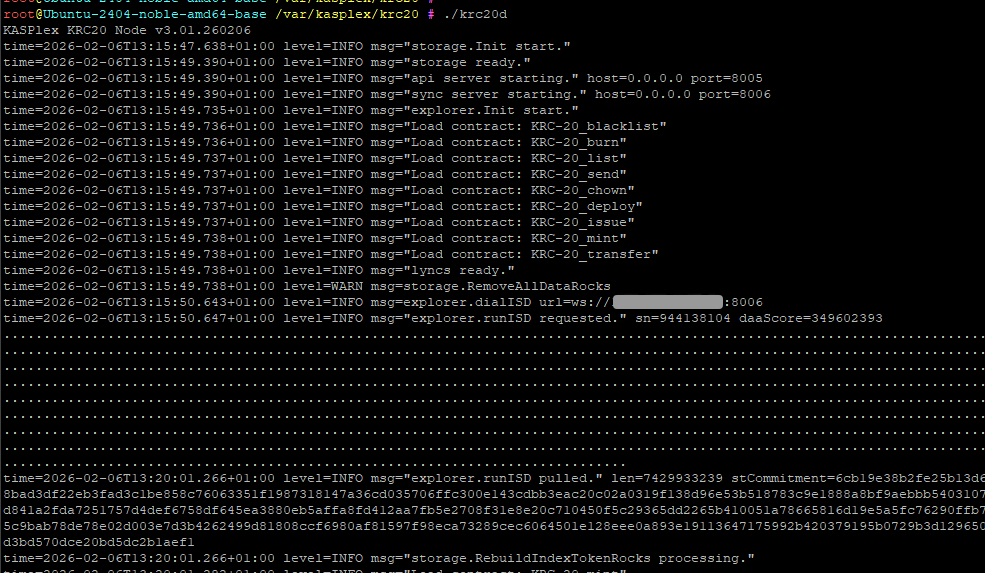
尝试升级到 Go 1.26 ,KRC-20 新节点的各组件运行良好。 得益于 GC 与 CGO 的底层优化,整体性能提升约 10-15% ,Lyncs引擎处理能力约 12K TPS on 16 Cores 。
中文
1
5
30
1.3K
5bb55b
5bb55b@5bb55b·
@Valodeous I recall this was a "misunderstanding" caused by different field names in the API. I think we can fix it by adding a set of "v2" APIs (instead of changing the original ones).
English
1
0
3
145
Dalton
Dalton@Valodeous·
Awesome that's much appreciated! On that note of token verification metrics, there was also a discrepancy between mainnet and tn10 for the kasplex indexer for burn total, circulating supply, and total supply. Previously tn10 indexer showed Burn Total but for mainnet, circulating and total supply were missing last time i checked and CMC is still showing unverified for all KRC20 projects as it auto updates in alignment with the indexer. I do sincerely appreciate all your hard work!
English
1
0
2
197
5bb55b
5bb55b@5bb55b·
@Valodeous While not the main point, the top 100 holder statistics have indeed been implemented, if that's what you're referring to. Additionally, KRC-20 nodes will support a debug API, allowing direct access to raw data for all states.
English
1
0
11
739
Dalton
Dalton@Valodeous·
@5bb55b Is this for mainnet to update the indexer to pull all the missing/incomplete data fields that CMC and CG require to verify token supply?
English
1
0
5
872
5bb55b
5bb55b@5bb55b·
KRC-20 is about to reach its next milestone.
5bb55b tweet media
English
15
51
248
28.1K
5bb55b
5bb55b@5bb55b·
@kaspador_ No, I can't let you leak any more, hahaha.
English
1
0
13
312
supertypo
supertypo@supertypo_kas·
First of all, I see a bunch of new contributors donating to @kaspa_stream since the @kasfyi ann. Very much appreciated🙏 I've started on krc20 support (token balances, history etc), to soften the blow. I hope kasfyi can be saved as getting everything right will take time.
English
12
20
140
8.8K
coderofstuff
coderofstuff@coderofstuff_·
PR740 by @IzioDev (and initially by DS) was just merged into the rusty-kaspa repo! This is a significant contribution that allows populated txs to be returned in RPC. It serves a lot of important use-cases needed for integrations such as: - being able to tell the source address (sender) of an accepted tx - being able to calculate the fee paid by a tx when it’s been accepted I’m sure exchanges (which need source address info), apps (like kasia who may need to know senders) and indexers (such as KRC20 which care about fees) would appreciate this info now being accessible. Exposing these properly to RPC required digging and understanding well how things are stored in Kaspa’s node consensus stores. An effort that @IzioDev undertook and pulled through! Kudos to you
coderofstuff tweet media
English
16
56
236
26.1K
Kasplex
Kasplex@kasplex·
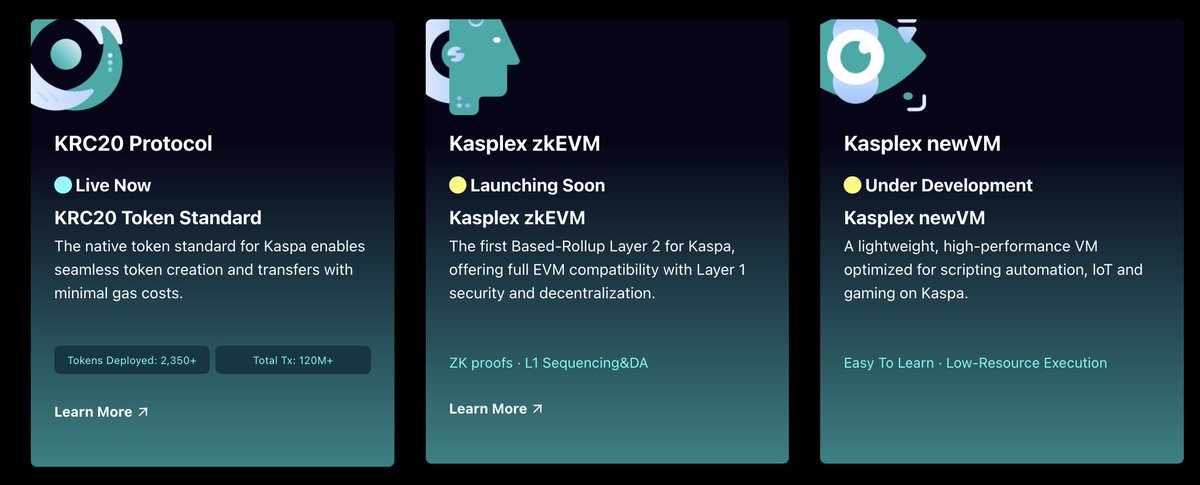
Kasplex zkEVM: Smart contracts arrive on Kaspa Layer 2 Kasplex, in collaboration with the Kaspa Ecosystem Foundation (KEF) @Kaspa_KEF , has officially launched its zkEVM Layer-2 mainnet, bringing Ethereum-compatible smart contracts to the Kaspa network. This launch represents more than just a technical achievement. It’s the first time that programmable dApps, DeFi protocols, and complex smart contracts can run on Kaspa; an ecosystem known for its ultra-fast, Layer-1 proof-of-work blockchain. For developers, it opens a brand-new design space; for the Kaspa community, it’s a leap into decentralized finance, tokenization, and beyond. Background: The foundation laid by “Crescendo” Kaspa’s Crescendo hard fork, activated on May 5, 2025, was a historic milestone for the network. Internally labeled v1.0.0, Crescendo was the culmination of years of research into blockDAG scaling Kaspa’s unique consensus innovation that allows blocks to be created and confirmed in parallel. Key upgrades introduced with Crescendo include: • Block rate increase: Kaspa’s throughput jumped from 1 block per second (BPS) to 10 BPS, multiplying raw network capacity by a factor of 10. • Transaction ordering improvements: Ordered transaction execution was made possible; an essential prerequisite for any Layer-2 that relies on determinism in state changes. • Layer-2 readiness: Protocol updates for latency reduction, parallelism, and data availability ensured that Kaspa could support zk-rollups and other scaling solutions. • Developer foundations: By upgrading the underlying infrastructure, Crescendo essentially “primed” Kaspa for programmable logic, while retaining its hallmark instant confirmation and finality. Without Crescendo, Kasplex would not have been possible. It transformed Kaspa into a foundation ready for programmability at scale. What Is Kasplex zkEVM? Kasplex is the first zkEVM rollup deployed on Kaspa. Kasplex inherits Ethereum compatibility, meaning that developers can use the same tools they already know Solidity, Hardhat, Remix, Truffle, MetaMask without learning a brand-new development stack. Deployment is as simple as redirecting RPC endpoints. Some of Kasplex’s defining features include: • Gas in $KAS: Unlike most L2s that introduce a separate token, Kasplex uses bridged $KAS from Layer-1 as the native gas token. This preserves economic alignment and keeps value within the Kaspa ecosystem. • Bridging mechanism: A two-way bridge enables users to move $KAS from L1 → L2 to use in smart contracts, and back from L2 → L1 seamlessly. • Open node infrastructure: Kasplex offers three types of nodes that anyone can run, ensuring decentralization rather than limiting validation to a closed set of operators. This is more than a technical upgrade, it’s a strategic expansion for Kaspa: • For developers, Kasplex lowers the entry barrier: if you can code on Ethereum, you can now code on Kaspa. • For users, it means fast, low-cost DeFi, NFTs, DAOs, and experimental applications all secured by Kaspa’s proof-of-work Layer-1. • For the ecosystem, it’s the bridge to mass adoption: Kaspa goes from being a high-throughput Layer-1 to a complete smart contract platform. L2 Testnet: Key metrics & early performance Here are some of the notable statistics from Kasplex’s testnet since launch • Blocks generated: ~ 6.5 million (Kasplex does not generate empty blocks); blocks are produced only when there is payload to commit from L1. • Transactions: ~ 24 million • Unique wallets: over 300,000 • Throughput: over 1,000 transactions per second (tps) • Average block time: 0.9–1 (bps) These numbers speak to robustness, stability, and growing adoption. They suggest the system is performing well under load. Components Here’s how Kasplex is structured, and what its ecosystem includes: • Two-way bridge: Supports transfers from L1 → L2 → L1, so users can move $KAS into the Layer-2 environment, use them for gas/contracts, then exit if needed. kasbridge-evm.kaspafoundation.org • RPC / API: Full RPC endpoints supporting EVM-compatible calls evmrpc.kasplex.org • Explorer: Blockchain explorer for viewing transactions, blocks, and smart contract state on L2. explorer.kasplex.org • Chain ID: 202555 (this is the identifier for the Kasplex Layer-2 chain). • Token: $KAS • Official website: kasplex.org • Documentation: docs-kasplex.gitbook.io/l2-network • Layer 2 audit: github.com/kasplex/evm-l2… • Community: linktr.ee/kasplex What’s Next: Roadmap & Upgrades Kasplex is not static; several future developments are in motion: • KRC-20 (Kasplex’s token/inscription standard) will receive important upgrades before year-end. • A new EVM-Lua interface is in development that will allow for alternative smart contract languages or scripting paradigms. • Further Layer-2 functionality upgrades leveraging innovations from Kaspa itself (for instance, zero-knowledge proof improvements, “vprogs” or virtual programs, etc.). Why this matters: Implications for Kaspa & the ecosystem • DeFi readiness: Kasplex unlocks detailed smart contracts and composability, enabling AMMs, lending/borrowing, stablecoins, and all the tools of decentralized finance. • Developer onboarding: Because it’s zkEVM + Ethereum‐compatible, porting existing dApps is much easier. This will accelerate ecosystem growth. • Scalability with security: Kaspa’s PoW + blockDAG architecture combined with Kasplex’s roll-up design aims to maintain strong security and decentralization. • KAS utility: Using $KAS as the gas token helps retain economic alignment, not relying on an external token. Closing thoughts We extend our sincere gratitude to the Kaspa core developers, whose groundbreaking work made this possible, and to the Kaspa community, whose vision and energy continue to inspire us. A special thanks goes to all the teams and builders who tested their applications on the Kasplex testnet, providing invaluable feedback that helped shape the mainnet launch. Kasplex zkEVM is not just our achievement, it is the result of collective dedication, collaboration, and belief in what Kaspa can become. This milestone belongs to all of us, and it marks just the beginning of what we can build together.
English
208
637
1.6K
169.3K
5bb55b
5bb55b@5bb55b·
I don’t know much about Sparkle, but I think it’s a system at different levels. Sparkle looks like a more complex infrastructure at the bottom level, but the Lua-based VM provides a simplified implementation of the application layer. It is lighter and faster than solidity-EVM, but still slower than golang.
English
0
0
4
238
Picaye
Picaye@picaye·
@5bb55b @plzsats So, like sparkle, but much faster available? (And eventually different programming language but who knows)
English
1
0
0
275
5bb55b
5bb55b@5bb55b·
EVM means a fixed technology path (with bloated compatibility builds), which is certainly true. But we can also explore other possibilities after untying some old shackles. For example, it can easily implement parallel computing, has very simple and easy-to-learn programming syntax, and has relatively faster execution speed, etc.
English
3
4
35
3.8K
5bb55b
5bb55b@5bb55b·
@Dodo13080274 我确实更喜欢轻量级的各种东西😆。
中文
1
0
1
95
5bb55b
5bb55b@5bb55b·
If we wrote the contract in Lua.
5bb55b tweet media
English
13
21
88
28.4K
5bb55b
5bb55b@5bb55b·
@oneforonehaha @SentinelKaspa @kaspador_ @Kaspa_KEF @kasplex It is still a very early experimental version. As an open SC environment, it still needs at least two modifications to the underlying mechanism, but it is sufficient for the system contract of KRC20. Next, I need to tune the performance.
English
1
0
16
502
JH
JH@oneforonehaha·
@SentinelKaspa @5bb55b @kaspador_ That is not a question for @Kaspa_KEF but for @kasplex. Maybe this is the LuaVM not related and in parallel to EVM, or maybe Kasplex team is still figuring out how to use KRC20 to raise funds before they can get ready.
JH tweet media
English
2
1
17
751
5bb55b
5bb55b@5bb55b·
@shit_o_shi As an embedded scripting language, it is very lightweight and fast (with the JIT-compiler). I think that in some specific application scenarios, it is not worth making things too complicated or even creating a new language😃.
English
1
0
5
284
Michael Sutton
Michael Sutton@michaelsuttonil·
I don’t want to say too much, but it’s kind of an initial limitation of avoiding long-term state (ie focusing on short term episodes/games) in order to speed up the deployment of this engine. What ever we’re doing here, I’m not talking a big dev effort, but rather doing a first minimal version in the right way so that the community can takeover
English
5
5
123
4.1K
Michael Sutton
Michael Sutton@michaelsuttonil·
I know I promised a cool post, but I’ve concluded we should finalize the infra/prototype code first so that we can open source it along with the post explaining the concept. Please bear with me a little longer. sneak peek: the raw idea is a fast/immediate path for vibe coding episode-based kdapps. --- General roadmap post tbd and will take longer.
English
44
119
592
49.8K
coderofstuff
coderofstuff@coderofstuff_·
@5bb55b @michaelsuttonil Please feel free to dm me anytime for any technical questions about the node and I’ll try to answer or guide you to the answer
English
1
0
10
267
5bb55b
5bb55b@5bb55b·
From the perspective of the concept of the protocol and the user interaction experience, my personal suggestion is that wallets or any place where tokens are displayed can clearly distinguish between two different modes (mint or issue), and for the issue mode, it is necessary to display the beginning and end of the ca. In another sense, the unique ticker in the mint mode has a certain scarcity attribute.
English
0
1
25
991
5bb55b
5bb55b@5bb55b·
@Dodo13080274 区块链领域还是更需要开放式交流,对我而言必须持续高速学习,虽然写了20年代码,但进入这个领域也就两年不到,惯性谦虚哈哈。
中文
2
0
8
276
🌱🅳🄾🅳🄾 哆哆 𐤊|dodo.kas🍀
概念太多,教育太多 产品落地才是目的,才是大结果的前提
JH@oneforonehaha

On top of the previous post: In my opinion, @kasplex has this "modesty of Confucianism", and I see it as a problem. The team is actually very passionate and they had a good talk with @dimdumon and other builders in Hong Kong, while their inactiveness on X may look like indifference. That is understandable though good at coding and X posting seems to be a dichotomy (genius such as @MichaelSuttonIL are exceptions). @khriskang and @5bb55b never placed themselves as “educators”, or sees the community as “students” or “need to be educated”. They care about quality of their codes, and we encourage them to see the community (not just the #Kaspa community) as customers. It is the builder’s responsibility to build a product that people will like and enjoy their experience with it, not vice versa. Similarly, I think @kaspador_ sees himself as someone from the community, to grow and to reflect the community voice and opinions, not a teacher saying something sound complicated and wait for audience who don’t understand for clapping. #Kaspa needs more products, not concepts (though I promise we are good at concepts, too).

中文
1
0
3
631