ADaitche

29 posts

ADaitche

ADaitche

@ADaitche

Katılım Şubat 2021
76 Takip Edilen3 Takipçiler
ADaitche
ADaitche@ADaitche·
@CRUDEOIL231 Based on this, we shouldn't expect Brent/WTI majorly spiking any time soon?
English
0
0
0
319
JH
JH@CRUDEOIL231·
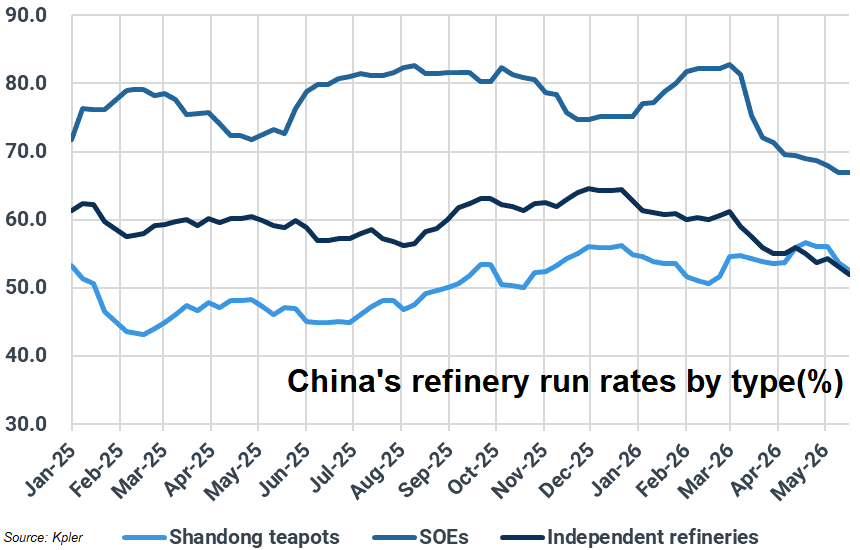
I’ve been grinding away trying to map out China’s recent crude plays, but after going through today's report, I have to hand it to OIES—they scripted the plumbing way better than me. Here is my quick breakdown after running through their print, alongside the Chinese refinery throughput chart to help connect the dots. - Three months into the Hormuz crunch, and Beijing is completely blindsiding the market with its crude playbook. A heavyweight that easily sucked in 11mb/d over the last five years just saw its import prints plunge to 9.3mb/d in April. Now, the forward data says May and June seaborne arrivals are about to crater straight into the gutter at 6.5mb/d. Instead of running its usual playbook of panic-dumping the SPR to backstop the market during a supply crisis, Beijing just completely cock-blocked refiners from touching the strategic vaults, only greenlighting commercial stock draws. To make it worse, refiners aren't even willing to bleed their own commercial inventories, while state traders are acting like total penny-pinchers—happily flipping premium WAF cargoes back into the market and hoarding dirt-cheap Russian barrels instead. This is a complete 180 from the 2021 power crunch, when Beijing panicked and ordered everyone to grab supply 'at any cost.' The heavyweights and policymakers in Beijing clearly think they can outmaneuver this supply shock and keep the economic damage locked down by playing a few smart, tactical micro-levers. China’s true red line for freezing out imports is hardwired to the scale of their run cuts. If they try to copy-paste their five-year average throughput of 14.1mb/d, the exact moment seaborne arrivals drop below 9.2mb/d, they’re trapped—they either have to open the strategic taps wide or start chasing expensive market barrels. Instead, chopping runs by 5% down to a 13.4mb/d baseline is hands-down their most realistic, long-term survival play. In this setup, if domestic crude extraction and pipeline taps keep humming, they can easily coast for a few months without taking a single economic hit, even with seaborne prints scraping a measly 7.9–8.5mb/d, because transportation fuels like gas and diesel will still be taken care of. However cranking run cuts to a nuclear 10% scenario means they could survive without chasing a single market barrel even if seaborne flows dry up to 7.2mb/d—but they'd have to throw petrochemical feedstocks like naphtha and LPG under the bus just to keep gas and diesel flowing, a desperate move that runs on borrowed time and stalls out after a few months unless the whole economy is in a total tailspin. To micromanage this whole run-rate circus, China's refining complex is pulling a highly responsive lever: the yield shift. Beijing explicitly told state majors like Sinopec and PetroChina to ditch chemical feedstocks and prioritize flooding the market with gas and diesel, and these plants immediately saluted by shifting their product yields by several percentage points on a dime. As a result, the real bloodbath isn't happening at the refining gate—it's completely decimating the downstream petrochemical chain. With Hormuz blocked, their seaborne naphtha inflows were already sliced in half, but a 5% run cut is about to bleed domestic naphtha and LPG supplies by tens of millions of tons a quarter, sending a compounding, fatal shock straight through the petchem feedstock backbone. They are keeping wheels turning by guaranteeing gas and diesel, but the squeeze on industrial chemical feedstocks is completely running on borrowed time. To paper over the massive raw material hole in the petchem chain, Beijing is shoving its massive 'Coal-to-Chemicals' complex into the spotlight, branding it as a strategic shield against volatile crude under the 15th Five-Year Plan. Thanks to dirt-cheap, stable domestic coal, inland plants churning out olefins and methanol are running hot to boost volumes, but this quick fix hits a hard ceiling when it comes to replacing lost barrels at scale due to structural bottlenecks. The core infrastructure is trapped deep in the northwestern sticks like Inner Mongolia, meaning slamming those products down to the massive manufacturing teeth on the southeastern coast comes with a punishing logistics and freight premium. Most importantly, coal gasification routes physically cannot clone key aromatics or specialized LPG chemical chains—the feedstock deficit is mathematically locked in. On top of that, the fact that Beijing is sitting on a massive 1.1-1.3 billion barrel pile without tapping it proves that institutional red tape is locking up the plumbing. The 100 million barrels buried deep in dark underground rock caverns—completely invisible to satellites—are almost entirely SPR, requiring endless red tape like complex auctions and market disclosures, so Beijing is hoarding it as a nuclear option. Even for the commercial barrels that are accessible, refiners are terrified to draw down because plotting out the repayment timeframe to replace that crude is a total mathematical nightmare in this chaotic macro environment. Beijing is pulling off a highly calculated micromanagement script here: they are completely freezing out the inventory draw requests from state-owned heavyweights like Sinopec, who are nakedly exposed to global benchmarks and were the first to aggressively slash throughput. Instead, they are using the Shandong teapots as a human shield—handing these independent refiners tax breaks and strict run-rate mandates because they have the flexibility to stomach toxic, illicit Iranian and Russian barrels to cushion the margin bleed. Bottom line, this entire web of macro levers—starving imports, shifting yields, hunting for distressed barrels, and burning through coal-to-chem assets—will keep the lights on and protect the economic skeleton through the peak of summer, but only under that tight 5% run cut baseline that keeps seaborne arrivals pinned at roughly 8mb/d. But with May and June seaborne prints already locked in at a subterranean 6.5mb/d, the expiration date on this makeshift band-aid play cannot stretch into autumn. Short of letting their entire national refining infrastructure suffer a catastrophic meltdown, Beijing is running straight into a hard physical wall. Before late summer wraps up, they will be forced to either open the strategic floodgates and dump their massive stockpiles or make a frantic U-turn right back into the international physical market, chasing heavy volumes aggressively at any price. #oott #iran
JH tweet media
English
74
109
660
129.4K
ADaitche
ADaitche@ADaitche·
@OilCfd @CRUDEOIL231 Are you saying there is no meaningful demand destruction in China or the opposite? Sorry, can't tell 😅
English
1
0
4
547
Oil Bandit 🛢️
Oil Bandit 🛢️@OilCfd·
@CRUDEOIL231 it's demand man...domestic jet prices are in line with international prices and demand kept up... now road fuels demand dropping 10% in just weeks? I don't buy it.. chinese gasoil and gasoline has been shit all along
English
2
0
17
1.9K
Jim Bianco
Jim Bianco@biancoresearch·
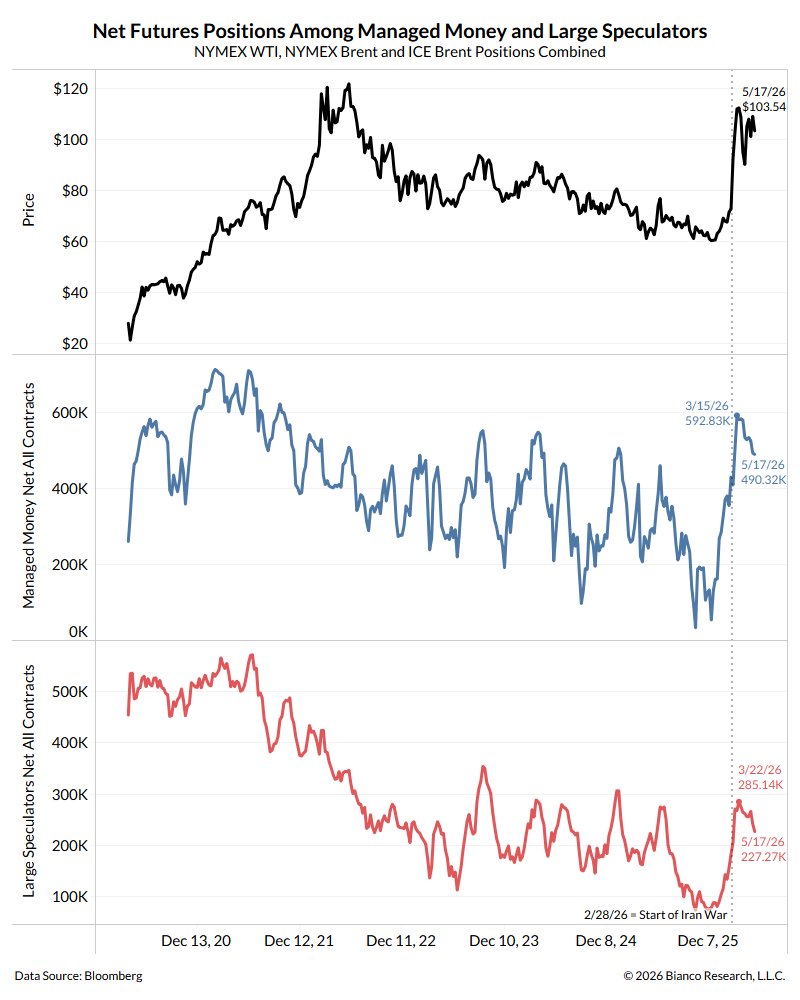
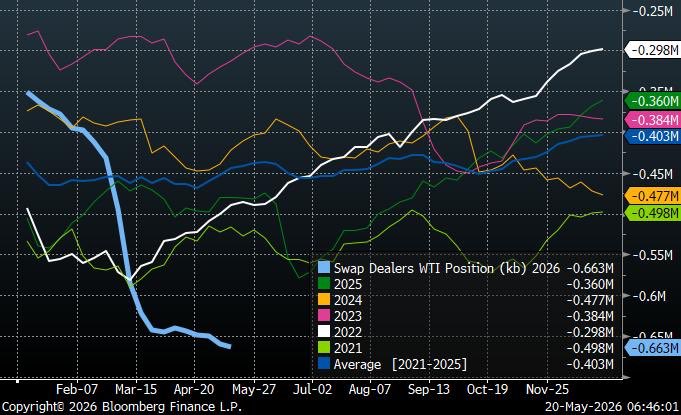
The repost details the Wall Street consensus that the Strait is days away from reopening, and this will lead to crude prices plummeting. Add this chart. It shows that most of the net long positions among managed money (CTAs) and Large Speculators were established BEFORE the war began (and made good money), and they have been paring it back since the opening days of the war (prices are higher today). Restated, Wall Street's peak oil bullishness was over two months ago, and they have been pulling back every week. Industry professionals (i.e., Commercial Traders) are on the other side of Wall Street. Which side do you want to be on? @CommodMkt
Jim Bianco tweet media
Jim Bianco@biancoresearch

1/3 Financial Market participants truly believe that any day now, the Strait opens, the oil starts flowing, and this war is over and soon forgotten. Trump gives them what they want to hear, and they buy it every time, like he just did again. x.com/zerohedge/stat…

English
43
55
327
105.2K
Jeffrey Currie 🆔++
Jeffrey Currie 🆔++@CommodMkt·
@biancoresearch Completely agree Jim. Add this to your list - half billion barrels of producer selling in the last two months.
Jeffrey Currie 🆔++ tweet media
English
9
25
255
46.5K
GrandMufti
GrandMufti@muftimoh·
@ADaitche @tleilax___ @Kayrros Not exactly “tank bottoms” but we should be able to draw down to ~150 mb (kind of a structural floor for the caverns)
English
1
0
2
110
Yet another commodity guy
I estimate at least for crude about 2.8 billions barrels of linefill and tank bottoms. This is from known pipeline infrastructure and measurable inventories. That inventory is unavailable for commerce and can't be drawn. This is from GEM data and @Kayrros
Yet another commodity guy tweet mediaYet another commodity guy tweet mediaYet another commodity guy tweet media
English
16
161
769
407.4K
ADaitche
ADaitche@ADaitche·
@IliaBouchouev @MiaGindis Do I understand this right, you're teaching AI agents how to trade oil? I'd love to read more, whatever you can reveal.
English
0
0
0
115
ADaitche
ADaitche@ADaitche·
@m4h007 How do you see Chinas role in all of this? Do you think they could push Iran to deal, for some concessions by the US?
English
0
0
1
193
Majid Hosseini
Majid Hosseini@m4h007·
It’s still too early to tell what has been the real outcome of the confrontation between Iran and US forces near the Strait of Hormuz, but two things are clear:  1) Iran’s current strategy, while nearly optimal, is unstable, just like its strategy of nuclear ambiguity was, which led to the current conflict.  2) Just like the run-up to the war, the optimality of position is incentivizing Iran to not respond forcefully enough to the US military coercion to open the Strait.  First, let’s recount why Iran’s current strategy is nearly optimal: Iran's current plan seems to be: avoid challenging the ceasefire, engage in negotiations to buy time for oil shortages to bite, skirt the blockade without breaking it, and use the blockade as justification for keeping the Strait closed to the US and its allies. This strategy is nearly optimal because it avoids death and destruction, it buys time for the physical shortages of oil to kick in to force the US hand while keeping Iran’s economy going. It’s not perfectly optimal because as I explained in my previous posts, it’s leaving the narrative in paper markets in Trump’s hands, which gives him room to maneuver (see tweets 1, 2, and 3 below). But it’s not a stable position to be in, just like the nuclear threshold state wasn’t.  In the nuclear matter, Iran’s position seemed optimal: not a nuclear state, but close enough to become one if need be. But the position wasn’t stable. Iran created enough incentive and excuse for its adversaries to attack it, but it didn’t create enough deterrence to prevent those attacks. In the Strait of Hormuz matter, Iran’s position is nearly optimal, but Iran is making a fundamental mistake. It assumes the US will accept defeat and either accept Iran’s terms or simply be forced to leave the war because of the economic pressure.  Iran went into the Islamabad negotiations with the mentality that it has won the war and Trump had accepted its terms as basis for negotiations.  But there’s a difference between a) an adversary being militarily defeated, b) the adversary internally accepting that defeat, and c) the adversary being openly willing to acknowledge the defeat. Military gains are converted into political wins only after step c. Until the defeated side is willing to acknowledge defeat, either through written instruments or leaving the field, it will keep searching for ways to reverse the battlefield outcome. Steps b and c have not happened for Trump. They also have not happened, and will not happen for a long time, for most of the US foreign policy establishment.  Accepting defeat and publicly acknowledging it is not just a matter of national reckoning. It’s a matter of the status of the US in the world, and its relationships with its orbital states.  This means that unless Iran creates an unambiguous deterrence, the US will keep trying to force open the Strait.  Consider the sequence of events: blockade in the gulf of Oman => US destroyers forcing their way into the Persian Gulf => US destroyers forcing their way out and launching Tomahawk missiles against Iran’s coastline. Compare this to an earlier sequence of events: Soleimani assassination => bombing of the Iranian consulate => attacks on Iranian territory => 12-day war => current war. In each case, failure to deter unambiguously at the early stage has led to further escalation.  Compare this with Ansarullah in Yemen whose demonstrated resolve and capabilities established a clear deterrent against the US. (Western establishment analysts working from US-aligned premises have recently reached the same diagnosis about the lead-up to this war: Iran's failure was insufficient deterrence. See, e.g., Grajewski & Panda in Foreign Affairs and Eveleth in Foreign Policy.) This is why, if you look at the US MOU draft proposal, it seeks to remove Iran’s main deterrent — the HEU and enrichment, because when the deterrent is gone, coming back will be easier.
English
32
70
283
29.4K
Unintended Consequence
Unintended Consequence@UnintendedCons5·
After 2.5 months the US finally develops a SoH strategy. It’s not enough - the IRGC has to fall. Take the SoH and it can be done with time, but that can’t be done in months.
English
6
0
27
3.4K
ADaitche
ADaitche@ADaitche·
@ektrit What do you mean by "The Pentagon is de-dollarizing with permission by Congress" ?
English
2
0
0
1.4K
War Economy by Kris 📿
De-dollarization has accelerated globally and internally in America. The Pentagon is de-dollarizing with permission by Congress. A part of Congress is understanding that de-dollarization, as is, is in the interest of America. ektrit.substack.com
English
4
23
131
30.4K
Mehdi (e/λ)
Mehdi (e/λ)@BetterCallMedhi·
petit conseil devant les opportunités et les défis qu’offrent l’IA, faites-en ce que vous voulez: comme je l’ai souvent écrit ici depuis mon enfance j’ai pris l’habitude de m’isoler totalement afin de matérialiser mes pensées sur une feuille blanche et c’est aussi sûrement ce rdv que je me suis imposé avec la plume mais surtout avec moi-même qui m’a permis de construire une bulle de protection tout autour de moi afin de faire face aux nombreuses péripéties de la vie réelle et soyons honnêtes, beaucoup de gens ont une peur viscérale de se retrouver seuls face à eux mêmes, c’est exactement pour cette raison que tiktok, instagram et les notifications permanentes rencontrent un tel succès depuis des années pour moi ces ces outils ne sont absolument pas des distractions innocentes ils sont sans aucun doute des dispositifs sophistiqués d’évitement existentiel qui permettent à des centaines de millions de gens de fuir 16 heures/ jour la rencontre la + importante de leur vie, celle avec leur propre intériorité alors que c’est précisément dans cette rencontre silencieuse et parfois douloureuse que se construisent l’identité véritable, la singularité cognitive & la paix profonde dont aucune dopamine artificielle ne pourra jamais offrir l’équivalent ce rituel quotidien m’a aussi permis de développer une chose précieuse que peu de gens cultivent vraiment, la capacité d’accueillir l’ennui profond sans paniquer, de rester assis pendant 3h sans aucune stimulation extérieure jusqu’à ce que les idées les + inattendues remontent toutes seules à la surface & je reste persuadé que c’est exactement dans ces silences fertiles que se construisent patiemment les ponts entre les disciplines par ex quand la biologie marine éclaire soudain un problème d’ingénierie ou quand le souvenir d’uune ancienne conv avec un paysan vous donne subitement la clé d’une question d’architecture logicielle qui vous bloquait depuis des semaines mais sachez que cette capacité ne tombe pas du ciel comme un don de naissance car pour moi elle se mérite par des années de curiosité innée féroce lire 12 livres/an difficiles dans des champs qui n’ont rien à voir entre eux, voyager seul en mode sac à dos dans des pays où vous ne parlez pas la langue, regardez des documentaires de neurosciences quand vous bossez dans le code, écouter des artisans charpentiers raconter leur métier quand vous êtes chercheur… je crois que c’est cette accumulation patiente de matière première mentale hétéroclite qui permet ensuite à votre cerveau de reconnaître tout seul les invariants qui traversent toutes les disciplines humaines & ainsi de devlopper une réelle vision holistique du monde d’aillzurs, je peux vous le dire avec certitude aujourd’hui, dans 10 ans ce qui séparera ceux qui auront fait de l’IA un véritable allié démultiplicateur de ceux qui se seront fait absorber par elle ne tiendra ni à votre QI(j’ai bcp de doute sur l’objectivité de cette métrique mais j’y reviendrai un jour), ni à vos diplômes ni à votre maîtrise des prompts, ça tiendra uniquement à ce que vous aurez nourri en vous pendant les heures où personne ne vous regardait pour moi le stylo qui glisse lentement sur la feuille blanche chaque soir reste la dernière infrastructure cognitive souveraine que personne au monde ne pourra jamais vous voler, c’est la seule zone qui vous appartient encore totalement et tant que vous l’entretenez chaque jour vous resterez profondément libre dans une époque qui transforme tous les autres en simples consommateurs de pensée pré-mâchée et dont le cerveau totalement atrophié sera justeune larve pensez toujours le monde sur le TRÈS long terme et ce que je viens de vous écrire ici est justement une clé de votre survie à très long terme face à l’IA
Français
44
108
685
34.4K
ADaitche
ADaitche@ADaitche·
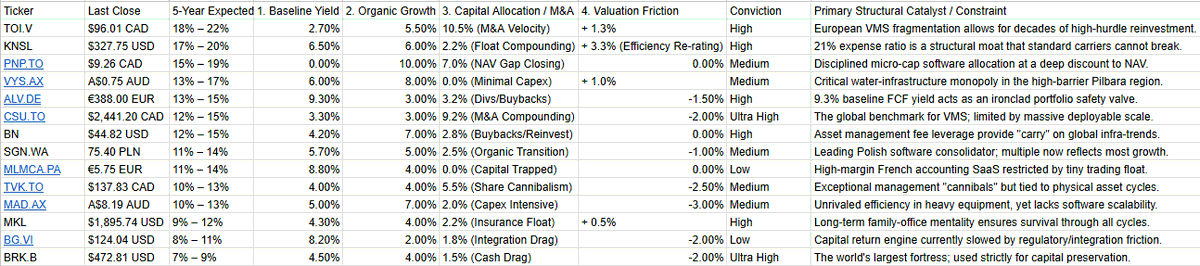
@NicoperJES Which parts of the table come from AI? All columns or just the text comment on the right?
English
1
0
0
82
Whitney Baker
Whitney Baker@TotemMacro·
If CB prints regardless, yields rise, reinforcing the bond supply/demand gap. If an oil shock caused the inflation, this adds a BoP shock for US creditors to the normal export decline. They outright sell dollar assets = even bigger bond gap, plus an FX spiral. Can’t print.
English
5
2
37
3K
Whitney Baker
Whitney Baker@TotemMacro·
When trade declines and the US fiscal deficit expands (as in recessions) there’s *automatically* not enough bond demand. If deflationary, the gap is plugged by domestics, funded out of stocks. If inflationary, not only does the gap not close, but CB printing is also constrained.
English
3
7
64
6.4K
Anton Likhodedov
Anton Likhodedov@ALikhodedov·
For Dated Brent - see my note - it explains everything in detail - the trip from $100 futures to $132 Dated (as of 13 Apr) to $148 paid for immediately loading barrels of Forties. For WTI - if you took delivery in May, I think the scheduling is determined by the seller (I am less familiar with WTI though). So you will get your barrels in Cushing, OK end of May. You need to then move them to US Gulf ($3 difference even now after drop - was $6). Then if you want to move to Asia - it is like 40+ days and expensive freight. So you will have your barrels in Asia in july - and at a much higher costs.
English
1
0
4
378
Anton Likhodedov
Anton Likhodedov@ALikhodedov·
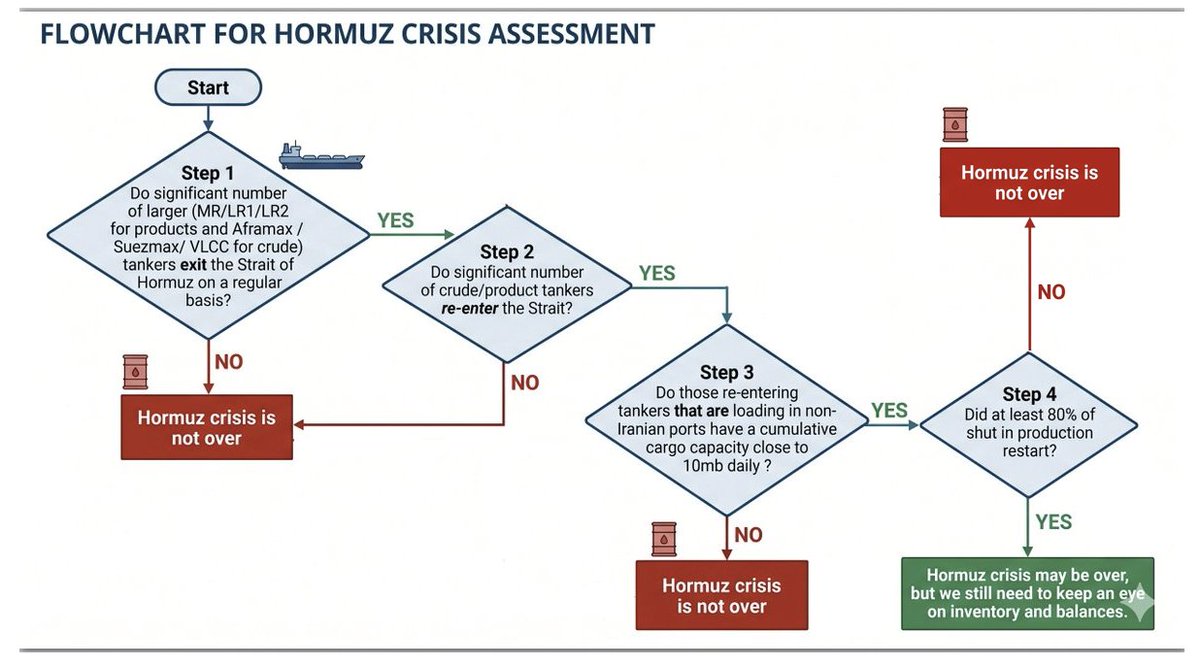
I presume that once US/Iran delegations meet we will eventually get to some MOU / ceasefire extention (along the lines of what NYT reported on Friday) and mutual "opening" of Hormuz. Perhaps if US would also provide a temporary sanctions relief it would be a strong enough incentive for Iran to go for it (and then this can could be kicked further down the road, as agreeing on core matters seems very hard)? Judging by this weekend's experience (32 outbound ships on Saturday as per Kpler- before IRGC announcement/firing) uptick in Hormuz traffic would be substantial and I imagine the market will dump Brent again. The existing trapped crude will temporarily soften the physical market as well. In my view it would be an opportunity to reload for the 3rd time in the last 3 weeks: between logistical and operational complexity of reopening and Iran's incentives to drag things out the full normalisation will take much longer, than the market prices currently. From what I can tell, the "Hormuz crisis is over / Hormuz is so yesterday" crowd largely falls into 2 categories 1) those who acknowledge the non-triviality of reopening, but have assumptions that are too optimistic (e.g. on redirection / temporary reprieve math) and do not fully reflect transportation / restart constraints in a highly heterogeneous system. 2) Those who simply do not think about it - either by actively trying to not learn the important details or assuming that being on the path to normalisation is enough (because the market is forward looking). The problem is that 13mbd liquids production shut in and 10mbd+ of inventory draws keep you in the present. Opex commodities can trade like paper assets - when we are far from physical constraints, but we are not far from them. JP Morgan estimated that OECD commercial crude inventories will fall towards operational minimums early in May. Eventually besides having a longer-term problem of very low inventory that is solvable in a surplus market via reasonably higher prices, we will also run into a flow problem - ending up unable to draw inventory (maybe not globally, but in certain regions - e.g. inventory in China does not really help Shri Lanka). And the latter is only solvable via *unreasonably* high prices, because the market always balances and you would need to destroy a lot of demand. Not all of the impact would hit crude futures (similar to how records product prices in Asia and very high - $150+ landed crude prices there did not really translate into anything above $120 in futures), but I imagine it will spread between all components - cracks / physical premiums / freight / futures prices .... Some competent people think we are already guaranteed to get there ... I do not have a strong view and actually hope we are not (massive demand destruction is not good for anyone including oil bulls). But what I am certain about is that we do not really have many weeks to f&**k around - when production losses are running close to 100mb a week.... Created the flow chart for the "does not matter" crowd:
Anton Likhodedov tweet media
English
13
19
100
9.4K
ADaitche
ADaitche@ADaitche·
@Rory_Johnston Say, hypothetically, Hormuz opens on Monday. Are there enough tankers *nearby* to go in and soak up the reserves? Now that they go to US, this would delay normalization further, right?
English
3
0
4
3.2K
Rory Johnston
Rory Johnston@Rory_Johnston·
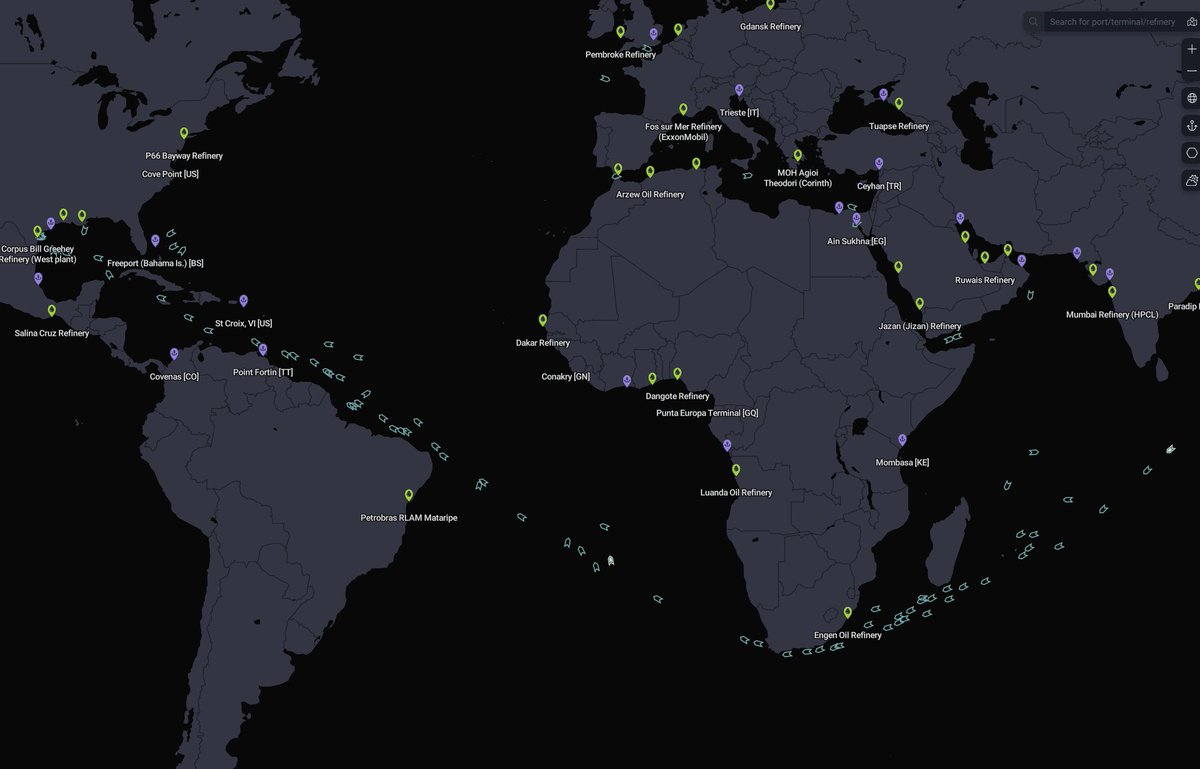
Very cool seeing the wave of empty tankers heading to the US to pick up some desperately needed crude for Hormuz-starved markets. All the tankers on the map below are empty VLCCs (~2 million barrel capacity each) currently heading for the US Gulf Coast.
Rory Johnston tweet media
Ayuso@AyusoValue

US crude exports are about to boom.

English
320
1.7K
7.6K
1.6M
ADaitche
ADaitche@ADaitche·
@ctindale You describe how the west is over-confident in paper claims, ignores the complex physical world that underpins them and under-invests in resilience. What are the western countries that are the least complacent? I'm thinking which countries to live in, in the next decades.
English
0
0
0
91
ADaitche
ADaitche@ADaitche·
@ctindale Also, any thoughts (or citations) on how to make the system more robust? Or, at least, for individuals to become more robust.
English
0
0
0
11
ADaitche
ADaitche@ADaitche·
@ctindale Very instructive, thank you! Curious, have you (or anybody else) studied this more quantitatively? I'm thinking of modeling the system as a non-linear dynamical system. Then study stability and attractors; e.g. what other attractor might we land on if we leave the current one
English
2
0
0
368