Wess Mitchell

75 posts

Wess Mitchell banner
Wess Mitchell

Wess Mitchell

@AWessMitchell

Principal and Co-Founder of The Marathon Initiative. Author of Great Power Diplomacy: The Skill of Statecraft from Attila the Hun to Kissinger. Views my own.

Virginia, USA Katılım Mayıs 2025
60 Takip Edilen487 Takipçiler
Sabitlenmiş Tweet
Wess Mitchell
Wess Mitchell@AWessMitchell·
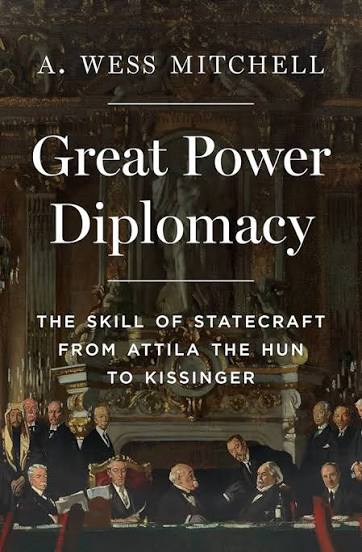
Great Power Diplomacy published today! Thanks to Eric Crahan & his colleagues @Princeton for what turned out to be a beautiful book. Available at: tinyurl.com/5czmkhs5
Wess Mitchell tweet media
English
3
0
15
1.2K
Wess Mitchell
Wess Mitchell@AWessMitchell·
Thx to Francis Sempa @amspectator for reviewing GPD. “In the post-CW world, history did not come to its Hegelian end... [nor] reach the Kantian apogee of perpetual peace. All of the diplomatic achievements recounted in Mitchell’s book were temporary.”  spectator.org/the-illusion-o…
English
0
0
2
221
Wess Mitchell
Wess Mitchell@AWessMitchell·
Thx to Sir Ivan Rogers @MackinderForum for reviewing Great Power Diplomacy. “Mitchell’s analysis is particularly timely given current international circumstances which lead us to compare favourably the approach of Archidamus with that of the Athenians.” mackinderforum.org/book-reviews/a…
English
0
0
0
74
Wess Mitchell retweetledi
Sean Durns
Sean Durns@SeanDurns·
A must read by @AWessMitchell “The United States is at a similar juncture today. For three and a half decades, it has maintained peace and sustained influence in all the world’s major regions without difficult tradeoffs. It continued to assume it can do so even as the country’s relative economic strength decreased and rival military buildups eroded its superiority. As a consequence, the United States now faces a serious misalignment between its national power and the strategic objectives to which it has become accustomed.”
Sean Durns@SeanDurns

A Grand Strategy of Consolidation: How Trump Can Revitalize American Power foreignaffairs.com/united-states/…
English
1
1
2
296
Wess Mitchell retweetledi
Greg R. Lawson
Greg R. Lawson@ConservaWonk·
Rarely do I see another piece that so closely mirrors my own views on what should be the American #grandstrategy in an era of overstretch, #debt & tech competition with our greatest adversary- #China. But this @AWessMitchell piece in @foreignaffairs is one. foreignaffairs.com/united-states/… He & @USWPColby understand our historic moment. Excerpt, "As the United Kingdom did in Fisher’s time, the United States needs to embrace a strategy of consolidation. The second Trump administration has taken significant steps in this direction, undertaking ambitious domestic reforms to expand national power with respect to China. The war it launched with Iran in February could advance consolidation if it remains narrowly scoped, but it could undermine the strategy if it becomes protracted. Going forward, Washington must fully commit to the consolidation blueprint; future administrations need to stay the course to ensure the strategy bears fruit. That means not getting sucked into big wars or lulled back into old policy habits that reinforce the U.S. strategic predicament. If it focuses on consolidation, the United States has a historic chance to regain its bearings as a great power and prevail in a sustained competition with China, the most powerful adversary in U.S. history." This work from Mitchell echoes my own over the last decade plus in @thehill, thehill.com/blogs/pundits-… In @amconmag, theamericanconservative.com/its-time-for-a… & @TheNatlInterest, nationalinterest.org/feature/americ… nationalinterest.org/feature/defini… Further excerpts from Mitchell: "Many of history’s most successful consolidations were undertaken by great powers at their zenith that needed a period of focused recuperation to gain a second wind. A classic example is the Roman Empire during Hadrian’s reign. Immediately before he became emperor in AD 117, Rome had embarked on wars that extended its power deeper into eastern Europe, the Caucasus, and the Middle East. Although these campaigns were militarily successful, they overextended the Roman army and depleted the empire’s coffers. Hadrian consolidated by disgorging his predecessor Trajan’s conquests and fortifying a defensible perimeter along the Roman Empire’s natural borders: the Rhine, Danube, and Euphrates Rivers. He negotiated a peace with Rome’s top adversary (the Parthian empire in present-day Iran), delegated more to allies, and ramped up domestic economic and administrative reforms. The result was a new golden age... "Nearer to the present, U.S. President Richard Nixon embarked on a form of consolidation in the late 1960s and early 1970s, when the United States was war-weary but not in true decline. Nixon’s goal was to refocus Washington on its main contest with the Soviet Union. Like Hadrian and Fisher, he pursued détente with rivals and shifted security burdens to allies, such as by adopting the Guam Doctrine, which held Asian partners responsible for their own conventional defense. He paired these moves with an ambitious program of economic reform, renegotiating trade relations with allies, expanding domestic energy production, and investing in U.S. infrastructure and technological innovation. This eased fiscal pressures, increased exports, and allowed the United States to refocus its military expenditures."
English
2
3
9
567
Wess Mitchell
Wess Mitchell@AWessMitchell·
My latest essay @ForeignAffairs argues for a US strategy of consolidation: ramp up national bases of strength, renovate alliances, and use strategic diplomacy to mark time with rivals. We can learn a lot from the Emperor Hadrian and Admiral Jacky Fisher. foreignaffairs.com/united-states/…
English
1
0
10
126
Wess Mitchell retweetledi
Jarrett Stepman
Jarrett Stepman@JarrettStepman·
@ConservaWonk @AWessMitchell I’ve just started reading it. Excellent book. His book about the strategy of the Hapsburg empire was also very much worth reading if you haven’t picked that one up yet.
English
0
1
3
146
Wess Mitchell
Wess Mitchell@AWessMitchell·
OTD in 1650 the infamous Capt. William Mitchell, 1st of my family to arrive in the new world, set sail from England for the colonies on the ship ‘Thomas & John.’
English
0
0
5
143
Wess Mitchell retweetledi
Justin Overbaugh 🇺🇸
Justin Overbaugh 🇺🇸@JustinOverbaugh·
Great article by @AWessMitchell in Imprimis. As we re-imagine our relationships with partners and allies, this particular section was thought-provoking: "A corollary has to do with allies. America has a larger number of allies than any great power in history. As a maritime power in the style of Venice and Britain, America benefits from having allies at the world’s chokepoints and in strategic regions. But diplomacy with allies, too, must be judged by its outcomes. Does the behavior of a particular ally ease or increase the concentration of U.S. military power against the main threat? Does it relieve or add to America’s burden in wartime? Does its trade policy help or hinder the goal of reindustrialization here at home in the face of the growing threat from China? Alliances that lack reciprocity in trade or do not share the burden in security need to be fixed. The goal is strategic renovation: to rebalance the ledger of burdens and benefits in U.S. alliances so that they are more favorable to the U.S. and therefore more sustainable." - A. Wess Mitchell imprimis.hillsdale.edu/recovering-the…
English
1
5
9
821
Patrick Porter
Patrick Porter@PatPorter76·
I've reviewed A. Wess Mitchell's formidable book for @firstthingsmag, out in April. He calls for a rediscovery of diplomacy's core, not superficially as "comms" or as handmaiden to military force, but as art of arranging power in space & time, to concentrate it & limit threats.
Patrick Porter tweet media
English
11
141
777
55.4K
Wess Mitchell
Wess Mitchell@AWessMitchell·
@PatPorter76 @firstthingsmag Thanks @PatPorter76 for your generous appraisal & for reviewing GPD! Diplomacy doesn't get the attention it deserves (esp in modern times) as a component of grand strategy. Hopefully the book gives a start in remedying that.
English
0
1
11
2.9K
Wess Mitchell retweetledi
Greg R. Lawson
Greg R. Lawson@ConservaWonk·
#Diplomacy is an art America needs to rediscover in an era of great power politics & growing diffusion of power. @AWessMitchell has excellent thoughts of this in @HCimprimis. #Strategy imprimis.hillsdale.edu/recovering-the… Excerpt, "I should also define what I mean by strategy: it is the matching of national means, in the form of military and economic resources, to national ends, in the form of foreign threats and opportunities. Danger arises when gaps emerge between the means at a nation’s disposal and the ends to which those means must be applied. Diplomacy is critical when a state faces enemies too numerous or powerful to be deterred or defeated by military means alone. Diplomacy’s role in strategy is to increase the external means at the nation’s disposal by building coalitions and to reduce the threats arrayed against it through détente. Effective diplomacy permits states to avoid tests of strength that are beyond their ability to bear. There are two erroneous conceptions of diplomacy that have become entrenched in the modern mind, one mostly on the left and the other mostly on the right. The main error on the left is thinking that diplomacy’s purpose is to build rule-making institutions that transcend nation-states and that will eventually expunge war from the human experience. A historical example of this is seen in the policies of President Woodrow Wilson after the First World War, as in his promotion of a League of Nations. This way of thinking persists today in the liberal institutionalism of those who advocate for a rules-based international order. The main error on the right is thinking that human societies can only find true safety and honor in a preponderance of military power, and that diplomacy is more often than not a form of surrender. This view finds expression in the perennial accusations of appeasement or comparisons to Neville Chamberlain and the Munich Agreement of 1938—when the British Prime Minister agreed to Nazi Germany’s annexation of the Sudetenland as a means of preventing war—anytime an American president engages in direct diplomacy with a U.S. adversary. Both of these misconceptions are built on the notion that we can find a cleaner or more efficient substitute to the messiness of compromise, which is diplomacy’s stock-in-trade. The entrenchment of these views can be traced to the unusual circumstances that existed after the Cold War. American power was unmatched, liberal institutions were in the ascendancy, and history—in the famous formulation of Francis Fukuyama—had supposedly come to an end. There seemed to be no need for classical diplomacy, because the U.S. had no peer competitor with whom it needed to negotiate or compromise. As a result, American foreign policy embraced a transformationalist agenda of remaking the world—including our adversaries—in our image, through the spread of democracy and liberal economics. It is clear today, however, that what Fukuyama called history is in fact an ongoing reality and that our vacation from it is over. All the international institutions in the world cannot stop a war, should it come, between China and the U.S. Nor does the U.S. hold the margin of military superiority it did 30 years ago. Like past great powers, therefore, we will need skill in diplomacy to bring national means and national ends into alignment."
English
2
2
7
342
Wess Mitchell
Wess Mitchell@AWessMitchell·
My letter to the editor in today’s WSJ: the munitions crunch validates years of warnings by Elbridge Colby. “He foresaw the current predicament long before most others & had the courage to confront it long before it was politically convenient to do so.” wsj.com/opinion/elbrid…
English
1
3
15
979
Wess Mitchell
Wess Mitchell@AWessMitchell·
Thanks to @GrahamTAllison and Meghan O'Sullivan @BelferCenter for hosting me this past week to discuss my book Great Power Diplomacy , as well as U.S.-China competition, the war in Iran and U.S. grand strategy.
English
0
1
4
211
Wess Mitchell
Wess Mitchell@AWessMitchell·
Worth reading yesterday’s clear-eyed SASC testimony by @USWPColby. His call for the US to navigate between isolationism & “unfettered use of military force” recalls HAK's observation that Nixon steered a prudential path between “overextension & isolation." armed-services.senate.gov/imo/media/doc/…
English
0
1
4
277
Wess Mitchell
Wess Mitchell@AWessMitchell·
Thanks to Larry Rifkin for hosting me on @trendspodcast. We talked about why the US became over-reliant on sanctions & military power after the Cold War—and how the Trump administration is putting diplomacy back at the forefront of US grand strategy. americatrendspodcast.com/2026/01/28/ep-…
English
0
0
2
186
Wess Mitchell
Wess Mitchell@AWessMitchell·
My oped comparing remarks by @SecRubio & AOC at Munich. Rubio’s vision is civilizational rejuvenation; AOC’s is technocratic restoration. Rubio sees the West as a sacred inheritance; AOC sees it as administrative construct to promote abstract social goals. washingtonpost.com/opinions/2026/…
English
20
1
3
268
Wess Mitchell
Wess Mitchell@AWessMitchell·
@SecRubio’s MSC speech was a historic reaffirmation of the civilizational West as something worth fighting for & the organizing reason for NATO. Evokes an oft-overlooked passage of the 1949 NATO charter: to safeguard our “common heritage & civilization”. state.gov/releases/offic…
English
0
0
4
198