Adam Borco

469 posts

Adam Borco banner
Adam Borco

Adam Borco

@AdamBorco

#Bitcoin harmonic averagist. Chief scientist at @atomiqlabs 🧪

Katılım Aralık 2014
202 Takip Edilen395 Takipçiler
Alex Bosworth
Alex Bosworth@alexbosworth·
A problem with the current P2P BTC networks is that semi-useful data is deleted; and centralized points are the only ones retaining and distributing it. But other semi-useful data is not deleted; and it's a burden to clients. A solution I see is to make a P2P market for this data
English
2
0
2
795
Adam Borco
Adam Borco@AdamBorco·
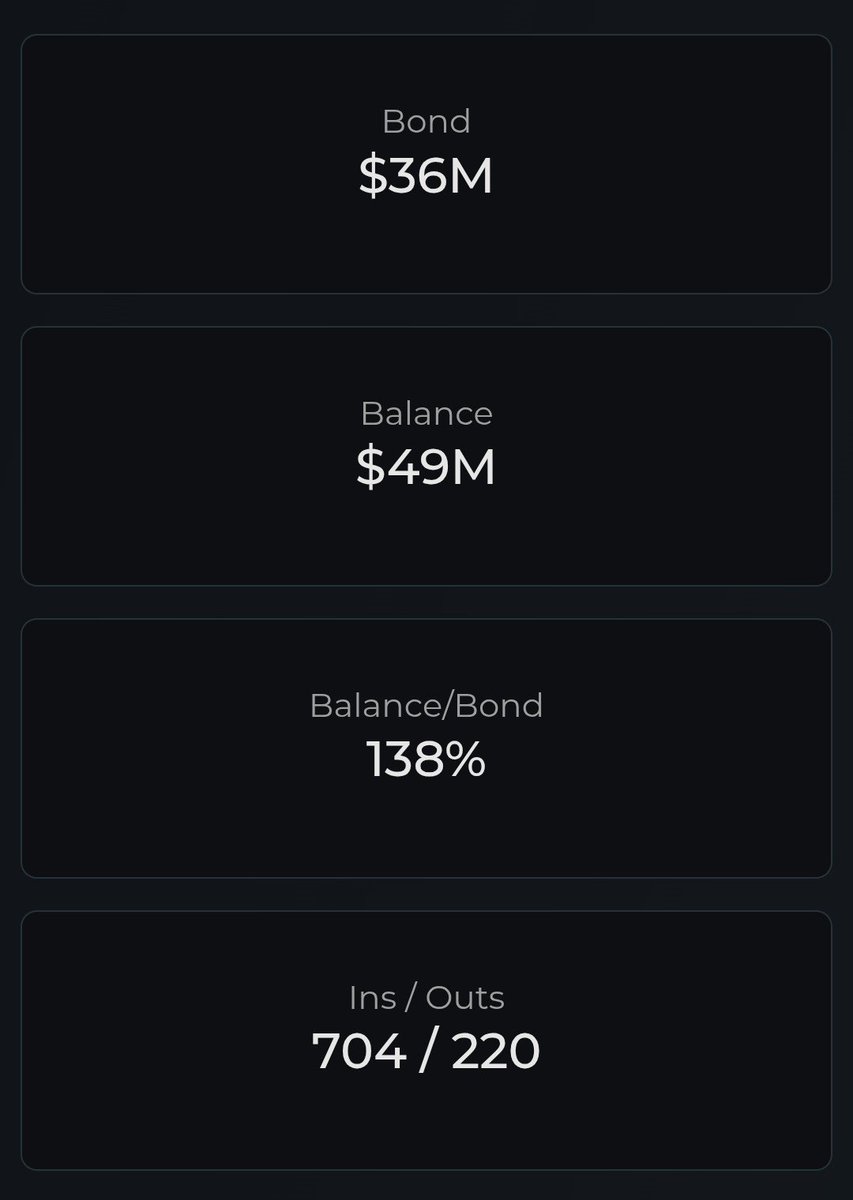
@KentonC137 What a well-secured and definitely economically sound system this thorchain is. Surely more people will be fine trusting it.
Adam Borco tweet media
English
0
0
0
26
Drift
Drift@DriftProtocol·
We are observing unusual activity on the protocol. We are currently investigating. Please do not deposit funds into the protocol while we investigate. This is not an April Fools joke. Proceed with caution until further notice. We’ll provide additional updates from this account.
English
766
281
1.8K
1.4M
Adam Borco
Adam Borco@AdamBorco·
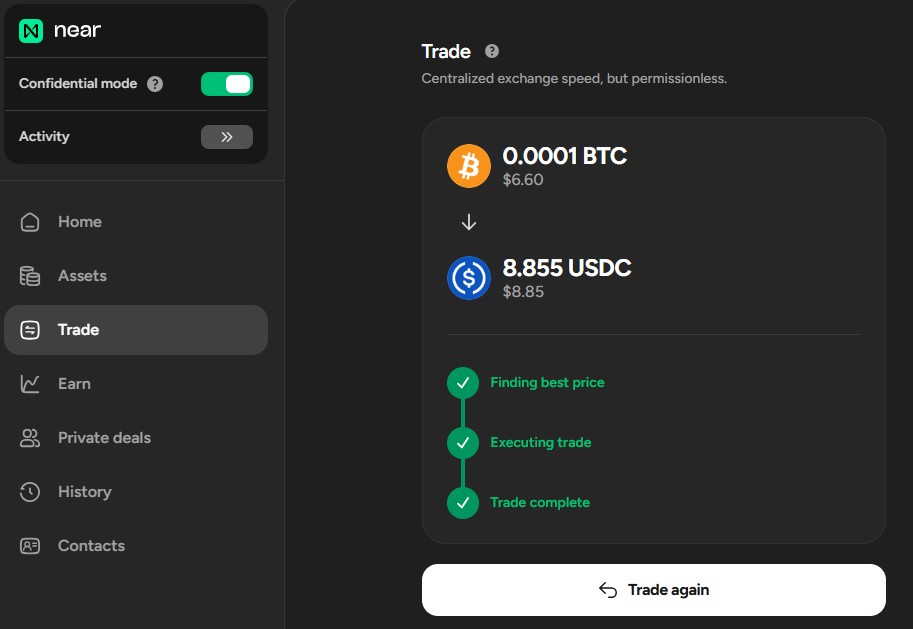
@q8i0181 @saylor @near_intents @NEARFoundation Ahh I see, I assumed you have swapped native BTC, but this was the BTC that was already deposited on near, and then you swapped it to USDC which I guess you then held on near for some time and then withdraw by pieces.
English
0
0
1
22
Q8i
Q8i@q8i0181·
The transaction is completed within a privacy pool — you can see that "a transaction occurred" but you don't know "who" initiated it. Then it's split into different amounts and transferred to different addresses (transfers can happen within the privacy pool), left dormant for several days, and finally withdrawn in batches — making it very difficult to trace any correlation. If you don't quite follow my explanation, that's okay — go to near.com and try it yourself, then check the on-chain records, and you'll appreciate the elegance of the design.
English
1
0
1
56
Adam Borco
Adam Borco@AdamBorco·
@bonomat @alexeiZamyatin Well, if you control majority of the hashrate and are willing to reorg blocks that contain the double spends you can pull it off.
English
1
0
0
21
Philipp
Philipp@bonomat·
@alexeiZamyatin I honestly can't see how you can release the funds on the other chain before the bitcoin transaction is confirmed.
English
2
0
3
96
Adam Borco
Adam Borco@AdamBorco·
@ericng39 Yep, I see. Not a big fan of upgrade keys, but for some systems you need them. You probably don't wanna use this for wallets though, as it gives someone an authority to drain everyone's account with a malicious upgrade.
English
0
0
1
75
Eric Ng
Eric Ng@ericng39·
The first example that comes to mind is incident response. If you have many contracts that are effectively instances of the same system, like pools in a DEX, accounts in a wallet provider, markets in a prediction protocol, etc. and a critical bug is found, upgrading one-by-one gives bad actors potential enough time to exploit.
English
1
0
0
25
Eric Ng
Eric Ng@ericng39·
What's the current state of the art for upgrading hundreds of contracts to the same implementation on Starknet?
English
2
0
2
357
Adam Borco
Adam Borco@AdamBorco·
Yo, if you'd have the same kinda dashboard in the ethereum land you would be seeing the very same pattern from time to time with Lido having a quarter of the stake. At least these miners using the Foundry pool can switch pools at any moment, the same cannot be said about all the ETH depositors in Lido.
English
4
0
8
1K
zodomo.eth (🌍,💻)
zodomo.eth (🌍,💻)@Zodomo·
I'll never understand how a PoW stan can see this and think it isn't a problem. Brother in christ, your chain is centralizing in real time.
zodomo.eth (🌍,💻) tweet media
English
33
16
191
16.3K
Bread
Bread@generalbreadco·
Introducing Bread The app that will change how we all experience Bitcoin Reply with your referral code for early access
Bread tweet media
English
597
100
1.2K
249.5K
Adam Borco
Adam Borco@AdamBorco·
That really depends, if the new code that will be required for the upgrade increases the attack surface (which it will since it adds additional code and logic) and adds an 0.1% annual probability of there being an exploitable vulnerability in bitcoin then actually upgrading might be more expensive.
English
0
0
1
29
Alexander John Lee
Alexander John Lee@alexanderlee314·
@AdamBorco I agree. Just pointing out that its actually expensive to not upgrade to conservative (hash based) PQ crypto
English
1
0
1
22
Alexander John Lee
Alexander John Lee@alexanderlee314·
Assume there is a 0.1% annual probability that a quantum computer capable of breaking ECDSA is developed. This 0.1% risk means near total loss of a $2T asset. As a hypothetical, what would the insurance premium be per year over the next 10 years. Answer is ~$6-20B per year.
David Tse@dntse

Dan Boneh gets phone calls every few days asking whether quantum computing threatens Bitcoin. I'm not an expert in quantum cryptography, but Robin Linus thinks the fear is overblown. Right now, I'm focused on the more immediate challenge: launching the Bitcoin vault without losing anyone's bitcoin.

English
2
0
10
782
Adam Borco
Adam Borco@AdamBorco·
@januszg_ @isabelfoxenduke So it looks like a single MCP signer set + Hashi key in a TEE for all the deposits. The size or nature of the MCP signer set is not really elaborated upon much.
English
1
0
1
50
Isabel Foxen Duke⚡️
Isabel Foxen Duke⚡️@isabelfoxenduke·
Thought worth sharing for the L2 nerds out there… I got to read the docs on how this works under the hood and it’s essentially a “layer 1.5” architecture wherein Bitcoin keys are managed via smart contracts on Sui. I actually really like this architecture… the trust assumptions outperform most federated Bitcoin bridges… just saying
Sui@SuiNetwork

Introducing Hashi: a new era of Bitcoin finance on Sui. Bitcoin's market cap exceeds $1 trillion. < 0.5% of it is used in DeFi. Hashi is here to change that, with commitments from industry leaders including BitGo, Bullish, Erebor Bank, FalconX, Fordefi, Ledger, and more.

English
6
2
25
2.6K
Adam Borco
Adam Borco@AdamBorco·
@isabelfoxenduke @BobBodily But ICP has a single signer set for all the deposit if I am not mistaken. Or at least a single signer set for ODIN fun. Here if I understand correctly every deposit uses a different subset of the Sui validators.
English
0
0
0
34
Adam Borco
Adam Borco@AdamBorco·
Right, so this is the sense where it works a bit like a spider chain, you have multiple sharded keys (one for each deposit), where different subset of validators hold the shards for each and every one of them. That indeed might be better than the standard federated bridge (acting as a single honeypot), especially if there is also some slashing involved for the misbehaving validators (adding economic cost to the attack).
English
2
0
1
45
Isabel Foxen Duke⚡️
Isabel Foxen Duke⚡️@isabelfoxenduke·
Spiders chains is literally spreading out the funds in the bridge across different addresses or different “honeypots” if you will. Hashi is a primitive for a single bridge (or for each bridge) - in theory they could work together. Although the word “bridge” isn’t quite write for Hashi because there’s no wrapper. Sharded keys for BTC on layer 1 are simply managed by MPC smart contracts — but any number of validators in the PoS network could hold the correct key shards at any given time and different validators will ultimately hold key shards for each tx that is executed by different smart contracts. Another way of thinking about it is there is a different L1 key (sharded between multiple validators) for each smart contract execution on the network.
English
1
0
0
52
Adam Borco
Adam Borco@AdamBorco·
@isabelfoxenduke Oh, so is it like a spiderchain then? That different subsets of the validators hold keys to different vaults? Or is it just one rotating multisig used for all the vaults in a given time?
English
1
0
0
43
Isabel Foxen Duke⚡️
Isabel Foxen Duke⚡️@isabelfoxenduke·
@AdamBorco I think it’s a lot harder to compromise the signer set here, bc the set of shards could exist anywhere amongst a whole plethora of different validators within the PoS network at anytime. The signers aren’t stagnant in specific locations.
English
1
0
0
64
Adam Borco
Adam Borco@AdamBorco·
@100y_eth @circle "designed to be non custodial" "uses TEE on AWS" ~Laughs in Jeff Bezos~
English
0
0
4
101
100y
100y@100y_eth·
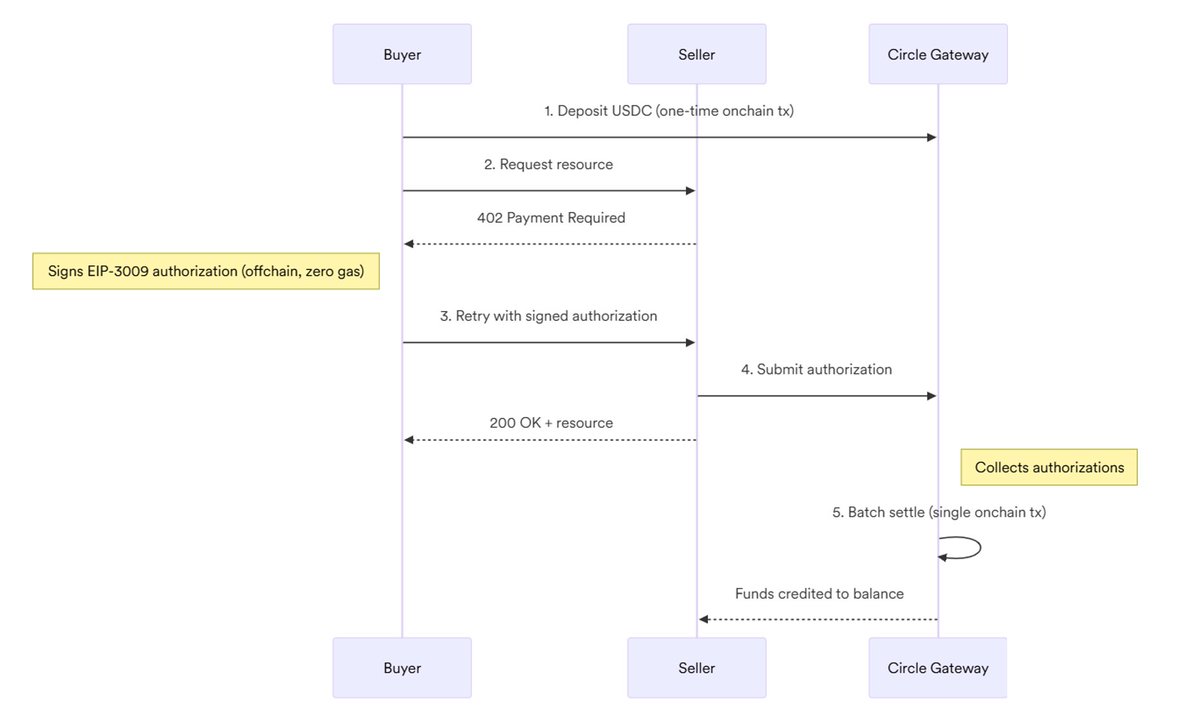
How do Circle’s Nanopayments work? @circle has unveiled a new feature called Nanopayments. It allows transfers as small as $0.000001 while claiming zero gas fees. How is that possible? The secret lies in batched settlement. If every payment created its own onchain transaction, gas costs would quickly add up. Instead, Nanopayments collects users’ offchain payment signatures through the Circle Gateway. The system calculates net balances and periodically settles accumulated payments in a single batch. How Nanopayments Work Here is a simplified look at the process: 1. Deposit: The buyer sends USDC from their wallet to the Circle Gateway Wallet. This is an onchain transaction and gas is paid only once at the initial deposit. 2. Request and negotiate: The buyer requests a paid resource from the seller. The seller can respond through the x402 protocol. 3. Sign authorization: The buyer signs an EIP-3009 message. This is an offchain signature that authorizes payment to the seller and requires no gas. 4. Settle and serve: Circle Gateway verifies the signature and checks the buyer’s balance. The corresponding amount is locked. The seller immediately delivers the paid resource to the buyer. 5. Batch settlement: The Gateway periodically aggregates pending offchain signatures, calculates net balances, and settles them onchain in a single transaction. In other words, thousands of offchain payment transactions are consolidated into one onchain transaction. That is why the effective gas cost approaches zero. Security Model One point worth highlighting is that the offchain payment authorization process might appear custodial at first glance. However, Circle Gateway is designed to be non custodial. Circle Gateway runs inside an AWS Nitro Enclave TEE. Within this environment, the system verifies EIP-3009 signatures, computes batch settlement results, and signs the final batch transactions. The TEE signing keys are securely protected using AWS KMS. Even Circle employees cannot access the enclave or the keys. Thoughts There have been many attempts to implement micropayments. Most approaches simply relied on sending transactions on networks with extremely low gas fees. Nanopayments takes a different path. By aggregating offchain transactions and processing them in batches, it dramatically reduces gas costs. (For reference, the USDT chain @Stable has implemented a similar concept at the network level called the USDT Transfer Aggregator.) This approach could become especially meaningful in the future. As the agentic economy evolves, AI agents may increasingly stream payments in real time. Nanopayments creates the infrastructure that makes that model viable.
100y tweet media
English
22
23
205
22.3K