Adam Pippert

12.1K posts

Adam Pippert banner
Adam Pippert

Adam Pippert

@AdamPippert

Wishing social media could be an asset and not a liability again…

Depends on the day, usually OR Katılım Eylül 2021
133 Takip Edilen585 Takipçiler
Adam Pippert
Adam Pippert@AdamPippert·
@KeruboSk Going to bed early, practicing this every day, and drinking too much coffee.
English
0
0
0
0
Sophia ❣️
Sophia ❣️@KeruboSk·
Apparently there are people who wake up before their alarm… and just get up. Just one alarm. No snooze. No struggle. Explain yourselves. How do you do that?
English
6.5K
1.5K
17.4K
655.9K
Cody Schneider
Cody Schneider@codyschneiderxx·
the secret to b2b saas is selling things that get people promoted
English
30
27
767
36.2K
Adam Pippert
Adam Pippert@AdamPippert·
@wydyama I miss it. I rented a Lotus once and definitely thought it was ridiculous for like 2 hours, but once I got the pattern down I couldn’t drive auto again.
English
0
0
0
99
Ryan
Ryan@ohryansbelt·
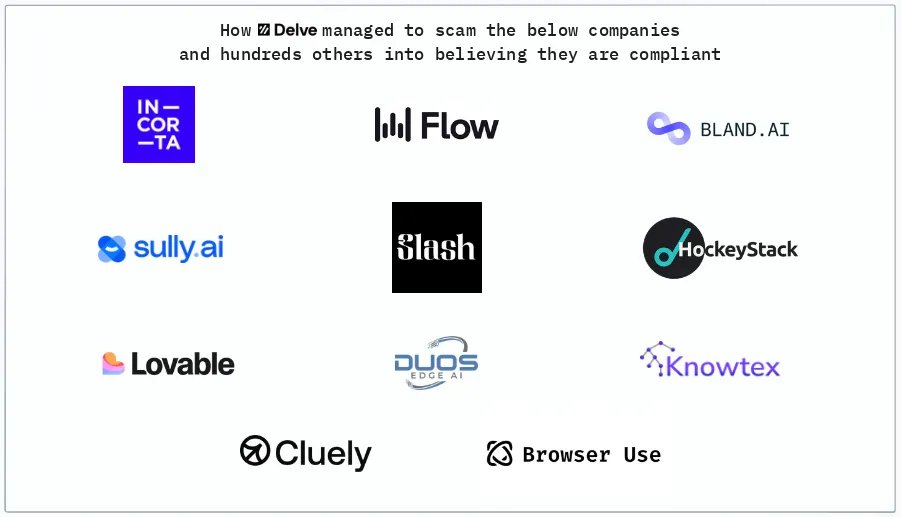
Delve, a YC-backed compliance startup that raised $32 million, has been accused of systematically faking SOC 2, ISO 27001, HIPAA, and GDPR compliance reports for hundreds of clients. According to a detailed Substack investigation by DeepDelver, a leaked Google spreadsheet containing links to hundreds of confidential draft audit reports revealed that Delve generates auditor conclusions before any auditor reviews evidence, uses the same template across 99.8% of reports, and relies on Indian certification mills operating through empty US shells instead of the "US-based CPA firms" they advertise. Here's the breakdown: > 493 out of 494 leaked SOC 2 reports allegedly contain identical boilerplate text, including the same grammatical errors and nonsensical sentences, with only a company name, logo, org chart, and signature swapped in > Auditor conclusions and test procedures are reportedly pre-written in draft reports before clients even provide their company description, which would violate AICPA independence rules requiring auditors to independently design tests and form conclusions > All 259 Type II reports claim zero security incidents, zero personnel changes, zero customer terminations, and zero cyber incidents during the observation period, with identical "unable to test" conclusions across every client > Delve's "US-based auditors" are actually Accorp and Gradient, described as Indian certification mills operating through US shell entities. 99%+ of clients reportedly went through one of these two firms over the past 6 months > The platform allegedly publishes fully populated trust pages claiming vulnerability scanning, pentesting, and data recovery simulations before any compliance work has been done > Delve pre-fabricates board meeting minutes, risk assessments, security incident simulations, and employee evidence that clients can adopt with a single click, according to the author > Most "integrations" are just containers for manual screenshots with no actual API connections. The author describes the platform as a "SOC 2 template pack with a thin SaaS wrapper" > When the leak was exposed, CEO Karun Kaushik emailed clients calling the allegations "falsified claims" from an "AI-generated email" and stated no sensitive data was accessed, while the reports themselves contained private signatures and confidential architecture diagrams > Companies relying on these reports could face criminal liability under HIPAA and fines up to 4% of global revenue under GDPR for compliance violations they believed were resolved > When clients threaten to leave, Delve reportedly pairs them with an external vCISO for manual off-platform work, which the author argues proves their own platform can't deliver real compliance > Delve's sales price dropped from $15,000 to $6,000 with ISO 27001 and a penetration test thrown in when a client mentioned considering a competitor
Ryan tweet media
erin griffith@eringriffith

A detailed and brutal look at the tactics of buzzy AI compliance startup Delve "Delve built a machine designed to make clients complicit without their knowledge, to manufacture plausible deniability while producing exactly the opposite." substack.com/home/post/p-19…


English
219
325
3.9K
1.4M
Adam Pippert
Adam Pippert@AdamPippert·
@techsaleshackz Best BDR I ever had went straight to AE and did 1100% of his number his first year, established our permanent 10x hard cap.
English
0
0
0
154
Techsaleshackz
Techsaleshackz@techsaleshackz·
Decagon promoing sdrs to Ent AE Are we buying this or Is this a fake title
Techsaleshackz tweet media
English
26
1
113
43K
Adam Pippert
Adam Pippert@AdamPippert·
@KingBootoshi One is a year doing workloads for a company, the other a month by yourself. Big difference. Maybe the biggest of all. Right answer is you should e spending $250k on tokens yourself on your own business that pays you $2mil/yr in revenue.
English
0
0
0
26
Adam Pippert
Adam Pippert@AdamPippert·
@sergeykarayev We really should say ‘self-custody’ instead of ‘local’, because honestly that’s more important than the actual physical location of the model you run.
English
0
0
0
27
Sergey Karayev
Sergey Karayev@sergeykarayev·
Running agents locally is a dead end. The future of software development is hundreds of agents running at all times of the day — in response to bug alerts, emails, Slack messages, meetings, and because they were launched by other agents. The only sane way to support this is with cloud containers. Local agents hit a wall quickly: • No scale. You can only run as many agents (and copies of your app) as your hardware allows. • No isolation. Local agents share your filesystem, network, and credentials. One rogue agent can affect everything else. • No team visibility. Teammates can't see what your agents are doing, review their work, or interact with them. • No always-on capability. Agents can't respond to signals (alerts, messages, other agents) when your machine is off or asleep. Cloud agents solve all of these problems. Each agent runs in its own isolated container with its own environment, and they can run 24/7 without depending on any single machine. This year, every software company will have to make the transition from work happening on developer's local machines from 9am-6pm to work happening in the cloud 24/7 -- or get left behind by companies who do.
English
71
16
230
19.4K
Adam Pippert
Adam Pippert@AdamPippert·
@braelyn_ai St Regis has a pool. Not the answer you were looking for, but technically correct.
English
0
0
1
97
Braelyn ⛓️
Braelyn ⛓️@braelyn_ai·
this is the first time I’ve ever wondered where I can find a pool in San Francisco
English
26
4
68
5.3K
Adam Pippert
Adam Pippert@AdamPippert·
@colmdotcom Depends on the consumers. Dev tools companies love what they do because they sell to smart people or idiots they can make fun of and still be culturally acceptable. Most customers are idiots, but we don’t have the luxury of telling them so.
English
0
0
0
248
Colm Hayden
Colm Hayden@colmdotcom·
I’m sorry but consumer is a trillion times more fun than B2B
English
57
15
486
27.8K
Adam Pippert
Adam Pippert@AdamPippert·
@jezell @ivanburazin They’re asking Firebase Studio users to do exactly this, or weirdly enough, switching to Antigravity.
English
0
0
1
87
Jesse Ezell
Jesse Ezell@jezell·
@ivanburazin Replaced by the ai studio probably since it has firebase integration built in to the vibe code stack
English
2
0
17
2.2K
Ivan Burazin
Ivan Burazin@ivanburazin·
Another day, another product killed by Google. Less than a year after launch, Firebase Studio is shutting down.
Ivan Burazin tweet media
English
58
16
299
35.8K
David Herrmann
David Herrmann@herrmanndigital·
How do you all keep up with all the AI shit? Like it's insane.
English
210
4
304
34.6K
Yuchen Jin
Yuchen Jin@Yuchenj_UW·
I noticed something interesting: Claude Code auto-adds itself as a co-author on every git commit. Codex doesn’t. That’s why you see Claude everywhere on GitHub, but not Codex. I wonder why OpenAI is not doing that. Feels like an obvious branding strategy OpenAI is skipping.
English
200
31
1.6K
145.6K
⭕ Brock Pierson
⭕ Brock Pierson@brockpierson·
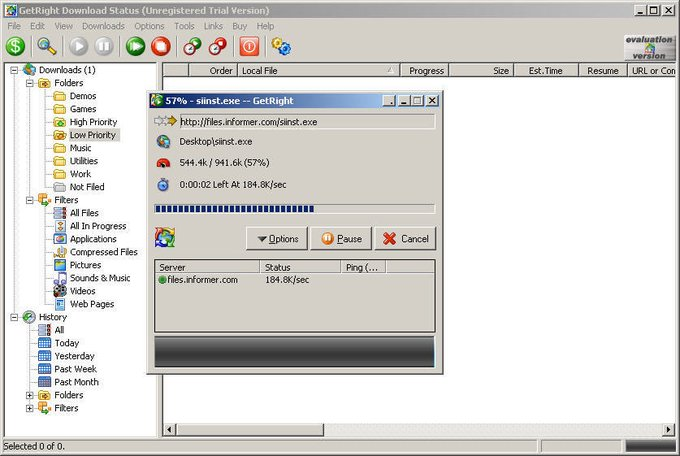
Might be a bit of a deep cut here, but did anyone else use GetRight or any other "download manager" back in the day?
⭕ Brock Pierson tweet media
English
123
4
196
11.1K
Adam Pippert
Adam Pippert@AdamPippert·
@kylewgrove @runaway_vol Nah, I’ll just use M-x escape-vim (because, naturally, I run it inside an emacs REPL like a sane person).
English
0
1
2
34
kylegrove
kylegrove@kylewgrove·
@runaway_vol all you have to do is ESC m-m-right foot pedal without-legs mode. It's quite ergonomic compared to emacs.
English
1
0
1
42
alex zhang
alex zhang@a1zhang·
someone should try having RLMs write REPL code primarily using DSPy
English
6
7
123
16.3K
Adam Pippert
Adam Pippert@AdamPippert·
@the_octobro You are an octopus: big brain and 8 legs. Most of us only walk forwards. Not so easy, this is why we struggle with FP. It asks us to go directions we don’t normally go.
English
0
0
1
13
octo
octo@the_octobro·
Why do people say functional programming is hard? It's very simple: Everything is tree
English
20
3
96
6.3K
Peter Gostev
Peter Gostev@petergostev·
These kind of claims never pass the sniff test. Benchmarks can be cheated, but if it worked 0-11% of the time on real tasks (which are not part of benchmarks) nobody would ever use LLMs for coding.
Lossfunk@lossfunk

🚨 Shocking: Frontier LLMs score 85-95% on standard coding benchmarks. We gave them equivalent problems in languages they couldn't have memorized. They collapsed to 0-11%. Presenting EsoLang-Bench. Accepted to the Logical Reasoning and ICBINB workshops at ICLR 2026 🧵

English
11
1
63
8.8K
michael
michael@_michaelginn·
@redtachyon @petergostev Except there’s plenty of esoteric, domain specific, and low resourced PLs that people do use, and it’s important to know whether models will work without much training data.
English
1
0
1
96