Sabitlenmiş Tweet

Me enamoro. Motivación para estudiar ciencias y hacer posible esto algún día. Entre otras cosas. vimeo.com/108650530?ref=…
Español
Adrià 🌲🌳
652 posts

@AdrMmp
\PhD student in Neurorobotics \effective human optimism




Back at the airport, on my way to the US for Google I/O. I’m really hoping we’ll also see some announcements around the Siri-Gemini update, because that’s the one I’ve been waiting for. See you in a few hours!
New essay on the economics of structural change and the post-commodity future of work. 1. Almost any question about the impact of advanced AI on the economy needs to start at the same place: what is still scarce? Answer that, and the analysis becomes pretty straightforward. This essay explores what becomes scarce if AI really can replicate most of what humans do in production, and what this mean for the future of jobs. 2. My conjecture, working through the economics: labor reallocates across sectors, and the sector it reallocates to has properties that keep labor a meaningful share of the economy. Ultimately this is about the structure of demand itself. For this, we have to go back to Girard, Augustine and Rousseau: once people's base needs are met, their preferences shift to comparative motives (e.g., status, exclusivity, social desirability). This motive is inherently non-satiated. 4. The key paper is Comin, Lashkari, and Mestieri (Econometrica 2021). As people get richer, they don't buy proportionally more of everything. They shift spending toward sectors with higher income elasticity. They estimate income effects account for 75%+ of observed structural change. 5. The ironic consequence: the sector that gets automated becomes a smaller share of the economy, not a larger one. Agriculture got massively more productive and its share of employment collapsed. Manufacturing too. The "stagnant" sectors absorb the spending and the jobs. 6. So the question is: which sectors have high income elasticity in a post-AGI world? I argue it's what I call the relational sector. Categories where the human isn't just an input into production, it is part of the value. 7. Why does the relational sector have high income elasticity? Because human desire has a mimetic, relational dimension. We don't just want things for their intrinsic properties. We want what others want, and we want it more when others can't have it. Girard, Rousseau, Augustine, and Hobbes all saw this. 8. In work with Kristóf Madarász, we showed this experimentally: WTP roughly doubles when a random subset of others is excluded from the good. And in new work with Graelin Mandel, AI involvement kills the premium. Human-made art gains 44% from exclusivity; AI-made art only 21%. 9. This all comes together for the core argument. The sector that absorbs spending as AI makes commodity production cheap is one where human provenance is part of the value, and demand for it grows faster than income. Exactly the profile that keeps labor meaningful. 10. To be clear about the claim: I'm NOT saying aggregate labor share must rise. It may fall. The claim is about sectoral composition, i.e., where expenditure and employment go once commodities get cheap, and the fact that the sector that will absorb reallocated labor maps to a substantial component of human preferences and desire. 11. If you're interested in the formal model, a linked companion technical note works out all the economics. Read the essay here: aleximas.substack.com/p/what-will-be…


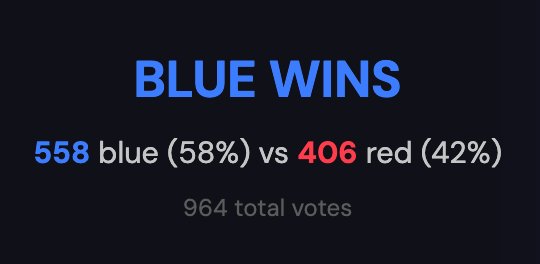
wtf is 58% a law of nature or something

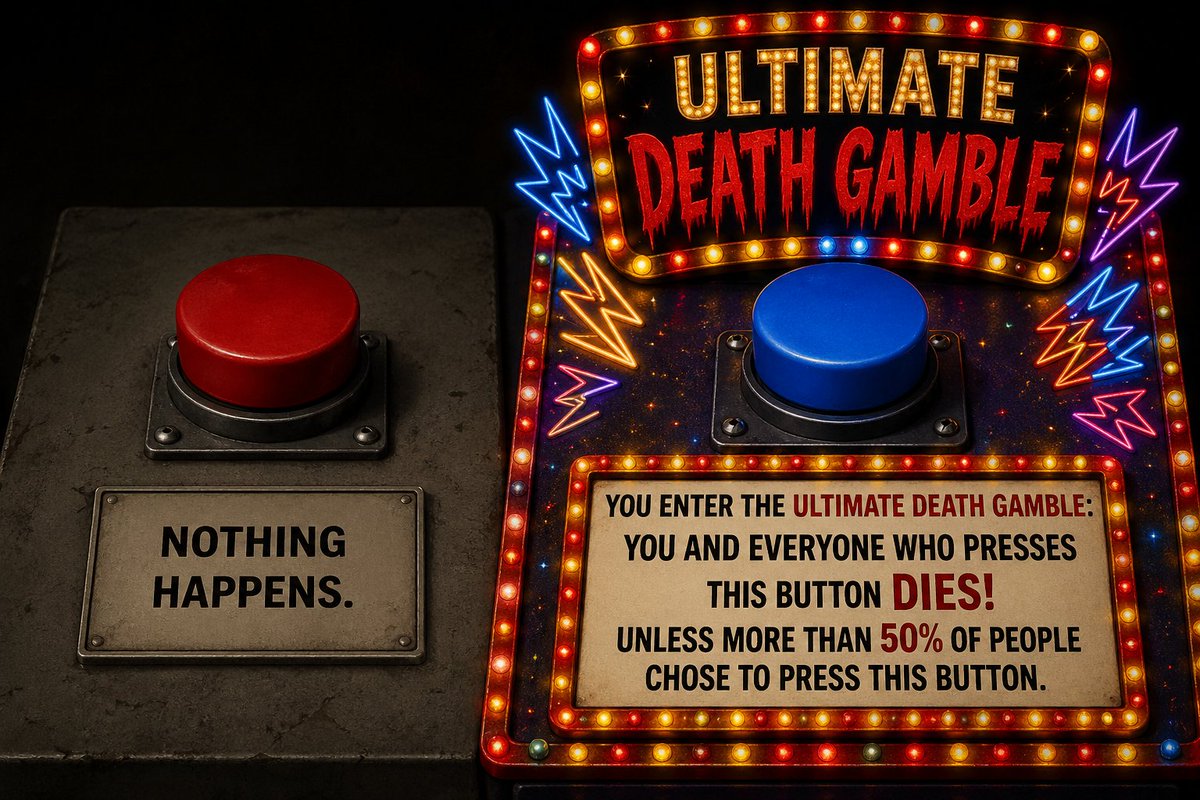
We're doing the "Blender" game again There is a large blender. Everyone in the world has to decide whether to step into the blender. If at least 50% of the people do step into the blender, it will be unable to overcome their inertia to get started, and everyone survives. If less than 50% of the people step into the blender, then they all get blended up into paste and die. People who do not step into the blender suffer no adverse effects. Would you step into the blender? (Blue=step into the blender, Red= don't do that)

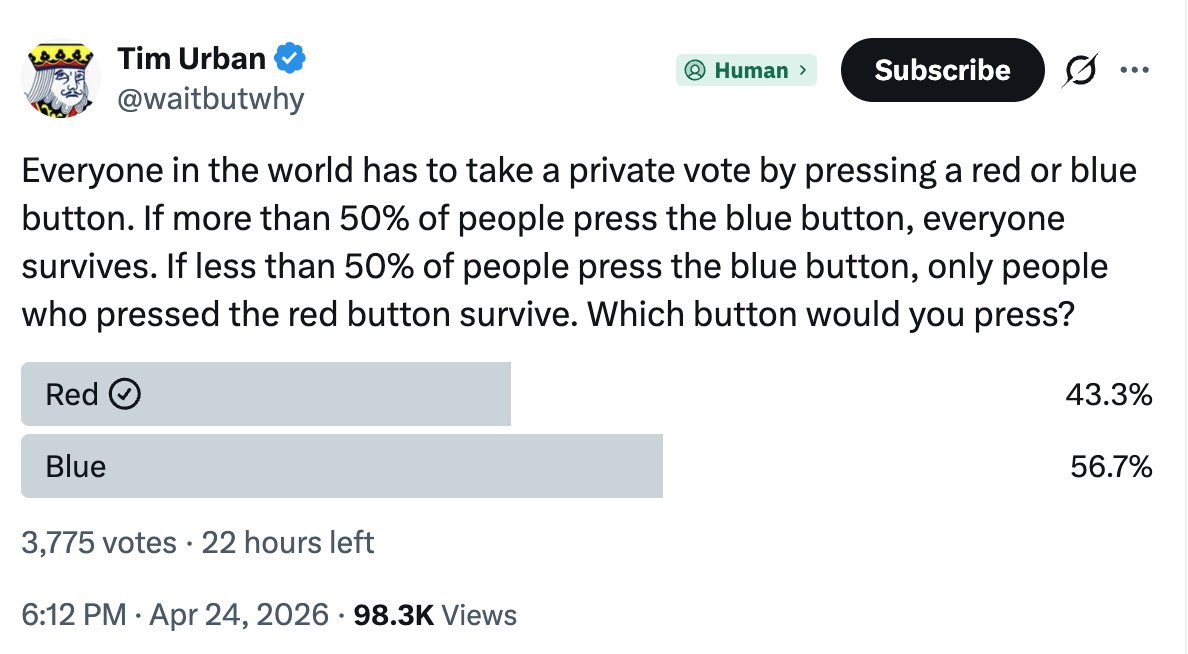
Everyone in the world has to take a private vote by pressing a red or blue button. If more than 50% of people press the blue button, everyone survives. If less than 50% of people press the blue button, only people who pressed the red button survive. Which button would you press?
@HiFromMichaelV @catehall The scenario seems underspecified to determine the Schelling points. Imagine the buttons are votes for a ruler. The red ruler is vindictive: if he wins he kills anyone who didn’t vote for him. The blue ruler doesn’t. So blue is the Schelling point. But in Roko’s version red is.


Everyone in the world has to take a private vote by pressing a red or blue button. If more than 50% of people press the blue button, everyone survives. If less than 50% of people press the blue button, only people who pressed the red button survive. Which button would you press?