Adriel Sanchez

4K posts

Adriel Sanchez banner
Adriel Sanchez

Adriel Sanchez

@AdrielTweets

Minister of the gospel in San Diego, author of Praying With Jesus, and Why We Worship: https://t.co/nwUfpPOA62 @solamediaorg

Katılım Ağustos 2020
304 Takip Edilen3.9K Takipçiler
Sabitlenmiş Tweet
Adriel Sanchez
Adriel Sanchez@AdrielTweets·
Turned in revisions for my book on worship with @ivpress. The latest title is, "Why We Worship." Just under 60k words, it's 10 chapters and covers everything from 20th C. liturgical developments, the different elements of a worship service and their significance, and how worship/liturgy informs life and mission. The book is a journey through the liturgy into heaven, and my prayer is that it helps Christians from various traditions recover a more biblical and catholic view of Sunday's significance. There's also an appendix on the theology of welcoming children in worship. Excited to share with you, I think pub. is just under a year out.
English
14
10
112
10.1K
Adriel Sanchez
Adriel Sanchez@AdrielTweets·
@derekradney Your original post was solid, Derek. It is in fact the case that we’re tempted to justify the behavior and teaching of the people in our tribe while being less patient with those we differ from.
English
0
0
0
17
Adriel Sanchez
Adriel Sanchez@AdrielTweets·
Some great background on the work of our committee! 👇🏽
Ben Ratliff@_BenRatliff

A Directory with a Smile: Why the PCA Should Welcome the Revised Directory for Worship For more than fifty years, the Presbyterian Church in America has lived with a curious arrangement. We have a Book of Church Order made up of three parts: the Form of Government, the Rules of Discipline, and the Directory for Worship. Yet the Directory for Worship has largely remained in a secondary constitutional status. It has been “an approved guide” and “the mind of the Church agreeable to the Standards,” but not binding in all its parts. Several chapters have been granted full constitutional authority, but the whole Directory has not. That means that the central activity of the Church has not had the same constitutional clarity as our doctrine, order, and discipline. The Ad Interim Committee on Revisions to the Directory for Worship is bringing forward a proposal that seeks to address that long-standing gap. Their report describes the revised Directory as “a carefully framed proposal,” shaped through “study, discovery, discussion and principled compromise,” and unanimously submitted with the hope that it “will honor our Triune God and edify this church.” I want to convince you that we should match their spirit and approve their revisions as our new Directory for Worship. On a recent episode of @PolityMatters, we had the opportunity to interview three members of the committee: Nate Shurden @nateshurden, Joel St. Clair @joel_stclair, and Chad Van Dixhoorn. (Subscribe, so you don’t miss it.) What came through in the conversation was not merely that the committee had produced a constitutional proposal, but that they had labored to give the PCA something warm, biblical, useful, and pastoral. Committee Chairman Nate Shurden explained that a directory, in the Reformed and Presbyterian tradition, is not a prayer book. It does not give fixed liturgical forms or prescribe every word of a service. But neither is it a vague appeal to spontaneity. “A directory traditionally within the Reformed and Presbyterian world,” he said, “seeks to lay out biblical principles and foundations… identifying ordinary elements for worship, giving pastoral directions for how worship should be practiced and conducted so that worship is governed by the Word of God.” He went on to say that a directory “literally gives direction” and “helps to give wisdom, theologically and biblically and practically, so that our worship will be ordered and edifying.” That is a helpful way to think about this proposal. The revised Directory is not an attempt to make every PCA congregation look identical. It is not an effort to flatten the breadth of our denomination. The committee explicitly says that the chapters were written to be “readable” and to “reflect the breadth of our denomination’s practice.” It aims to provide constitutional guidance without unnecessary over-prescription. Chad Van Dixhoorn used a memorable image in the interview. A prayer book, he suggested, can be like walking into a furniture store and saying, “I’ll take one of those living rooms.” Everything is already arranged. A directory, by contrast, is more like “Home Depot” or “IKEA”—the pieces are there, but they must be assembled wisely. His point was not to make worship casual or improvised, but to emphasize the genius of the Presbyterian directory tradition: it gives real direction without binding consciences to fixed forms. That balance is one of the great strengths of the proposed revision. The report itself says the committee sought to avoid both “an overbearing prescription of particular forms” and “an unhelpful abandonment of Reformed principles.” In other words, the Directory aims to give the guidance ministers, elders, and members need while also recognizing “the large measure of liberty granted by Christ to His church.” This may be one of the most pastorally important features of the whole proposal. The PCA is not a small, culturally uniform denomination. We have church plants, historic congregations, urban churches, rural churches, campus churches, large churches, small churches, churches with very simple services, and churches with more developed liturgical patterns. A good directory must be able to speak faithfully to all of them. It must be clear enough to guide us and broad enough to serve us. Joel St. Clair made another important point in the interview. We should not imagine that the Directory is a dusty document for rare use. The Form of Government may come into view most obviously at session meetings, congregational meetings, or presbytery. The Rules of Discipline, though essential, are used in particular circumstances. But worship is every week. Joel said, “When you think about the elements that are in the directory, that’s every week. That’s also during the week in family worship. There are things that cover the whole of life.” His hope was that the Directory would help every member of the church say, “This is Reformed worship. This is what this looks like.” That is exactly right. A good Directory for Worship should not merely settle debates; it should teach the church how to delight in the worship of God. And this is where the revised Directory is especially encouraging. The committee did not simply revise for technical precision. They sought to make the Directory devotional and explicitly theological. The report says that the current Directory sometimes gives instruction “with a frown” where the revised Directory seeks to communicate “with a smile.” It seeks to set biblical indicatives beneath biblical imperatives, highlighting the truths about God and His gospel that inform our worship. That positive tone appears immediately in the proposed Chapter 47: “Worship of the divine Father, Son, and Holy Spirit is the highest privilege of a Christian.” Corporate worship is described as the triune God summoning His church to meet with Him and be blessed by Him. Worship is not treated first as a burden, a performance, or a battleground, but as the great privilege of the redeemed. This is not softening Reformed worship. It is strengthening it. The regulative principle is not less beautiful because it is stated with warmth. Biblical order is not less biblical because it is presented as gift. Constitutional clarity is not less useful because it is devotional. Nate Shurden acknowledged that the proposed Directory is not perfect and that some may wish particular sections were tighter. But he offered a helpful image: the committee is trying “to build a fence around… a playground that hasn’t had one before.” The fence may not answer every future question. It may be refined over time. But, he said, “having a fence is better than the one that we don’t have right now.” That is a wise way to think about this moment. The question before the PCA is not whether every commissioner would have written every sentence exactly this way. The question is whether this proposal represents a faithful, useful, constitutional step forward for the church. The committee’s answer is yes. Nate said the members of the committee believe this Directory will have “a formatively positive impact upon the life and health and peace and purity of the PCA.” He described the committee’s work as marked by prayer, joy, disagreement, and brotherly unity, and expressed the hope that “the Spirit of the Living God would take that same spirit and spread it amongst us in the PCA.” Joel St. Clair closed with a similar hope. He said that some may be anxious that the Directory is either too open or too restrictive. But his encouragement was simple: read it. “Open up and read not only the introductory remarks but read through the actual Directory for Worship. I hope you’re ministered to. That was the result for all of us on the committee.” He then expressed the hope that the Assembly would “take a step forward and complete what’s been 50 years in the making.” A constitutional Directory for Worship will not solve every worship question in our denomination. It will not remove the need for wisdom, charity, or pastoral judgment. It will not make every congregation identical. But it can give us a common, biblical, confessional, and pastoral framework for the worship of the Triune God. The revised Directory gives the PCA an opportunity to say that the worship of our Triune God is not an afterthought. It is not merely local custom. It is not merely inherited habit. Worship is the highest privilege of the Christian and the church’s glad response to the Father, through the Son, by the Spirit. For that reason, we should receive this proposal with gratitude, read it carefully, discuss it charitably, and pray that the Lord will use it to honor His name and edify His church. pulpitmatters.com/p/a-directory-…

English
0
1
16
1.7K
Adriel Sanchez
Adriel Sanchez@AdrielTweets·
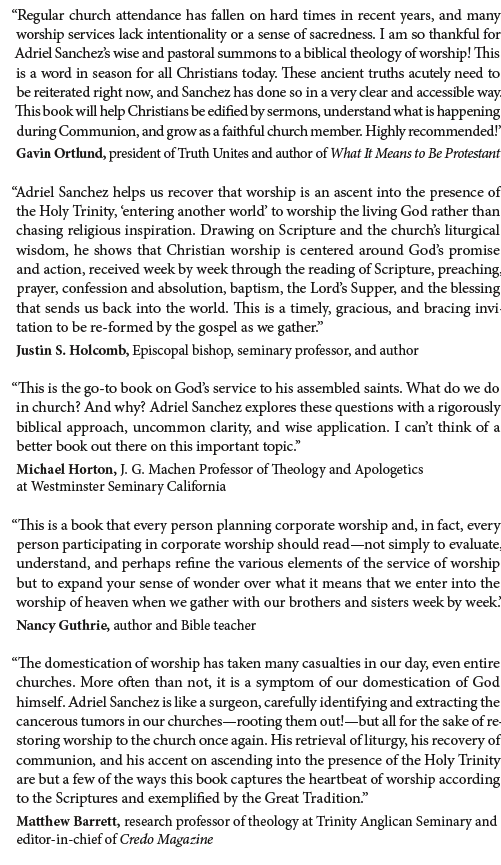
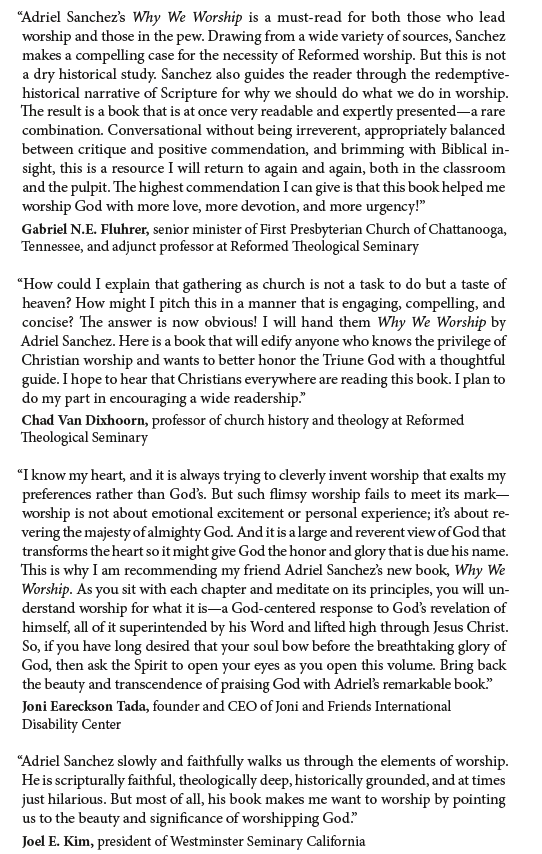
Grateful to receive the following endorsements for my forthcoming book, Why We Worship. The book is now available for preorder on Amazon and releases in September.
Adriel Sanchez tweet mediaAdriel Sanchez tweet media
English
4
3
53
2.8K
Adriel Sanchez
Adriel Sanchez@AdrielTweets·
I understand the fear here (and who wants to be exhausted with a century of amendments!), but one encouragement: In the background section to the DFW it is noted that the preface to our BCO states that our Reformed faith is characterized by a doctrine and piety, government and discipline, and a *view of worship*. Guiding directories have historically been a key part of this view of worship. The intention with these was not to be overly prescriptive, but to supply genuinely helpful guidance. I believe that the DFW will be an encouragement to our churches insofar as it can be a tool for deeper reflection on and appreciation of worship among our body. The inevitability of future debates shouldn’t discourage us from a step in this direction, especially with its potential to edify our churches, and given the importance of serious reflection on worship in the Reformed tradition. In short, there may be items to discuss down the line (the document was submitted to the brothers with all humility, as we did not “now suppose that its work is perfect…”) but what we stand to gain by receiving it outweighs the potential for future amendments. If I may add as a personal note: the Lord really blessed our committee with a great sense unity and joy along the way! It was a real privilege to work with each member of the committee, and my respect for the brothers has only grown through the process. My only sadness is that our time together seems to be coming to an end! I’m thankful for them and thankful for all of the fathers and brothers who have been giving thoughtful feedback and encouragement since the DFW was shared. Pray for us!
Jerry Stutzman@jeretics

I like the DFW but I almost don’t want to vote for it because we are going to expend so much energy trying to “fix” it over the next one hundred years. #PCAGA

English
5
4
46
4.4K
Jared
Jared@RevJaredJones·
@AdrielTweets I cut it for time but I made the same point, there's definitely an overlap between evangelical contemporary worship and liturgical renewal worship, and an overlap in the intention. A lot of contemporary evangelicalism is very Roman-esque
English
1
0
6
135
Jared
Jared@RevJaredJones·
The way people talk about "liturgy" with Anglicanism today is a 20th century retcon and not really how Anglicans understood worship. Trying out a new video format: "8 Minutes of Anglicanism." A chance for me to get some unformed thoughts out...
Jared tweet media
English
8
1
48
4.5K
Adriel Sanchez
Adriel Sanchez@AdrielTweets·
If you're interested in the Protestant Christian Nationalism or Catholic Integralism discourse, check out the full conversation between @MichaelHorton_ and political philosopher @kvallier. Vallier talks about the rise of illiberalism, why he thinks Protestant CN lacks rigor and is doomed to fail, and the line between enforcement and violating human dignity. I'm a third of the way through Vallier's OUP book on integralism, and I've been impressed by his ability to steelman opposing arguments. In this conversation I thought it was interesting how aware he was (as an Eastern Orthodox Christian) of the different voices in the Protestant CN camp: Wolfe, Wilson, Webbon, etc.
Sola Media@solamediaorg

If politics is war, when do the ends stop justifying the means? @kvallier on Christian Nationalism.

English
2
6
32
4.4K
Adriel Sanchez
Adriel Sanchez@AdrielTweets·
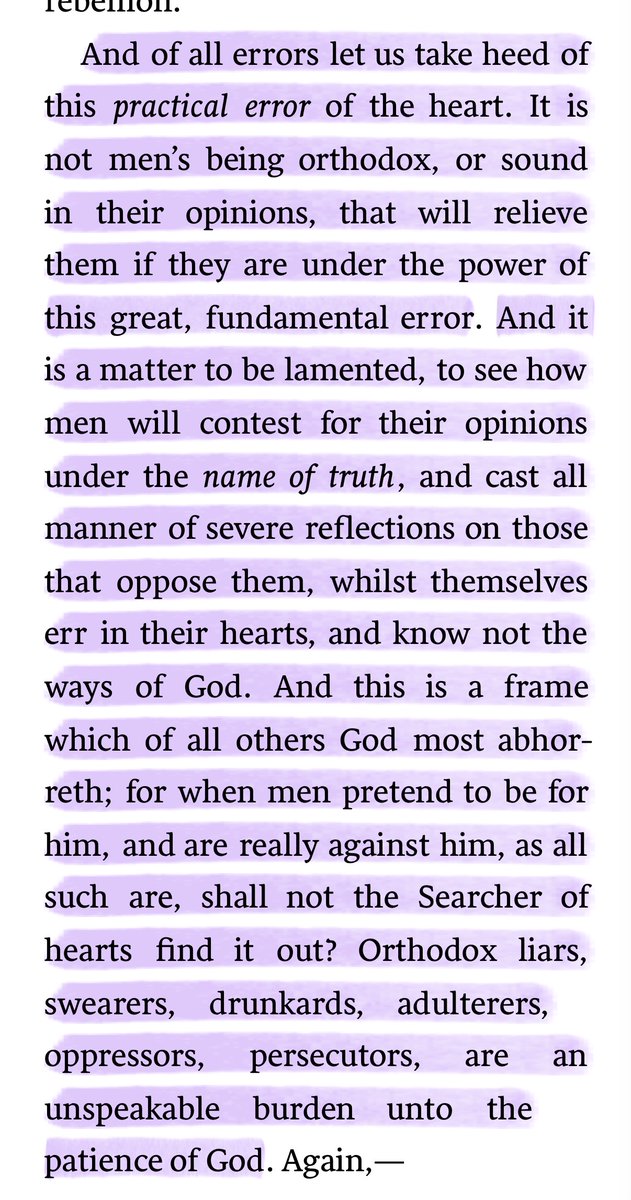
John Owen on the dangers of practical antinomianism. Don't be an Orthodox liar, swearer, drunkard, etc. Orthodoxy can never be a cover for licentiousness.
Adriel Sanchez tweet media
English
0
5
21
971
Adriel Sanchez
Adriel Sanchez@AdrielTweets·
Thanks for checking out the doc, George. I wouldn't read into this difference. We wanted to emphasize the centrality of the preached word and weren't insinuating that preaching is something other than a divine ordinance. I'd also see the substance of what's communicated by "ordinance" as summed up in the language of special means. "An ordinance of God for the salvation of men" = "a special means used by Him to call His elect to salvation."
English
3
0
7
372
George Sayour
George Sayour@GeorgeSayour·
Anyone know why Preaching is no longer referred to as an ORDINANCE of God in the proposed DFW? @nateshurden @AdrielTweets (See below for difference) Current Language - 53.1 The preaching of the Word is an ORDINANCE of God for the salvation of men. New Language: 51.1The preaching of the Word is an ORDINARY and central part of the worship of God, and a special means used by Him to call His elect to salvation (WLC 68). Also see Current 53.4
English
4
0
15
1.8K
Adriel Sanchez
Adriel Sanchez@AdrielTweets·
Being a part of this committee has been a great encouragement. God blessed us with a spirit of charity and unity, and I pray our labors are a blessing to the PCA for years to come.
Scott Edburg@SEdburg

A true highlight and gift to the assembly is the work completed by the DFW committee. This committee has produced a unifying DFW. Let us rally around it to complete this legacy project to the honor and glory of Christ. @AdrielTweets @nateshurden @joel_stclair

English
0
3
24
1.4K
Adriel Sanchez
Adriel Sanchez@AdrielTweets·
One contrast between the bad shepherds of Ezekiel 34, and the Good Shepherd of John 10 is that the bad shepherds became like wild beasts who ate the flock (Eze. 34:10), but the Good Shepherd lets the flock eat him. Christ's Flesh and Blood are the green pastures of our grazing.
English
1
3
20
543
Michael Saville
Michael Saville@Saville1561·
@AdrielTweets Ok, but are you sure that Doug actually disagrees with you on that? I’m pretty confident he holds to the pedagogical function of the law.
English
1
0
0
39
Adriel Sanchez
Adriel Sanchez@AdrielTweets·
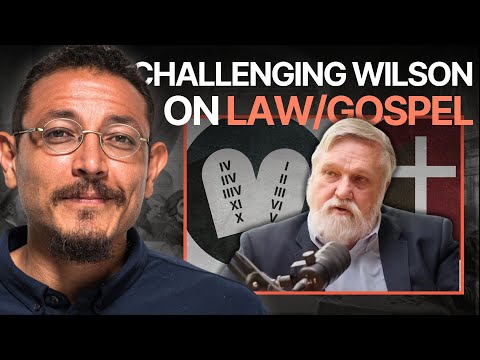
I made this video a while back on the law gospel distinction. There are various ways we can speak of "law" and "gospel" in Scripture, but strictly speaking "law signifies that part of the Divine word which consists in precepts and prohibitions... [and] gospel signifies the doctrine of grace, and of the fullest salvation in Christ Jesus, to be received of elect sinners." (Witsius) Especially in the matter of our justification, they are like oil and water (Calvin). When the orthodox distinguished betw. law and gospel, they are speaking in these strict terms and we should follow their lead. To reject this distinction is one of the great errors in theology. Hence, "Everyone who is able to rightly judge between the law and the Gospel can give thanks to God and know that he is a theologian." (Luther) youtu.be/_O_BH8KQmK0?si… via @YouTube
YouTube video
YouTube
English
3
10
49
6.4K
Adriel Sanchez
Adriel Sanchez@AdrielTweets·
Thanks for sharing. The question is whether the law in its function is objectively distinct from the gospel here. The agitators rather than being led by the law to Christ, sought to be under it as a works covenant. This is indeed a misapplication, but the point of the distinction still stands. This distinction isn’t something that’s merely “in us” but rises out of the biblical text.
English
1
0
1
82
Michael Saville
Michael Saville@Saville1561·
I think it is far better to take the two covenants in Galatians 4 as representing to responses to the Word: Faith and unbelief. Incidentally, that's the view I learned at Covenant Seminary from Jack Collins and also from Robert Rayburn. faithtacoma.org/1-galatians-ra… At Covenant, we learned that Paul in Gal. 3-4 was dealing with the legalistic misuse of the law...not the law as intended. Incidentally, this was also the view of Dabney. I don't see this as at all contrary to the Reformed Faith.
English
1
0
1
121
Adriel Sanchez retweetledi
Sola Media
Sola Media@solamediaorg·
"The question with regard to worship is never whether God is going to show up, but am I going to be there to receive the gifts that he's promised to give?" @AdrielTweets and @Caleb_E_Keith of @1517 on why nothing can replace the local church. youtu.be/MQLyaZuSSKA?si…
YouTube video
YouTube
English
0
3
13
1.9K
Adriel Sanchez
Adriel Sanchez@AdrielTweets·
The "I AM" statement of John 8:58 should be read with the slavery background of v. 34. Jesus' audience was "enslaved to sin." They needed emancipation just like the Hebrews in Exodus. To both groups, I AM came and revealed himself as emancipator. He's not just saying, "I'm God" in John 8, but "You are slaves, and I AM the God who has come to set you free."
English
3
5
27
1K