
Sabitlenmiş Tweet
Dominik
8.2K posts


Dominik
@Ae_Quitas
Mille⟦a⟧nnial丨 #ToyotaKata 丨 #FORMwelt 丨 Science and Systems 丨The Art, Science and Craft of making things different.
Dänemark Katılım Ekim 2017
464 Takip Edilen331 Takipçiler
@MrProWestie @BattleNonSense You mean like having to beg again and again for them to reintroduce a mechanic that was missing every time and was added, such as being able to take over as squad leader on request? 😂🙃
English

@BattleNonSense I hate saying this, but with EVERY new Battlefield game there’s always legacy bugs fixed in previous titles that come back to haunt us.
I wish we didn’t have to do this dance every time 😅
English
Okay, this is a perfect example of Battlefield 6's current desync/netcode problems:
- DC looking at enemy, enemy looking the other way
- Enemy starts firing, DC takes damage, enemy still facing the other way
- DC dies, enemy killcam red overlay FINALLY shows they're turning around to face DC
This is a MAJOR issue in Battlefield 6 because you can never be sure if an enemy is looking at you or not. Hopefully this is addressed in the Dec 9th patch.
@DRUNKKZ3 @tiggr_ - for visibility.
SgtDangerCow@SgtDangerCow
Srsly wtf...
English


I find it interesting that the word "science" in English has acquired a rather narrow meaning, usually referring only to the natural sciences. I have been wondering for some while now if not the shift of the meaning and use of the word "science" has had an impact on how the English-speaking world thinks about knowledge discovery, often dismissing knowledge in any discipline that is not part of what they call "science".
If you look up the German translation of “science”, you will get "Wissenschaft", which means loosely speaking 'dealing with knowledge' (“Wissen” = knowledge). But it’s a poor translation, because “Wissenschaft” is about knowledge discovery in general, not about the natural world in particular.
The origin of the word "science" is the Latin word "scientia" from scire ‘know’. That is, the original meaning also referred to knowledge in general, not to some disciplines in particular.
Consequently, in German, mathematics is -- of course -- a science. We also have "music science" (Musikwissenschaft) and "religion science" (Religionswissenschaft) and "literature science" (Literaturwissenschaft), etc, as they all deal with knowledge in some sense.
These latter examples are part of what in English is called "humanistics". In German they are called "Geisteswissenschaft", which means kind of "science of the mind" (that makes it sound like consciousness research, but I can't think of a better translation).
Philosophy is also a "science of the mind", in the German sense, as it concerns itself with knowledge.
I have talked to some Spanish people who have told me that they use the word 'ciencia' more in the German meaning of the word, not in the English one (not sure this is correct, my Spanish isn’t great).
You may notice this sometimes online, if you have non-native English speakers, some tend to assume eg that mathematics is science, whereas English native speakers find this odd.
One of the consequences of this linguistic shift seems to have been that as the English speaking world became dominant in science, the new “scientists” stopped paying attention to philosophy, as that was no longer part of their “science”.
This is especially obvious in physics, where you can see this happening in the early 20th century. While physicists previously had valued philosophical discourse, they later discarded it as supposedly useless.
Personally I think it’s a big problem and the major reason why the foundations of physics have stagnated. The new ‘scientists’ in this discipline seem to think that ‘theories’ are ‘scientific’ just because you can write them in maths. As a consequence, they keep on producing mathematical theories about nothing in particular.
If they stopped to think about what they are doing and why it’s not working and maybe read some philosophers, we’d make more progress.
The blame is partly on philosophers though because they seem to take pride in not being useful to scientists, usually not concerning themselves with any questions that physicists could actually use. Like why aren’t there thousands of philosophers discussing cosmological priors or naturalness or how to find out whether two models are “the same”.
Somewhat disturbingly, I have had several exchanges with so-called philosophers of science who clearly seem to take pride in being useless, and get offended if you ask them to be useful, as they see ‘being useful’ as being the task of scientists, which they are not.
And that returns me to my misgiving about the English use of the word ‘science’.
This was a “short” reply I wrote to Philip’s quote from Dirac…
x.com/philipcball/st…
English
Dominik retweetledi

Only a few know, how much one must know to know how little one knows.
- Werner Heisenberg
English
Dominik retweetledi
dX: You're against economic prosperity.
Me: Eh?
dX: You're against growth?
Me: We don't have to grow the economy to make more people prosperous, we just have to fairly distribute what we already create. We can build a sustainable, green and prosperous economy with what we have.
English

#Organisationsentwicklung kann selbst nicht auf das bloße #Lernen personaler oder sozialer #Systeme beschränkt bleiben, sondern muss darüber auch das Lernen des Lernens problematisieren. Burkard Sievers 1️⃣9️⃣7️⃣7️⃣
Deutsch
Dominik retweetledi

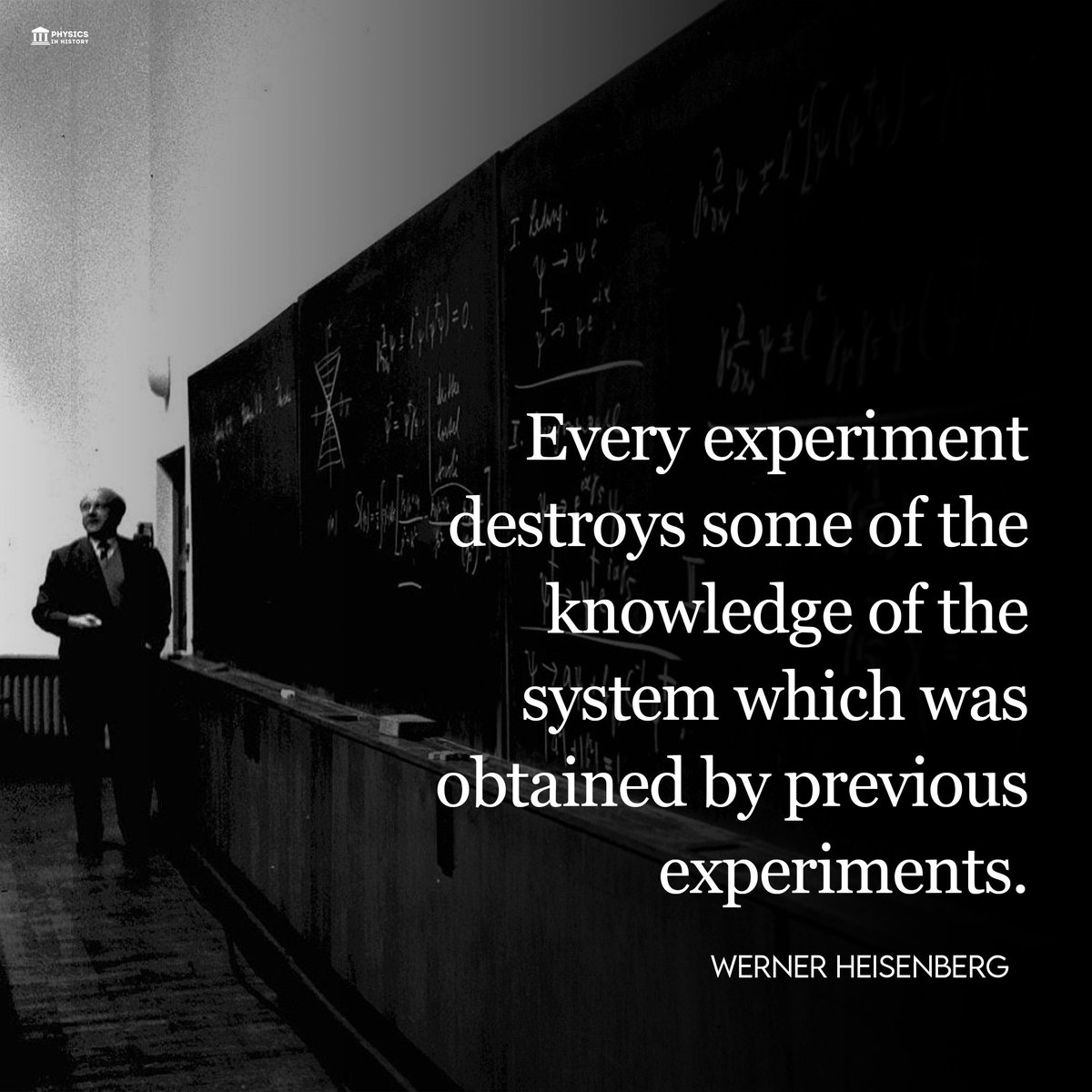
Werner Heisenberg on scientific experiments ✍️
English
Dominik retweetledi
If you want to compete against China then you'll need universal basic income, massive scale civic engagement, use of sortition, Gov as an investor but with higher levels of situational awareness across technological, economic, social and political landscapes and not just territorial.
English
Dominik retweetledi

This is scary, like the sun is a kidnapper taking us to a second location twitter.com/tuidelescriban…
English
@JaqubAjmal Ui. I immediately remember all those great Jet Li and Jackie Chan movies.
English
Wo bin ich heute ins Nächstmögliche gegangen, um dem Wünschenswerten näher zu kommen? @beyond_ideology
Deutsch