Aedan Yue Li

611 posts

Aedan Yue Li banner
Aedan Yue Li

Aedan Yue Li

@AedanLi

💻🧠🤖

Canada Katılım Mayıs 2018
333 Takip Edilen370 Takipçiler
Aedan Yue Li retweetledi

Steve Stewart-Williams
Steve Stewart-Williams@SteveStuWill·
Parenting practices seem to have little or no impact on children's personalities, contrary to some of the best-known theories in psychology. (Longitudinal study; N = 3,880) online.ucpress.edu/collabra/artic…
Steve Stewart-Williams tweet media
English
149
508
2.8K
3.2M
Aedan Yue Li retweetledi
Dr. Yin Wang
Dr. Yin Wang@Bruce_Yin_Wang·
I am beyond excited to share a new preprint from my lab ‘The Conceptual Structure of Human Relationships across Modern and Historical Cultures’. We discovered a universal representational space of social relationship concepts. doi.org/10.31234/osf.i…
English
2
35
106
28.4K
Aedan Yue Li retweetledi
Greer
Greer@GreerIsNotHere·
I am not sure of the official DAY OF PUBLICATION but my taste ensembles are in JEP:G! psycnet.apa.org/record/2024-09… please read if you have ever found yourself wondering "on average, how sweet are these briefly presented food pictures?" w/ jon cant and @KeisukeFukuda4
English
1
8
10
1.5K
Aedan Yue Li retweetledi
Sophia Sanborn
Sophia Sanborn@naturecomputes·
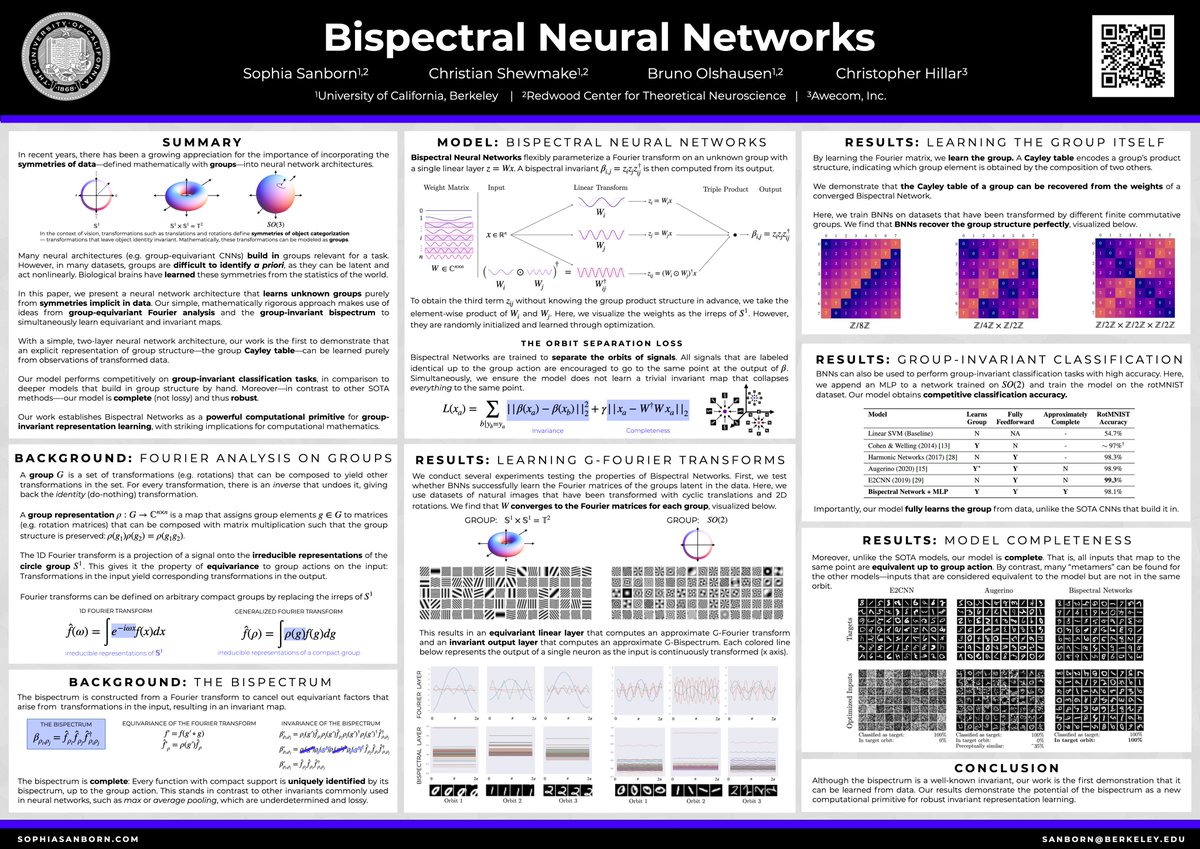
Bispectral Neural Networks go to #ICLR2023! In this work, we present a new neural network architecture capable of learning unknown groups purely from the symmetries implicit in data —with @cashewmake2, Bruno Olshausen, and Christopher Hillar 1/17
Sophia Sanborn tweet media
English
11
101
456
70.4K
Aedan Yue Li retweetledi
Aran Komatsuzaki
Aran Komatsuzaki@arankomatsuzaki·
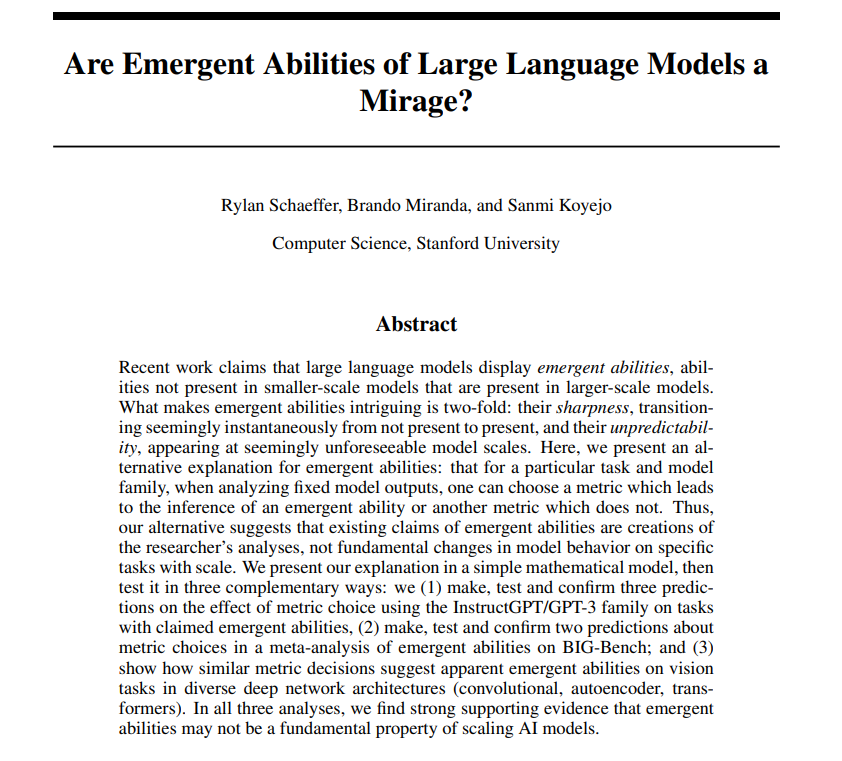
Are Emergent Abilities of Large Language Models a Mirage? Presents an alternative explanation for emergent abilities: one can choose a metric which leads to the inference of an emergent ability or another metric which does not. arxiv.org/abs/2304.15004
Aran Komatsuzaki tweet media
English
25
176
915
626.7K
Aedan Yue Li retweetledi
Imaging Neuroscience
Imaging Neuroscience@ImagingNeurosci·
It was amazing to see the massive support this week for this big change - thank you. And huge thank you to the 870 people who already signed up to review for Imaging Neuroscience! Can we make it a thousand? :-)
Imaging Neuroscience@ImagingNeurosci

We have had a large number of people offer to become reviewers for Imaging Neuroscience - so we now have a short web form to register yourself as a reviewer - we'll get back in touch shortly - many thanks! Please see the journal website: imaging-neuroscience.org

English
3
44
184
62.2K
Aedan Yue Li
Aedan Yue Li@AedanLi·
@tyrell_turing @LecoqJerome @PessoaBrain By analogy, our current definitions of "sentience" seem based on the verbal/correlated outputs of the system that generates it (e.g., double-dipping), so it fails when generalizing from humans to LMMs (e.g., cross-validation)
English
0
0
0
78
Blake Richards
Blake Richards@tyrell_turing·
@LecoqJerome @PessoaBrain But none of that provides a *definition* of sentience that we could use to decide if an LLM is sentient (except for Tononi's work). It instead tells us about (to use the usual phrase) the "correlates of consciousness" in brains.
English
5
0
2
277
Blake Richards
Blake Richards@tyrell_turing·
I don't think LLMs are sentient, but I agree with Geoff that the only honest answer is that we don't actually know, formally speaking. I would even go so far as to say we may *never* know, because I suspect sentience is like life, i.e. there is no clear line to be drawn.
Jeff Clune@jeffclune

I agree. "I'm amazed that people confidently pronounce these things are not sentient, and when you ask them what they mean by sentient they say well they don't really know. So how can you be confident they're not sentient if you don't know what sentient means? "-Geoff Hinton 1/2

English
13
5
40
15.6K
Aedan Yue Li retweetledi
Quanta Magazine
Quanta Magazine@QuantaMagazine·
Major physical advances from the last century — general relativity, the Standard Model and the hunt for the Higgs boson — all have symmetry to thank. New symmetries promise new breakthroughs. quantamagazine.org/a-new-kind-of-…
English
2
13
60
12.7K
Aedan Yue Li retweetledi
Quanta Magazine
Quanta Magazine@QuantaMagazine·
Constellations of chemicals interact to form the fragrances familiar to us. To truly understand smell, scientists need to map the relationships among these molecules. Machine learning can help. quantamagazine.org/ai-model-links…
English
1
24
76
19.1K
Aedan Yue Li
Aedan Yue Li@AedanLi·
@MarcCoutanche @StriemAmit There's an older paper finding consistency for taste (0.84/1 "bits"): pubmed.ncbi.nlm.nih.gov/10598466/ But this is based on word-taste confusions. Agree someone should look at the correlations among individual similarity matrices without labels to decouple word from sense consistency
English
0
0
1
668
Aedan Yue Li
Aedan Yue Li@AedanLi·
@MarcCoutanche @StriemAmit I think it's a really interesting question why there are much lower correspondences for taste in GPT-3 shown in this work (r = 0.2). By contrast, in our shape work humans tend to be correlated to each other at r = ~0.9
English
0
0
0
39
Aedan Yue Li
Aedan Yue Li@AedanLi·
@MarcCoutanche @StriemAmit What is especially interesting about this work, is that there are *differences* among the psychophysical dimensions. These dimensions have also been presumably trained from scientific literature (e.g., taste/consonants/timbre)
English
1
0
0
31
Aedan Yue Li retweetledi
Imaging Neuroscience
Imaging Neuroscience@ImagingNeurosci·
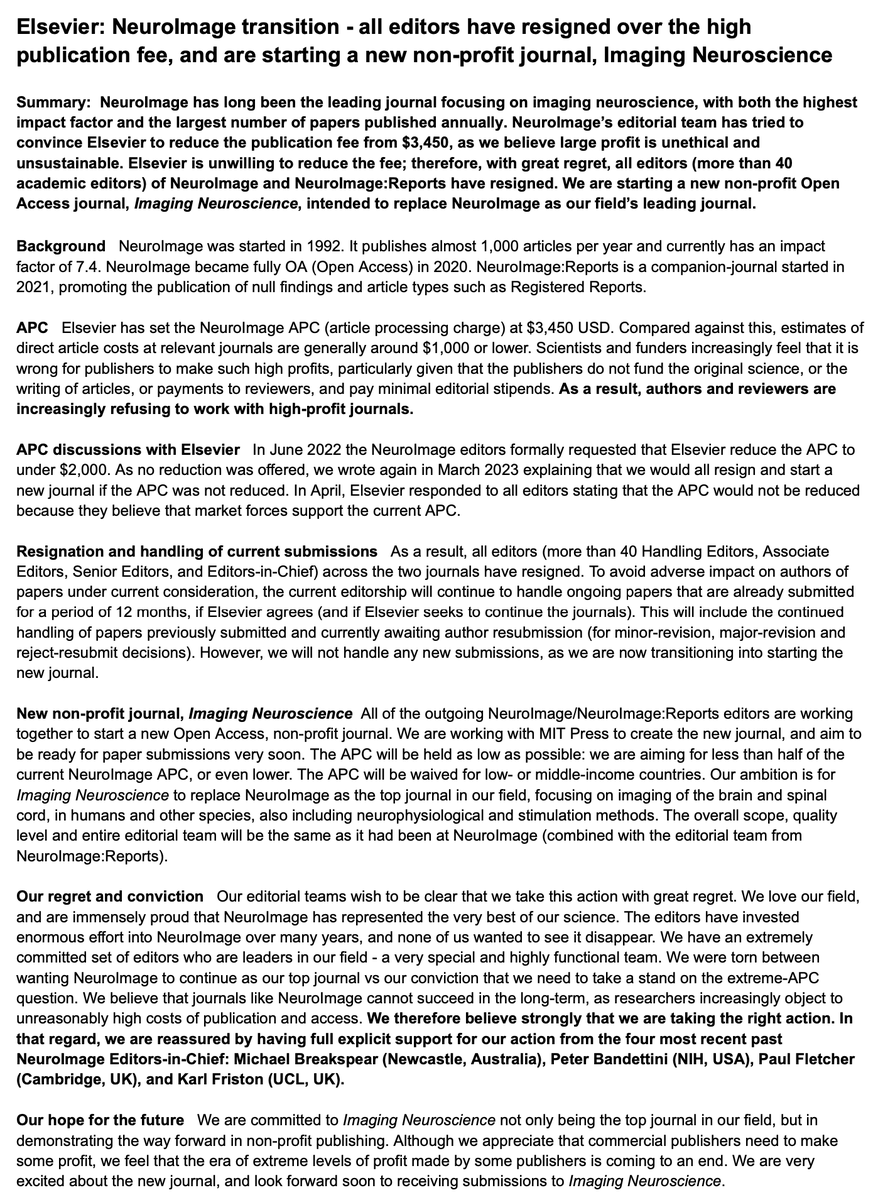
All NeuroImage and NeuroImage:Reports editors have resigned over the high publication fee, and are starting a new non-profit journal imaging-neuroscience.org This comes with great regret, and a huge amount of thought and discussion- please read announcement to get more details.
Imaging Neuroscience tweet mediaImaging Neuroscience tweet media
English
150
1.9K
4.1K
2.4M
Aedan Yue Li retweetledi
Masafumi Oizumi
Masafumi Oizumi@oizumim·
Updated the preprint below! We have included the THINGS data (similarity of 1854 natural objects) and successfully aligned the mental representations of 1854 objects across individuals in an unsupervised manner using Gromov-Wasserstein optimal transport. psyarxiv.com/h3pqm/
Genji Kawakita@gen21ka

Is my “red” your “red”? In this preprint with @ariel_zj, @NaoTsuchiya, @oizumim, we propose a novel quantitative method to compare subjective experiences in a purely unsupervised manner based on the qualia structure paradigm. 1/13 psyarxiv.com/h3pqm/


English
0
11
32
11K
Yohan J. John
Yohan J. John@DrYohanJohn·
This seems guaranteed to happen very soon. Someone will give an LLM a set of drives or goals, and embed it in a perception-action loop. At this point, if it does reasonably well at satisfying its goals, can we say that its representations are grounded and therefore meaningful?
Ian Wright@ianpaulwright

According to loop-closing semantics the answer is "yes", but the LLMs also need goals and the actuators that in principle can achieve them. Such systems necessarily define "manipulable features" of their world that are, objectively, the semantic content of their internal states.

English
5
2
15
5.6K