Alex Story

6.5K posts

Alex Story banner
Alex Story

Alex Story

@AlexPStory

It don’t mean a thing, if it don’t got that swing Olympian, writer (politics and macro-economics), keen observer.

Wakefield Katılım Haziran 2020
134 Takip Edilen4.5K Takipçiler
Alex Story retweetledi
Marc Gravely
Marc Gravely@MarcGravely·
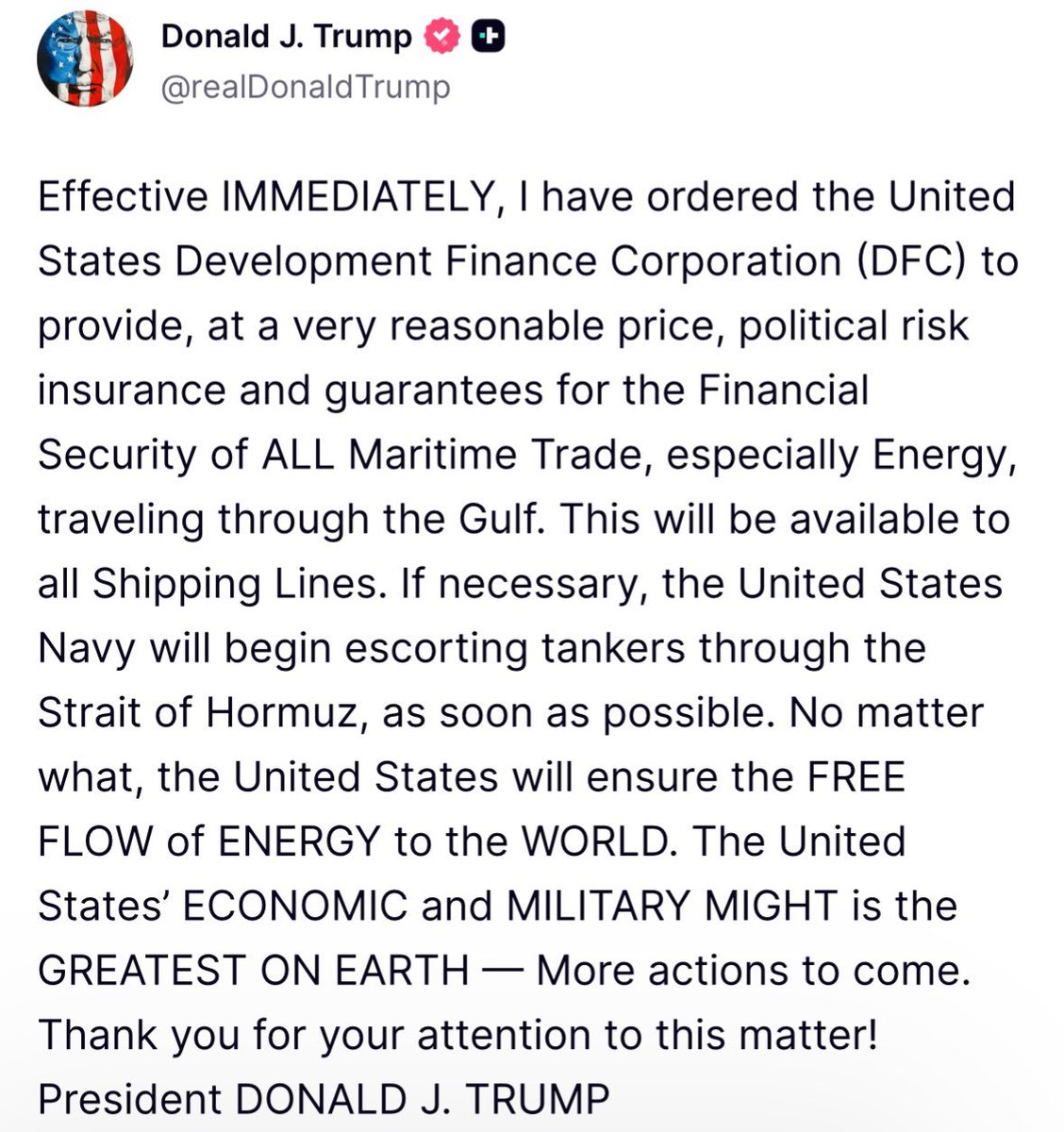
Yesterday, I explained how seven insurance firms in London shut down one-fifth of the world's oil supply. Today, Trump may have just made the most aggressive sovereign insurance play in modern history. Here's what happened and why it matters: Trump ordered the U.S. Development Finance Corporation to immediately offer political risk insurance and guarantees to all maritime trade through the Gulf. Especially energy. Backed by Navy escorts if needed. Read that through the lens of what I described yesterday. The Strait didn't close because of missiles. It closed because the insurance market collapsed. P&I clubs pulled coverage, reinsurers withdrew, and the entire commercial shipping architecture froze. This move doesn't address the military problem. It addresses the actuarial one. The DFC is stepping into the void that Lloyd's and the London reinsurance market created when they pulled out. The U.S. government is effectively saying: we will underwrite what the private market won't. No sovereign has attempted to replace the global marine war risk market in real time during an active conflict. Here's why the structural implications are significant: 1. It challenges Lloyd's dominance. For centuries, London has been the center of gravity for marine insurance. Lloyd's and its reinsurers controlled pricing, terms, and risk appetite for global shipping. That concentration is exactly what made the actuarial blockade possible. A handful of firms in one city froze global oil flows. The DFC offering competitive political risk coverage to all shipping lines is a direct challenge to that architecture. If American-backed insurance proves cheaper and more reliable during crises, shippers may not return to London when the dust settles. 2. It breaks the actuarial blockade. I said yesterday that China has massive leverage over Iran but zero leverage over Lloyd's. The same was true of every oil-producing and oil-consuming nation watching their economies choke. This goes around the insurance market entirely. If the DFC covers the voyage and the Navy escorts the tanker, the ships sail. Oil flows. The spreadsheet blockade breaks. 3. It redirects billions in premium revenue. War risk premiums in the Gulf are currently running at extreme multiples — 3× to 5× pre-conflict rates. Those premiums were flowing to London reinsurers who then pulled coverage anyway. Now those premiums flow to Washington. At rates the DFC can set below the panicked London market, while still generating substantial returns. The same shippers get cheaper coverage. The revenue just changes continents. 4. It creates a chokepoint within the chokepoint. The Strait of Hormuz is already the world's most critical energy bottleneck. If the U.S. is both insurer and naval escort, America controls access at two levels: physical security and financial coverage. No other nation can replicate that. You need the world's dominant navy and a sovereign balance sheet large enough to backstop the risk. Only one country has both. 5. It reassures every stakeholder simultaneously. Gulf producers were watching exports freeze. Asian and European consumers were watching energy prices spike. Both feared the Iran campaign would wreck their economies. One announcement addressed all of them: your oil will move, your ships will be covered, and the rates will be reasonable. Yesterday I described a system with no TARP, no Fed equivalent, no backstop at global scale. This may be the first attempt to build one in real time, during the crisis itself. The actuarial blockade just met a sovereign counterparty.
Marc Gravely tweet media
English
548
4.1K
14.4K
1.3M
Emelia
Emelia@FreyaNorthnyot·
I’m Swedish. White, with Viking blood in my veins. From the cold North where strength and honor were forged. And yes… I’m Muslim.
English
1.4K
1.8K
22K
342.1K
Alex Story retweetledi
J Stewart
J Stewart@triffic_stuff_·
🚨BOMBSHELL EXPOSÉ: TREVOR PHILLIPS RIPS LID OFF LABOUR'S GROOMING GANGS COVER-UP 💣 Keir Starmer and the Labour Party Sabotaging National Inquiry to Hide Racial Targeting of White Girls and Decades of Failure in Their Own Councils In a devastating intervention, Sir Trevor Phillips has blown the whistle on what he calls a deliberate political cover-up at the heart of Britain's grooming gangs scandal. The former Equality and Human Rights Commission chair accuses Labour of sabotaging the national inquiry because of its explosive racial implications — and because so much of the abuse took place under Labour-controlled councils that did nothing to stop it. “The government clearly never wanted these two things to be put together,” Phillips declared. He points to Labour's efforts to downplay “the intersection of race and sexual predation,” insisting the perpetrators deliberately targeted victims because they were white and outside the groomers' community. “These children are chosen because of their race. They are chosen because they are white and because they’re outside the community of the groomers.” Phillips highlights the chilling uniqueness of these crimes: unlike typical child abuse kept hidden, grooming gangs operate in plain sight — with perpetrators knowing they are shielded. “The other thing is these people know that they are protected. They’re protected politically, they’re protected by social workers, they’re protected by local police. That is the scandal here.” He pulls no punches on why a full reckoning has been avoided: “Much of this took place in local Labour councils and the authorities who were supposed to be watching over this, stopping it, monitoring it and all the rest of it were controlled by those councils and they did nothing.” This is not just institutional failure — it's a politically motivated shield thrown over horrific, racially aggravated sexual exploitation that went on for years under Labour's watch. Right now, they deserve justice — and Britain deserves the full, fearless national inquiry that has been denied for far too long.
English
651
8.8K
21.6K
798.2K
nairamarley
nairamarley@officialnairam1·
“Every night, in Ramadan, Allah chooses people to be saved from the hell fire” prophet muhammed (SAW) May you be one of them.
English
739
1.6K
14K
182.7K
David S.
David S.@davids_s_·
This is my 3rd Ramadan as a Muslim. Islam is for everyone 🤲🏻
English
1K
590
13K
493.5K
Alex Story retweetledi
Jim Chimirie 🇬🇧
Jim Chimirie 🇬🇧@JChimirie66677·
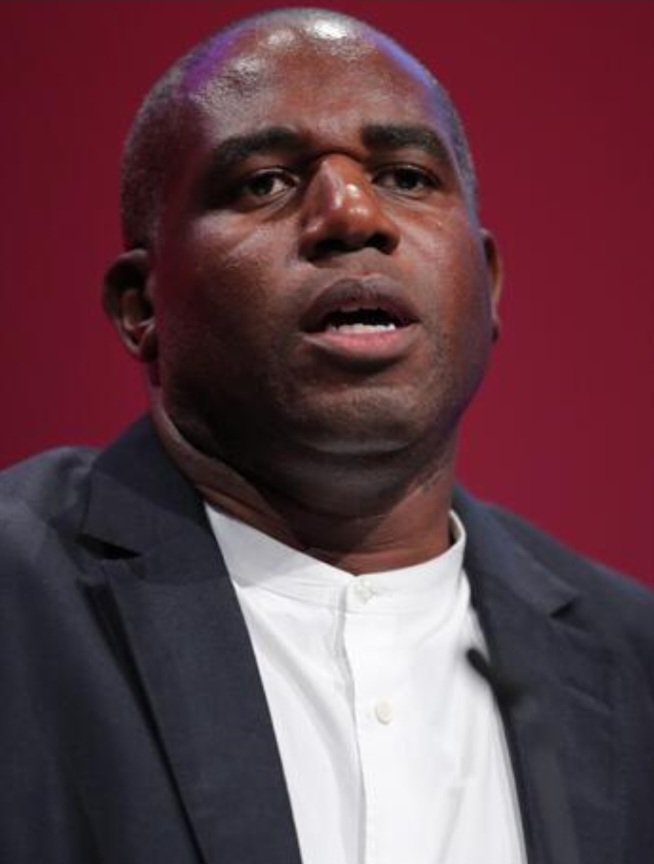
Sovereignty by Instalment: How Britain Is Quietly Giving Ground There is now an undeniable pattern. Britain retreats at the frontier, bends to foreign jurisdiction and pays for the privilege of being managed by others. What presents itself as a series of pragmatic decisions is in fact a single posture: surrender dressed as cooperation. Under Keir Starmer, Britain is not merely accommodating Europe again. It is quietly shedding the habits of sovereignty – the institutional reflexes, legal controls and democratic scrutiny that make a country capable of governing itself at all. Start with Gibraltar, a British Overseas Territory held since 1704. Under the deal now being finalised, it will be policed at its own border by Spanish guards acting on behalf of the European Union. British travellers will present their passports twice. Spanish officials will have the final say on entry. That is the practical inversion of sovereignty. When a state yields to a foreign power the authority to decide who may enter its territory, the argument about who is in charge is already settled – and settled against you. The treaty reportedly runs to more than 700 pages. It was negotiated in secrecy and is being fast-tracked through EU structures as a Commission-only instrument, bypassing ratification by all 27 member states for speed. British MPs have not read it. They have not been allowed to scrutinise it. Yet the EU Council is said to be targeting signature within six weeks. David Lammy promised full parliamentary scrutiny. Nick Thomas-Symonds announced the deal's completion in Madrid. The promise and the reality do not align, and that gap is not accidental – it is procedural. The substance is damaging enough. The deal would align Gibraltar with EU rules on state aid, taxation, labour and the environment. It embeds Spanish officials in airport border operations. It requires Britain to fund EU regional cohesion programmes and cover training costs. In effect, it transfers authority. The border becomes Spanish. The rules become European. The bill remains British. This sits beside a wider pattern of payment and submission. Billions to rejoin Erasmus. Concessions on fishing rights. Alignment on food and plant health regulations. A steady accumulation of legal and regulatory concessions restoring Brussels’ influence without a referendum or mandate. Brexit promised independence. What is arriving is dependence by instalment. Chagos established the template. Britain has agreed to hand sovereignty of the Chagos Islands to Mauritius, including the strategic base at Diego Garcia – a facility the United States considers essential and whose future is now uncertain. Gibraltar follows the same logic: soften the border, embed foreign officials, dilute legal control and call it modernisation. The precedent is being noticed. When a government signals that sovereignty is negotiable, others draw their own conclusions. Argentina's president Javier Milei has already renewed calls for the Falklands. Defenders call this realism. But realism begins with interests, not apologies. Britain's interests in Gibraltar are strategic, legal and democratic: control of a Mediterranean chokepoint, legal clarity for British subjects and parliamentary oversight of major treaties. All three are being compromised at once. Remove reach and resolve and you do not purchase goodwill; you create leverage for those who kept theirs. What is being offered is a smaller Britain. One that pays more, decides less and is invited to call the arrangement progress. Nations rarely disappear in a single act. They recede through a chain of concessions until the accumulated loss becomes irreversible. Gibraltar is the latest instalment. Accept less. Sign quickly. Call it partnership. "David Lammy promised full parliamentary scrutiny. Nick Thomas-Symonds announced the deal's completion in Madrid. The promise and the reality do not align, and that gap is not accidental – it is procedural."
Jim Chimirie 🇬🇧 tweet mediaJim Chimirie 🇬🇧 tweet media
English
44
286
577
12.6K
Alex Story
Alex Story@AlexPStory·
@OperaSocialist Why do you comment? You hate no one more than the Christian. Your faith (socialism) directly contradicts Christianity.
English
0
0
1
51
Socialist Opera Singer
Socialist Opera Singer@OperaSocialist·
You can't claim to be a Christian and also vote Reform, Restore, Reclaim, Advance or any of the other far-right "parties". Christianity is about inclusion not exclusion. Jesus was a Jew who welcomed everyone regardless of race or background.
English
935
532
1.9K
69K
Alex Story
Alex Story@AlexPStory·
@Beejaysport Until you read the hadiths and the koran, which is something Homobeaulaji never did.
English
0
0
0
51
Omobolaji
Omobolaji@Beejaysport·
Prophet Muhammad is the best role model for everyone.
English
731
1.1K
11.8K
135.7K
Alex Story retweetledi
Dominic Frisby
Dominic Frisby@DominicFrisby·
The Canterbury Tales and the AI Panic Guidance from Geoffrey Chaucer. Your Sunday thought piece. Geoffrey Chaucer wrote The Canterbury Tales in around 1400, and it is considered one of the first great works of English literature. Try reading it today and you might question the “English” part. Here’re the opening lines: Whan that Aprille with his shoures soote, The droghte of March hath perced to the roote, It does not get much easier. Canterbury Tales is the story of group of pilgrims who walk from Southwark to Canterbury Cathedral. I have done the pilgrimage myself and I would urge you to as well. The structure is quite simple. To pass the time, the pilgrims have to a storytelling contest and so each tells his or her tale. There are around thirty pilgrims - in effect, thirty professions, and so we get the Knight’s Tale, the Miller’s Tale, the Wife of Bath’s Tale and so on. Here is the interesting part. Since the story was written in 1400 we have had, off the top of my head, the printing press, the Agricultural Revolution, the Industrial Revolution, steam power, fossil fuels, the internal combustion engine, electricity, aviation, nuclear power, computers, the internet, smartphones and now artificial intelligence. And yet, if you look the list of characters below, every single one of Chaucer’s professions still exists in some recognisable form today. You could go all the way back to the dawn of civilisation and argue the same thing. We still have farmers. We still have merchants. We still have lawyers, doctors, religious people, soldiers, landlords, craftsmen, entertainers, administrators and hustlers. AI will change the nature of the job, but it will not erase the underlying human needs that created it. Machines put many farm labourers out of work at the turn of the 19th century, but they also generated enormous productivity, which created new industries and new jobs, and, it’s worth noting, productivity which enabled us to be able to ban slavery. The net result was not mass permanent unemployment but rising prosperity. What Actually Changes What does get destroyed is power structure. Feudalism has gone. The Church no longer dominates European politics - not the Christian Church, anyway. Guilds have faded. The landed aristocracy has all but gone. In their place we have the modern State, bureaucracy, multinational banks, global corporations, Big Tech, Big Pharma, the mainstream media and so on. AI is more likely to erode existing hierarchies than to eliminate work altogether. It will compress middle layers. It will reduce friction. It will concentrate power in some places and decentralise it in others. Chaucer’s Cast, Modernised Here is Chaucer's cross-section of professions in medieval England. I have added approximate modern equivalents. Narrator – content creator (!) Host – Event organiser, podcast presenter Knight – Army officer Squire – Cadet, trainee officer Knight’s Yeoman – Bodyguard, fixer, executive assistant Prioress – Headmistress, senior religious leader Second Nun – Clergy Nun’s Priest – Chaplain Monk – Buddhist Friar – Fundraiser, community organiser Merchant – Import–export, trader, entrepreneur Clerk – Researcher Man of Law – Barrister, judge Franklin – Wealthy landowner, landlord, businessman Haberdasher – Fashion retailer, Etsy seller Carpenter – Erm Weaver – Textile manufacturer Dyer – Industrial processor Tapestry-maker – Textile artisan Cook – Chef Shipman – Merchant mariner, sailor Physician – Doctor Wife of Bath – Self-made businesswoman Parson – Imam Plowman – Smallholder farmer Miller – Construction materials supplier Manciple – Buyer, procurement officer Reeve – Estate manager, COO Summoner – Bailiff, compliance officer Pardoner – Social justice warrior Canon – Serial start-up founder, “entrepreneur’ Canon’s Yeoman – Startup engineer The Real Question I think a fear frenzy is being whipped up precisely because nobody knows quite how this is goiong to pan out. Uncertainty breeds fear. And I say this as someone who has lost his primary source of income (voiceovers) to AI. The work changes. The tools change. The leverage changes. The power centres change. The underlying human needs do not. There will still be farmers because people eat. There will still be merchants because people trade. There will still be storytellers because people crave stories. Most importantly of all, there will still be opportunities, if anything there will be more of them. AI will reduce headcount in some sectors. It will elevate productivity so dramatically that fewer people are required to produce more output. That is economic evolution. If you are worried about AI taking your job, ask yourself this: are you positioned inside an old power structure that is about to weaken? Or are you aligned with the next one forming? If you want to read the article in full, or listen to it, link is in the the next tweet
Dominic Frisby tweet media
English
13
29
136
16.5K
Alex Story
Alex Story@AlexPStory·
@7signxx You must have picked up a different Koran from the one most people read. The Disney version?
English
18
0
17
2.4K
Idris
Idris@7signxx·
Pick up a Qur'an, read it with an open mind, and decide for yourself...
English
188
1.8K
5.9K
88K
Alex Story retweetledi
Department of State
Department of State@StateDept·
The United States and Europe belong to a civilization that stretches over continents, crossed over oceans, and persisted for thousands of years: from Athens to Rome to America.  Western Civilization must embrace its noble legacy if it is to reverse its decline.
Department of State tweet media
English
4.4K
6K
32.3K
2.3M
Alex Story retweetledi
Jim Chimirie 🇬🇧
Jim Chimirie 🇬🇧@JChimirie66677·
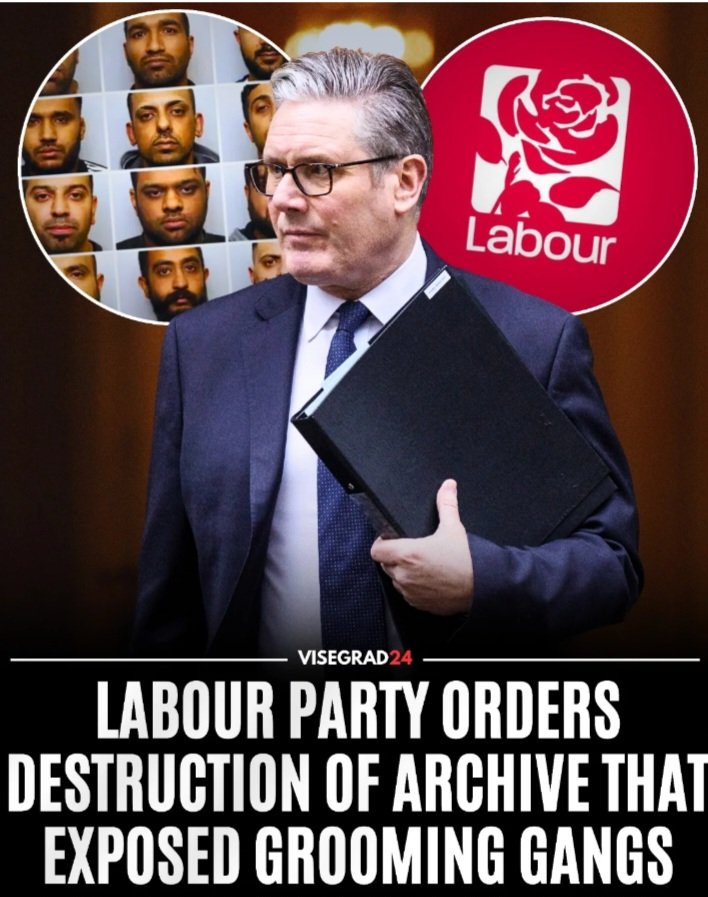
Why Is Labour Deleting Court Records Just as the Grooming Gang Inquiry Begins? The plan to delete the Courtsdesk archive has detonated in a country already drowning in mistrust. As Nick Timothy MP has warned, the decision risks handing criminals and cover-ups a gift at the very moment scrutiny is intensifying. For years, survivors of grooming gangs had to fight to drag the truth into daylight while institutions delayed, denied and deflected. They were ignored and smeared until the scale of the scandal became impossible to hide. That history matters, because it explains why the Government's latest move is so dangerous. The Ministry of Justice has ordered the destruction of the largest court reporting archive in Britain. Courtsdesk holds records from millions of magistrates' court cases, built since a 2020 agreement with the Government. These are not trivial files. They are the raw material journalists rely on to understand what is actually happening in the justice system. Over the past five years, the archive revealed a staggering truth: only 4.2% of court listings were being properly reported to journalists. That means 24 out of every 25 cases were wrongly listed or never listed at all, and around 1.6 million cases were heard without any advance listing being published. Seventeen courts did not publish a single advance listing in five years. The justice system was already operating in semi-darkness. Now the lights are being switched off entirely. Remove this data and investigators lose the ability to trace patterns, link offenders, and test official claims against reality. That matters in any area of crime. It matters even more when the country is about to begin a national inquiry into grooming gangs; crimes that thrived precisely because patterns were missed, warnings were ignored and information was fragmented. The official justification is talk of data rules and alleged breaches. Yet Courtsdesk says no serious breach was ever reported to the Information Commissioner – something that would have been legally required within 72 hours if it had occurred. If that is true, the Government's explanation collapses. And once it collapses, the question becomes unavoidable: why destroy the data at all? Recent history makes that question impossible to ignore. Labour did not rush to open a national inquiry into grooming gangs. Ministers resisted calls for one. Parliament rejected proposals for a statutory investigation. Only after months of public pressure did the Government reverse course. Transparency was not volunteered. It was forced. That is the backdrop against which this decision now sits. As scrutiny grows, the Government plans to delete a database that helps journalists and investigators uncover patterns in crime and institutional failure. Ministers call it housekeeping, but the optics are catastrophic: after years of fighting for the truth, the state now appears ready to close one of the last windows into the justice system. Trust in institutions erodes slowly. It drains away through delay, denial and defensiveness. The grooming-gang scandals shattered confidence because they showed what happens when authorities fail to act and then fail to admit the scale of that failure. The lesson should have been obvious: openness is the only path back to credibility. Instead, the Government sends the opposite message: destroy the data, erase the archive, and ask the public to trust a system that is removing the tools needed to scrutinise it. Intent matters less than perception. And the perception is stark: just as scrutiny begins, the evidence base is shrinking. A government confident in its record would preserve evidence, expand transparency and invite scrutiny. This government is doing the opposite. When the state deletes the paper trail just as the search for truth begins, trust does not grow. It collapses. Once the public believes evidence is being erased, the damage to confidence in the justice system will be lasting.
Jim Chimirie 🇬🇧 tweet media
English
215
1.7K
3.2K
29.5K
Alex Story retweetledi
Winston Marshall
Winston Marshall@MrWinMarshall·
“We sacrificed 100,000+ girls in the name of multiculturalism” Investigative journalist Julie Bindel (@bindelj) sits down for a forensic and disturbing conversation on organised child sexual exploitation and institutional failure in Britain. We discuss the recent r*pe gang inquiry currently taking place, and new details about how these gangs weren’t just operating in Britain but were trafficking internationally… Podcast out now on all platforms | Links in replies
English
184
4.3K
12K
190.8K
Alex Story retweetledi
Jim Chimirie 🇬🇧
Jim Chimirie 🇬🇧@JChimirie66677·
The Lawyer, the Prime Minister and the Long Campaign to Give Chagos Away The most revealing fact about the Chagos deal is not the price tag, the treaty chaos, or the diplomatic humiliation. It is the timeline. Long before Keir Starmer entered Downing Street, the legal case for surrendering the islands was already being built by people he knew, worked with, and publicly called friends. For fourteen years, Professor Philippe Sands KC led the legal campaign for Mauritius in the international courts. From 2010 to 2024, his team was paid around £8 million to challenge British sovereignty over the Chagos Islands. That work helped produce the International Court of Justice advisory opinion that Starmer would later cite as the moral and legal justification for handing the territory away and committing Britain to a £35 billion lease of Diego Garcia. The intellectual scaffolding of the policy existed long before the policy itself. By the time Starmer acted, the argument had already been written. Sands is no distant academic. He is a long-standing friend of the Prime Minister, a fellow founder of Matrix Chambers, and a colleague of Attorney General Lord Hermer. He campaigned for Starmer's leadership, introduced him publicly at the Hay Festival, and later appeared before Parliament arguing that Britain had "illegally occupied" the islands. The same lawyer who helped build Mauritius' case then stepped into Westminster to advocate the political outcome his legal work had prepared. No envelopes, no secret meetings, no hidden transfers. Just a small, influential professional circle whose ideas travelled from courtroom to Cabinet room almost unchanged. This matters because it reframes the entire story. The Chagos deal did not emerge suddenly from a security review or a military assessment. It grew out of a long legal campaign grounded in the language of decolonisation and international law. Sands compared Britain's control of the islands to Russia's annexation of Crimea. He attended ceremonies where the Mauritian flag was raised over the territory. He spoke repeatedly about Britain's need to confront its colonial past. Those arguments were not fringe opinions whispered on the margins. They became the official language of government. Look at the continuity. A legal case is built over a decade. An advisory opinion is secured. A Prime Minister from the same professional milieu arrives in power. The government adopts the same framing, the same language, and the same conclusion. Sovereignty becomes a liability. International courts become moral referees. The handover of territory becomes a gesture of virtue rather than a question of strategy. The transition from advocacy to policy is seamless. This is why the story is so politically explosive. It does not prove corruption. It reveals something more unsettling. A governing class shaped by the same institutions, trained in the same legal philosophy, and convinced of the same moral narrative about Britain's place in the world. A network of lawyers, civil servants, academics and politicians who move through the same circles, cite the same authorities, and eventually govern according to the same assumptions they once argued in court. When critics talk about the "Blob", this is what they mean in real life. Not secret plots. Not shadowy pay-offs. A closed professional culture that regards sovereignty as an outdated problem and international approval as the ultimate prize. The Chagos decision begins to look less like a hard-headed act of statecraft and more like the moment a long-running legal campaign finally acquired political power. The question now is simple: national interest or a professional class that had already decided Britain should lose? When policy mirrors the arguments of a tight legal network, advocacy and governance blur. The Chagos deal came from somewhere familiar and it will not fade quietly. "Sands is no distant academic. He is a long-standing friend of the Prime Minister"
Jim Chimirie 🇬🇧 tweet mediaJim Chimirie 🇬🇧 tweet media
English
234
1.5K
3.2K
94K