
Sabitlenmiş Tweet
Alexandre Lamure
687 posts


Alexandre Lamure
@AlexandreLamure
Graphics guy at Quantic Dream, thoughts are my own Bluesky: @alexandrelamure.bsky.social Mastodon: https://t.co/po1ORNRuJ7
Ile-de-France, France Katılım Ocak 2018
776 Takip Edilen710 Takipçiler
Alexandre Lamure retweetledi

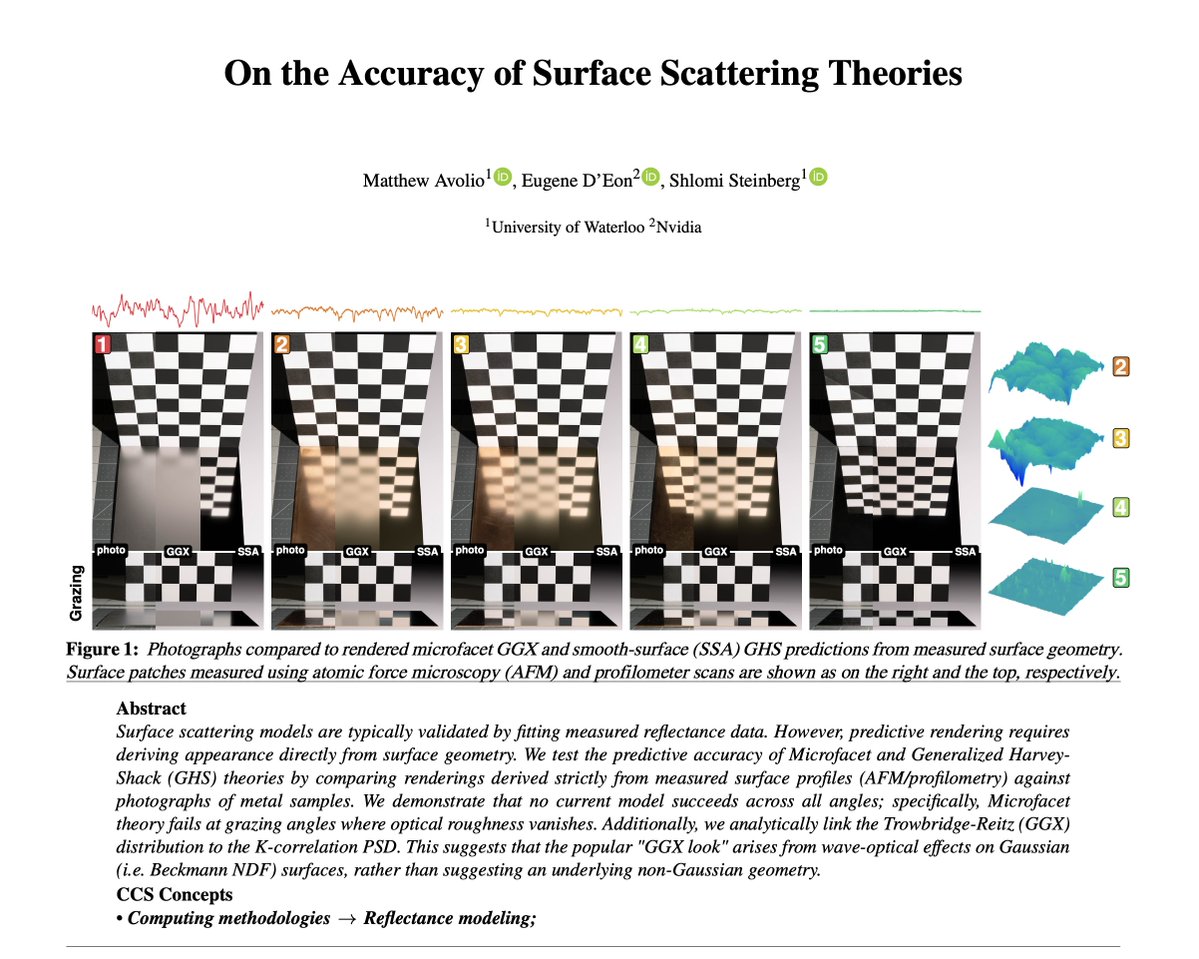
There's a neat short paper from Eurographics this year that evaluates how well microfacet shading models actually predict measured reflectance. The answer is: not nearly as well as one would hope!
(1/3)
ssteinberg.xyz/2026_surface_s…
English
Alexandre Lamure retweetledi

Introducing AMD DGF SuperCompression gpuopen.com/learn/introduc…
Italiano
Alexandre Lamure retweetledi

youtu.be/Xolb8DcrbLc
The recorded EUROGRAPHICS 2026 talk for our wave tracing paper. Very honored that this paper received the Günter Enderle Best Paper Honorable Mention award.
Collaboration with Matt Pharr (NVIDIA).
YouTube
English
@Dispatch_Graph I simply meant evaluating the occlusion of a ray that goes through some volumetric stuff like fog.
Unless your volumetric is analytic fog or super cheap to raymarch, there's no easy way to account for it in real-time GI.
But that could be used for the placement and animation too
English

@AlexandreLamure Wdym by that? Volumetric visibility as in it could be used to e.g. prevent volumetric smoke propagation through solide without a baking pass? Because that could be very interesting indeed
English
My idea, a 🧵
I named it NVF — Neural Visibility Fields
Warning: potentially shitty idea. proceed with caution
λmélie Heinrich@Dispatch_Graph
Yesterday I was bored and I came up with an actually pretty decent idea for a neural rendering technique I wrote it down and immediately realized it could only work for like one niche use case Is this how researchers feel every day. "I'm gonna be the next Hillaire" and then they just write it down and they're like "aw man :("
English
@Dispatch_Graph Another nice benefit of NVFs would be the ability to query volumetric visibility
English
@Dispatch_Graph This paper kinda explored this
gpuopen.com/download/HPG20…
Using NNs makes it time-constant and super easy to scale for different configs, that's the biggest win imo
English
Alexandre Lamure retweetledi

Subtle things to make your shaders better:
1) Anti-aliasing - Real life is not limited to pixels so unless you're specifically going for a pixelated style, you should be anti-aliasing everything!
mini.gmshaders.com/p/antialiasing

English
Alexandre Lamure retweetledi

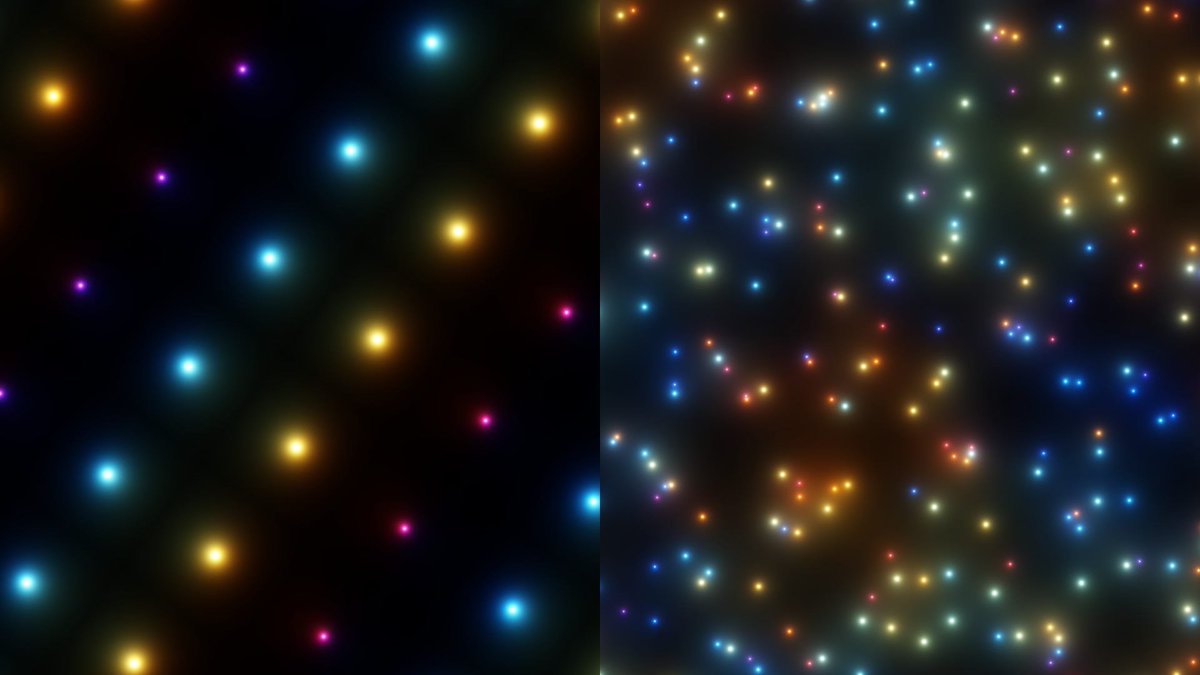
Will present the new input encoding method "PEPS: Positional Encoding Projected Sampling" at i3D. In the paper, we show that 25% better compression. If you have NTC implementation with MLP, you can add this on top of it and see improvements. arxiv.org/abs/2604.24167
English
Alexandre Lamure retweetledi

Alexandre Lamure retweetledi

Alexandre Lamure retweetledi

While my vacation days coming to the end, finished a blog post on modern rendering culling techniques 😜
I tried to keep it practical: not a deep dive, but a broad overview of the main methods, tradeoffs, and how they fit together in a real renderer.
Frustum culling, occlusion, GPU-driven rendering, meshlets, Nanite, light culling, etc.
krupitskas.github.io/posts/modern_c…
#gamedev #rendering #dx12
English
Alexandre Lamure retweetledi

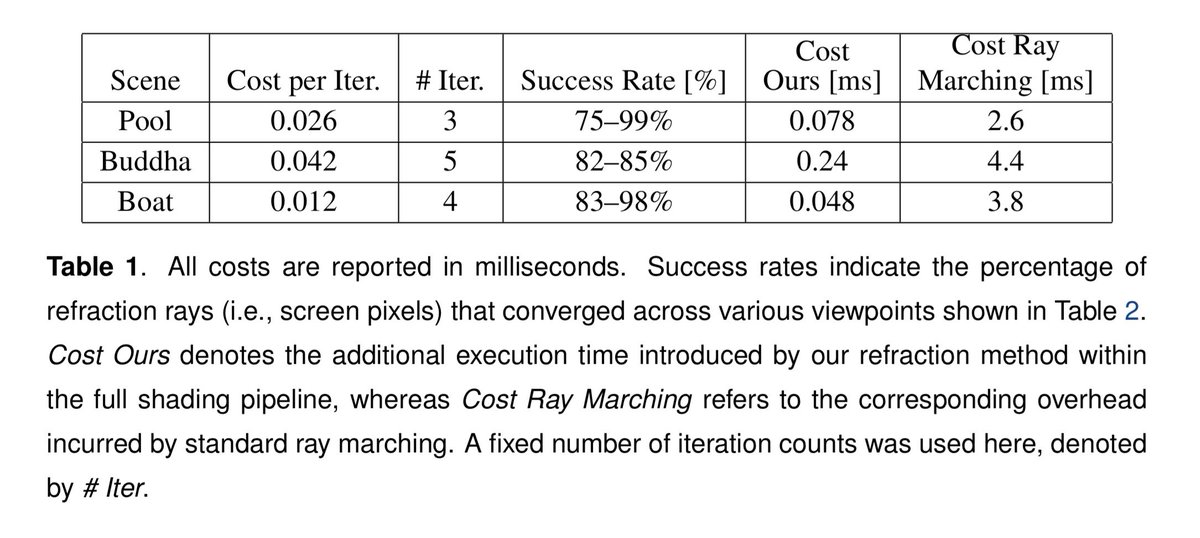
Ultra-fast Screen-Space Refractions and Caustics via Newton’s Method

Chase Mayer, Ulf Assarsson, Erik Sintorn
Paper: jcgt.org/published/0015…
Code (MIT): github.com/TheManTheMythT…
Abstract
We introduce a novel screen-space refraction method that replaces standard ray marching with Newton’s method for root finding. For each pixel, we define a function as the difference between the refracted ray depth and the G-buffer depth, and iteratively refine the intersection using the tangent plane of the current G-buffer point. This achieves rapid convergence, typically within only a few iterations, thereby reducing per-pixel cost. We further analyze common failure cases, such as depth discontinuities or poor initial guesses, and propose practical strategies to detect and then mitigate or resolve them. We also demonstrate our approach on refracted light rays to accelerate screen-space caustics.



English
Alexandre Lamure retweetledi

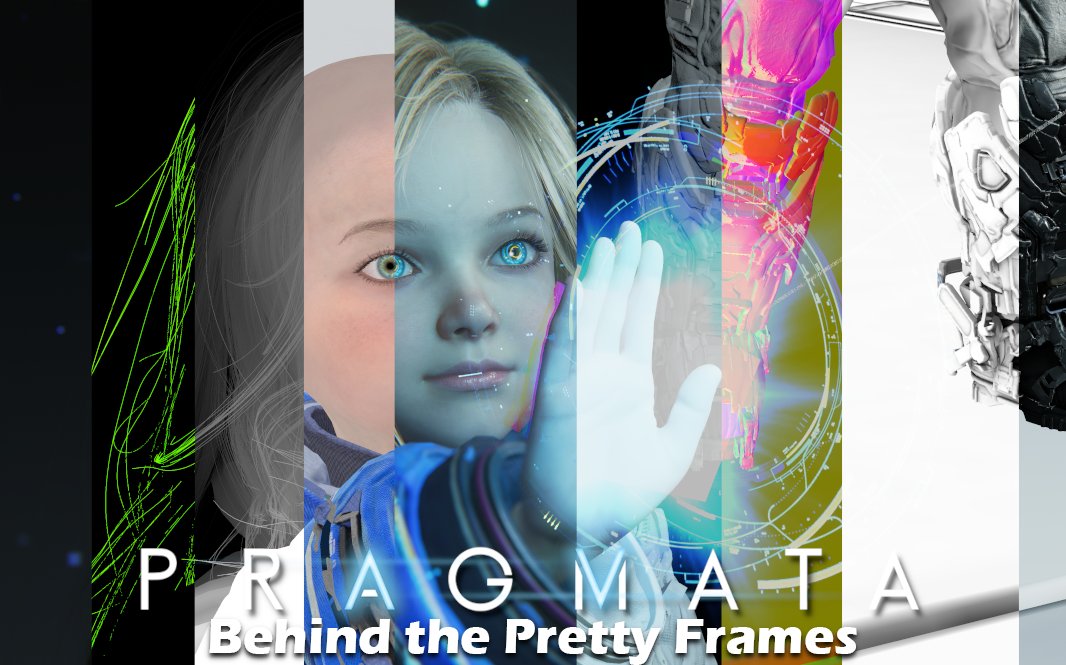
Behind the pretty frames of #PRAGMATA. Breaking down many tricks and hidden gems of the renderer behind @CAPCOM_RandD's RE Engine.
i hope you enjoy & find this few months worth of freetime article useful...
i had FUN playing the demo and digging every bit of it, & looking forward for the game official release next week!!!!
mamoniem.com/behind-the-pre…
@PRAGMATAgame @PRAGMATA_JP @CAPCOM_RandD
English
Alexandre Lamure retweetledi
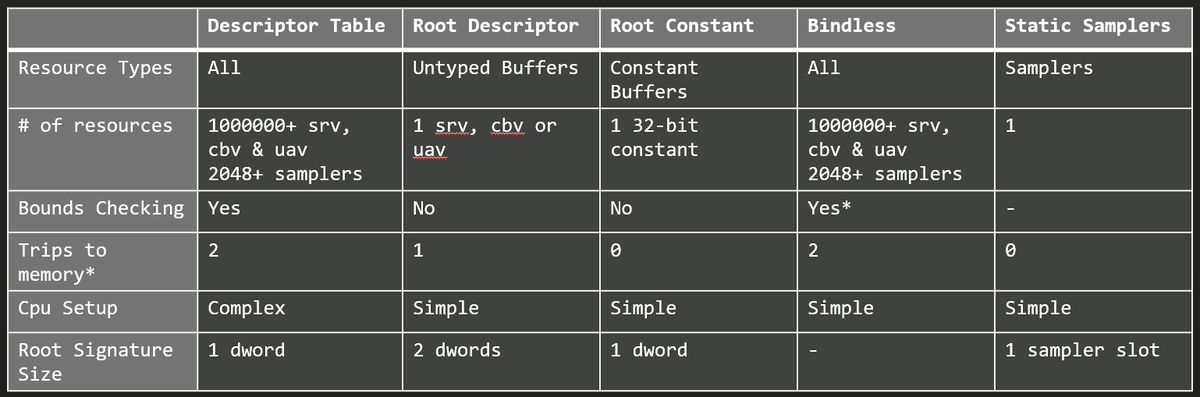
Useful table summarising the various ways to pass resource descriptors to a shader via a root signature (from …tic.graphicsprogrammingconference.com/public/2025/sl…)
English
Alexandre Lamure retweetledi
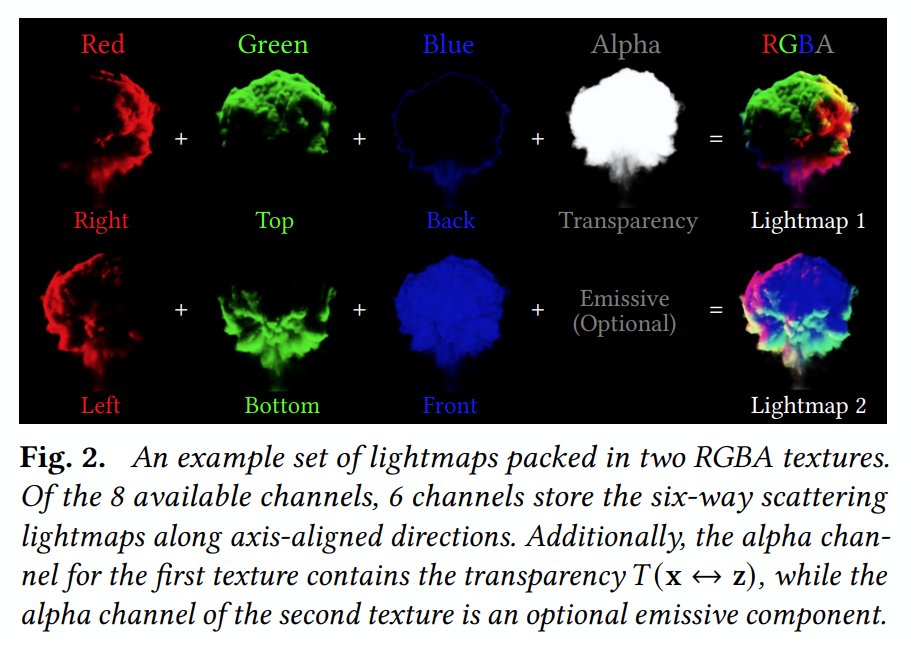
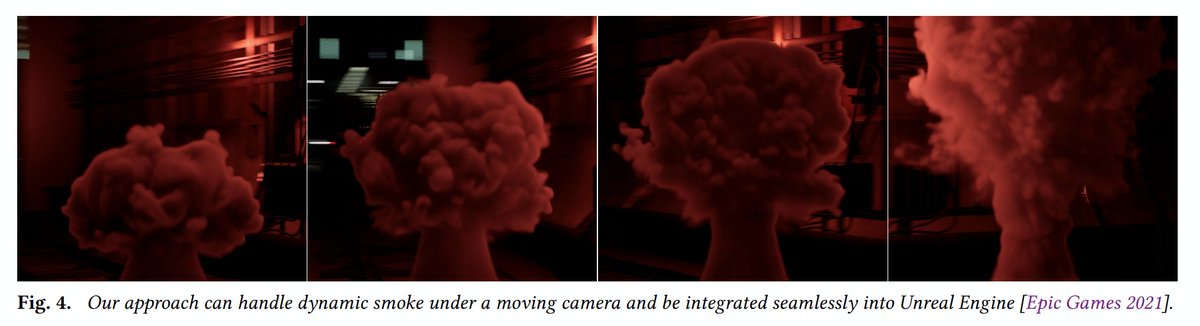
Real-time Neural Six-way Lightmaps
Wei Li, Hanxiao Sun, Tao Huang, Haoxiang Wang, Tongtong Wang, Zherong Pan, Kui Wu
(Tsinghua University, China; LIGHTSPEED, Australia)
arxiv.org/abs/2604.03748
Abstract
Participating media are a pervasive and intriguing visual effect in virtual environments. Unfortunately, rendering such phenomena in real-time is notoriously difficult due to the computational expense of estimating the volume rendering equation. While the six-way lightmaps technique has been widely used in video games to render smoke with a camera-oriented billboard and approximate lighting effects using six precomputed lightmaps, achieving a balance between realism and efficiency, it is limited to pre-simulated animation sequences and is ignorant of camera movement. In this work, we propose a neural six-way lightmaps method to strike a long-sought balance between dynamics and visual realism. Our approach first generates a guiding map from the camera view using ray marching with a large sampling distance to approximate smoke scattering and silhouette. Then, given a guiding map, we train a neural network to predict the corresponding six-way lightmaps. The resulting lightmaps can be seamlessly used in existing game engine pipelines. This approach supports visually appealing rendering effects while enabling real-time user interactivity, including smoke-obstacle interaction, camera movement, and light change. By conducting a series of comprehensive benchmarks, we demonstrate that our method is well-suited for real-time applications, such as games and VR/AR.


English
@Dispatch_Graph Love it! It's super well-explained 🙂
The diction is a bit fast, but it's fine and the subtitles are correct if necessary
English
I made a video where I talk about the different things I like about Metal!
Link in description
λmélie Heinrich@Dispatch_Graph
Working on something :)
English
Alexandre Lamure retweetledi
Great collection of extensive articles on the architecture of a large number of (older) consoles, good read! copetti.org/writings/conso…
English
It seems indeed to work like this. I'm very surprised they tried this approach so early instead of using a G-buffer.
We'll see how that works for a real real-time version
Mike Dereviannykh@Mishok2000
I spent some time looking into DLSS 5 rendering from the pure tech side - so ignoring the artistic debate for a second, I think it may already be showing early signs of something much more interesting: - Implicit Inverse Rendering
English
Alexandre Lamure retweetledi

The blog post "Virtual Memory Tricks" by Niklas Gray explores clever, underutilized ways to leverage operating system virtual memory features (via APIs like VirtualAlloc or mmap) to solve common programming problems efficiently.
Some of the key techniques discussed are ..
• reserving extremely large virtual address spaces for arrays (e.g., billions of elements) without consuming physical RAM until pages are actually accessed, enabling simple, fast fixed-size data structures like global game object arrays or huge lookup tables.
• using virtual memory reservations to generate guaranteed-unique application-wide IDs (by returning pointers from reserved blocks)
• implementing an "end-of-page allocator" that places allocations at page boundaries to catch out-of-bounds or use-after-free bugs via immediate access violations, and avoiding fragmentation issues since virtual memory allows non-contiguous physical pages.
• implementing a gapless ring buffer that uses shared mappings to handle wraparound seamlessly without extra boundary logic.
Overall, the author argues that directly controlling virtual memory unlocks powerful, scalable, and safer memory management patterns beyond conventional malloc usage.
link to the blog post: ruby0x1.github.io/machinery_blog…
English
Alexandre Lamure retweetledi
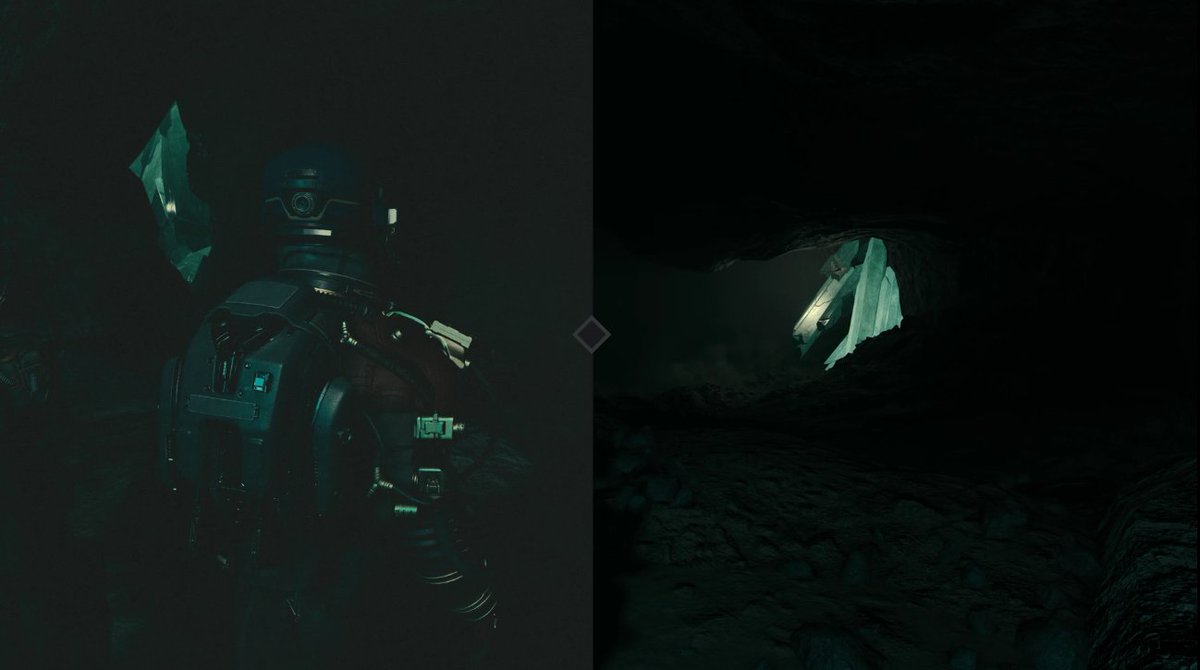
My pleasure to announce Gamma Studios' website, alongside the first of a series of technical articles on color grading and tonemapping:
gammastudios.tech/technical-colo…
Give it a read if you want a detailed analysis on why some games raise blacks so much to make an OLED look like an LCD!
I'd love to hear your opinions on my technical findings and conclusions!
English